SAL Institute of Technology and
Engineering Research
Two-Stroke Engine
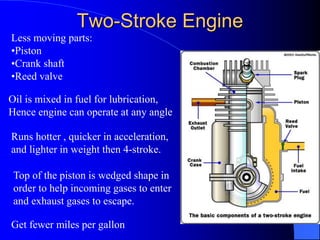
Less moving parts:
•Piston
•Crank shaft
•Reed valve
Oil is mixed in fuel for lubrication,
Hence engine can operate at any angle
Runs hotter , quicker in acceleration,
and lighter in weight then 4-stroke.
Top of the piston is wedged shape in
order to help incoming gases to enter
and exhaust gases to escape.
Get fewer miles per gallon
Operation of two-stroke engine
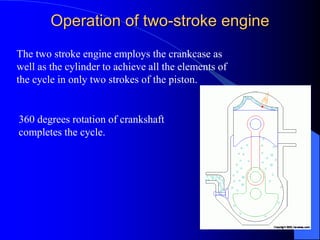
The two stroke engine employs the crankcase as
well as the cylinder to achieve all the elements of
the cycle in only two strokes of the piston.
360 degrees rotation of crankshaft
completes the cycle.
Intake & Compression stroke
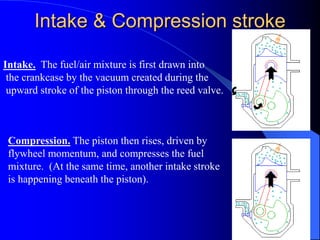
Intake. The fuel/air mixture is first drawn into
the crankcase by the vacuum created during the
upward stroke of the piston through the reed valve.
Compression. The piston then rises, driven by
flywheel momentum, and compresses the fuel
mixture. (At the same time, another intake stroke
is happening beneath the piston).
Power & Exhaust/Transfer Stroke
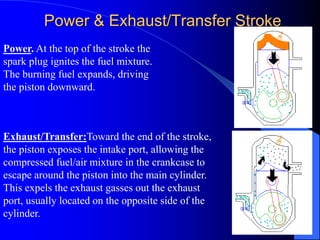
Power. At the top of the stroke the
spark plug ignites the fuel mixture.
The burning fuel expands, driving
the piston downward.
Exhaust/Transfer:Toward the end of the stroke,
the piston exposes the intake port, allowing the
compressed fuel/air mixture in the crankcase to
escape around the piston into the main cylinder.
This expels the exhaust gasses out the exhaust
port, usually located on the opposite side of the
cylinder.
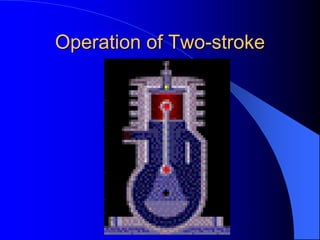
Operation of Two-stroke
-: THANK YOU :-

TWO STROKE ENGINE PPT

  • 1.
    SAL Institute ofTechnology and Engineering Research
  • 3.
    Two-Stroke Engine Less movingparts: •Piston •Crank shaft •Reed valve Oil is mixed in fuel for lubrication, Hence engine can operate at any angle Runs hotter , quicker in acceleration, and lighter in weight then 4-stroke. Top of the piston is wedged shape in order to help incoming gases to enter and exhaust gases to escape. Get fewer miles per gallon
  • 4.
    Operation of two-strokeengine The two stroke engine employs the crankcase as well as the cylinder to achieve all the elements of the cycle in only two strokes of the piston. 360 degrees rotation of crankshaft completes the cycle.
  • 5.
    Intake & Compressionstroke Intake. The fuel/air mixture is first drawn into the crankcase by the vacuum created during the upward stroke of the piston through the reed valve. Compression. The piston then rises, driven by flywheel momentum, and compresses the fuel mixture. (At the same time, another intake stroke is happening beneath the piston).
  • 6.
    Power & Exhaust/TransferStroke Power. At the top of the stroke the spark plug ignites the fuel mixture. The burning fuel expands, driving the piston downward. Exhaust/Transfer:Toward the end of the stroke, the piston exposes the intake port, allowing the compressed fuel/air mixture in the crankcase to escape around the piston into the main cylinder. This expels the exhaust gasses out the exhaust port, usually located on the opposite side of the cylinder.
  • 7.
  • 8.