CRYSTALLOGRAPHY
RAJSHREE.R
• Crystallography
1. Crystalline solids
2. Amorphous solids
3. Space Lattice
4. Unit cell
5. Bravais lattice
6. Calculation of the following for SC, BCC, FCC, HCP structure
i. Atoms per unit cell
ii. Coordination number
iii. Packaging factor
Matter
• Any substance which has mass and occupies space
• All physical objects are composed of matter.
MATTER
Solid Liquid Gas
Solids:
• Objects with definite size and shape
are known as solids.
• Incompressible, Rigid, Mechanically
strong, Atoms are closely packed.
Liquids & Gases:
• Atoms or molecules are not fixed
and cannot form any shape and size.
They gain the shape and size of the
container.
• loosely packed.
Solids are classified into two
categories
i) Crystalline Solids:
The solids in which atoms or molecules are arranged
in a regular and orderly manner in three dimensional
pattern, are called Crystalline Solids.
Ex: i) Metalic: Gold, Silver, Aluminium
ii) Non-Metalic: Diamond, Silicon, Nacl, Quartz,
Graphite etc.,
ii) Amorphous Solids
The solids in which atoms or molecules are
not arranged in a regular and orderly manner
in three dimensional pattern, are called
Amorphous Solids
Ex: Glass, Plastic,rubber
Crystalline Solids Amorphous Solids
1.Atoms or molecules have regular periodic
arrangements
2.They are anisotropic in nature.
3. They exhibit directional properties.
4.They have sharp melting points.
5. Crystal breaks along regular crystal planes
and hence the crystal pieces have regular
shape
Ex: Copper, Silver, Aluminium etc
Atoms or molecules are not arranged in a
regular periodic manner. They have random
arrangement.
They are isotropic in nature.
They do not exhibit directional properties.
They do not possess sharp melting points
Amorphous solids breaks into irregular shape
due to lack of crystal plane.
Ex: Glass, Plastic, rubber, etc.
Differences between
Crystalline solid and
Amorphous solid
Space Lattice (or) Crystal Lattice
• A space lattice is an array of points showing how particles
(atoms, ions or molecules) are arranged at different sites in
three dimensional spaces.
• The regular orderly arrangement of lattice points in space
which resembles the atoms or molecules in a crystal is
known as Space lattice.
• A crystal structure is formed only when the group of atoms is
arranged identically at the lattice point.
• The group of atoms or molecules is called a basis.
Unit Cell
• The smallest block or geometrical figure from
which the crystal is buildup by repetition in three
dimensions, is called unit cell.
(or)
The fundamental grouping of particles which are
repeating entities, is called unit cell.
• It is a fundamental elementary pattern.
• This unit cell is basic structural unit or building
blocks of the crystal structure
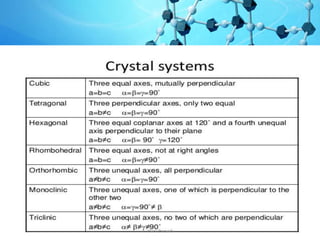
Seven Crystal System
IMPORTANT TERMS
• Primitive lattice (P) :
• In this lattice the unit cell
consists of eight corner atoms
and all these corner atoms
contribute only one effective
atom for the lattice.
• Body centered
lattice (I):
• In this lattice, in addition
to the eight corner
atoms, it consists of one
complete atom at the
centre.
• Face Centered lattice (F):
In this lattice along with the
corner atoms, each face will
have one centre atom
• Base Centered lattice (C):
• In this lattice along with the
corner atoms, the base and
opposite face will have centre
atoms
Bravais Lattices
• The French scientist August Bravais, demonstrated in 1850 that
only 14 types of unit cells are compatible with the orderly
arrangements of atoms found in crystals.
• These three-dimensional configurations of points used to
describe the orderly arrangement of atoms in a crystal.
• Each point represents one or more atoms in the actual crystal,
and if the points are connected by lines, a crystal lattice is
formed.
Bravais 14 types of unit
cells
Important definitions
• Atomic radius (r):
• The half of the distance between any two successive atoms in a
crystal lattice is called atomic radius.
• Nearest Neighbour Distance (2r) :
• The distance between two nearest neighboring atoms in a crystal
lattice is known as the nearest neighbour distance.
Important definitions
• Effective number of atoms per unit cell:
• The total number of atoms in a unit cell by considering the
contribution of corner atoms, centre atoms and face centered
atoms, is called Effective number of atoms per unit cell.
• Coordination number (N) :
• The number of equidistant neighbors that an atom has in a
crystal lattice is known as the coordination number.
Important definitions
• Atomic Packing Factor:
• The ratio between the total volume occupied by the atoms in a unit
cell to the total volume of the unit cell is called Packaging factor
• Interstitial Space (or) Void Space
• The empty space available in a crystal lattice with atoms occupying
their respective positions is called Interstitial space or void space.
Principal Metallic Crystal Structures
• 90% of the metals have either Body Centered Cubic (BCC),
Face Centered Cubic (FCC) or Hexagonal Close Packed
(HCP) crystal structure.
• HCP is denser version of simple hexagonal crystal structure.
Simple Cubic
• A simple cubic unit structure consists of eight corner
atoms. It is a primitive cell.
• Lattice parameters:
a = b = c and α = β = γ = 900
• Effective number of atoms in unit cell:
• In actual crystals each and every corner atom is
shared by eight adjacent unit cells. There each and
every corner atom contributes 1/8 of its part to one
unit cell. Hence effective number of atoms in unit cell
= [1/8] X 8 = 1
Coordination number:
For corner atom, there are four nearest
neighbours in its own plane. There is
another nearest neighbour in a plane which
lies just above this atom and yet another
nearest neighbour in another plane which
lies just below this atom. Therefore the total
number of nearest neighbours is 6.
• Atomic packing factor:
• A corner atom is shared by eight unit cells
• Contribution of a corner atom is 1/8
• Cube has 8 corners
• Hence contribution of 8 corner atoms= [1/8]X8 = 1
• Number of atoms per unit cell= 1
• If r is the radius of the atom, distance between the
centers of two neighboring atoms = 2r = a
Atomic radius r = a/2
• Volume of one atom = 4/3 πr3
• Volume of unit cell = a3
• atomic packing factor =
• =
= π/6
• atomic packing factor = 0.52 i.e. 52 % of the volume of the
simple cubic unit cell is occupied by atoms. The void space
is 48%
• Example: Polonium crystal. Hence this structure is loosely
packed.
Body Centered Cubic
Body centered cubic structure consists of eight corner atoms and
one body centered atom. It is not a primitive cell.
Lattice parameters: a = b = c and α = β = γ = 900
Effective number of atoms in unit cell:
In BCC unit cell, each and every corner atom is shared by
eight adjacent unit cells. Total number of atoms contributed by
corner atoms = [1/8] X 8 = 1
BCC unit cell has 1 full atom at the center of the unit cell.
The effective number of atoms present in a bcc unit cell is =1+1 = 2
• Coordination number:
• the nearest neighbor for a body centered atom is a corner atom. A
body centered atom is surrounded by eight corner atoms.
Therefore the coordination number of a bcc unit cell is 8.
• Atomic radius: For BCC the atoms touch along the body diagonal
• The diagonal length = 4r
• From ∆ le ABC AC2 = AB2 + BC2 D
• = a2 + a2 = 2a2
• AC =
From ∆ le ACD AD2 = AC2 + CD2
= 2a2 + a2
= 3a2
AD =
therefore = 4r
i.e r =
a
a
C
A
B
E F
G
•r
2r
r•
4r
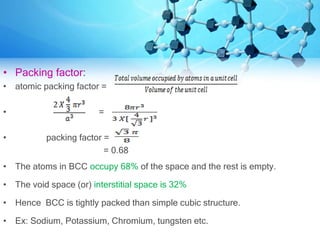
• Packing factor:
• atomic packing factor =
• =
• packing factor =
= 0.68
• The atoms in BCC occupy 68% of the space and the rest is empty.
• The void space (or) interstitial space is 32%
• Hence BCC is tightly packed than simple cubic structure.
• Ex: Sodium, Potassium, Chromium, tungsten etc.
Face Centered Cubic
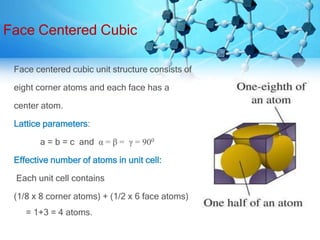
Face centered cubic unit structure consists of
eight corner atoms and each face has a
center atom.
Lattice parameters:
a = b = c and α = β = γ = 900
Effective number of atoms in unit cell:
Each unit cell contains
(1/8 x 8 corner atoms) + (1/2 x 6 face atoms)
= 1+3 = 4 atoms.
• Atomic radius can be calculated as follows:
To fit the same size spheres along the face diagonal, the face
diagonal must be four times the radius of the spheres, i.e.
d=4r
• From Pythagoras the face diagonal is :
• Hence,
Coordination number:
• For corner atom, there are four face
centered atoms.
• These face centered atoms are its
nearest neighbours.
• In a plane just above this corner
atom, it has four more face centered
atoms.
• In a plane which lies just below this
corner it has yet four more face
centered atoms.
• Therefore the nearest number of
atoms is 12
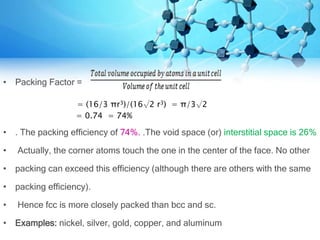
• Packing Factor:
• Each unit cell contains
• (1/8 x 8 corner atoms) + (1/2 x 6 face atoms)
= 1+3 = 4 atoms.
a(√2/4) = r
a = (4/√2) r
a = 2√2 r
Volume of the atoms in the cell
= 4 x (4/3 πr3)
= 16/3 πr3
Volume of cube = a3
= (2√2 r)3
= 16√2 r3
• Packing Factor =
= (16/3 πr3)/(16√2 r3) = π/3√2
= 0.74 = 74%
• . The packing efficiency of 74%. .The void space (or) interstitial space is 26%
• Actually, the corner atoms touch the one in the center of the face. No other
• packing can exceed this efficiency (although there are others with the same
• packing efficiency).
• Hence fcc is more closely packed than bcc and sc.
• Examples: nickel, silver, gold, copper, and aluminum
Hexagonal Close Packed
Structure
• It consists of three layers of atoms.
• The bottom layer has six corner atoms and one face
centred atom.
• The middle layer has three full atoms.
• The upper layer has six corner atoms and one face
centred atom.
• Each and every corner atom contributes 1/6 of its part
to one unitcell.
• The number of total atoms contributed by the corner
atoms of both top and bottom layers is 1/6  12 = 2.
• The face centred atom contributes 1/2 of its
part to one unit cell.
• Since there are 2 face centred atoms, one in
the top and the other in the bottom layers,
the number of atoms contributed by face
centred atoms is 1/2x2 = 1.
• Besides these atoms, there are 3 full atoms
in the middle layer.
• Total number of atoms present in an HCP
unit cell is 2+1+3 = 6.
• Co-ordination Number (CN)
• The face centered atom touches
6 corner atoms in its plane.
• The middle layer has 3 atoms.
• There are 3 more atoms, which
are in the middle layer of the
other unit cell.
• Therefore the total number of
nearest neighbours is 6+3+3=12.
• Atomic Radius (R)
• Consider any two corner atoms.
• Each and every corner atom
touches each other.
• Therefore a = 2r.
i.e., The atomic radius, r = a/2
a
a r r
• Atomic Packing Factor (APF)
• Packing Factor =
• Total volume occupied by atoms in a unit cell (v)
• Volume occupied by atoms in a unitcell (v) = 6  4/3 r3
• Substitute r = a/2 ,
• v = 6  4/3  (a/2) 3 = 6  4/3 (a3/8)
• v = a3
30 
O
30 
X
B
A
O
A
C
a
Volume of the Unit cell (V)
V = Area of the base × height
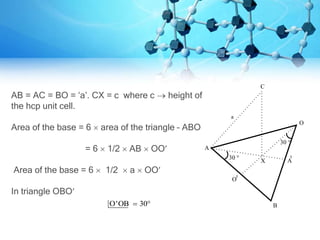
AB = AC = BO = ‘a’. CX = c where c  height of
the hcp unit cell.
Area of the base = 6  area of the triangle – ABO
= 6  1/2  AB  OO
Area of the base = 6  1/2  a  OO
In triangle OBO
O'OB 30 
30 
O
30 
X
B
A
O
A
C
a
cos30º =
 OO = a cos 30º = a
Now, substituting the value of OO,
Area of the base = 6   a  a
=
OO' OO'
BO a

3
2
1
2
3
2
2
3 3a
2
30 
O
30 
X
B
A
O
A
C
a
• V = Area of the base × height
• Volume of the unit cell (V) =  c
• Packing Factor =
=
• Packing Factor =
2
3 3a
2
3
2
v a
V 3 3 a c
2


3
2
2 a
3 3a c

2 a
c3 3

To find the height (C) of HCP unit cell
In the triangle ABA,
Cos 30º =
AA = AB cos 30º = a
Bu AX = AA =
i.e. AX =
30 
O
30 
X
B
A
O
A
C
a
A'AB 30 
AA'
AB
3
2
2
3
2 3
a
3 2
a
3
• In the triangle AXC,
• AC 2 = AX 2 + CX 2
• Substituting the values of AC, AX and CX,
• a 2 =
2 2
a c
23
   
   
  
2 2
2 a c
a
3 4
 
2 2
2c a
a
4 3
 
2
2c 1
a 1
4 3
 
  
 
• Now substituting the calculated value in Packing Factor =
• Packing Factor = =
• Atomic packing factor (APF) = =74%
• The packing efficiency of 74%. .The void space (or) interstitial space is 26%
c 8
a 3

2
2
c 8
3a

2 a
c3 3

2 3
83 3
 2 3
3 3 2 2

0.74
3 2


Crystal Facts
• Snowflakes– these are ice crystals
which are formed high up in
the clouds when water freezes.
They always have six sides, but
every single one of them is unique.
• Timing crystals– When an electric
current is sent through some crystal,
they vibrate at a very specific rate.
Quartz crystals are used in watches
and other electronics to keep
accurate time.
Cave of Crystals in Naica, Chihuahua, Mexico

Crystallography

  • 1.
  • 2.
    • Crystallography 1. Crystallinesolids 2. Amorphous solids 3. Space Lattice 4. Unit cell 5. Bravais lattice 6. Calculation of the following for SC, BCC, FCC, HCP structure i. Atoms per unit cell ii. Coordination number iii. Packaging factor
  • 3.
    Matter • Any substancewhich has mass and occupies space • All physical objects are composed of matter. MATTER Solid Liquid Gas
  • 4.
    Solids: • Objects withdefinite size and shape are known as solids. • Incompressible, Rigid, Mechanically strong, Atoms are closely packed. Liquids & Gases: • Atoms or molecules are not fixed and cannot form any shape and size. They gain the shape and size of the container. • loosely packed.
  • 5.
    Solids are classifiedinto two categories i) Crystalline Solids: The solids in which atoms or molecules are arranged in a regular and orderly manner in three dimensional pattern, are called Crystalline Solids. Ex: i) Metalic: Gold, Silver, Aluminium ii) Non-Metalic: Diamond, Silicon, Nacl, Quartz, Graphite etc.,
  • 6.
    ii) Amorphous Solids Thesolids in which atoms or molecules are not arranged in a regular and orderly manner in three dimensional pattern, are called Amorphous Solids Ex: Glass, Plastic,rubber
  • 7.
    Crystalline Solids AmorphousSolids 1.Atoms or molecules have regular periodic arrangements 2.They are anisotropic in nature. 3. They exhibit directional properties. 4.They have sharp melting points. 5. Crystal breaks along regular crystal planes and hence the crystal pieces have regular shape Ex: Copper, Silver, Aluminium etc Atoms or molecules are not arranged in a regular periodic manner. They have random arrangement. They are isotropic in nature. They do not exhibit directional properties. They do not possess sharp melting points Amorphous solids breaks into irregular shape due to lack of crystal plane. Ex: Glass, Plastic, rubber, etc. Differences between Crystalline solid and Amorphous solid
  • 8.
    Space Lattice (or)Crystal Lattice • A space lattice is an array of points showing how particles (atoms, ions or molecules) are arranged at different sites in three dimensional spaces. • The regular orderly arrangement of lattice points in space which resembles the atoms or molecules in a crystal is known as Space lattice. • A crystal structure is formed only when the group of atoms is arranged identically at the lattice point. • The group of atoms or molecules is called a basis.
  • 10.
    Unit Cell • Thesmallest block or geometrical figure from which the crystal is buildup by repetition in three dimensions, is called unit cell. (or) The fundamental grouping of particles which are repeating entities, is called unit cell. • It is a fundamental elementary pattern. • This unit cell is basic structural unit or building blocks of the crystal structure
  • 11.
  • 13.
    IMPORTANT TERMS • Primitivelattice (P) : • In this lattice the unit cell consists of eight corner atoms and all these corner atoms contribute only one effective atom for the lattice.
  • 14.
    • Body centered lattice(I): • In this lattice, in addition to the eight corner atoms, it consists of one complete atom at the centre.
  • 15.
    • Face Centeredlattice (F): In this lattice along with the corner atoms, each face will have one centre atom
  • 16.
    • Base Centeredlattice (C): • In this lattice along with the corner atoms, the base and opposite face will have centre atoms
  • 17.
    Bravais Lattices • TheFrench scientist August Bravais, demonstrated in 1850 that only 14 types of unit cells are compatible with the orderly arrangements of atoms found in crystals. • These three-dimensional configurations of points used to describe the orderly arrangement of atoms in a crystal. • Each point represents one or more atoms in the actual crystal, and if the points are connected by lines, a crystal lattice is formed.
  • 18.
    Bravais 14 typesof unit cells
  • 19.
    Important definitions • Atomicradius (r): • The half of the distance between any two successive atoms in a crystal lattice is called atomic radius. • Nearest Neighbour Distance (2r) : • The distance between two nearest neighboring atoms in a crystal lattice is known as the nearest neighbour distance.
  • 20.
    Important definitions • Effectivenumber of atoms per unit cell: • The total number of atoms in a unit cell by considering the contribution of corner atoms, centre atoms and face centered atoms, is called Effective number of atoms per unit cell. • Coordination number (N) : • The number of equidistant neighbors that an atom has in a crystal lattice is known as the coordination number.
  • 21.
    Important definitions • AtomicPacking Factor: • The ratio between the total volume occupied by the atoms in a unit cell to the total volume of the unit cell is called Packaging factor • Interstitial Space (or) Void Space • The empty space available in a crystal lattice with atoms occupying their respective positions is called Interstitial space or void space.
  • 22.
    Principal Metallic CrystalStructures • 90% of the metals have either Body Centered Cubic (BCC), Face Centered Cubic (FCC) or Hexagonal Close Packed (HCP) crystal structure. • HCP is denser version of simple hexagonal crystal structure.
  • 23.
    Simple Cubic • Asimple cubic unit structure consists of eight corner atoms. It is a primitive cell. • Lattice parameters: a = b = c and α = β = γ = 900 • Effective number of atoms in unit cell: • In actual crystals each and every corner atom is shared by eight adjacent unit cells. There each and every corner atom contributes 1/8 of its part to one unit cell. Hence effective number of atoms in unit cell = [1/8] X 8 = 1
  • 24.
    Coordination number: For corneratom, there are four nearest neighbours in its own plane. There is another nearest neighbour in a plane which lies just above this atom and yet another nearest neighbour in another plane which lies just below this atom. Therefore the total number of nearest neighbours is 6.
  • 25.
    • Atomic packingfactor: • A corner atom is shared by eight unit cells • Contribution of a corner atom is 1/8 • Cube has 8 corners • Hence contribution of 8 corner atoms= [1/8]X8 = 1 • Number of atoms per unit cell= 1 • If r is the radius of the atom, distance between the centers of two neighboring atoms = 2r = a Atomic radius r = a/2 • Volume of one atom = 4/3 πr3 • Volume of unit cell = a3
  • 26.
    • atomic packingfactor = • = = π/6 • atomic packing factor = 0.52 i.e. 52 % of the volume of the simple cubic unit cell is occupied by atoms. The void space is 48% • Example: Polonium crystal. Hence this structure is loosely packed.
  • 27.
    Body Centered Cubic Bodycentered cubic structure consists of eight corner atoms and one body centered atom. It is not a primitive cell. Lattice parameters: a = b = c and α = β = γ = 900 Effective number of atoms in unit cell: In BCC unit cell, each and every corner atom is shared by eight adjacent unit cells. Total number of atoms contributed by corner atoms = [1/8] X 8 = 1 BCC unit cell has 1 full atom at the center of the unit cell. The effective number of atoms present in a bcc unit cell is =1+1 = 2
  • 28.
    • Coordination number: •the nearest neighbor for a body centered atom is a corner atom. A body centered atom is surrounded by eight corner atoms. Therefore the coordination number of a bcc unit cell is 8.
  • 29.
    • Atomic radius:For BCC the atoms touch along the body diagonal • The diagonal length = 4r • From ∆ le ABC AC2 = AB2 + BC2 D • = a2 + a2 = 2a2 • AC = From ∆ le ACD AD2 = AC2 + CD2 = 2a2 + a2 = 3a2 AD = therefore = 4r i.e r = a a C A B E F G •r 2r r• 4r
  • 30.
    • Packing factor: •atomic packing factor = • = • packing factor = = 0.68 • The atoms in BCC occupy 68% of the space and the rest is empty. • The void space (or) interstitial space is 32% • Hence BCC is tightly packed than simple cubic structure. • Ex: Sodium, Potassium, Chromium, tungsten etc.
  • 31.
    Face Centered Cubic Facecentered cubic unit structure consists of eight corner atoms and each face has a center atom. Lattice parameters: a = b = c and α = β = γ = 900 Effective number of atoms in unit cell: Each unit cell contains (1/8 x 8 corner atoms) + (1/2 x 6 face atoms) = 1+3 = 4 atoms.
  • 32.
    • Atomic radiuscan be calculated as follows: To fit the same size spheres along the face diagonal, the face diagonal must be four times the radius of the spheres, i.e. d=4r • From Pythagoras the face diagonal is : • Hence,
  • 33.
    Coordination number: • Forcorner atom, there are four face centered atoms. • These face centered atoms are its nearest neighbours. • In a plane just above this corner atom, it has four more face centered atoms. • In a plane which lies just below this corner it has yet four more face centered atoms. • Therefore the nearest number of atoms is 12
  • 34.
    • Packing Factor: •Each unit cell contains • (1/8 x 8 corner atoms) + (1/2 x 6 face atoms) = 1+3 = 4 atoms. a(√2/4) = r a = (4/√2) r a = 2√2 r Volume of the atoms in the cell = 4 x (4/3 πr3) = 16/3 πr3 Volume of cube = a3 = (2√2 r)3 = 16√2 r3
  • 35.
    • Packing Factor= = (16/3 πr3)/(16√2 r3) = π/3√2 = 0.74 = 74% • . The packing efficiency of 74%. .The void space (or) interstitial space is 26% • Actually, the corner atoms touch the one in the center of the face. No other • packing can exceed this efficiency (although there are others with the same • packing efficiency). • Hence fcc is more closely packed than bcc and sc. • Examples: nickel, silver, gold, copper, and aluminum
  • 36.
    Hexagonal Close Packed Structure •It consists of three layers of atoms. • The bottom layer has six corner atoms and one face centred atom. • The middle layer has three full atoms. • The upper layer has six corner atoms and one face centred atom. • Each and every corner atom contributes 1/6 of its part to one unitcell. • The number of total atoms contributed by the corner atoms of both top and bottom layers is 1/6  12 = 2.
  • 37.
    • The facecentred atom contributes 1/2 of its part to one unit cell. • Since there are 2 face centred atoms, one in the top and the other in the bottom layers, the number of atoms contributed by face centred atoms is 1/2x2 = 1. • Besides these atoms, there are 3 full atoms in the middle layer. • Total number of atoms present in an HCP unit cell is 2+1+3 = 6.
  • 38.
    • Co-ordination Number(CN) • The face centered atom touches 6 corner atoms in its plane. • The middle layer has 3 atoms. • There are 3 more atoms, which are in the middle layer of the other unit cell. • Therefore the total number of nearest neighbours is 6+3+3=12.
  • 40.
    • Atomic Radius(R) • Consider any two corner atoms. • Each and every corner atom touches each other. • Therefore a = 2r. i.e., The atomic radius, r = a/2 a a r r
  • 41.
    • Atomic PackingFactor (APF) • Packing Factor = • Total volume occupied by atoms in a unit cell (v) • Volume occupied by atoms in a unitcell (v) = 6  4/3 r3 • Substitute r = a/2 , • v = 6  4/3  (a/2) 3 = 6  4/3 (a3/8) • v = a3
  • 42.
    30  O 30  X B A O A C a Volumeof the Unit cell (V) V = Area of the base × height
  • 43.
    AB = AC= BO = ‘a’. CX = c where c  height of the hcp unit cell. Area of the base = 6  area of the triangle – ABO = 6  1/2  AB  OO Area of the base = 6  1/2  a  OO In triangle OBO O'OB 30  30  O 30  X B A O A C a
  • 44.
    cos30º =  OO= a cos 30º = a Now, substituting the value of OO, Area of the base = 6   a  a = OO' OO' BO a  3 2 1 2 3 2 2 3 3a 2 30  O 30  X B A O A C a
  • 45.
    • V =Area of the base × height • Volume of the unit cell (V) =  c • Packing Factor = = • Packing Factor = 2 3 3a 2 3 2 v a V 3 3 a c 2   3 2 2 a 3 3a c  2 a c3 3 
  • 46.
    To find theheight (C) of HCP unit cell In the triangle ABA, Cos 30º = AA = AB cos 30º = a Bu AX = AA = i.e. AX = 30  O 30  X B A O A C a A'AB 30  AA' AB 3 2 2 3 2 3 a 3 2 a 3
  • 47.
    • In thetriangle AXC, • AC 2 = AX 2 + CX 2 • Substituting the values of AC, AX and CX, • a 2 = 2 2 a c 23            2 2 2 a c a 3 4   2 2 2c a a 4 3   2 2c 1 a 1 4 3       
  • 48.
    • Now substitutingthe calculated value in Packing Factor = • Packing Factor = = • Atomic packing factor (APF) = =74% • The packing efficiency of 74%. .The void space (or) interstitial space is 26% c 8 a 3  2 2 c 8 3a  2 a c3 3  2 3 83 3  2 3 3 3 2 2  0.74 3 2  
  • 49.
    Crystal Facts • Snowflakes–these are ice crystals which are formed high up in the clouds when water freezes. They always have six sides, but every single one of them is unique. • Timing crystals– When an electric current is sent through some crystal, they vibrate at a very specific rate. Quartz crystals are used in watches and other electronics to keep accurate time.
  • 50.
    Cave of Crystalsin Naica, Chihuahua, Mexico