
Done By : 
Gourisankaran P 
Class: 10 E 
Roll No: 31
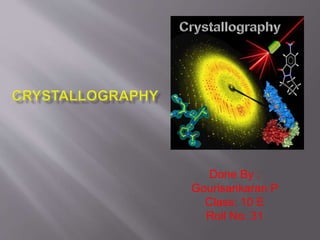
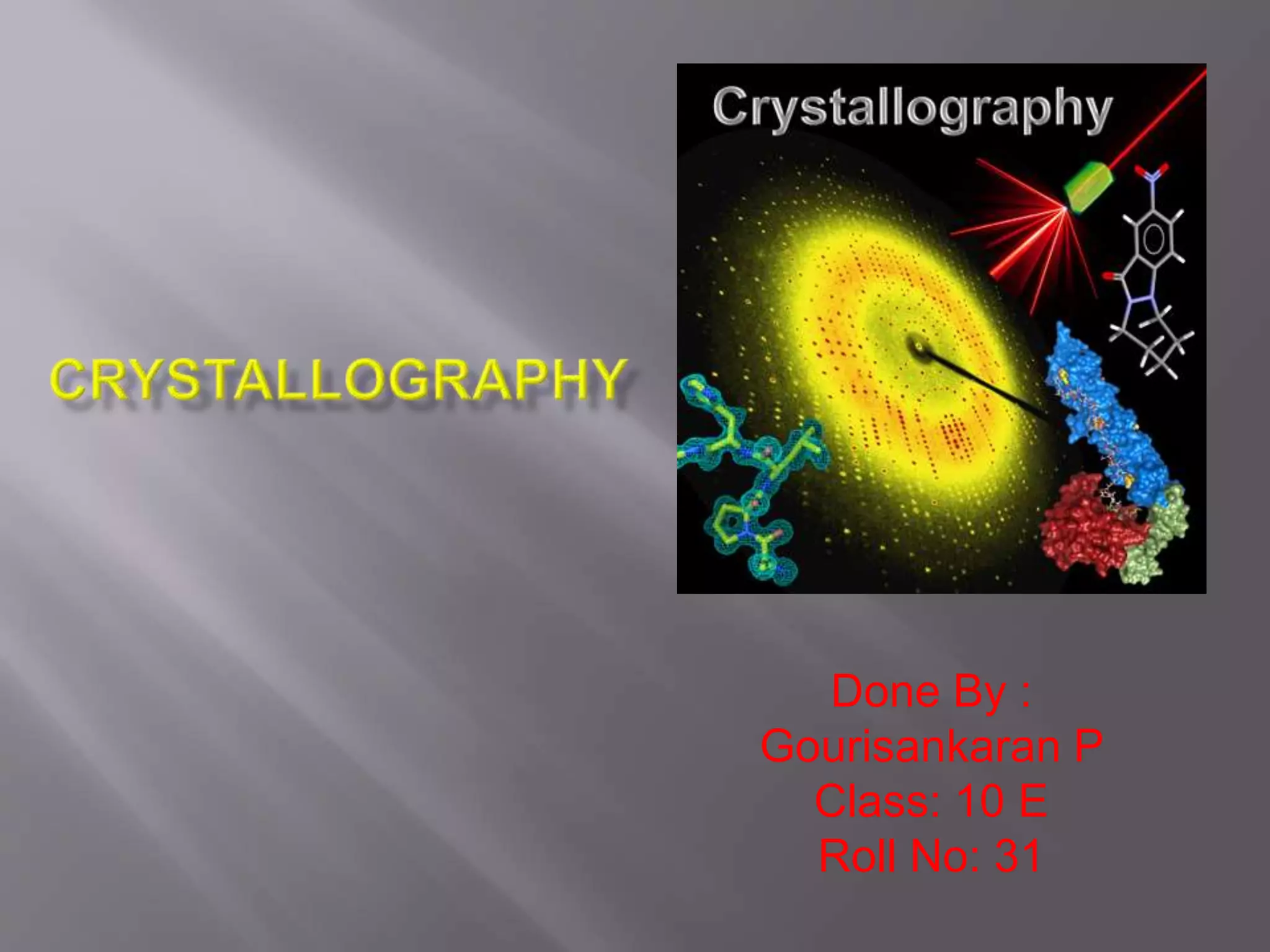
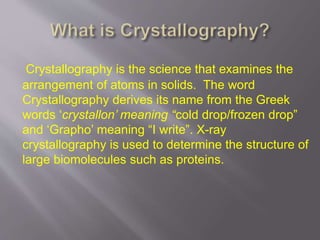
Crystallography is the science that examines the 
arrangement of atoms in solids. The word 
Crystallography derives its name from the Greek 
words ‘crystallon’ meaning “cold drop/frozen drop” 
and ‘Grapho’ meaning “I write”. X-ray 
crystallography is used to determine the structure of 
large biomolecules such as proteins.
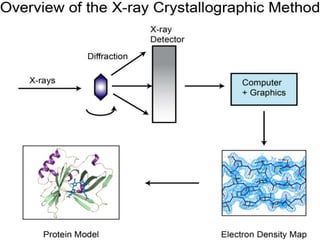
X-ray crystallography is a method of determining the 
arrangement of atoms within a crystal, in which a 
beam of X-rays strikes a crystal and diffracts into 
many specific directions. From the angles and 
intensities of these diffracted beams, a 
crystallographer can produce a three-dimensional 
picture of the density of electrons within the crystal.
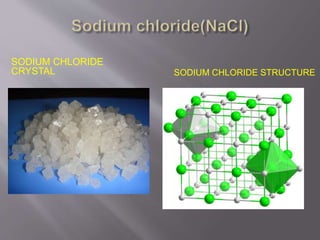
SODIUM CHLORIDE 
CRYSTAL SODIUM CHLORIDE STRUCTURE
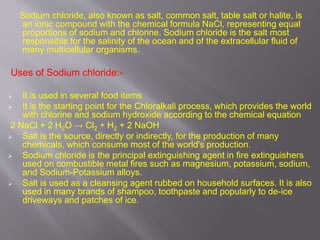
Sodium chloride, also known as salt, common salt, table salt or halite, is 
an ionic compound with the chemical formula NaCl, representing equal 
proportions of sodium and chlorine. Sodium chloride is the salt most 
responsible for the salinity of the ocean and of the extracellular fluid of 
many multicellular organisms. 
Uses of Sodium chloride:- 
 It is used in several food items 
 It is the starting point for the Chloralkali process, which provides the world 
with chlorine and sodium hydroxide according to the chemical equation 
2 NaCl + 2 H2O → Cl2 + H2 + 2 NaOH 
 Salt is the source, directly or indirectly, for the production of many 
chemicals, which consume most of the world's production. 
 Sodium chloride is the principal extinguishing agent in fire extinguishers 
used on combustible metal fires such as magnesium, potassium, sodium, 
and Sodium-Potassium alloys. 
 Salt is used as a cleansing agent rubbed on household surfaces. It is also 
used in many brands of shampoo, toothpaste and popularly to de-ice 
driveways and patches of ice.
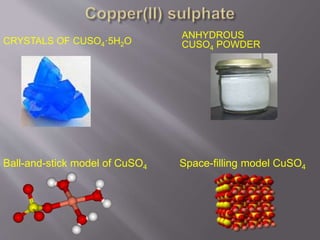
CRYSTALS OF CUSO4·5H2O 
ANHYDROUS 
CUSO4 POWDER 
Ball-and-stick model of CuSO4 Space-filling model CuSO4
Copper(II) sulfate, also known as cupric sulfate or copper 
sulphate, is the chemical compound with the chemical 
formula CuSO4. The anhydrous form is a pale green or gray-white 
powder, whereas the pentahydrate (CuSO4·5H2O), the 
most commonly encountered salt, is bright blue. 
Uses of Copper(II) sulphate :- 
 Copper sulfate pentahydrate is used as a fungicide. Mixed 
with lime it is called ”Bordeaux mixture” and used to control 
fungus on grapes, melons, and other berries. 
 Copper sulfate is employed in organic synthesis. The 
anhydrous salt is used as a dehydrating agent for forming and 
manipulating acetal groups. The hydrated salt can be 
intimately mingled with potassium permanganate to give an 
oxidant for the conversion of primary alcohols. 
 Copper sulfate is a commonly included chemical in 
children's chemistry sets and is often used to grow crystals 
in schools and in copper plating experiments.
Crystallography

Crystallography

  • 1.
    Done By : Gourisankaran P Class: 10 E Roll No: 31
  • 2.
    Crystallography is thescience that examines the arrangement of atoms in solids. The word Crystallography derives its name from the Greek words ‘crystallon’ meaning “cold drop/frozen drop” and ‘Grapho’ meaning “I write”. X-ray crystallography is used to determine the structure of large biomolecules such as proteins.
  • 4.
    X-ray crystallography isa method of determining the arrangement of atoms within a crystal, in which a beam of X-rays strikes a crystal and diffracts into many specific directions. From the angles and intensities of these diffracted beams, a crystallographer can produce a three-dimensional picture of the density of electrons within the crystal.
  • 6.
    SODIUM CHLORIDE CRYSTALSODIUM CHLORIDE STRUCTURE
  • 8.
    Sodium chloride, alsoknown as salt, common salt, table salt or halite, is an ionic compound with the chemical formula NaCl, representing equal proportions of sodium and chlorine. Sodium chloride is the salt most responsible for the salinity of the ocean and of the extracellular fluid of many multicellular organisms. Uses of Sodium chloride:-  It is used in several food items  It is the starting point for the Chloralkali process, which provides the world with chlorine and sodium hydroxide according to the chemical equation 2 NaCl + 2 H2O → Cl2 + H2 + 2 NaOH  Salt is the source, directly or indirectly, for the production of many chemicals, which consume most of the world's production.  Sodium chloride is the principal extinguishing agent in fire extinguishers used on combustible metal fires such as magnesium, potassium, sodium, and Sodium-Potassium alloys.  Salt is used as a cleansing agent rubbed on household surfaces. It is also used in many brands of shampoo, toothpaste and popularly to de-ice driveways and patches of ice.
  • 9.
    CRYSTALS OF CUSO4·5H2O ANHYDROUS CUSO4 POWDER Ball-and-stick model of CuSO4 Space-filling model CuSO4
  • 10.
    Copper(II) sulfate, alsoknown as cupric sulfate or copper sulphate, is the chemical compound with the chemical formula CuSO4. The anhydrous form is a pale green or gray-white powder, whereas the pentahydrate (CuSO4·5H2O), the most commonly encountered salt, is bright blue. Uses of Copper(II) sulphate :-  Copper sulfate pentahydrate is used as a fungicide. Mixed with lime it is called ”Bordeaux mixture” and used to control fungus on grapes, melons, and other berries.  Copper sulfate is employed in organic synthesis. The anhydrous salt is used as a dehydrating agent for forming and manipulating acetal groups. The hydrated salt can be intimately mingled with potassium permanganate to give an oxidant for the conversion of primary alcohols.  Copper sulfate is a commonly included chemical in children's chemistry sets and is often used to grow crystals in schools and in copper plating experiments.