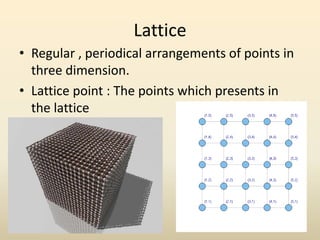

Lattice
• Regular , periodical arrangements of points in
  three dimension.
• Lattice point : The points which presents in
  the lattice
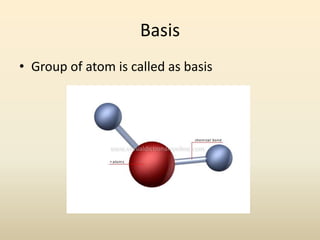
Basis
• Group of atom is called as basis
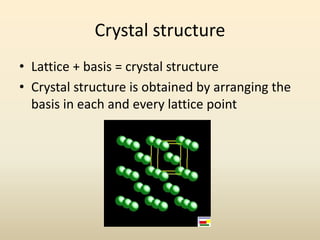
Crystal structure
• Lattice + basis = crystal structure
• Crystal structure is obtained by arranging the
  basis in each and every lattice point
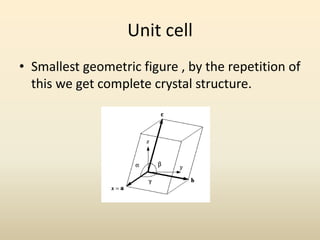
Unit cell
• Smallest geometric figure , by the repetition of
  this we get complete crystal structure.
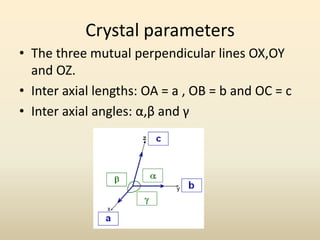
Crystal parameters
• The three mutual perpendicular lines OX,OY
  and OZ.
• Inter axial lengths: OA = a , OB = b and OC = c
• Inter axial angles: α,β and γ
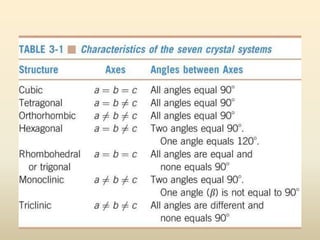
Crystal system
Cubic
Orthorhombic
Monoclinic
Triclinic
Hexagonal
Rhombohedral
Tetragonal
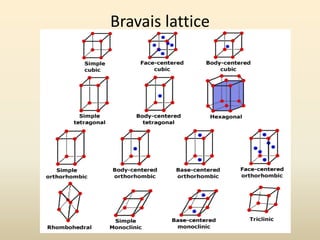
Bravais lattice
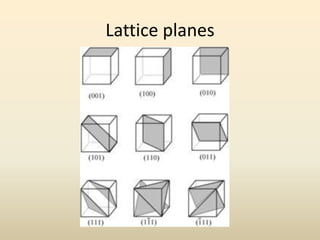
Lattice planes
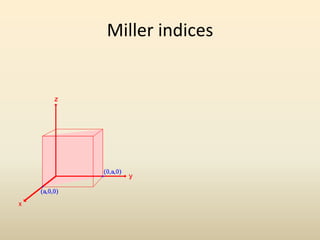
Miller indices
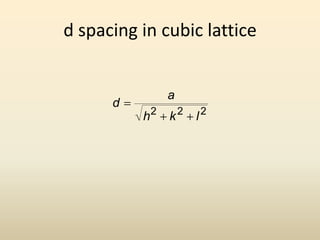
d spacing in cubic lattice


               a
      d
          h2   k2   l2
Calculation of number of atoms
 per unit cell – Atomic radius –
Coordination number – Packing
factor for SC , BCC ,FCC and HCP
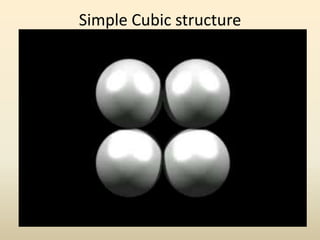
Simple Cubic structure
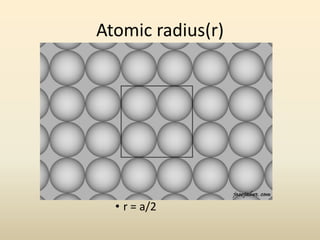
Atomic radius(r)


  • r = a/2
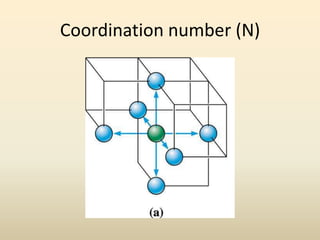
Coordination number (N)
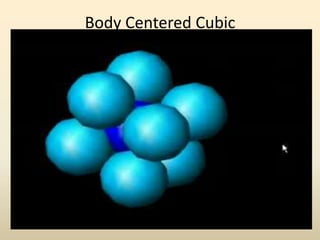
Body Centered Cubic
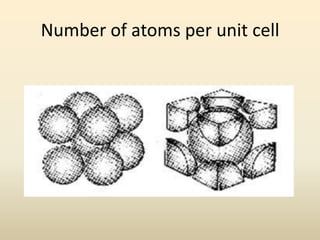
Number of atoms per unit cell
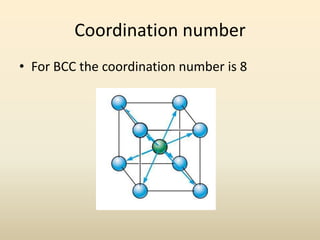
Coordination number
• For BCC the coordination number is 8
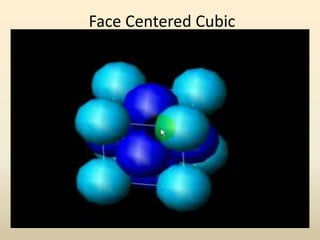
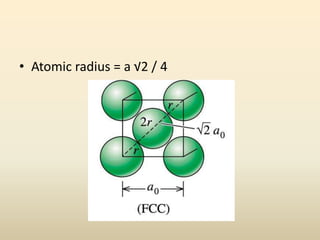
Face Centered Cubic
• Atomic radius = a √2 / 4
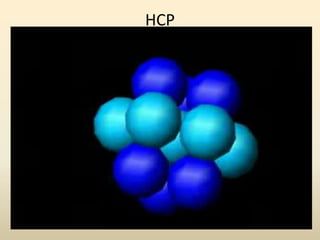
HCP
Na Cl structure
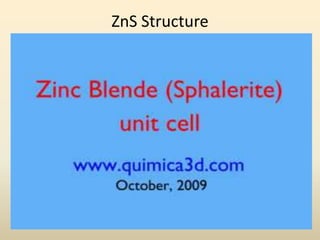
ZnS Structure
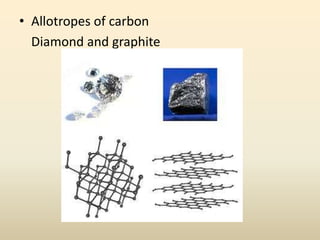
diamond and graphite Structure
Polymorphism and allotropy
• Polymorphism is a physical phenomenon where
  a material may have more than one crystal
  structure.
• A material that shows polymorphism exists in
  more than one type of space lattice in the solid
  state. If the change in structure is
  reversible, then the polymorphic change is
  known as allotropy.
• The prevailing crystal structure depends on both
  the temperature and the external pressure.
• Allotropes of carbon
  Diamond and graphite
Crystal defects
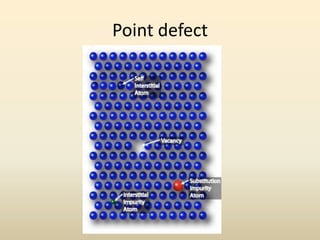
•   Point defect
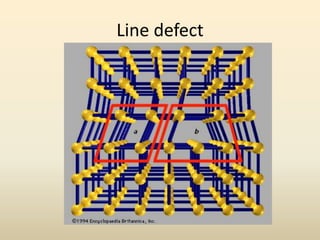
•    line defect
•   surface defect
•    Burger vector
Point defect
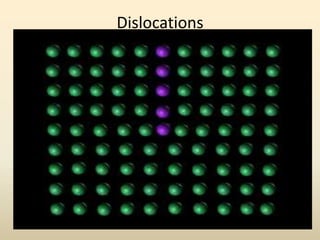
Line defect
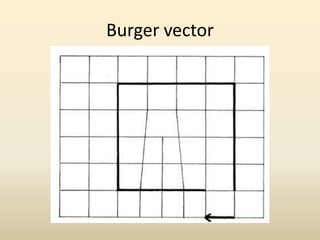
Burger vector
Dislocations

Crystal Physics