crystalline and non-crystalline materials
• Solids exist in nature in two principal forms: crystalline and non-crystalline
(amorphous)
Crystalline material:
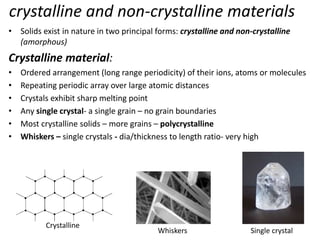
• Ordered arrangement (long range periodicity) of their ions, atoms or molecules
• Repeating periodic array over large atomic distances
• Crystals exhibit sharp melting point
• Any single crystal- a single grain – no grain boundaries
• Most crystalline solids – more grains – polycrystalline
• Whiskers – single crystals - dia/thickness to length ratio- very high
Crystalline
Single crystal
Whiskers
Crystalline materials
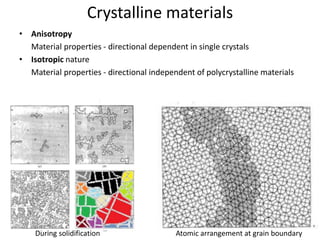
• Anisotropy
Material properties - directional dependent in single crystals
• Isotropic nature
Material properties - directional independent of polycrystalline materials
During solidification Atomic arrangement at grain boundary
Noncrystalline (amorphous) materials
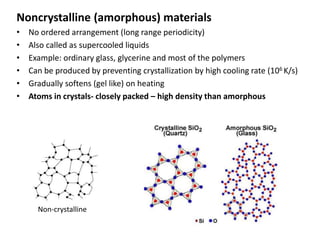
• No ordered arrangement (long range periodicity)
• Also called as supercooled liquids
• Example: ordinary glass, glycerine and most of the polymers
• Can be produced by preventing crystallization by high cooling rate (106 K/s)
• Gradually softens (gel like) on heating
• Atoms in crystals- closely packed – high density than amorphous
Non-crystalline
Space lattice
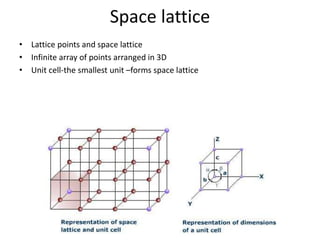
• Lattice points and space lattice
• Infinite array of points arranged in 3D
• Unit cell-the smallest unit –forms space lattice
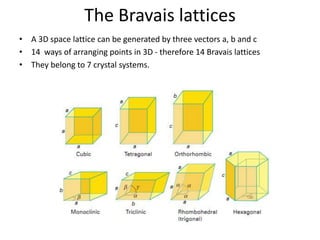
The Bravais lattices
• A 3D space lattice can be generated by three vectors a, b and c
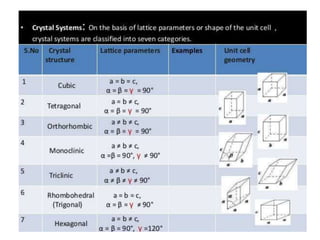
• 14 ways of arranging points in 3D - therefore 14 Bravais lattices
• They belong to 7 crystal systems.
14 ways of arranging points in 3D - therefore 14 Bravais lattices
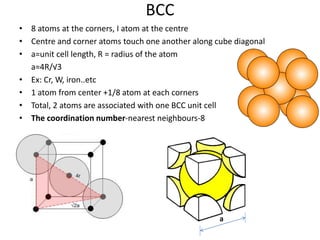
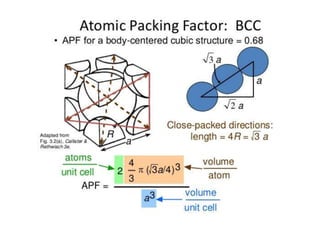
BCC
• 8 atoms at the corners, I atom at the centre
• Centre and corner atoms touch one another along cube diagonal
• a=unit cell length, R = radius of the atom
a=4R/√3
• Ex: Cr, W, iron..etc
• 1 atom from center +1/8 atom at each corners
• Total, 2 atoms are associated with one BCC unit cell
• The coordination number-nearest neighbours-8
a
a
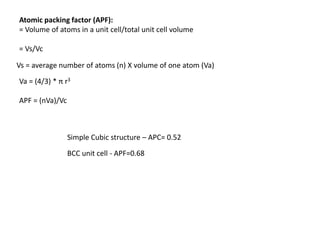
Atomic packing factor (APF):
= Volume of atoms in a unit cell/total unit cell volume
= Vs/Vc
BCC unit cell - APF=0.68
Vs = average number of atoms (n) X volume of one atom (Va)
Simple Cubic structure – APC= 0.52
Va = (4/3) * π r3
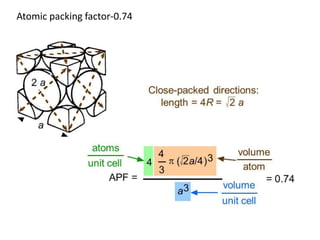
APF = (nVa)/Vc
Simple Cubic structure
FCC
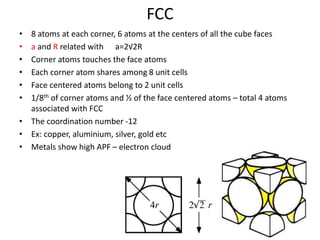
• 8 atoms at each corner, 6 atoms at the centers of all the cube faces
• a and R related with a=2√2R
• Corner atoms touches the face atoms
• Each corner atom shares among 8 unit cells
• Face centered atoms belong to 2 unit cells
• 1/8th of corner atoms and ½ of the face centered atoms – total 4 atoms
associated with FCC
• The coordination number -12
• Ex: copper, aluminium, silver, gold etc
• Metals show high APF – electron cloud
Atomic packing factor-0.74
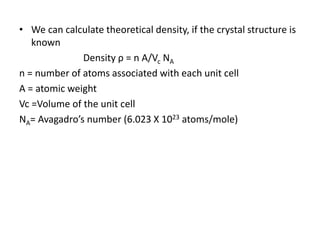
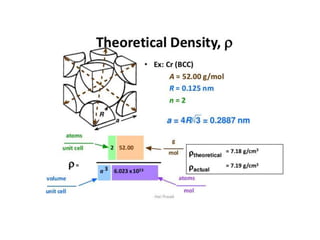
• We can calculate theoretical density, if the crystal structure is
known
Density ρ = n A/Vc NA
n = number of atoms associated with each unit cell
A = atomic weight
Vc =Volume of the unit cell
NA= Avagadro’s number (6.023 X 10²³ atoms/mole)
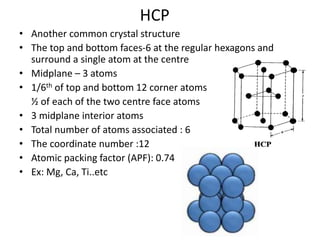
HCP
• Another common crystal structure
• The top and bottom faces-6 at the regular hexagons and
surround a single atom at the centre
• Midplane – 3 atoms
• 1/6th of top and bottom 12 corner atoms
½ of each of the two centre face atoms
• 3 midplane interior atoms
• Total number of atoms associated : 6
• The coordinate number :12
• Atomic packing factor (APF): 0.74
• Ex: Mg, Ca, Ti..etc
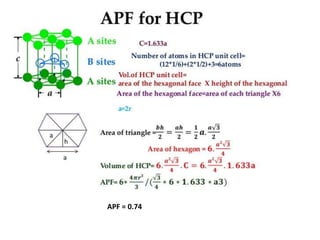
APF = 0.74
Summary
• Stability-metastability
• Atomic bonds
• Crystalline and non-crystalline materials
• Space lattice, unitcell
• Different crystal structures
• BCC, FCC and hcp structures

Unit 1_crystal structures.pptx

  • 1.
    crystalline and non-crystallinematerials • Solids exist in nature in two principal forms: crystalline and non-crystalline (amorphous) Crystalline material: • Ordered arrangement (long range periodicity) of their ions, atoms or molecules • Repeating periodic array over large atomic distances • Crystals exhibit sharp melting point • Any single crystal- a single grain – no grain boundaries • Most crystalline solids – more grains – polycrystalline • Whiskers – single crystals - dia/thickness to length ratio- very high Crystalline Single crystal Whiskers
  • 2.
    Crystalline materials • Anisotropy Materialproperties - directional dependent in single crystals • Isotropic nature Material properties - directional independent of polycrystalline materials During solidification Atomic arrangement at grain boundary
  • 3.
    Noncrystalline (amorphous) materials •No ordered arrangement (long range periodicity) • Also called as supercooled liquids • Example: ordinary glass, glycerine and most of the polymers • Can be produced by preventing crystallization by high cooling rate (106 K/s) • Gradually softens (gel like) on heating • Atoms in crystals- closely packed – high density than amorphous Non-crystalline
  • 4.
    Space lattice • Latticepoints and space lattice • Infinite array of points arranged in 3D • Unit cell-the smallest unit –forms space lattice
  • 5.
    The Bravais lattices •A 3D space lattice can be generated by three vectors a, b and c • 14 ways of arranging points in 3D - therefore 14 Bravais lattices • They belong to 7 crystal systems.
  • 7.
    14 ways ofarranging points in 3D - therefore 14 Bravais lattices
  • 8.
    BCC • 8 atomsat the corners, I atom at the centre • Centre and corner atoms touch one another along cube diagonal • a=unit cell length, R = radius of the atom a=4R/√3 • Ex: Cr, W, iron..etc • 1 atom from center +1/8 atom at each corners • Total, 2 atoms are associated with one BCC unit cell • The coordination number-nearest neighbours-8 a a
  • 9.
    Atomic packing factor(APF): = Volume of atoms in a unit cell/total unit cell volume = Vs/Vc BCC unit cell - APF=0.68 Vs = average number of atoms (n) X volume of one atom (Va) Simple Cubic structure – APC= 0.52 Va = (4/3) * π r3 APF = (nVa)/Vc
  • 10.
  • 12.
    FCC • 8 atomsat each corner, 6 atoms at the centers of all the cube faces • a and R related with a=2√2R • Corner atoms touches the face atoms • Each corner atom shares among 8 unit cells • Face centered atoms belong to 2 unit cells • 1/8th of corner atoms and ½ of the face centered atoms – total 4 atoms associated with FCC • The coordination number -12 • Ex: copper, aluminium, silver, gold etc • Metals show high APF – electron cloud
  • 13.
  • 14.
    • We cancalculate theoretical density, if the crystal structure is known Density ρ = n A/Vc NA n = number of atoms associated with each unit cell A = atomic weight Vc =Volume of the unit cell NA= Avagadro’s number (6.023 X 10²³ atoms/mole)
  • 16.
    HCP • Another commoncrystal structure • The top and bottom faces-6 at the regular hexagons and surround a single atom at the centre • Midplane – 3 atoms • 1/6th of top and bottom 12 corner atoms ½ of each of the two centre face atoms • 3 midplane interior atoms • Total number of atoms associated : 6 • The coordinate number :12 • Atomic packing factor (APF): 0.74 • Ex: Mg, Ca, Ti..etc
  • 17.
  • 18.
    Summary • Stability-metastability • Atomicbonds • Crystalline and non-crystalline materials • Space lattice, unitcell • Different crystal structures • BCC, FCC and hcp structures