Crystallography
In 1669 Nicolaus Steno found angles between adjacent prism faces of quartz crystal (interfacial angle), to be 120 °.  In 1780 Carangeot invented the goniometer, a protactor like device used to measure interfacial angles on crystals. Law of “constancy of interfacial angels”: angles between equivalent faces of crystals of the same mineral are always the same.The law acknowledges that the size and shape of the crystal may vary.
In 1784 Rene’Hauy hypothesized the existence of basic building blocks  of crystals called integral molecules and argued that large crystals formed when many integral molecules bonded together.
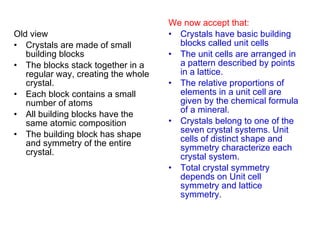
Old view Crystals are made of small building blocks The blocks stack together in a regular way, creating the whole crystal. Each block contains a small  number of atoms All building blocks have the same atomic composition The building block has shape and symmetry of the entire crystal. We now accept that: Crystals have basic building blocks called unit cells The unit cells are arranged in a pattern described by points in a lattice. The relative proportions of elements in a unit cell are given by the chemical formula of a mineral. Crystals belong to one of the seven crystal systems. Unit cells of distinct shape and symmetry characterize each crystal system. Total crystal symmetry depends on Unit cell symmetry and lattice symmetry.
Crystal Geometry Crystals Lattice Lattice points, lattice translations Cell--Primitive & non primitive Lattice parameters Crystal=lattice+motif
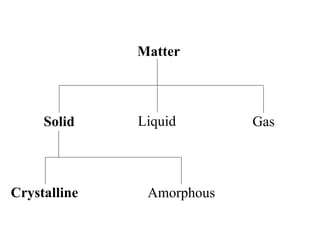
Matter Crystalline Amorphous Solid Liquid Gas
Crystal?
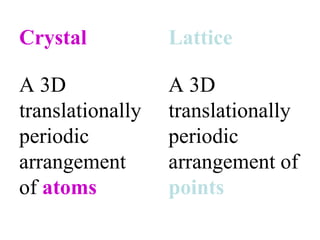
A 3D translationally periodic arrangement of atoms in space is called a crystal.
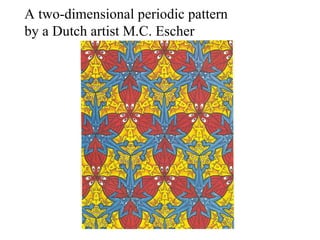
A two-dimensional periodic pattern by a Dutch artist M.C. Escher
Lattice?
A 3D translationally periodic arrangement of points in space is called a lattice.
A 3D translationally periodic arrangement of  atoms Crystal A 3D translationally periodic arrangement of  points Lattice
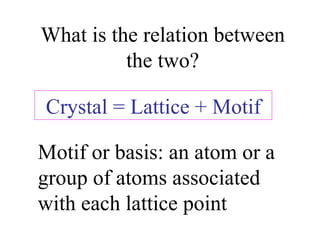
What is the relation between the two? Crystal = Lattice + Motif Motif or basis: an atom or a group of atoms associated with each lattice point
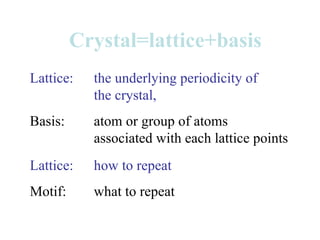
Crystal=lattice+basis Lattice:  the underlying periodicity of  the crystal, Basis:  atom or group of atoms  associated with each lattice points Lattice:  how to repeat Motif:  what to repeat
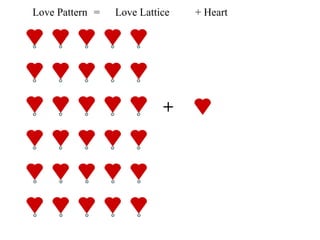
+ Love Pattern Love Lattice + Heart =
Space Lattice A  discrete  array of points in  3-d space  such that every point has  identical surroundings
Lattice Finite or infinite?
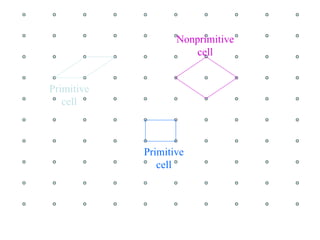
Primitive cell Primitive cell Nonprimitive cell
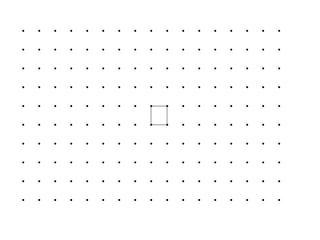
Cells A cell is a finite representation of the  infinite lattice A cell is a parallelogram (2D) or a  parallelopiped (3D) with lattice points at  their corners. If the lattice points are only at the  corners, the cell is primitive. If there are lattice points in the cell other  than the corners, the cell is nonprimitive.
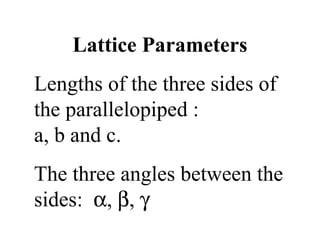
Lattice Parameters Lengths of the three sides of the parallelopiped :  a, b and c. The three angles between the sides:   ,   ,  
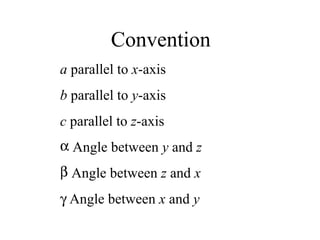
Convention a  parallel to  x -axis b  parallel to  y -axis c  parallel to  z -axis Angle between  y  and  z Angle between  z  and  x    Angle between  x  and  y
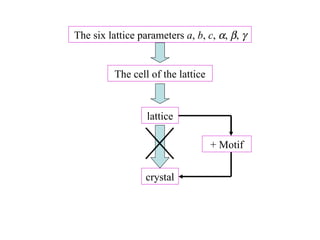
The six lattice parameters  a ,  b ,  c ,   ,   ,   The cell of the lattice lattice crystal + Motif
 
In order to define translations in 3-d space, we need 3 non-coplanar vectors Conventionally, the fundamental translation vector is taken from one lattice point to the next in the chosen direction
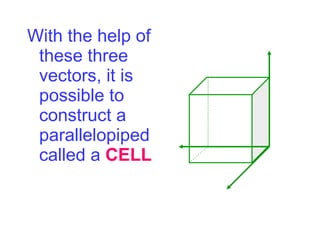
With the help of these three vectors, it is possible to construct a parallelopiped called a   CELL
The smallest cell with lattice points at its eight corners has effectively only one lattice point in the volume of the cell. Such a cell is called   PRIMITIVE CELL
Bravais  Space Lattices Conventionally, the finite representation of space lattices is done using  unit cells  which show maximum possible symmetries with the smallest size. Symmetries: 1.Translation 2. Rotation 3. Reflection
Considering Maximum Symmetry, and Minimum Size Bravais concluded that there are only  14  possible Space Lattices   (or Unit Cells to represent them).   These belong to  7  Crystal Classes
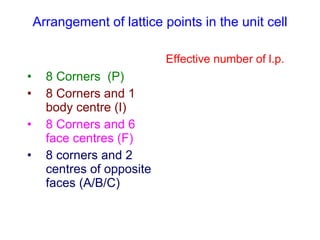
Arrangement of lattice points in the unit cell 8 Corners  (P) 8 Corners and 1 body centre (I) 8 Corners and 6 face centres (F) 8 corners and 2 centres of opposite faces (A/B/C) Effective number of l.p.
Cubic Crystals Simple Cubic (P) Body Centred Cubic (I) – BCC Face Centred Cubic (F) - FCC
Tetragonal Crystals Simple Tetragonal Body Centred Tetragonal
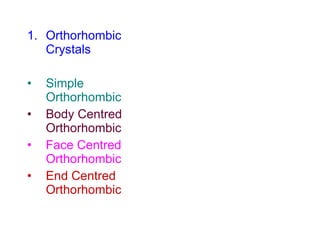
Orthorhombic Crystals Simple Orthorhombic Body Centred Orthorhombic Face Centred Orthorhombic End Centred Orthorhombic
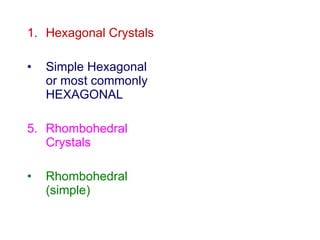
Hexagonal Crystals Simple Hexagonal or most commonly HEXAGONAL Rhombohedral Crystals Rhombohedral (simple)
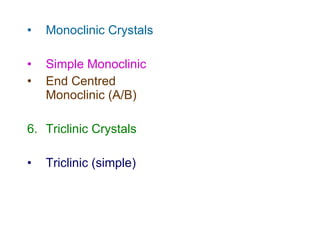
Monoclinic Crystals Simple Monoclinic End Centred Monoclinic (A/B) Triclinic Crystals Triclinic (simple)
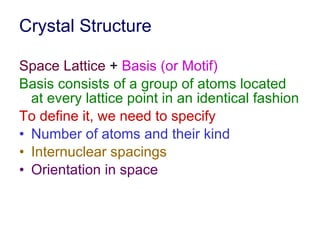
Crystal Structure Space Lattice  +  Basis (or Motif) Basis consists of a group of atoms located at every lattice point in an identical fashion To define it, we need to specify Number of atoms and their kind Internuclear spacings Orientation in space
Atoms are assumed to be  hard spheres

Space lattices

  • 1.
  • 2.
    In 1669 NicolausSteno found angles between adjacent prism faces of quartz crystal (interfacial angle), to be 120 °. In 1780 Carangeot invented the goniometer, a protactor like device used to measure interfacial angles on crystals. Law of “constancy of interfacial angels”: angles between equivalent faces of crystals of the same mineral are always the same.The law acknowledges that the size and shape of the crystal may vary.
  • 3.
    In 1784 Rene’Hauyhypothesized the existence of basic building blocks of crystals called integral molecules and argued that large crystals formed when many integral molecules bonded together.
  • 4.
    Old view Crystalsare made of small building blocks The blocks stack together in a regular way, creating the whole crystal. Each block contains a small number of atoms All building blocks have the same atomic composition The building block has shape and symmetry of the entire crystal. We now accept that: Crystals have basic building blocks called unit cells The unit cells are arranged in a pattern described by points in a lattice. The relative proportions of elements in a unit cell are given by the chemical formula of a mineral. Crystals belong to one of the seven crystal systems. Unit cells of distinct shape and symmetry characterize each crystal system. Total crystal symmetry depends on Unit cell symmetry and lattice symmetry.
  • 5.
    Crystal Geometry CrystalsLattice Lattice points, lattice translations Cell--Primitive & non primitive Lattice parameters Crystal=lattice+motif
  • 6.
  • 7.
  • 8.
    A 3D translationallyperiodic arrangement of atoms in space is called a crystal.
  • 9.
    A two-dimensional periodicpattern by a Dutch artist M.C. Escher
  • 10.
  • 11.
    A 3D translationallyperiodic arrangement of points in space is called a lattice.
  • 12.
    A 3D translationallyperiodic arrangement of atoms Crystal A 3D translationally periodic arrangement of points Lattice
  • 13.
    What is therelation between the two? Crystal = Lattice + Motif Motif or basis: an atom or a group of atoms associated with each lattice point
  • 14.
    Crystal=lattice+basis Lattice: the underlying periodicity of the crystal, Basis: atom or group of atoms associated with each lattice points Lattice: how to repeat Motif: what to repeat
  • 15.
    + Love PatternLove Lattice + Heart =
  • 16.
    Space Lattice A discrete array of points in 3-d space such that every point has identical surroundings
  • 17.
  • 18.
    Primitive cell Primitivecell Nonprimitive cell
  • 19.
    Cells A cellis a finite representation of the infinite lattice A cell is a parallelogram (2D) or a parallelopiped (3D) with lattice points at their corners. If the lattice points are only at the corners, the cell is primitive. If there are lattice points in the cell other than the corners, the cell is nonprimitive.
  • 20.
    Lattice Parameters Lengthsof the three sides of the parallelopiped : a, b and c. The three angles between the sides:  ,  , 
  • 21.
    Convention a parallel to x -axis b parallel to y -axis c parallel to z -axis Angle between y and z Angle between z and x  Angle between x and y
  • 22.
    The six latticeparameters a , b , c ,  ,  ,  The cell of the lattice lattice crystal + Motif
  • 23.
  • 24.
    In order todefine translations in 3-d space, we need 3 non-coplanar vectors Conventionally, the fundamental translation vector is taken from one lattice point to the next in the chosen direction
  • 25.
    With the helpof these three vectors, it is possible to construct a parallelopiped called a CELL
  • 26.
    The smallest cellwith lattice points at its eight corners has effectively only one lattice point in the volume of the cell. Such a cell is called PRIMITIVE CELL
  • 27.
    Bravais SpaceLattices Conventionally, the finite representation of space lattices is done using unit cells which show maximum possible symmetries with the smallest size. Symmetries: 1.Translation 2. Rotation 3. Reflection
  • 28.
    Considering Maximum Symmetry,and Minimum Size Bravais concluded that there are only 14 possible Space Lattices (or Unit Cells to represent them). These belong to 7 Crystal Classes
  • 29.
    Arrangement of latticepoints in the unit cell 8 Corners (P) 8 Corners and 1 body centre (I) 8 Corners and 6 face centres (F) 8 corners and 2 centres of opposite faces (A/B/C) Effective number of l.p.
  • 30.
    Cubic Crystals SimpleCubic (P) Body Centred Cubic (I) – BCC Face Centred Cubic (F) - FCC
  • 31.
    Tetragonal Crystals SimpleTetragonal Body Centred Tetragonal
  • 32.
    Orthorhombic Crystals SimpleOrthorhombic Body Centred Orthorhombic Face Centred Orthorhombic End Centred Orthorhombic
  • 33.
    Hexagonal Crystals SimpleHexagonal or most commonly HEXAGONAL Rhombohedral Crystals Rhombohedral (simple)
  • 34.
    Monoclinic Crystals SimpleMonoclinic End Centred Monoclinic (A/B) Triclinic Crystals Triclinic (simple)
  • 35.
    Crystal Structure SpaceLattice + Basis (or Motif) Basis consists of a group of atoms located at every lattice point in an identical fashion To define it, we need to specify Number of atoms and their kind Internuclear spacings Orientation in space
  • 36.
    Atoms are assumedto be hard spheres