Crystal structure of metals
• Atoms of a metal crystal are arranged in close-packed
structures.
• Most pure metals naturally adopt one of these three
closest packing arrangements
1)body-centered cubic (bcc),
2) face centered cubic, (fcc)
3)hexagonal close packed (hcp)
• primitive unit cell/Simple cubic unit cell -, atoms are present
at corners only. In a crystal lattice every corner is shared by eight
adjacent unit cells. Therefore, only 1/8 of an atom belong to a
particular unit cell.
• Since, there are 8 atoms present in a unit cell
• Therefore, total number of atoms in one unit cell =8×1/8=1
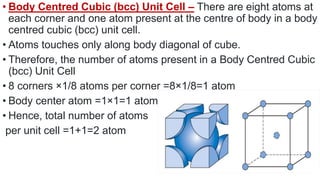
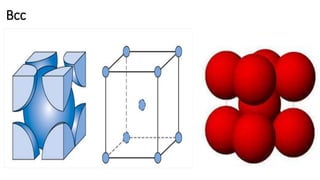
• Body Centred Cubic (bcc) Unit Cell – There are eight atoms at
each corner and one atom present at the centre of body in a body
centred cubic (bcc) unit cell.
• Atoms touches only along body diagonal of cube.
• Therefore, the number of atoms present in a Body Centred Cubic
(bcc) Unit Cell
• 8 corners ×1/8 atoms per corner =8×1/8=1 atom
• Body center atom =1×1=1 atom
• Hence, total number of atoms
per unit cell =1+1=2 atom
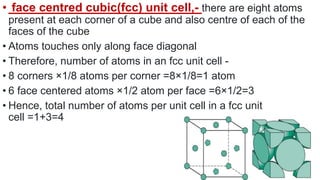
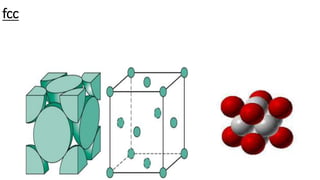
• face centred cubic(fcc) unit cell,- there are eight atoms
present at each corner of a cube and also centre of each of the
faces of the cube
• Atoms touches only along face diagonal
• Therefore, number of atoms in an fcc unit cell -
• 8 corners ×1/8 atoms per corner =8×1/8=1 atom
• 6 face centered atoms ×1/2 atom per face =6×1/2=3
• Hence, total number of atoms per unit cell in a fcc unit
cell =1+3=4
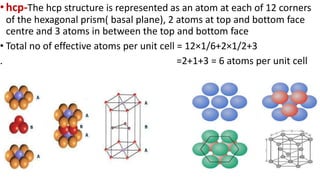
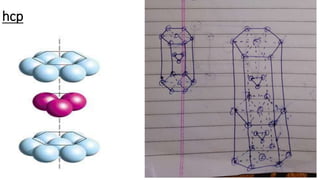
•hcp-The hcp structure is represented as an atom at each of 12 corners
of the hexagonal prism( basal plane), 2 atoms at top and bottom face
centre and 3 atoms in between the top and bottom face
• Total no of effective atoms per unit cell = 12×1/6+2×1/2+3
. =2+1+3 = 6 atoms per unit cell
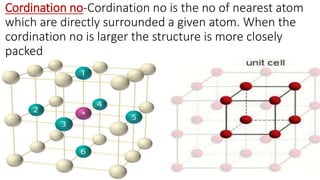
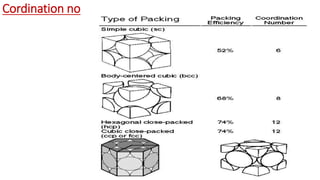
Cordination no-Cordination no is the no of nearest atom
which are directly surrounded a given atom. When the
cordination no is larger the structure is more closely
packed
Bcc
fcc
hcp
Cordination no

bcc ,fcc & hcp struc 2.pptx

  • 1.
    Crystal structure ofmetals • Atoms of a metal crystal are arranged in close-packed structures. • Most pure metals naturally adopt one of these three closest packing arrangements 1)body-centered cubic (bcc), 2) face centered cubic, (fcc) 3)hexagonal close packed (hcp)
  • 2.
    • primitive unitcell/Simple cubic unit cell -, atoms are present at corners only. In a crystal lattice every corner is shared by eight adjacent unit cells. Therefore, only 1/8 of an atom belong to a particular unit cell. • Since, there are 8 atoms present in a unit cell • Therefore, total number of atoms in one unit cell =8×1/8=1
  • 3.
    • Body CentredCubic (bcc) Unit Cell – There are eight atoms at each corner and one atom present at the centre of body in a body centred cubic (bcc) unit cell. • Atoms touches only along body diagonal of cube. • Therefore, the number of atoms present in a Body Centred Cubic (bcc) Unit Cell • 8 corners ×1/8 atoms per corner =8×1/8=1 atom • Body center atom =1×1=1 atom • Hence, total number of atoms per unit cell =1+1=2 atom
  • 4.
    • face centredcubic(fcc) unit cell,- there are eight atoms present at each corner of a cube and also centre of each of the faces of the cube • Atoms touches only along face diagonal • Therefore, number of atoms in an fcc unit cell - • 8 corners ×1/8 atoms per corner =8×1/8=1 atom • 6 face centered atoms ×1/2 atom per face =6×1/2=3 • Hence, total number of atoms per unit cell in a fcc unit cell =1+3=4
  • 5.
    •hcp-The hcp structureis represented as an atom at each of 12 corners of the hexagonal prism( basal plane), 2 atoms at top and bottom face centre and 3 atoms in between the top and bottom face • Total no of effective atoms per unit cell = 12×1/6+2×1/2+3 . =2+1+3 = 6 atoms per unit cell
  • 6.
    Cordination no-Cordination nois the no of nearest atom which are directly surrounded a given atom. When the cordination no is larger the structure is more closely packed
  • 7.
  • 8.
  • 9.
  • 10.