Engineering Material Science
Sharad Institute of Technology, College of
Engineering, Yadrav-Ichalkaranji.
By : Mr.Swapnil B Herwade
Asst. Professor, A&R Dept.
Sub Topics of Lecture:
•Unit cell and Space Lattice
•Parameters of Unit Cell
•Crystal Structure
•Types of Crystal Structure-
1. Simple Cubic Structure(SC)
2. Body Centred Cubic Structure(BCC)
3. Face Centred Cubic Structure(FCC)
4. Hexagonal Close Packed Structure(HCP)
•Average number of atoms per unit cell (Nav)
•Packing Efficiency or Atomic Packing Factor(APF)
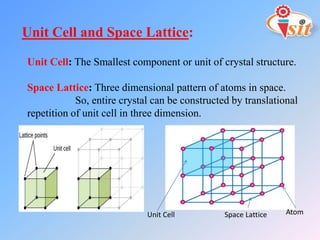
Unit Cell and Space Lattice:
Unit Cell: The Smallest component or unit of crystal structure.
Space Lattice: Three dimensional pattern of atoms in space.
So, entire crystal can be constructed by translational
repetition of unit cell in three dimension.
Unit Cell Space Lattice Atom
•If each atom in a lattice is replaced by a point, then each
point is called lattice point.
•Every point has identical or similar surrounding to the
other point.
•The space lattice of various materials differ in size and
shape of their unit cell
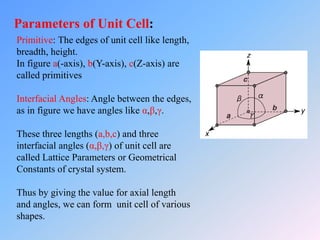
Parameters of Unit Cell:
Primitive: The edges of unit cell like length,
breadth, height.
In figure a(-axis), b(Y-axis), c(Z-axis) are
called primitives
Interfacial Angles: Angle between the edges,
as in figure we have angles like α,β,γ.
These three lengths (a,b,c) and three
interfacial angles (α,β,γ) of unit cell are
called Lattice Parameters or Geometrical
Constants of crystal system.
Thus by giving the value for axial length
and angles, we can form unit cell of various
shapes.
Crystal Structure:
• Simple Cubic Structure(SC)
• Body Centred Cubic Structure(BCC)
• Face Centred Cubic Structure(FCC)
• Hexagonal Close Packed Structure(HCP)
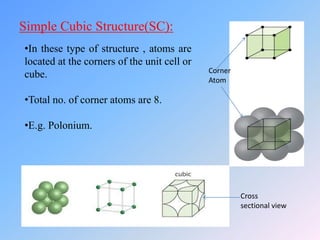
Simple Cubic Structure(SC):
•In these type of structure , atoms are
located at the corners of the unit cell or
cube.
•Total no. of corner atoms are 8.
•E.g. Polonium.
Corner
Atom
Cross
sectional view
Body Centred Cubic Structure(BCC):
•In this type of structure, atoms are located at
the corners of the unit cell or cube and one
atom at its centre.
•Total corner Atoms= 08
•Total Body centre atom= 01
•E.g. Lithium, Sodium, Potassium, tungsten,
Molybdenum etc.
Corner Atom
Body Center Atom
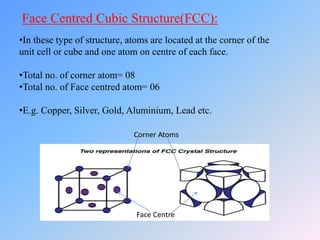
Face Centred Cubic Structure(FCC):
•In these type of structure, atoms are located at the corner of the
unit cell or cube and one atom on centre of each face.
•Total no. of corner atom= 08
•Total no. of Face centred atom= 06
•E.g. Copper, Silver, Gold, Aluminium, Lead etc.
Corner Atoms
Face Centre
Hexagonal Close Packed Structure(HCP):
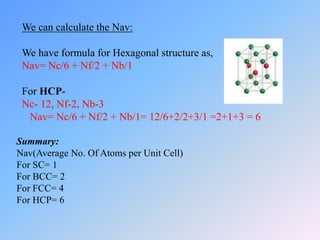
•In this type of structure atom is placed at
twelve corner of hexagonal cell, one atom at
centre of each hexagonal faces and three atom in
the body of the unit cell.
•Total Corner Atoms = 12
•Total Face centre atom= 02
•Total body centre atom= 03
•E.g. Zinc, Magnesium, Lithium, Beryllium etc.
Face Center
Corner Atom
Body center
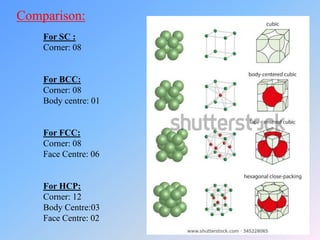
Comparison:
For SC :
Corner: 08
For BCC:
Corner: 08
Body centre: 01
For FCC:
Corner: 08
Face Centre: 06
For HCP:
Corner: 12
Body Centre:03
Face Centre: 02
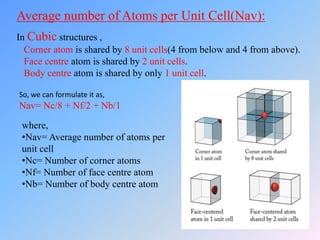
Average number of Atoms per Unit Cell(Nav):
In Cubic structures ,
Corner atom is shared by 8 unit cells(4 from below and 4 from above).
Face centre atom is shared by 2 unit cells.
Body centre atom is shared by only 1 unit cell.
So, we can formulate it as,
Nav= Nc/8 + Nf/2 + Nb/1
where,
•Nav= Average number of atoms per
unit cell
•Nc= Number of corner atoms
•Nf= Number of face centre atom
•Nb= Number of body centre atom
SITP, Yadrav-Ichalkaranji.
For Hexagonal structure,
Corner atom is shared by 6 unit cells(3 from below and 3 from above).
Face centre atom is shared by 2 unit cells.
Body centre atom is shared by only 1 unit cell.
So, we can formulate it as,
Nav= Nc/6 + Nf/2 + Nb/1
where,
•Nav= Average number of atoms
per unit cell
•Nc= Number of corner atoms
•Nf= Number of face centre atom
•Nb= Number of body centre atom
We can calculate the Nav:
We have formula for cubic structure as,
Nav= Nc/8 + Nf/2 + Nb/1
For SC-
Nc- 8, Nf-0, Nb-0
Nav= Nc/8 + Nf/2 + Nb/1= 8/8+0/2+0/1 =1+0+0 = 1
For BCC-
Nc- 8, Nf-0, Nb-1
Nav= Nc/8 + Nf/2 + Nb/1= 8/8+0/2+1/1 =1+0+1 = 2
For FCC-
Nc- 8, Nf-6, Nb-00
Nav= Nc/8 + Nf/2 + Nb/1= 8/8+6/2+0/1 =1+3+0 = 4
We can calculate the Nav:
We have formula for Hexagonal structure as,
Nav= Nc/6 + Nf/2 + Nb/1
For HCP-
Nc- 12, Nf-2, Nb-3
Nav= Nc/6 + Nf/2 + Nb/1= 12/6+2/2+3/1 =2+1+3 = 6
Summary:
Nav(Average No. Of Atoms per Unit Cell)
For SC= 1
For BCC= 2
For FCC= 4
For HCP= 6
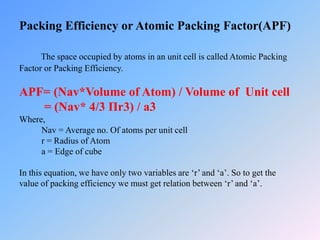
Packing Efficiency or Atomic Packing Factor(APF)
The space occupied by atoms in an unit cell is called Atomic Packing
Factor or Packing Efficiency.
APF= (Nav*Volume of Atom) / Volume of Unit cell
= (Nav* 4/3 Πr3) / a3
Where,
Nav = Average no. Of atoms per unit cell
r = Radius of Atom
a = Edge of cube
In this equation, we have only two variables are ‘r’ and ‘a’. So to get the
value of packing efficiency we must get relation between ‘r’ and ‘a’.
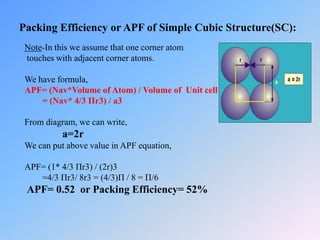
Packing Efficiency or APF of Simple Cubic Structure(SC):
Note-In this we assume that one corner atom
touches with adjacent corner atoms.
We have formula,
APF= (Nav*Volume of Atom) / Volume of Unit cell
= (Nav* 4/3 Πr3) / a3
From diagram, we can write,
a=2r
We can put above value in APF equation,
APF= (1* 4/3 Πr3) / (2r)3
=4/3 Πr3/ 8r3 = (4/3)Π / 8 = Π/6
APF= 0.52 or Packing Efficiency= 52%
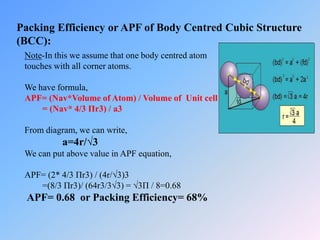
Packing Efficiency or APF of Body Centred Cubic Structure
(BCC):
Note-In this we assume that one body centred atom
touches with all corner atoms.
We have formula,
APF= (Nav*Volume of Atom) / Volume of Unit cell
= (Nav* 4/3 Πr3) / a3
From diagram, we can write,
a=4r/√3
We can put above value in APF equation,
APF= (2* 4/3 Πr3) / (4r/√3)3
=(8/3 Πr3)/ (64r3/3√3) = √3Π / 8=0.68
APF= 0.68 or Packing Efficiency= 68%
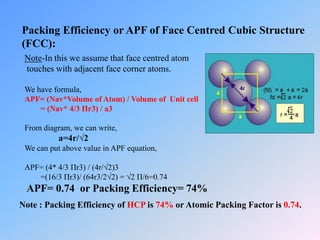
Packing Efficiency or APF of Face Centred Cubic Structure
(FCC):
Note-In this we assume that face centred atom
touches with adjacent face corner atoms.
We have formula,
APF= (Nav*Volume of Atom) / Volume of Unit cell
= (Nav* 4/3 Πr3) / a3
From diagram, we can write,
a=4r/√2
We can put above value in APF equation,
APF= (4* 4/3 Πr3) / (4r/√2)3
=(16/3 Πr3)/ (64r3/2√2) = √2 Π/6=0.74
APF= 0.74 or Packing Efficiency= 74%
Note : Packing Efficiency of HCP is 74% or Atomic Packing Factor is 0.74.
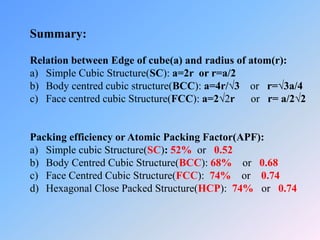
Summary:
Relation between Edge of cube(a) and radius of atom(r):
a) Simple Cubic Structure(SC): a=2r or r=a/2
b) Body centred cubic structure(BCC): a=4r/√3 or r=√3a/4
c) Face centred cubic Structure(FCC): a=2√2r or r= a/2√2
Packing efficiency or Atomic Packing Factor(APF):
a) Simple cubic Structure(SC): 52% or 0.52
b) Body Centred Cubic Structure(BCC): 68% or 0.68
c) Face Centred Cubic Structure(FCC): 74% or 0.74
d) Hexagonal Close Packed Structure(HCP): 74% or 0.74
Overall Summary
For SC :
Nc=08,Nb=00,Nf=00
Nav= 01
APF= 0.52 or 52%
For BCC:
Nc=08,Nb=01,Nf=00
Nav=2
APF= 0.68 or 68%
For FCC:
Nc=08,Nb=00,Nf=06
Nav=4
APF= 0.74 or 74%
For HCP:
Nc=12,Nb=3,Nf=2
Nav=6
APF= 0.74 or 74%
Crystal Structure.pptx

Crystal Structure.pptx

  • 1.
    Engineering Material Science SharadInstitute of Technology, College of Engineering, Yadrav-Ichalkaranji. By : Mr.Swapnil B Herwade Asst. Professor, A&R Dept.
  • 2.
    Sub Topics ofLecture: •Unit cell and Space Lattice •Parameters of Unit Cell •Crystal Structure •Types of Crystal Structure- 1. Simple Cubic Structure(SC) 2. Body Centred Cubic Structure(BCC) 3. Face Centred Cubic Structure(FCC) 4. Hexagonal Close Packed Structure(HCP) •Average number of atoms per unit cell (Nav) •Packing Efficiency or Atomic Packing Factor(APF)
  • 3.
    Unit Cell andSpace Lattice: Unit Cell: The Smallest component or unit of crystal structure. Space Lattice: Three dimensional pattern of atoms in space. So, entire crystal can be constructed by translational repetition of unit cell in three dimension. Unit Cell Space Lattice Atom
  • 4.
    •If each atomin a lattice is replaced by a point, then each point is called lattice point. •Every point has identical or similar surrounding to the other point. •The space lattice of various materials differ in size and shape of their unit cell
  • 5.
    Parameters of UnitCell: Primitive: The edges of unit cell like length, breadth, height. In figure a(-axis), b(Y-axis), c(Z-axis) are called primitives Interfacial Angles: Angle between the edges, as in figure we have angles like α,β,γ. These three lengths (a,b,c) and three interfacial angles (α,β,γ) of unit cell are called Lattice Parameters or Geometrical Constants of crystal system. Thus by giving the value for axial length and angles, we can form unit cell of various shapes.
  • 6.
    Crystal Structure: • SimpleCubic Structure(SC) • Body Centred Cubic Structure(BCC) • Face Centred Cubic Structure(FCC) • Hexagonal Close Packed Structure(HCP)
  • 7.
    Simple Cubic Structure(SC): •Inthese type of structure , atoms are located at the corners of the unit cell or cube. •Total no. of corner atoms are 8. •E.g. Polonium. Corner Atom Cross sectional view
  • 8.
    Body Centred CubicStructure(BCC): •In this type of structure, atoms are located at the corners of the unit cell or cube and one atom at its centre. •Total corner Atoms= 08 •Total Body centre atom= 01 •E.g. Lithium, Sodium, Potassium, tungsten, Molybdenum etc. Corner Atom Body Center Atom
  • 9.
    Face Centred CubicStructure(FCC): •In these type of structure, atoms are located at the corner of the unit cell or cube and one atom on centre of each face. •Total no. of corner atom= 08 •Total no. of Face centred atom= 06 •E.g. Copper, Silver, Gold, Aluminium, Lead etc. Corner Atoms Face Centre
  • 10.
    Hexagonal Close PackedStructure(HCP): •In this type of structure atom is placed at twelve corner of hexagonal cell, one atom at centre of each hexagonal faces and three atom in the body of the unit cell. •Total Corner Atoms = 12 •Total Face centre atom= 02 •Total body centre atom= 03 •E.g. Zinc, Magnesium, Lithium, Beryllium etc. Face Center Corner Atom Body center
  • 11.
    Comparison: For SC : Corner:08 For BCC: Corner: 08 Body centre: 01 For FCC: Corner: 08 Face Centre: 06 For HCP: Corner: 12 Body Centre:03 Face Centre: 02
  • 12.
    Average number ofAtoms per Unit Cell(Nav): In Cubic structures , Corner atom is shared by 8 unit cells(4 from below and 4 from above). Face centre atom is shared by 2 unit cells. Body centre atom is shared by only 1 unit cell. So, we can formulate it as, Nav= Nc/8 + Nf/2 + Nb/1 where, •Nav= Average number of atoms per unit cell •Nc= Number of corner atoms •Nf= Number of face centre atom •Nb= Number of body centre atom
  • 13.
    SITP, Yadrav-Ichalkaranji. For Hexagonalstructure, Corner atom is shared by 6 unit cells(3 from below and 3 from above). Face centre atom is shared by 2 unit cells. Body centre atom is shared by only 1 unit cell. So, we can formulate it as, Nav= Nc/6 + Nf/2 + Nb/1 where, •Nav= Average number of atoms per unit cell •Nc= Number of corner atoms •Nf= Number of face centre atom •Nb= Number of body centre atom
  • 14.
    We can calculatethe Nav: We have formula for cubic structure as, Nav= Nc/8 + Nf/2 + Nb/1 For SC- Nc- 8, Nf-0, Nb-0 Nav= Nc/8 + Nf/2 + Nb/1= 8/8+0/2+0/1 =1+0+0 = 1 For BCC- Nc- 8, Nf-0, Nb-1 Nav= Nc/8 + Nf/2 + Nb/1= 8/8+0/2+1/1 =1+0+1 = 2 For FCC- Nc- 8, Nf-6, Nb-00 Nav= Nc/8 + Nf/2 + Nb/1= 8/8+6/2+0/1 =1+3+0 = 4
  • 15.
    We can calculatethe Nav: We have formula for Hexagonal structure as, Nav= Nc/6 + Nf/2 + Nb/1 For HCP- Nc- 12, Nf-2, Nb-3 Nav= Nc/6 + Nf/2 + Nb/1= 12/6+2/2+3/1 =2+1+3 = 6 Summary: Nav(Average No. Of Atoms per Unit Cell) For SC= 1 For BCC= 2 For FCC= 4 For HCP= 6
  • 16.
    Packing Efficiency orAtomic Packing Factor(APF) The space occupied by atoms in an unit cell is called Atomic Packing Factor or Packing Efficiency. APF= (Nav*Volume of Atom) / Volume of Unit cell = (Nav* 4/3 Πr3) / a3 Where, Nav = Average no. Of atoms per unit cell r = Radius of Atom a = Edge of cube In this equation, we have only two variables are ‘r’ and ‘a’. So to get the value of packing efficiency we must get relation between ‘r’ and ‘a’.
  • 17.
    Packing Efficiency orAPF of Simple Cubic Structure(SC): Note-In this we assume that one corner atom touches with adjacent corner atoms. We have formula, APF= (Nav*Volume of Atom) / Volume of Unit cell = (Nav* 4/3 Πr3) / a3 From diagram, we can write, a=2r We can put above value in APF equation, APF= (1* 4/3 Πr3) / (2r)3 =4/3 Πr3/ 8r3 = (4/3)Π / 8 = Π/6 APF= 0.52 or Packing Efficiency= 52%
  • 18.
    Packing Efficiency orAPF of Body Centred Cubic Structure (BCC): Note-In this we assume that one body centred atom touches with all corner atoms. We have formula, APF= (Nav*Volume of Atom) / Volume of Unit cell = (Nav* 4/3 Πr3) / a3 From diagram, we can write, a=4r/√3 We can put above value in APF equation, APF= (2* 4/3 Πr3) / (4r/√3)3 =(8/3 Πr3)/ (64r3/3√3) = √3Π / 8=0.68 APF= 0.68 or Packing Efficiency= 68%
  • 19.
    Packing Efficiency orAPF of Face Centred Cubic Structure (FCC): Note-In this we assume that face centred atom touches with adjacent face corner atoms. We have formula, APF= (Nav*Volume of Atom) / Volume of Unit cell = (Nav* 4/3 Πr3) / a3 From diagram, we can write, a=4r/√2 We can put above value in APF equation, APF= (4* 4/3 Πr3) / (4r/√2)3 =(16/3 Πr3)/ (64r3/2√2) = √2 Π/6=0.74 APF= 0.74 or Packing Efficiency= 74% Note : Packing Efficiency of HCP is 74% or Atomic Packing Factor is 0.74.
  • 20.
    Summary: Relation between Edgeof cube(a) and radius of atom(r): a) Simple Cubic Structure(SC): a=2r or r=a/2 b) Body centred cubic structure(BCC): a=4r/√3 or r=√3a/4 c) Face centred cubic Structure(FCC): a=2√2r or r= a/2√2 Packing efficiency or Atomic Packing Factor(APF): a) Simple cubic Structure(SC): 52% or 0.52 b) Body Centred Cubic Structure(BCC): 68% or 0.68 c) Face Centred Cubic Structure(FCC): 74% or 0.74 d) Hexagonal Close Packed Structure(HCP): 74% or 0.74
  • 21.
    Overall Summary For SC: Nc=08,Nb=00,Nf=00 Nav= 01 APF= 0.52 or 52% For BCC: Nc=08,Nb=01,Nf=00 Nav=2 APF= 0.68 or 68% For FCC: Nc=08,Nb=00,Nf=06 Nav=4 APF= 0.74 or 74% For HCP: Nc=12,Nb=3,Nf=2 Nav=6 APF= 0.74 or 74%