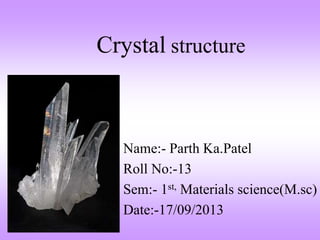
Crystal structure 
Name:- Parth Ka.Patel 
Roll No:-13 
Sem:- 1st, Materials science(M.sc) 
Date:-17/09/2013
Outline 
• Lattice 
• Basis 
• Crystal Structure 
– Poly Crystal 
– Single Crystal 
• Unit Cell 
• Cubic Crystal System 
– Simple Cubic(SC) , 
– Face Centered Cubic(FCC) , 
– Body Centered Cubic(BCC) 
- The seven crystal system 
- Hexagonal close pack unit cell(HCP) 
-References
Crystal structure = Lattice + Basis
Basic Of Crystal Structure 
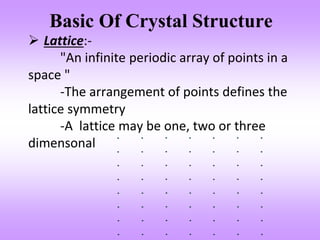
 Lattice:- 
"An infinite periodic array of points in a 
space " 
-The arrangement of points defines the 
lattice symmetry 
-A lattice may be one, two or three 
dimensonal
Cont… 
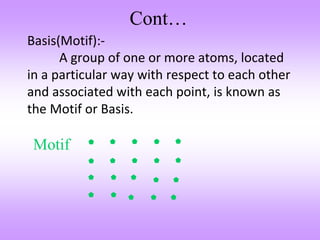
Basis(Motif):- 
A group of one or more atoms, located 
in a particular way with respect to each other 
and associated with each point, is known as 
the Motif or Basis. 
Motif      
     
   
  
 
  
 
Crystal structure 
       
       
       
       
       
       
       
      
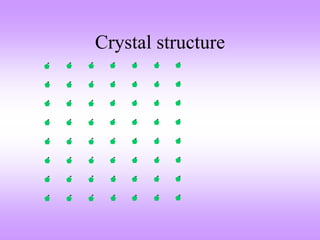
-so we obtain a crystal structure by adding 
the lattice and basis 
- So we can say that, When an atom or 
identical group of atoms is attached to every 
lattice point, we obtain a crystal structure.
• Crystals are classified into two types 
1. Poly crystal 
2. Single crystal 
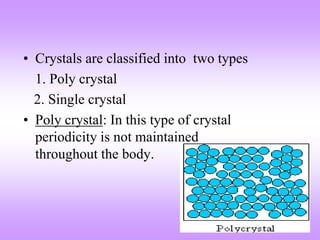
• Poly crystal: In this type of crystal 
periodicity is not maintained 
throughout the body.
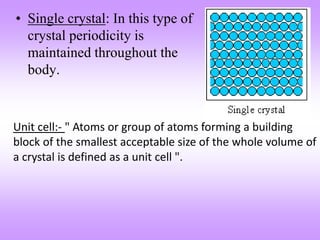
• Single crystal: In this type of 
crystal periodicity is 
maintained throughout the 
body. 
Unit cell:- " Atoms or group of atoms forming a building 
block of the smallest acceptable size of the whole volume of 
a crystal is defined as a unit cell ".
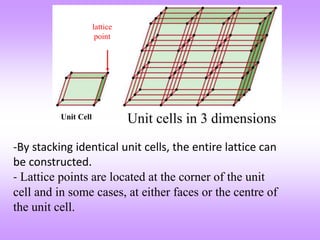
lattice 
point 
Unit Cell Unit cells in 3 dimensions 
-By stacking identical unit cells, the entire lattice can 
be constructed. 
- Lattice points are located at the corner of the unit 
cell and in some cases, at either faces or the centre of 
the unit cell.
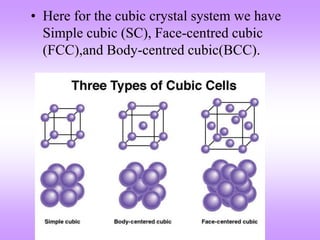
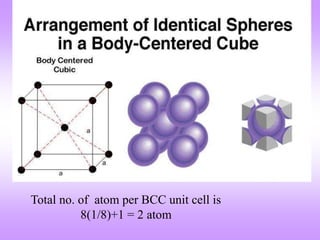
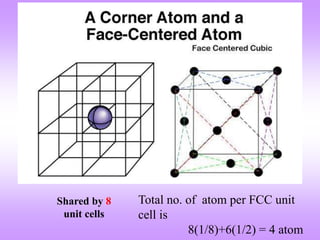
• Here for the cubic crystal system we have 
Simple cubic (SC), Face-centred cubic 
(FCC),and Body-centred cubic(BCC).
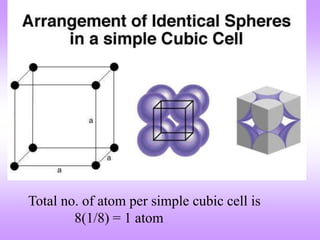
Total no. of atom per simple cubic cell is 
8(1/8) = 1 atom
Total no. of atom per BCC unit cell is 
8(1/8)+1 = 2 atom
Shared by 8 
unit cells 
Total no. of atom per FCC unit 
cell is 
8(1/8)+6(1/2) = 4 atom
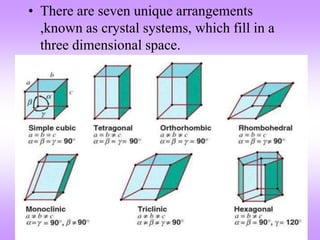
• There are seven unique arrangements 
,known as crystal systems, which fill in a 
three dimensional space.
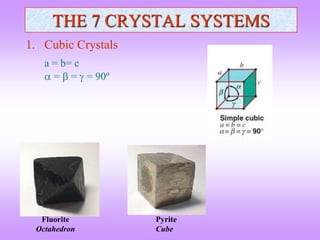
THE 7 CRYSTAL SYSTEMS 
1. Cubic Crystals 
a = b= c 
 =  =  = 90º 
Fluorite 
Octahedron 
Pyrite 
Cube
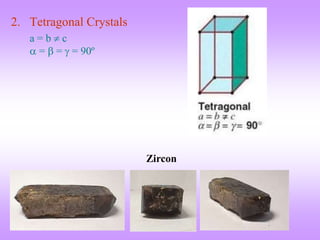
2. Tetragonal Crystals 
a = b  c 
 =  =  = 90º 
Zircon
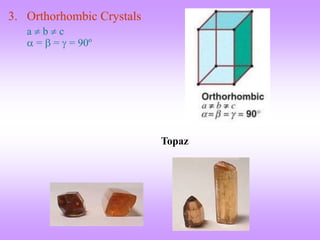
3. Orthorhombic Crystals 
a  b  c 
 =  =  = 90º 
Topaz
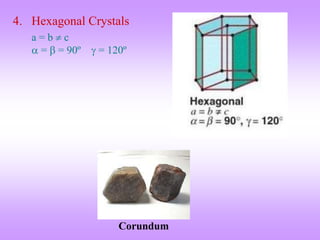
4. Hexagonal Crystals 
a = b  c 
 =  = 90º  = 120º 
Corundum
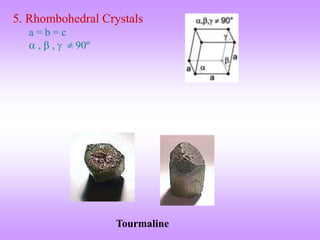
5. Rhombohedral Crystals 
a = b = c 
 ,  ,   90º 
Tourmaline
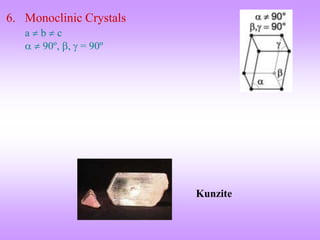
6. Monoclinic Crystals 
a  b  c 
  90º, ,  = 90º 
Kunzite
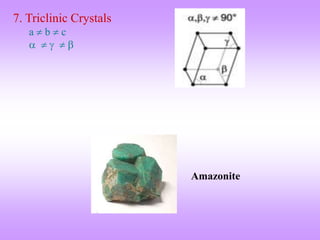
7. Triclinic Crystals 
a  b  c 
     
Amazonite
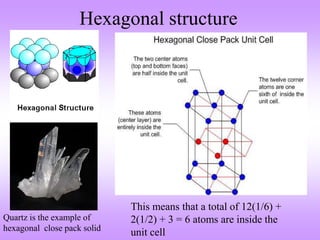
Hexagonal structure 
Quartz is the example of 
hexagonal close pack solid 
This means that a total of 12(1/6) + 
2(1/2) + 3 = 6 atoms are inside the 
unit cell
• References 
• The science and engineering of Materials 
By Donald R. Askeland 
Pradeep P.Phule 
Forth Edition 
Publisher : Bill stenquist 
Page no. 76 to 84 
- Google images (Crystal structure)
Crystal structure

Crystal structure

  • 1.
    Crystal structure Name:-Parth Ka.Patel Roll No:-13 Sem:- 1st, Materials science(M.sc) Date:-17/09/2013
  • 2.
    Outline • Lattice • Basis • Crystal Structure – Poly Crystal – Single Crystal • Unit Cell • Cubic Crystal System – Simple Cubic(SC) , – Face Centered Cubic(FCC) , – Body Centered Cubic(BCC) - The seven crystal system - Hexagonal close pack unit cell(HCP) -References
  • 3.
    Crystal structure =Lattice + Basis
  • 4.
    Basic Of CrystalStructure  Lattice:- "An infinite periodic array of points in a space " -The arrangement of points defines the lattice symmetry -A lattice may be one, two or three dimensonal
  • 5.
    Cont… Basis(Motif):- Agroup of one or more atoms, located in a particular way with respect to each other and associated with each point, is known as the Motif or Basis. Motif                    
  • 6.
    Crystal structure                                                       
  • 7.
    -so we obtaina crystal structure by adding the lattice and basis - So we can say that, When an atom or identical group of atoms is attached to every lattice point, we obtain a crystal structure.
  • 8.
    • Crystals areclassified into two types 1. Poly crystal 2. Single crystal • Poly crystal: In this type of crystal periodicity is not maintained throughout the body.
  • 9.
    • Single crystal:In this type of crystal periodicity is maintained throughout the body. Unit cell:- " Atoms or group of atoms forming a building block of the smallest acceptable size of the whole volume of a crystal is defined as a unit cell ".
  • 10.
    lattice point UnitCell Unit cells in 3 dimensions -By stacking identical unit cells, the entire lattice can be constructed. - Lattice points are located at the corner of the unit cell and in some cases, at either faces or the centre of the unit cell.
  • 11.
    • Here forthe cubic crystal system we have Simple cubic (SC), Face-centred cubic (FCC),and Body-centred cubic(BCC).
  • 12.
    Total no. ofatom per simple cubic cell is 8(1/8) = 1 atom
  • 13.
    Total no. ofatom per BCC unit cell is 8(1/8)+1 = 2 atom
  • 14.
    Shared by 8 unit cells Total no. of atom per FCC unit cell is 8(1/8)+6(1/2) = 4 atom
  • 15.
    • There areseven unique arrangements ,known as crystal systems, which fill in a three dimensional space.
  • 16.
    THE 7 CRYSTALSYSTEMS 1. Cubic Crystals a = b= c  =  =  = 90º Fluorite Octahedron Pyrite Cube
  • 17.
    2. Tetragonal Crystals a = b  c  =  =  = 90º Zircon
  • 18.
    3. Orthorhombic Crystals a  b  c  =  =  = 90º Topaz
  • 19.
    4. Hexagonal Crystals a = b  c  =  = 90º  = 120º Corundum
  • 20.
    5. Rhombohedral Crystals a = b = c  ,  ,   90º Tourmaline
  • 21.
    6. Monoclinic Crystals a  b  c   90º, ,  = 90º Kunzite
  • 22.
    7. Triclinic Crystals a  b  c      Amazonite
  • 23.
    Hexagonal structure Quartzis the example of hexagonal close pack solid This means that a total of 12(1/6) + 2(1/2) + 3 = 6 atoms are inside the unit cell
  • 24.
    • References •The science and engineering of Materials By Donald R. Askeland Pradeep P.Phule Forth Edition Publisher : Bill stenquist Page no. 76 to 84 - Google images (Crystal structure)