Lab# 02
Basic Introduction to
Crystallography
By Yousaf Haroon
Lab Engineer FMCE
Contents of lab 2
• Crystallography and crystal systems.
• Lattice and motif
• Unit cell
• Coordination number
• How to find CN of SC,FCC and BCC.
• Number of atoms in a unit cell ( SC,FCC,BCC)
• Atomic Packing Factor (SC, FCC,BCC)
The branch of science concerned with the structure and
properties of crystals.
Crystal structure
The atomic arrangement inside a crystalline
material is called crystal structure.
Why do we study
crystal structure?
1. Properties
2. Applications
Similar materials having different
properties and applications?
Fundamental concepts
Crystalline/Non crystalline materials
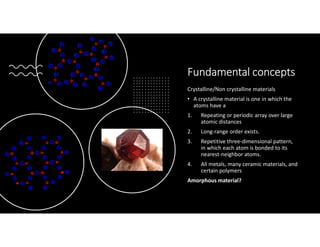
• A crystalline material is one in which the
atoms have a
1. Repeating or periodic array over large
atomic distances
2. Long-range order exists.
3. Repetitive three-dimensional pattern,
in which each atom is bonded to its
nearest-neighbor atoms.
4. All metals, many ceramic materials, and
certain polymers
Amorphous material?
Hard sphere model
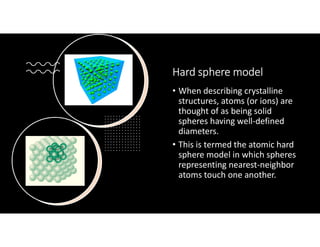
• When describing crystalline
structures, atoms (or ions) are
thought of as being solid
spheres having well-defined
diameters.
• This is termed the atomic hard
sphere model in which spheres
representing nearest-neighbor
atoms touch one another.
Lattice and motif
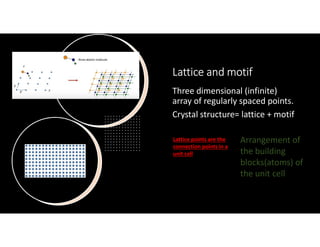
Three dimensional (infinite)
array of regularly spaced points.
Crystal structure= lattice + motif
Lattice points are the
connection points in a
unit cell
Arrangement of
the building
blocks(atoms) of
the unit cell
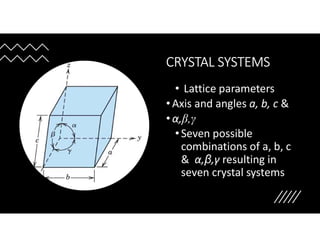
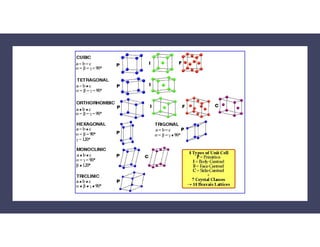
CRYSTAL SYSTEMS
• Lattice parameters
•Axis and angles a, b, c &
•α,ꞵ,γ
•Seven possible
combinations of a, b, c
& α,ꞵ,γ resulting in
seven crystal systems
Unit cell
•Small repeating
entities
•Unit cells for most
crystal structures are
parallelepipeds or
prisms having three
sets of parallel faces.
Coordinate number
and point
coordinates
• Number of nearest-
neighbors or touching
atoms
• The position of any point
located within a unit cell
may be specified in terms
of its coordinates as
fractional multiples of the
unit cell edge lengths (i.e.,
in terms of a, b, and c)
Number of atoms in a unit cell
The Crystal Structure of Metals
Metals usually have crystal
structures:
1. Simple cubic
2. Body centered cubic
3. Face centered cubic
15
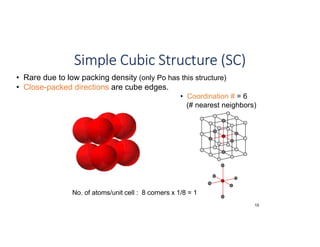
• Rare due to low packing density (only Po has this structure)
• Close-packed directions are cube edges.
• Coordination # = 6
(# nearest neighbors)
Simple Cubic Structure (SC)
No. of atoms/unit cell : 8 corners x 1/8 = 1
16
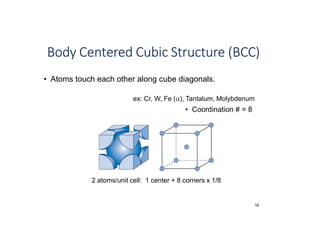
• Coordination # = 8
• Atoms touch each other along cube diagonals.
Body Centered Cubic Structure (BCC)
ex: Cr, W, Fe (), Tantalum, Molybdenum
2 atoms/unit cell: 1 center + 8 corners x 1/8
17
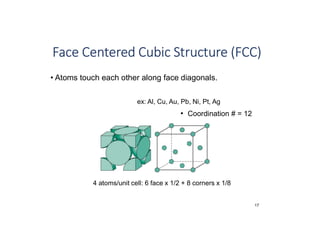
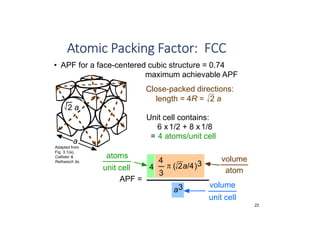
• Coordination # = 12
• Atoms touch each other along face diagonals.
Face Centered Cubic Structure (FCC)
ex: Al, Cu, Au, Pb, Ni, Pt, Ag
4 atoms/unit cell: 6 face x 1/2 + 8 corners x 1/8
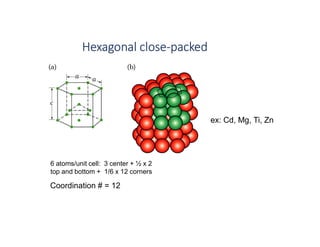
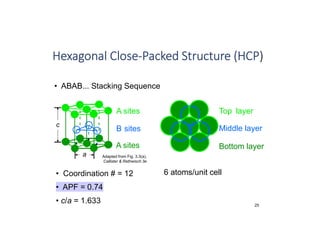
Hexagonal close-packed
Coordination # = 12
ex: Cd, Mg, Ti, Zn
6 atoms/unit cell: 3 center + ½ x 2
top and bottom + 1/6 x 12 corners
Atomic packing factor
•How closely atoms are packed in a unit cell.
•How much portion an atom occupy.
• The APF is the sum of the sphere volumes of all atoms
within a unit cell!
20
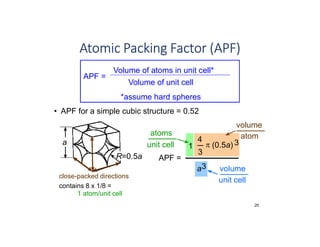
• APF for a simple cubic structure = 0.52
APF =
a3
4
3
p (0.5a) 3
1
atoms
unit cell
atom
volume
unit cell
volume
Atomic Packing Factor (APF)
APF =
Volume of atoms in unit cell*
Volume of unit cell
*assume hard spheres
close-packed directions
a
R=0.5a
contains 8 x 1/8 =
1 atom/unit cell
21
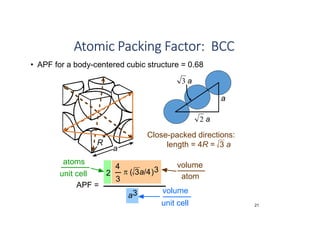
Atomic Packing Factor: BCC
a
APF =
4
3
p ( 3a/4)3
2
atoms
unit cell atom
volume
a3
unit cell
volume
length = 4R =
Close-packed directions:
3 a
• APF for a body-centered cubic structure = 0.68
a
R
a
2
a
3
22
• APF for a face-centered cubic structure = 0.74
Atomic Packing Factor: FCC
maximum achievable APF
APF =
4
3
p ( 2a/4)3
4
atoms
unit cell atom
volume
a3
unit cell
volume
Close-packed directions:
length = 4R = 2 a
Unit cell contains:
6 x1/2 + 8 x1/8
= 4 atoms/unit cell
a
2 a
Adapted from
Fig. 3.1(a),
Callister &
Rethwisch 3e.
Stacking sequences
24
A sites
B B
B
B
B
B B
C sites
C C
C
A
B
B sites
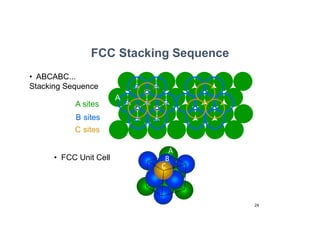
• ABCABC...
Stacking Sequence
• FCC Unit Cell
FCC Stacking Sequence
B B
B
B
B
B B
B sites
C C
C
A
C C
C
A
A
B
C
25
• Coordination # = 12
• ABAB... Stacking Sequence
• APF = 0.74
Adapted from Fig. 3.3(a),
Callister & Rethwisch 3e.
Hexagonal Close-Packed Structure (HCP)
6 atoms/unit cell
• c/a = 1.633
c
a
A sites
B sites
A sites Bottom layer
Middle layer
Top layer

Lab-2 Crystallography in Materials Science

  • 1.
    Lab# 02 Basic Introductionto Crystallography By Yousaf Haroon Lab Engineer FMCE
  • 2.
    Contents of lab2 • Crystallography and crystal systems. • Lattice and motif • Unit cell • Coordination number • How to find CN of SC,FCC and BCC. • Number of atoms in a unit cell ( SC,FCC,BCC) • Atomic Packing Factor (SC, FCC,BCC)
  • 3.
    The branch ofscience concerned with the structure and properties of crystals.
  • 4.
    Crystal structure The atomicarrangement inside a crystalline material is called crystal structure.
  • 5.
    Why do westudy crystal structure? 1. Properties 2. Applications Similar materials having different properties and applications?
  • 6.
    Fundamental concepts Crystalline/Non crystallinematerials • A crystalline material is one in which the atoms have a 1. Repeating or periodic array over large atomic distances 2. Long-range order exists. 3. Repetitive three-dimensional pattern, in which each atom is bonded to its nearest-neighbor atoms. 4. All metals, many ceramic materials, and certain polymers Amorphous material?
  • 7.
    Hard sphere model •When describing crystalline structures, atoms (or ions) are thought of as being solid spheres having well-defined diameters. • This is termed the atomic hard sphere model in which spheres representing nearest-neighbor atoms touch one another.
  • 8.
    Lattice and motif Threedimensional (infinite) array of regularly spaced points. Crystal structure= lattice + motif Lattice points are the connection points in a unit cell Arrangement of the building blocks(atoms) of the unit cell
  • 9.
    CRYSTAL SYSTEMS • Latticeparameters •Axis and angles a, b, c & •α,ꞵ,γ •Seven possible combinations of a, b, c & α,ꞵ,γ resulting in seven crystal systems
  • 11.
    Unit cell •Small repeating entities •Unitcells for most crystal structures are parallelepipeds or prisms having three sets of parallel faces.
  • 12.
    Coordinate number and point coordinates •Number of nearest- neighbors or touching atoms • The position of any point located within a unit cell may be specified in terms of its coordinates as fractional multiples of the unit cell edge lengths (i.e., in terms of a, b, and c)
  • 13.
    Number of atomsin a unit cell
  • 14.
    The Crystal Structureof Metals Metals usually have crystal structures: 1. Simple cubic 2. Body centered cubic 3. Face centered cubic
  • 15.
    15 • Rare dueto low packing density (only Po has this structure) • Close-packed directions are cube edges. • Coordination # = 6 (# nearest neighbors) Simple Cubic Structure (SC) No. of atoms/unit cell : 8 corners x 1/8 = 1
  • 16.
    16 • Coordination #= 8 • Atoms touch each other along cube diagonals. Body Centered Cubic Structure (BCC) ex: Cr, W, Fe (), Tantalum, Molybdenum 2 atoms/unit cell: 1 center + 8 corners x 1/8
  • 17.
    17 • Coordination #= 12 • Atoms touch each other along face diagonals. Face Centered Cubic Structure (FCC) ex: Al, Cu, Au, Pb, Ni, Pt, Ag 4 atoms/unit cell: 6 face x 1/2 + 8 corners x 1/8
  • 18.
    Hexagonal close-packed Coordination #= 12 ex: Cd, Mg, Ti, Zn 6 atoms/unit cell: 3 center + ½ x 2 top and bottom + 1/6 x 12 corners
  • 19.
    Atomic packing factor •Howclosely atoms are packed in a unit cell. •How much portion an atom occupy. • The APF is the sum of the sphere volumes of all atoms within a unit cell!
  • 20.
    20 • APF fora simple cubic structure = 0.52 APF = a3 4 3 p (0.5a) 3 1 atoms unit cell atom volume unit cell volume Atomic Packing Factor (APF) APF = Volume of atoms in unit cell* Volume of unit cell *assume hard spheres close-packed directions a R=0.5a contains 8 x 1/8 = 1 atom/unit cell
  • 21.
    21 Atomic Packing Factor:BCC a APF = 4 3 p ( 3a/4)3 2 atoms unit cell atom volume a3 unit cell volume length = 4R = Close-packed directions: 3 a • APF for a body-centered cubic structure = 0.68 a R a 2 a 3
  • 22.
    22 • APF fora face-centered cubic structure = 0.74 Atomic Packing Factor: FCC maximum achievable APF APF = 4 3 p ( 2a/4)3 4 atoms unit cell atom volume a3 unit cell volume Close-packed directions: length = 4R = 2 a Unit cell contains: 6 x1/2 + 8 x1/8 = 4 atoms/unit cell a 2 a Adapted from Fig. 3.1(a), Callister & Rethwisch 3e.
  • 23.
  • 24.
    24 A sites B B B B B BB C sites C C C A B B sites • ABCABC... Stacking Sequence • FCC Unit Cell FCC Stacking Sequence B B B B B B B B sites C C C A C C C A A B C
  • 25.
    25 • Coordination #= 12 • ABAB... Stacking Sequence • APF = 0.74 Adapted from Fig. 3.3(a), Callister & Rethwisch 3e. Hexagonal Close-Packed Structure (HCP) 6 atoms/unit cell • c/a = 1.633 c a A sites B sites A sites Bottom layer Middle layer Top layer