DST-SERC School on Texture and Microstructure
BASIC CRYSTALLOGRAPHY
Rajesh Prasad
Department of Applied Mechanics
Indian Institute of Technology
New Delhi 110016
rajesh@am.iitd.ac.in
2
Contents
Crystal, Lattice and Motif
Unit cells, Lattice Parameters and Projections
Miller Indices & Miller-Bravais Indices
Directions and Planes
Classification of Lattices:
7 crystal systems
14 Bravais lattices
Reciprocal lattice
3
A 3D translationaly
periodic arrangement
of atoms in space is
called a crystal.
Crystal ?
4
Lattice?
A 3D translationally
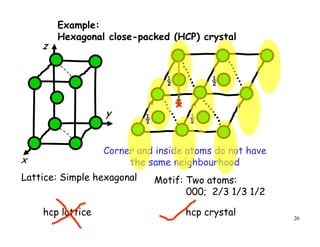
periodic arrangement
of points in space is
called a lattice.
5
A 3D
translationally
periodic
arrangement
of atoms
Crystal
A 3D
translationally
periodic
arrangement of
points
Lattice
6
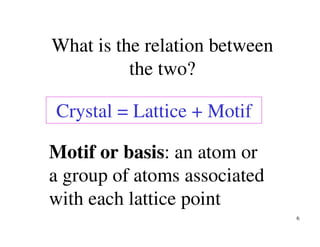
What is the relation between
the two?
Crystal = Lattice + Motif
Motif or basis: an atom or
a group of atoms associated
with each lattice point
7
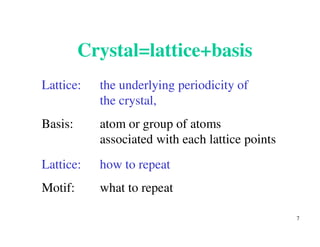
Crystal=lattice+basis
Lattice: the underlying periodicity of
the crystal,
Basis: atom or group of atoms
associated with each lattice points
Lattice: how to repeat
Motif: what to repeat
8
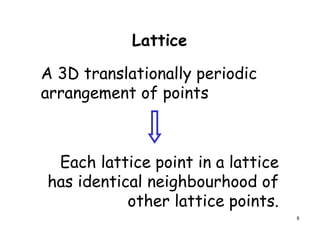
A 3D translationally periodic
arrangement of points
Each lattice point in a lattice
has identical neighbourhood of
other lattice points.
Lattice
9
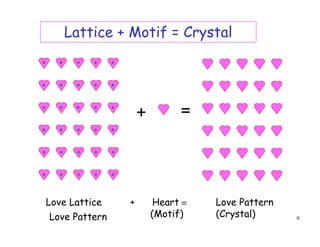
+
Love Pattern
(Crystal)
Love Lattice + Heart
(Motif)
=
=
Lattice + Motif = Crystal
Love Pattern
10
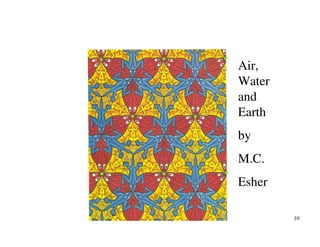
Air,
Water
and
Earth
by
M.C.
Esher
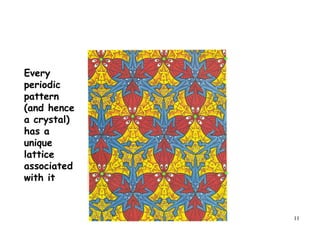
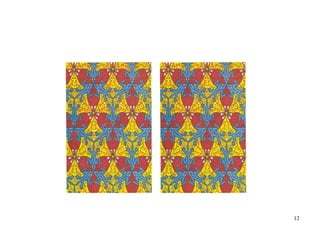
11
Every
periodic
pattern
(and hence
a crystal)
has a
unique
lattice
associated
with it
12
13
Contents
Crystal, Lattice and Motif
Unit cells, Lattice Parameters and Projections
Miller Indices & Miller-Bravais Indices
Directions and Planes
Classification of Lattices:
7 crystal systems
14 Bravais lattices
Reciprocal lattice
14
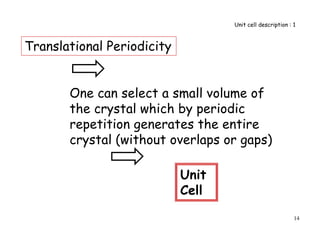
Translational Periodicity
One can select a small volume of
the crystal which by periodic
repetition generates the entire
crystal (without overlaps or gaps)
Unit
Cell
Unit cell description : 1
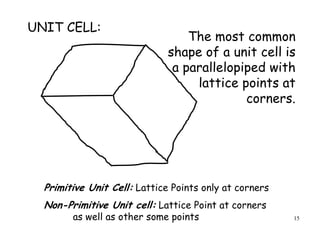
15
The most common
shape of a unit cell is
a parallelopiped with
lattice points at
corners.
UNIT CELL:
Primitive Unit Cell: Lattice Points only at corners
Non-Primitive Unit cell: Lattice Point at corners
as well as other some points
16
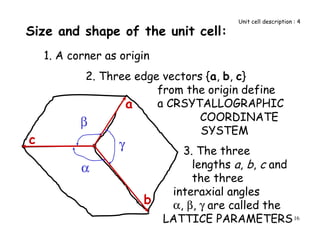
Size and shape of the unit cell:
1. A corner as origin
2. Three edge vectors {a, b, c}
from the origin define
a CRSYTALLOGRAPHIC
COORDINATE
SYSTEM
3. The three
lengths a, b, c and
the three
interaxial angles
α, β, γ are called the
LATTICE PARAMETERS
α
β
γ
a
b
c
Unit cell description : 4
17
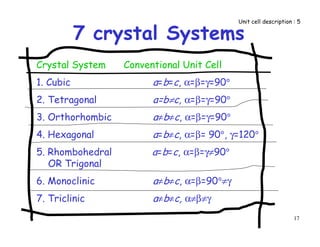
7 crystal Systems
Crystal System Conventional Unit Cell
1. Cubic a=b=c, α=β=γ=90°
2. Tetragonal a=b≠c, α=β=γ=90°
3. Orthorhombic a≠b≠c, α=β=γ=90°
4. Hexagonal a=b≠c, α=β= 90°, γ=120°
5. Rhombohedral a=b=c, α=β=γ≠90°
OR Trigonal
6. Monoclinic a≠b≠c, α=β=90°≠γ
7. Triclinic a≠b≠c, α≠β≠γ
Unit cell description : 5
18
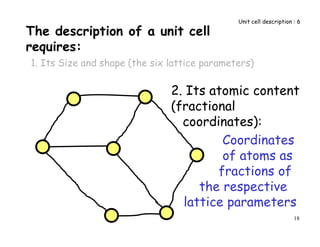
The description of a unit cell
requires:
1. Its Size and shape (the six lattice parameters)
2. Its atomic content
(fractional
coordinates):
Coordinates
of atoms as
fractions of
the respective
lattice parameters
Unit cell description : 6
19x
y
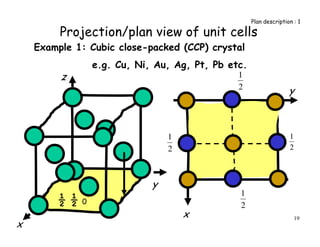
Projection/plan view of unit cells
½ ½ 0
Example 1: Cubic close-packed (CCP) crystal
e.g. Cu, Ni, Au, Ag, Pt, Pb etc.
2
1
2
1
2
1
2
1
x
y
z
Plan description : 1
20
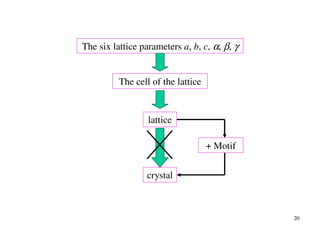
The six lattice parameters a, b, c, α, β, γ
The cell of the lattice
lattice
crystal
+ Motif
21
Contents
Crystal, Lattice and Motif
Unit cells, Lattice Parameters and Projections
Miller Indices & Miller-Bravais Indices
Directions and Planes
Classification of Lattices:
7 crystal systems
14 Bravais lattices
Reciprocal lattice
22
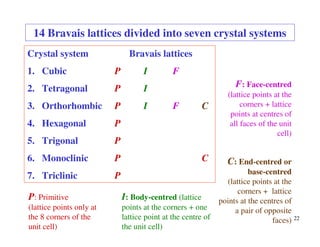
14 Bravais lattices divided into seven crystal systems
Crystal system Bravais lattices
1. Cubic P I F
2. Tetragonal P I
3. Orthorhombic P I F C
4. Hexagonal P
5. Trigonal P
6. Monoclinic P C
7. Triclinic P
P: Primitive
(lattice points only at
the 8 corners of the
unit cell)
I: Body-centred (lattice
points at the corners + one
lattice point at the centre of
the unit cell)
F: Face-centred
(lattice points at the
corners + lattice
points at centres of
all faces of the unit
cell)
C: End-centred or
base-centred
(lattice points at the
corners + lattice
points at the centres of
a pair of opposite
faces)
23
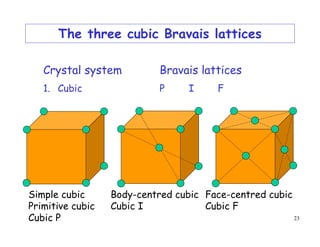
The three cubic Bravais lattices
Crystal system Bravais lattices
1. Cubic P I F
Simple cubic
Primitive cubic
Cubic P
Body-centred cubic
Cubic I
Face-centred cubic
Cubic F
24
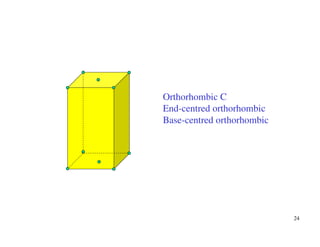
Orthorhombic C
End-centred orthorhombic
Base-centred orthorhombic
25
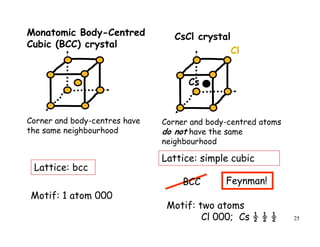
Monatomic Body-Centred
Cubic (BCC) crystal
Lattice: bcc
CsCl crystal
Lattice: simple cubic
BCC Feynman!
Corner and body-centres have
the same neighbourhood
Corner and body-centred atoms
do not have the same
neighbourhood
Motif: 1 atom 000
Motif: two atoms
Cl 000; Cs ½ ½ ½
Cs
Cl
26
½
½½
½
Lattice: Simple hexagonal
hcp lattice hcp crystal
Example:
Hexagonal close-packed (HCP) crystal
x
y
z
Corner and inside atoms do not have
the same neighbourhood
Motif: Two atoms:
000; 2/3 1/3 1/2
27
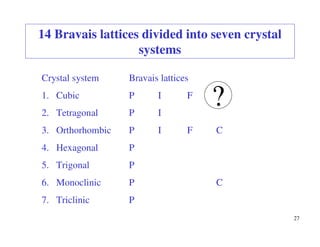
14 Bravais lattices divided into seven crystal
systems
Crystal system Bravais lattices
1. Cubic P I F
2. Tetragonal P I
3. Orthorhombic P I F C
4. Hexagonal P
5. Trigonal P
6. Monoclinic P C
7. Triclinic P
?
28
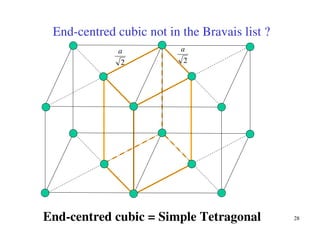
End-centred cubic not in the Bravais list ?
End-centred cubic = Simple Tetragonal
2
a
2
a
29
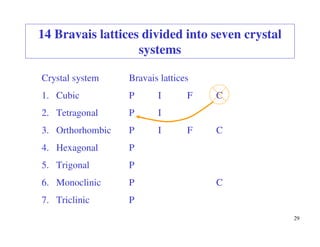
14 Bravais lattices divided into seven crystal
systems
Crystal system Bravais lattices
1. Cubic P I F C
2. Tetragonal P I
3. Orthorhombic P I F C
4. Hexagonal P
5. Trigonal P
6. Monoclinic P C
7. Triclinic P
30
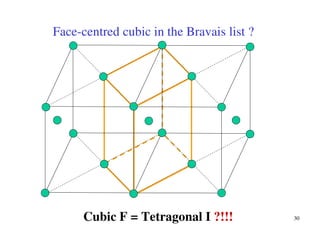
Face-centred cubic in the Bravais list ?
Cubic F = Tetragonal I ?!!!
31
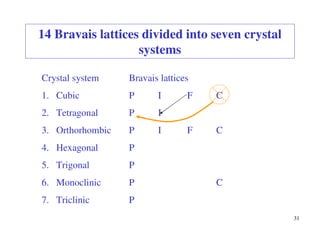
14 Bravais lattices divided into seven crystal
systems
Crystal system Bravais lattices
1. Cubic P I F C
2. Tetragonal P I
3. Orthorhombic P I F C
4. Hexagonal P
5. Trigonal P
6. Monoclinic P C
7. Triclinic P
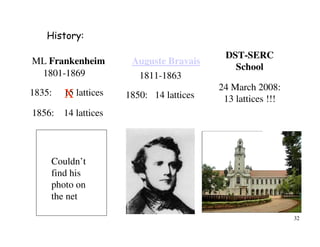
32
Couldn’t
find his
photo on
the net
1811-1863
Auguste Bravais
1850: 14 lattices1835: 15 lattices
ML Frankenheim
1801-1869
24 March 2008:
13 lattices !!!
DST-SERC
School
X
1856: 14 lattices
History:
33
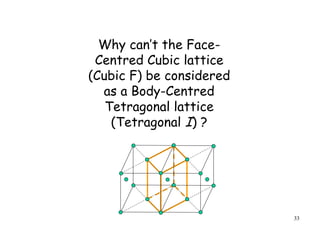
Why can’t the Face-
Centred Cubic lattice
(Cubic F) be considered
as a Body-Centred
Tetragonal lattice
(Tetragonal I) ?
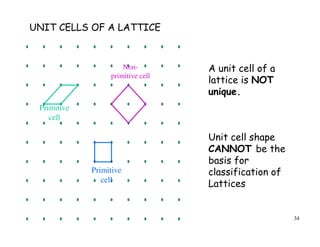
34
Primitive
cell
Primitive
cell
Non-
primitive cell
A unit cell of a
lattice is NOT
unique.
UNIT CELLS OF A LATTICE
Unit cell shape
CANNOT be the
basis for
classification of
Lattices
35
What is the basis for
classification of lattices
into
7 crystal systems
and
14 Bravais lattices?
36
Lattices are
classified on the
basis of their
symmetry
37
What is
symmetry?
38
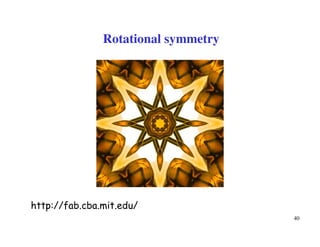
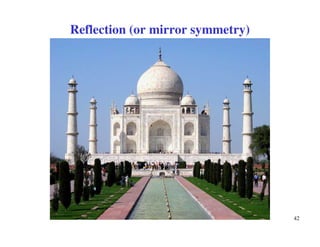
If an object is brought into self-
coincidence after some
operation it said to possess
symmetry with respect to that
operation.
Symmetry
39
NOW NO SWIMS ON MON
40
Rotational symmetry
http://fab.cba.mit.edu/
41
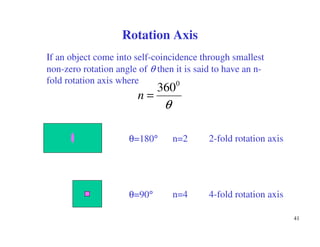
If an object come into self-coincidence through smallest
non-zero rotation angle of θ then it is said to have an n-
fold rotation axis where
θ
0
360
=n
θ=180°
θ=90°
Rotation Axis
n=2 2-fold rotation axis
n=4 4-fold rotation axis
42
Reflection (or mirror symmetry)
43
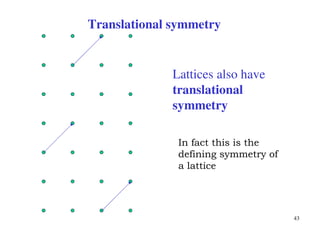
Lattices also have
translational
symmetry
Translational symmetry
In fact this is the
defining symmetry of
a lattice
44
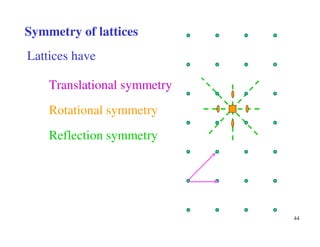
Symmetry of lattices
Lattices have
Rotational symmetry
Reflection symmetry
Translational symmetry
45
The group of all symmetry elements of a
crystal except translations (e.g. rotation,
reflection etc.) is called its POINT
GROUP.
The complete group of all symmetry
elements of a crystal including translations
is called its SPACE GROUP
Point Group and Space Group
46
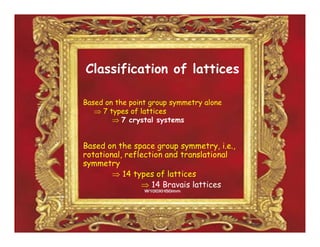
Classification of lattices
Based on the space group symmetry, i.e.,
rotational, reflection and translational
symmetry
⇒ 14 types of lattices
⇒ 14 Bravais lattices
Based on the point group symmetry alone
⇒ 7 types of lattices
⇒ 7 crystal systems
47
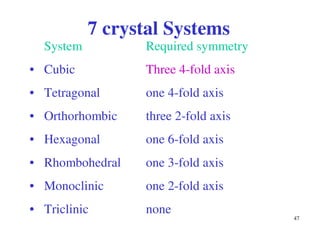
7 crystal Systems
System Required symmetry
• Cubic Three 4-fold axis
• Tetragonal one 4-fold axis
• Orthorhombic three 2-fold axis
• Hexagonal one 6-fold axis
• Rhombohedral one 3-fold axis
• Monoclinic one 2-fold axis
• Triclinic none
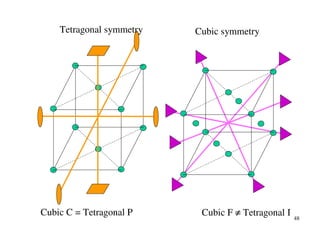
48
Tetragonal symmetry Cubic symmetry
Cubic C = Tetragonal P Cubic F ≠≠≠≠ Tetragonal I
49
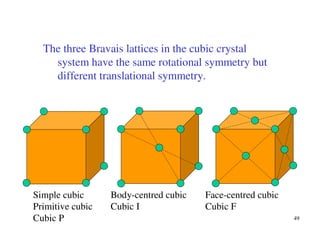
The three Bravais lattices in the cubic crystal
system have the same rotational symmetry but
different translational symmetry.
Simple cubic
Primitive cubic
Cubic P
Body-centred cubic
Cubic I
Face-centred cubic
Cubic F
50
QUESTIONS?
51
Contents
Crystal, Lattice and Motif
Unit cells, Lattice Parameters and Projections
Miller Indices & Miller-Bravais Indices
Directions and Planes
Classification of Lattices:
7 crystal systems
14 Bravais lattices
Reciprocal lattice
52
Miller Indices of directions and
planes
William Hallowes Miller
(1801 – 1880)
University of Cambridge
Miller Indices 1
53
1. Choose a point on the direction
as the origin.
2. Choose a coordinate system
with axes parallel to the unit
cell edges.
x
y 3. Find the coordinates of
another point on the direction in
terms of a, b and c
4. Reduce the coordinates to smallest integers.
5. Put in square brackets
Miller Indices of Directions
[100]
1a+0b+0c
z
1, 0, 0
1, 0, 0
Miller Indices 2
a
b
c
54
y
z
Miller indices of a direction:
only the orientation
not its position or sense
All parallel directions have the
same Miller indices
[100]x
Miller Indices 3
55
x
y
z
O
A
1/2, 1/2, 1
[1 1 2]
OA=1/2 a + 1/2 b + 1 c
P
Q
x
y
z
PQ = -1 a -1 b + 1 c
-1, -1, 1
Miller Indices of
Directions (contd.)
[ 1 1 1 ]
__
-ve steps are shown as bar over the number
Direction OA
Direction PQ
56
Miller indices of a family of symmetry related directions
[100]
[001]
[010]
uvw = [uvw] and all other directions related to
[uvw] by the symmetry of the crystal
cubic
100 = [100], [010],
[001]
tetragonal
100 = [100], [010]
Cubic
Tetragonal
[010]
[100]
Miller Indices 4
57
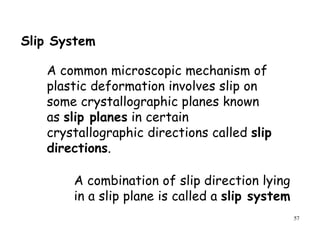
Slip System
A common microscopic mechanism of
plastic deformation involves slip on
some crystallographic planes known
as slip planes in certain
crystallographic directions called slip
directions.
A combination of slip direction lying
in a slip plane is called a slip system
58
Miller indices of slip directions in CCP
y
z
[110]
[110]
[101]
[ 101]
[011]
[101]
Slip directions = close-packed directions = face diagonals
x
Six slip directions:
[110]
[101]
[011]
[110]
[101]
[101]
All six slip
directions in ccp:
110
Miller Indices 5
59
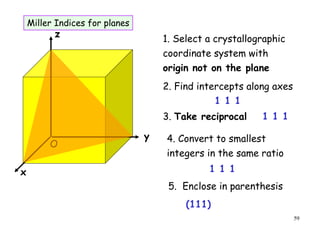
5. Enclose in parenthesis
Miller Indices for planes
3. Take reciprocal
2. Find intercepts along axes
1. Select a crystallographic
coordinate system with
origin not on the plane
4. Convert to smallest
integers in the same ratio
1 1 1
1 1 1
1 1 1
(111)
x
y
z
O
60
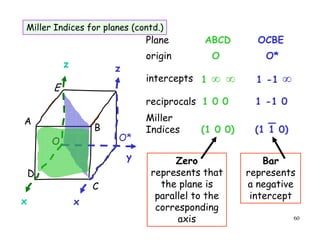
Miller Indices for planes (contd.)
origin
intercepts
reciprocals
Miller
Indices
A
B
C
D
O
ABCD
O
1 ∞ ∞
1 0 0
(1 0 0)
OCBE
O*
1 -1 ∞
1 -1 0
(1 1 0)
_
Plane
x
z
y
O*
x
z
E
Zero
represents that
the plane is
parallel to the
corresponding
axis
Bar
represents
a negative
intercept
61
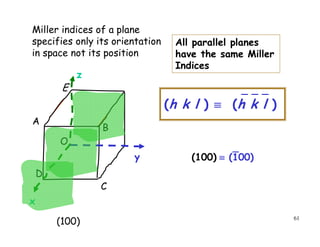
Miller indices of a plane
specifies only its orientation
in space not its position
All parallel planes
have the same Miller
Indices
A
B
C
D
O
x
z
y
E
(100)
(h k l ) ≡≡≡≡ (h k l )
_ _ _
(100) ≡≡≡≡ (100)
_
62
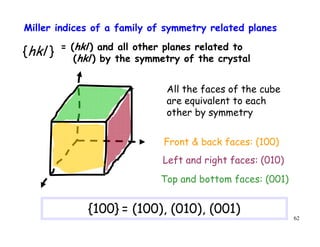
Miller indices of a family of symmetry related planes
= (hkl ) and all other planes related to
(hkl ) by the symmetry of the crystal
{hkl }
All the faces of the cube
are equivalent to each
other by symmetry
Front & back faces: (100)
Left and right faces: (010)
Top and bottom faces: (001)
{100} = (100), (010), (001)
63
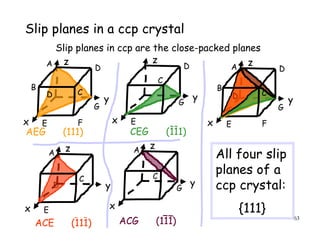
Slip planes in a ccp crystal
Slip planes in ccp are the close-packed planes
AEG (111)
A
D
FE
D
G
x
y
z
B
C
y
ACE (111)
A
E
D
x
z
C
ACG (111)
A
G
x
y
z
C
A D
FE
D
G
x
y
z
B
C
All four slip
planes of a
ccp crystal:
{111}
D
E
G
x
y
z
C
CEG (111)
64
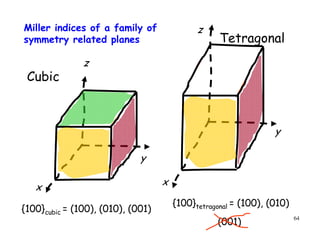
{100}cubic = (100), (010), (001)
{100}tetragonal = (100), (010)
(001)
Cubic
Tetragonal
Miller indices of a family of
symmetry related planes
x
z
y
z
x
y
65
[100]
[010]
Symmetry related directions in the
hexagonal crystal system
cubic
100 = [100], [010], [001]
hexagonal
100
Not permutations
Permutations
[110]
x
y
z
= [100], [010], [110]
66
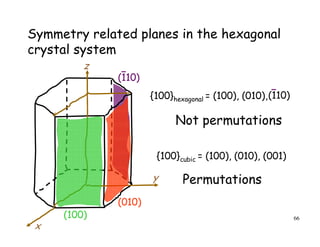
(010)
(100)
(110)
x
{100}hexagonal = (100), (010),
{100}cubic = (100), (010), (001)
Not permutations
Permutations
Symmetry related planes in the hexagonal
crystal system
(110)
y
z
67
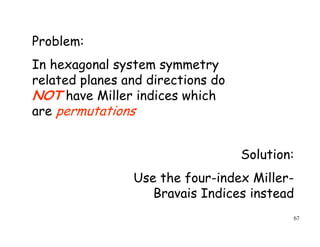
Problem:
In hexagonal system symmetry
related planes and directions do
NOT have Miller indices which
are permutations
Solution:
Use the four-index Miller-
Bravais Indices instead
68
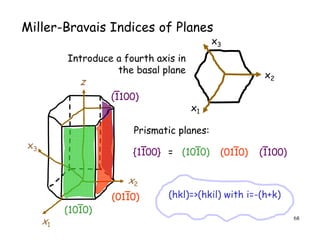
x1
x2
x3
(1010)
(0110)
(1100)
(hkl)=>(hkil) with i=-(h+k)
Introduce a fourth axis in
the basal plane
x1
x3
Miller-Bravais Indices of Planes
x2
Prismatic planes:
{1100} = (1100)
(1010)
(0110)
z
69
Miller-Bravais Indices of Directions in
hexagonal crystals
x1
x2
x3
Basal plane
=slip plane
=(0001)
[uvw]=>[UVTW]
wWvuTuvVvuU =+−=−=−= );();2(
3
1
);2(
3
1
Require that: 0=++ TVU
Vectorially 0aaa 21 =++ 3
caa
caaa
wvu
WTVU
++=
+++
21
321
a1
a2
a2
70
a1
a1
-a2
-a3
]0112[
a2
a3
x1
x2
x3
wWvuTuvVvuU =+−=−=−= );();2(
3
1
);2(
3
1
[ ] ]0112[0]100[ 3
1
3
1
3
2
≡−−⇒
[ ] ]0121[0]010[ 3
1
3
2
3
1
≡−−⇒
[ ] ]2011[0]011[ 3
2
3
1
3
1
≡−−⇒
x1:
x2:
x3:
Slip directions in hcp
0112
Miller-Bravais indices of slip directions in hcp
crystal:
71
Some IMPORTANT Results
Condition for a direction [uvw] to be parallel to a plane or lie in
the plane (hkl):
h u + k v + l w = 0
Weiss zone law
True for ALL crystal systems
h U + k V + i T +l W = 0
72
CUBIC CRYSTALS
[hkl] ⊥⊥⊥⊥ (hkl)
Angle between two directions [h1k1l1] and [h2k2l2]:
C
[111]
(111)
2
2
2
2
2
2
2
1
2
1
2
1
212121
cos
lkhlkh
llkkhh
++++
++
=θ
73
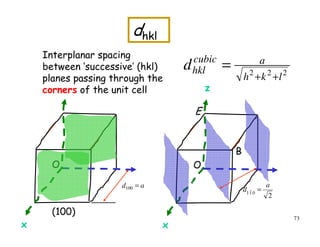
dhkl
Interplanar spacing
between ‘successive’ (hkl)
planes passing through the
corners of the unit cell
222
lkh
acubic
hkld
++
=
O
x
(100)
ad =100
B
O
x
z
E
2011
a
d =
74
[uvw] Miller indices of a direction (i.e. a set of
parallel directions)
<uvw> Miller indices of a family of symmetry
related directions
(hkl) Miller Indices of a plane (i.e. a set of
parallel planes)
{hkl} Miller indices of a family of symmetry
related planes
[uvtw] Miller-Bravais indices of a direction,
(hkil) plane in a hexagonal system
Summary of Notation convention for Indices
75
Contents
Crystal, Lattice and Motif
Unit cells, Lattice Parameters and Projections
Miller Indices & Miller-Bravais Indices
Directions and Planes
Classification of Lattices:
7 crystal systems
14 Bravais lattices
Reciprocal lattice
76
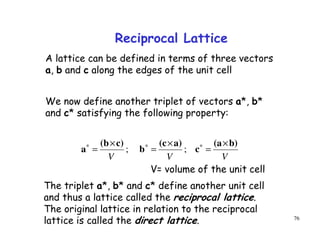
Reciprocal Lattice
A lattice can be defined in terms of three vectors
a, b and c along the edges of the unit cell
We now define another triplet of vectors a*, b*
and c* satisfying the following property:
The triplet a*, b* and c* define another unit cell
and thus a lattice called the reciprocal lattice.
The original lattice in relation to the reciprocal
lattice is called the direct lattice.
VVV
b)(a
c
a)(c
b
c)(b
a
×
=
×
=
×
= ∗∗∗
;;
V= volume of the unit cell
77
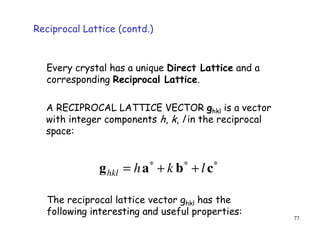
Every crystal has a unique Direct Lattice and a
corresponding Reciprocal Lattice.
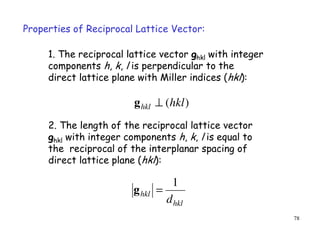
The reciprocal lattice vector ghkl has the
following interesting and useful properties:
A RECIPROCAL LATTICE VECTOR ghkl is a vector
with integer components h, k, l in the reciprocal
space:
∗∗∗
++= cbag lkhhkl
Reciprocal Lattice (contd.)
78
hkl
hkl
d
1
=g
1. The reciprocal lattice vector ghkl with integer
components h, k, l is perpendicular to the
direct lattice plane with Miller indices (hkl):
)(hklhkl ⊥g
Properties of Reciprocal Lattice Vector:
2. The length of the reciprocal lattice vector
ghkl with integer components h, k, l is equal to
the reciprocal of the interplanar spacing of
direct lattice plane (hkl):
79
Full significance of the
concept of the reciprocal
lattice will be appreciated
in the discussion of the x-
ray and electron
diffraction.
80
Thank You
81
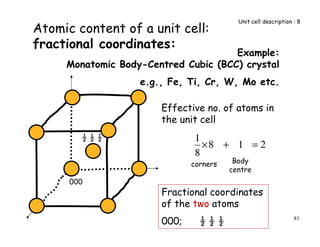
Example:
Monatomic Body-Centred Cubic (BCC) crystal
e.g., Fe, Ti, Cr, W, Mo etc.
Atomic content of a unit cell:
fractional coordinates:
Fractional coordinates
of the two atoms
000; ½ ½ ½
Unit cell description : 8
Effective no. of atoms in
the unit cell
218
8
1
=+×
corners Body
centre
000
½ ½ ½

Basic crystallography

  • 1.
    DST-SERC School onTexture and Microstructure BASIC CRYSTALLOGRAPHY Rajesh Prasad Department of Applied Mechanics Indian Institute of Technology New Delhi 110016 rajesh@am.iitd.ac.in
  • 2.
    2 Contents Crystal, Lattice andMotif Unit cells, Lattice Parameters and Projections Miller Indices & Miller-Bravais Indices Directions and Planes Classification of Lattices: 7 crystal systems 14 Bravais lattices Reciprocal lattice
  • 3.
    3 A 3D translationaly periodicarrangement of atoms in space is called a crystal. Crystal ?
  • 4.
    4 Lattice? A 3D translationally periodicarrangement of points in space is called a lattice.
  • 5.
    5 A 3D translationally periodic arrangement of atoms Crystal A3D translationally periodic arrangement of points Lattice
  • 6.
    6 What is therelation between the two? Crystal = Lattice + Motif Motif or basis: an atom or a group of atoms associated with each lattice point
  • 7.
    7 Crystal=lattice+basis Lattice: the underlyingperiodicity of the crystal, Basis: atom or group of atoms associated with each lattice points Lattice: how to repeat Motif: what to repeat
  • 8.
    8 A 3D translationallyperiodic arrangement of points Each lattice point in a lattice has identical neighbourhood of other lattice points. Lattice
  • 9.
    9 + Love Pattern (Crystal) Love Lattice+ Heart (Motif) = = Lattice + Motif = Crystal Love Pattern
  • 10.
  • 11.
    11 Every periodic pattern (and hence a crystal) hasa unique lattice associated with it
  • 12.
  • 13.
    13 Contents Crystal, Lattice andMotif Unit cells, Lattice Parameters and Projections Miller Indices & Miller-Bravais Indices Directions and Planes Classification of Lattices: 7 crystal systems 14 Bravais lattices Reciprocal lattice
  • 14.
    14 Translational Periodicity One canselect a small volume of the crystal which by periodic repetition generates the entire crystal (without overlaps or gaps) Unit Cell Unit cell description : 1
  • 15.
    15 The most common shapeof a unit cell is a parallelopiped with lattice points at corners. UNIT CELL: Primitive Unit Cell: Lattice Points only at corners Non-Primitive Unit cell: Lattice Point at corners as well as other some points
  • 16.
    16 Size and shapeof the unit cell: 1. A corner as origin 2. Three edge vectors {a, b, c} from the origin define a CRSYTALLOGRAPHIC COORDINATE SYSTEM 3. The three lengths a, b, c and the three interaxial angles α, β, γ are called the LATTICE PARAMETERS α β γ a b c Unit cell description : 4
  • 17.
    17 7 crystal Systems CrystalSystem Conventional Unit Cell 1. Cubic a=b=c, α=β=γ=90° 2. Tetragonal a=b≠c, α=β=γ=90° 3. Orthorhombic a≠b≠c, α=β=γ=90° 4. Hexagonal a=b≠c, α=β= 90°, γ=120° 5. Rhombohedral a=b=c, α=β=γ≠90° OR Trigonal 6. Monoclinic a≠b≠c, α=β=90°≠γ 7. Triclinic a≠b≠c, α≠β≠γ Unit cell description : 5
  • 18.
    18 The description ofa unit cell requires: 1. Its Size and shape (the six lattice parameters) 2. Its atomic content (fractional coordinates): Coordinates of atoms as fractions of the respective lattice parameters Unit cell description : 6
  • 19.
    19x y Projection/plan view ofunit cells ½ ½ 0 Example 1: Cubic close-packed (CCP) crystal e.g. Cu, Ni, Au, Ag, Pt, Pb etc. 2 1 2 1 2 1 2 1 x y z Plan description : 1
  • 20.
    20 The six latticeparameters a, b, c, α, β, γ The cell of the lattice lattice crystal + Motif
  • 21.
    21 Contents Crystal, Lattice andMotif Unit cells, Lattice Parameters and Projections Miller Indices & Miller-Bravais Indices Directions and Planes Classification of Lattices: 7 crystal systems 14 Bravais lattices Reciprocal lattice
  • 22.
    22 14 Bravais latticesdivided into seven crystal systems Crystal system Bravais lattices 1. Cubic P I F 2. Tetragonal P I 3. Orthorhombic P I F C 4. Hexagonal P 5. Trigonal P 6. Monoclinic P C 7. Triclinic P P: Primitive (lattice points only at the 8 corners of the unit cell) I: Body-centred (lattice points at the corners + one lattice point at the centre of the unit cell) F: Face-centred (lattice points at the corners + lattice points at centres of all faces of the unit cell) C: End-centred or base-centred (lattice points at the corners + lattice points at the centres of a pair of opposite faces)
  • 23.
    23 The three cubicBravais lattices Crystal system Bravais lattices 1. Cubic P I F Simple cubic Primitive cubic Cubic P Body-centred cubic Cubic I Face-centred cubic Cubic F
  • 24.
  • 25.
    25 Monatomic Body-Centred Cubic (BCC)crystal Lattice: bcc CsCl crystal Lattice: simple cubic BCC Feynman! Corner and body-centres have the same neighbourhood Corner and body-centred atoms do not have the same neighbourhood Motif: 1 atom 000 Motif: two atoms Cl 000; Cs ½ ½ ½ Cs Cl
  • 26.
    26 ½ ½½ ½ Lattice: Simple hexagonal hcplattice hcp crystal Example: Hexagonal close-packed (HCP) crystal x y z Corner and inside atoms do not have the same neighbourhood Motif: Two atoms: 000; 2/3 1/3 1/2
  • 27.
    27 14 Bravais latticesdivided into seven crystal systems Crystal system Bravais lattices 1. Cubic P I F 2. Tetragonal P I 3. Orthorhombic P I F C 4. Hexagonal P 5. Trigonal P 6. Monoclinic P C 7. Triclinic P ?
  • 28.
    28 End-centred cubic notin the Bravais list ? End-centred cubic = Simple Tetragonal 2 a 2 a
  • 29.
    29 14 Bravais latticesdivided into seven crystal systems Crystal system Bravais lattices 1. Cubic P I F C 2. Tetragonal P I 3. Orthorhombic P I F C 4. Hexagonal P 5. Trigonal P 6. Monoclinic P C 7. Triclinic P
  • 30.
    30 Face-centred cubic inthe Bravais list ? Cubic F = Tetragonal I ?!!!
  • 31.
    31 14 Bravais latticesdivided into seven crystal systems Crystal system Bravais lattices 1. Cubic P I F C 2. Tetragonal P I 3. Orthorhombic P I F C 4. Hexagonal P 5. Trigonal P 6. Monoclinic P C 7. Triclinic P
  • 32.
    32 Couldn’t find his photo on thenet 1811-1863 Auguste Bravais 1850: 14 lattices1835: 15 lattices ML Frankenheim 1801-1869 24 March 2008: 13 lattices !!! DST-SERC School X 1856: 14 lattices History:
  • 33.
    33 Why can’t theFace- Centred Cubic lattice (Cubic F) be considered as a Body-Centred Tetragonal lattice (Tetragonal I) ?
  • 34.
    34 Primitive cell Primitive cell Non- primitive cell A unitcell of a lattice is NOT unique. UNIT CELLS OF A LATTICE Unit cell shape CANNOT be the basis for classification of Lattices
  • 35.
    35 What is thebasis for classification of lattices into 7 crystal systems and 14 Bravais lattices?
  • 36.
    36 Lattices are classified onthe basis of their symmetry
  • 37.
  • 38.
    38 If an objectis brought into self- coincidence after some operation it said to possess symmetry with respect to that operation. Symmetry
  • 39.
  • 40.
  • 41.
    41 If an objectcome into self-coincidence through smallest non-zero rotation angle of θ then it is said to have an n- fold rotation axis where θ 0 360 =n θ=180° θ=90° Rotation Axis n=2 2-fold rotation axis n=4 4-fold rotation axis
  • 42.
  • 43.
    43 Lattices also have translational symmetry Translationalsymmetry In fact this is the defining symmetry of a lattice
  • 44.
    44 Symmetry of lattices Latticeshave Rotational symmetry Reflection symmetry Translational symmetry
  • 45.
    45 The group ofall symmetry elements of a crystal except translations (e.g. rotation, reflection etc.) is called its POINT GROUP. The complete group of all symmetry elements of a crystal including translations is called its SPACE GROUP Point Group and Space Group
  • 46.
    46 Classification of lattices Basedon the space group symmetry, i.e., rotational, reflection and translational symmetry ⇒ 14 types of lattices ⇒ 14 Bravais lattices Based on the point group symmetry alone ⇒ 7 types of lattices ⇒ 7 crystal systems
  • 47.
    47 7 crystal Systems SystemRequired symmetry • Cubic Three 4-fold axis • Tetragonal one 4-fold axis • Orthorhombic three 2-fold axis • Hexagonal one 6-fold axis • Rhombohedral one 3-fold axis • Monoclinic one 2-fold axis • Triclinic none
  • 48.
    48 Tetragonal symmetry Cubicsymmetry Cubic C = Tetragonal P Cubic F ≠≠≠≠ Tetragonal I
  • 49.
    49 The three Bravaislattices in the cubic crystal system have the same rotational symmetry but different translational symmetry. Simple cubic Primitive cubic Cubic P Body-centred cubic Cubic I Face-centred cubic Cubic F
  • 50.
  • 51.
    51 Contents Crystal, Lattice andMotif Unit cells, Lattice Parameters and Projections Miller Indices & Miller-Bravais Indices Directions and Planes Classification of Lattices: 7 crystal systems 14 Bravais lattices Reciprocal lattice
  • 52.
    52 Miller Indices ofdirections and planes William Hallowes Miller (1801 – 1880) University of Cambridge Miller Indices 1
  • 53.
    53 1. Choose apoint on the direction as the origin. 2. Choose a coordinate system with axes parallel to the unit cell edges. x y 3. Find the coordinates of another point on the direction in terms of a, b and c 4. Reduce the coordinates to smallest integers. 5. Put in square brackets Miller Indices of Directions [100] 1a+0b+0c z 1, 0, 0 1, 0, 0 Miller Indices 2 a b c
  • 54.
    54 y z Miller indices ofa direction: only the orientation not its position or sense All parallel directions have the same Miller indices [100]x Miller Indices 3
  • 55.
    55 x y z O A 1/2, 1/2, 1 [11 2] OA=1/2 a + 1/2 b + 1 c P Q x y z PQ = -1 a -1 b + 1 c -1, -1, 1 Miller Indices of Directions (contd.) [ 1 1 1 ] __ -ve steps are shown as bar over the number Direction OA Direction PQ
  • 56.
    56 Miller indices ofa family of symmetry related directions [100] [001] [010] uvw = [uvw] and all other directions related to [uvw] by the symmetry of the crystal cubic 100 = [100], [010], [001] tetragonal 100 = [100], [010] Cubic Tetragonal [010] [100] Miller Indices 4
  • 57.
    57 Slip System A commonmicroscopic mechanism of plastic deformation involves slip on some crystallographic planes known as slip planes in certain crystallographic directions called slip directions. A combination of slip direction lying in a slip plane is called a slip system
  • 58.
    58 Miller indices ofslip directions in CCP y z [110] [110] [101] [ 101] [011] [101] Slip directions = close-packed directions = face diagonals x Six slip directions: [110] [101] [011] [110] [101] [101] All six slip directions in ccp: 110 Miller Indices 5
  • 59.
    59 5. Enclose inparenthesis Miller Indices for planes 3. Take reciprocal 2. Find intercepts along axes 1. Select a crystallographic coordinate system with origin not on the plane 4. Convert to smallest integers in the same ratio 1 1 1 1 1 1 1 1 1 (111) x y z O
  • 60.
    60 Miller Indices forplanes (contd.) origin intercepts reciprocals Miller Indices A B C D O ABCD O 1 ∞ ∞ 1 0 0 (1 0 0) OCBE O* 1 -1 ∞ 1 -1 0 (1 1 0) _ Plane x z y O* x z E Zero represents that the plane is parallel to the corresponding axis Bar represents a negative intercept
  • 61.
    61 Miller indices ofa plane specifies only its orientation in space not its position All parallel planes have the same Miller Indices A B C D O x z y E (100) (h k l ) ≡≡≡≡ (h k l ) _ _ _ (100) ≡≡≡≡ (100) _
  • 62.
    62 Miller indices ofa family of symmetry related planes = (hkl ) and all other planes related to (hkl ) by the symmetry of the crystal {hkl } All the faces of the cube are equivalent to each other by symmetry Front & back faces: (100) Left and right faces: (010) Top and bottom faces: (001) {100} = (100), (010), (001)
  • 63.
    63 Slip planes ina ccp crystal Slip planes in ccp are the close-packed planes AEG (111) A D FE D G x y z B C y ACE (111) A E D x z C ACG (111) A G x y z C A D FE D G x y z B C All four slip planes of a ccp crystal: {111} D E G x y z C CEG (111)
  • 64.
    64 {100}cubic = (100),(010), (001) {100}tetragonal = (100), (010) (001) Cubic Tetragonal Miller indices of a family of symmetry related planes x z y z x y
  • 65.
    65 [100] [010] Symmetry related directionsin the hexagonal crystal system cubic 100 = [100], [010], [001] hexagonal 100 Not permutations Permutations [110] x y z = [100], [010], [110]
  • 66.
    66 (010) (100) (110) x {100}hexagonal = (100),(010), {100}cubic = (100), (010), (001) Not permutations Permutations Symmetry related planes in the hexagonal crystal system (110) y z
  • 67.
    67 Problem: In hexagonal systemsymmetry related planes and directions do NOT have Miller indices which are permutations Solution: Use the four-index Miller- Bravais Indices instead
  • 68.
    68 x1 x2 x3 (1010) (0110) (1100) (hkl)=>(hkil) with i=-(h+k) Introducea fourth axis in the basal plane x1 x3 Miller-Bravais Indices of Planes x2 Prismatic planes: {1100} = (1100) (1010) (0110) z
  • 69.
    69 Miller-Bravais Indices ofDirections in hexagonal crystals x1 x2 x3 Basal plane =slip plane =(0001) [uvw]=>[UVTW] wWvuTuvVvuU =+−=−=−= );();2( 3 1 );2( 3 1 Require that: 0=++ TVU Vectorially 0aaa 21 =++ 3 caa caaa wvu WTVU ++= +++ 21 321 a1 a2 a2
  • 70.
    70 a1 a1 -a2 -a3 ]0112[ a2 a3 x1 x2 x3 wWvuTuvVvuU =+−=−=−= );();2( 3 1 );2( 3 1 [] ]0112[0]100[ 3 1 3 1 3 2 ≡−−⇒ [ ] ]0121[0]010[ 3 1 3 2 3 1 ≡−−⇒ [ ] ]2011[0]011[ 3 2 3 1 3 1 ≡−−⇒ x1: x2: x3: Slip directions in hcp 0112 Miller-Bravais indices of slip directions in hcp crystal:
  • 71.
    71 Some IMPORTANT Results Conditionfor a direction [uvw] to be parallel to a plane or lie in the plane (hkl): h u + k v + l w = 0 Weiss zone law True for ALL crystal systems h U + k V + i T +l W = 0
  • 72.
    72 CUBIC CRYSTALS [hkl] ⊥⊥⊥⊥(hkl) Angle between two directions [h1k1l1] and [h2k2l2]: C [111] (111) 2 2 2 2 2 2 2 1 2 1 2 1 212121 cos lkhlkh llkkhh ++++ ++ =θ
  • 73.
    73 dhkl Interplanar spacing between ‘successive’(hkl) planes passing through the corners of the unit cell 222 lkh acubic hkld ++ = O x (100) ad =100 B O x z E 2011 a d =
  • 74.
    74 [uvw] Miller indicesof a direction (i.e. a set of parallel directions) <uvw> Miller indices of a family of symmetry related directions (hkl) Miller Indices of a plane (i.e. a set of parallel planes) {hkl} Miller indices of a family of symmetry related planes [uvtw] Miller-Bravais indices of a direction, (hkil) plane in a hexagonal system Summary of Notation convention for Indices
  • 75.
    75 Contents Crystal, Lattice andMotif Unit cells, Lattice Parameters and Projections Miller Indices & Miller-Bravais Indices Directions and Planes Classification of Lattices: 7 crystal systems 14 Bravais lattices Reciprocal lattice
  • 76.
    76 Reciprocal Lattice A latticecan be defined in terms of three vectors a, b and c along the edges of the unit cell We now define another triplet of vectors a*, b* and c* satisfying the following property: The triplet a*, b* and c* define another unit cell and thus a lattice called the reciprocal lattice. The original lattice in relation to the reciprocal lattice is called the direct lattice. VVV b)(a c a)(c b c)(b a × = × = × = ∗∗∗ ;; V= volume of the unit cell
  • 77.
    77 Every crystal hasa unique Direct Lattice and a corresponding Reciprocal Lattice. The reciprocal lattice vector ghkl has the following interesting and useful properties: A RECIPROCAL LATTICE VECTOR ghkl is a vector with integer components h, k, l in the reciprocal space: ∗∗∗ ++= cbag lkhhkl Reciprocal Lattice (contd.)
  • 78.
    78 hkl hkl d 1 =g 1. The reciprocallattice vector ghkl with integer components h, k, l is perpendicular to the direct lattice plane with Miller indices (hkl): )(hklhkl ⊥g Properties of Reciprocal Lattice Vector: 2. The length of the reciprocal lattice vector ghkl with integer components h, k, l is equal to the reciprocal of the interplanar spacing of direct lattice plane (hkl):
  • 79.
    79 Full significance ofthe concept of the reciprocal lattice will be appreciated in the discussion of the x- ray and electron diffraction.
  • 80.
  • 81.
    81 Example: Monatomic Body-Centred Cubic(BCC) crystal e.g., Fe, Ti, Cr, W, Mo etc. Atomic content of a unit cell: fractional coordinates: Fractional coordinates of the two atoms 000; ½ ½ ½ Unit cell description : 8 Effective no. of atoms in the unit cell 218 8 1 =+× corners Body centre 000 ½ ½ ½