Materials Science (MM1101)
Dr. Jichil Majhi
Dept. of Metallurgical and Materials Engineering
NIT Jamshedpur
Email Id: Jichilmajhi.met@nitjsr.ac.in
Ph. No.: 09658072304
Materials
 Materials are substances whose properties make them useful in structures,
machines, devices or products to serve the purpose.
 Importance of Materials – properties and applications
 Material Science involves study of relationships between synthesis,
processing, structure, properties and performance of materials that
enables engineering function.
 It also involves discovery and design of new materials.
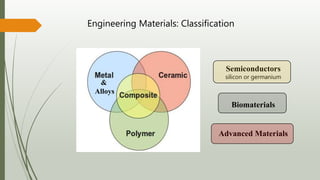
&
Alloys
Semiconductors
silicon or germanium
Biomaterials
Advanced Materials
Engineering Materials: Classification
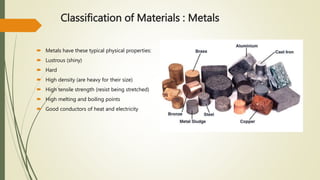
Classification of Materials : Metals
 Metals have these typical physical properties:
 Lustrous (shiny)
 Hard
 High density (are heavy for their size)
 High tensile strength (resist being stretched)
 High melting and boiling points
 Good conductors of heat and electricity
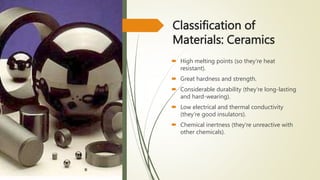
Classification of
Materials: Ceramics
 High melting points (so they're heat
resistant).
 Great hardness and strength.
 Considerable durability (they're long-lasting
and hard-wearing).
 Low electrical and thermal conductivity
(they're good insulators).
 Chemical inertness (they're unreactive with
other chemicals).
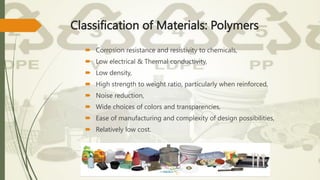
Classification of Materials: Polymers
 Corrosion resistance and resistivity to chemicals,
 Low electrical & Thermal conductivity,
 Low density,
 High strength to weight ratio, particularly when reinforced,
 Noise reduction,
 Wide choices of colors and transparencies,
 Ease of manufacturing and complexity of design possibilities,
 Relatively low cost.
Crystal geometry
• Crystal
• Lattice
• Motif
• 7 crystal system
• 14 Bravais lattice
• Miller indices
Crystal
A 3D periodic arrangement of atoms in space in termed as crystal.
Lattice
A 3D periodic arrangement of points in space in termed as lattice.
Crystal lattice
A 3D periodic arrangement of
atoms in space
A 3D periodic arrangement of
points in space
Physical object
It has some physical properties
such as weight, density, electrical
and thermal conductivity
Geometrical concept
It has only geometrical properties
Relationship between crystal and lattice
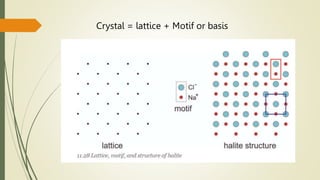
Crystal = lattice + Motif or basis
Motif or basis: An atom or a group of atoms associated with each
lattice point is called a motif or basis of the crystal
Crystal =
lattice (Underlying periodicity of crystal (How to repeat))
+ Motif or basis (atom or group of atoms which is periodically repeated (what to
repeat))
Crystal = lattice + Motif or basis
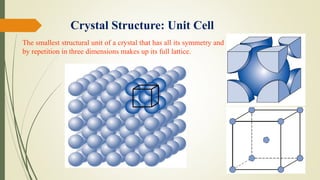
Crystal Structure: Unit Cell
The smallest structural unit of a crystal that has all its symmetry and
by repetition in three dimensions makes up its full lattice.
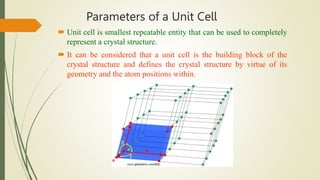
Parameters of a Unit Cell
 Unit cell is smallest repeatable entity that can be used to completely
represent a crystal structure.
 It can be considered that a unit cell is the building block of the
crystal structure and defines the crystal structure by virtue of its
geometry and the atom positions within.
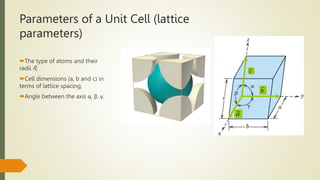
Parameters of a Unit Cell (lattice
parameters)
The type of atoms and their
radii R,
Cell dimensions (a, b and c) in
terms of lattice spacing,
Angle between the axis α, β, γ.
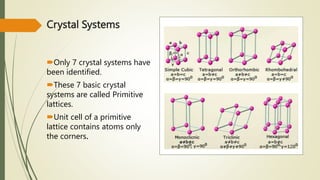
Crystal Systems
Only 7 crystal systems have
been identified.
These 7 basic crystal
systems are called Primitive
lattices.
Unit cell of a primitive
lattice contains atoms only
the corners.
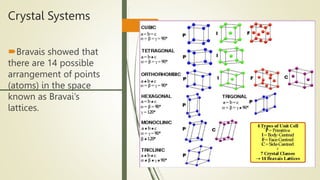
Crystal Systems
Bravais showed that
there are 14 possible
arrangement of points
(atoms) in the space
known as Bravai’s
lattices.
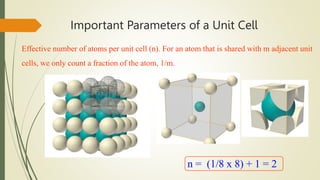
Important Parameters of a Unit Cell
Effective number of atoms per unit cell (n). For an atom that is shared with m adjacent unit
cells, we only count a fraction of the atom, 1/m.
n = (1/8 x 8) + 1 = 2
Important Parameters of a Unit Cell
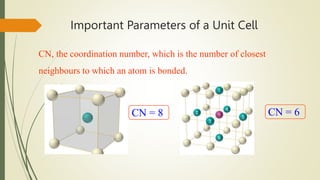
CN, the coordination number, which is the number of closest
neighbours to which an atom is bonded.
CN = 6
CN = 8
Important Parameters of a Unit Cell
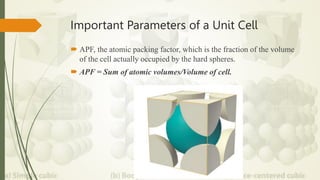
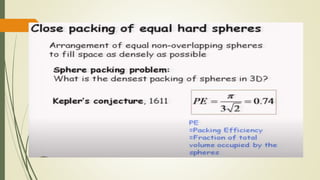
 APF, the atomic packing factor, which is the fraction of the volume
of the cell actually occupied by the hard spheres.
 APF = Sum of atomic volumes/Volume of cell.
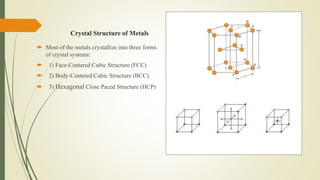
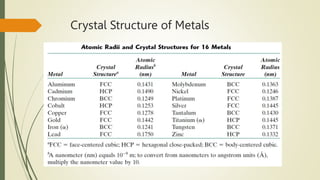
Crystal Structure of Metals
 Most of the metals crystallize into three forms
of crystal systems:
 1) Face-Centered Cubic Structure (FCC)
 2) Body-Centered Cubic Structure (BCC)
 3) Hexagonal Close Paced Structure (HCP)
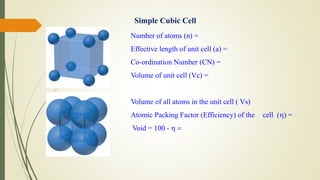
Number of atoms (n) =
Effective length of unit cell (a) =
Co-ordination Number (CN) =
Volume of unit cell (Vc) =
Volume of all atoms in the unit cell ( Vs)
Atomic Packing Factor (Efficiency) of the cell () =
Void = 100 -  =
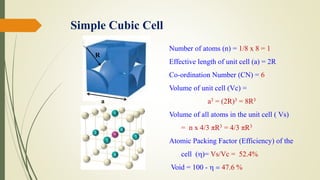
Simple Cubic Cell
Simple Cubic Cell
Number of atoms (n) = 1/8 x 8 = 1
Effective length of unit cell (a) = 2R
Co-ordination Number (CN) = 6
Volume of unit cell (Vc) =
a3 = (2R)3 = 8R3
Volume of all atoms in the unit cell ( Vs)
= n x 4/3 πR3 = 4/3 πR3
Atomic Packing Factor (Efficiency) of the
cell ()= Vs/Vc = 52.4%
Void = 100 -  = 47.6 %
a
R
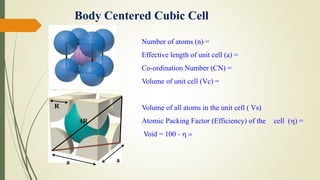
Body Centered Cubic Cell
Number of atoms (n) =
Effective length of unit cell (a) =
Co-ordination Number (CN) =
Volume of unit cell (Vc) =
Volume of all atoms in the unit cell ( Vs)
Atomic Packing Factor (Efficiency) of the cell () =
Void = 100 -  =
a
4R
R
a
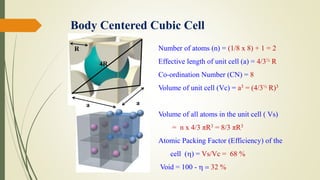
Body Centered Cubic Cell
Number of atoms (n) = (1/8 x 8) + 1 = 2
Effective length of unit cell (a) = 4/3½ R
Co-ordination Number (CN) = 8
Volume of unit cell (Vc) = a3 = (4/3½ R)3
Volume of all atoms in the unit cell ( Vs)
= n x 4/3 πR3 = 8/3 πR3
Atomic Packing Factor (Efficiency) of the
cell () = Vs/Vc = 68 %
Void = 100 -  = 32 %
a
4R
R
a
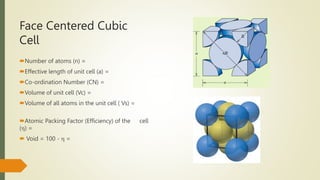
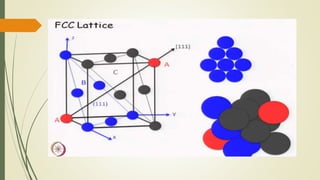
Face Centered Cubic
Cell
Number of atoms (n) =
Effective length of unit cell (a) =
Co-ordination Number (CN) =
Volume of unit cell (Vc) =
Volume of all atoms in the unit cell ( Vs) =
Atomic Packing Factor (Efficiency) of the cell
() =
 Void = 100 -  =
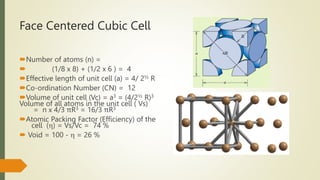
Face Centered Cubic Cell
Number of atoms (n) =
 (1/8 x 8) + (1/2 x 6 ) = 4
Effective length of unit cell (a) = 4/ 2½ R
Co-ordination Number (CN) = 12
Volume of unit cell (Vc) = a3 = (4/2½ R)3
Volume of all atoms in the unit cell ( Vs)
= n x 4/3 πR3 = 16/3 πR3
Atomic Packing Factor (Efficiency) of the
cell () = Vs/Vc = 74 %
 Void = 100 -  = 26 %
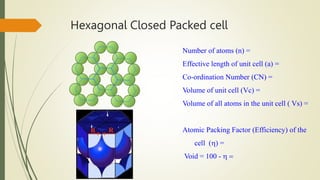
Hexagonal Closed Packed cell
Number of atoms (n) =
Effective length of unit cell (a) =
Co-ordination Number (CN) =
Volume of unit cell (Vc) =
Volume of all atoms in the unit cell ( Vs) =
Atomic Packing Factor (Efficiency) of the
cell () =
Void = 100 -  =
R R
Crystal Structure of Metals
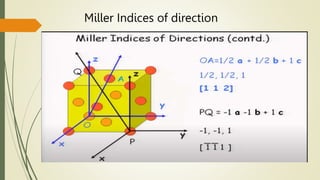
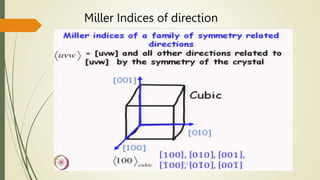
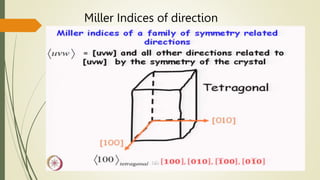
Miller Indices of direction
Put in square brackets [1 0 0]
Miller Indices of direction
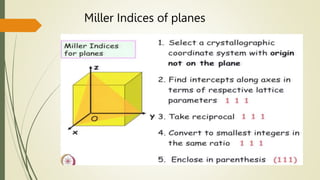
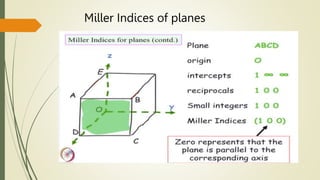
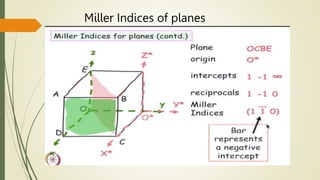
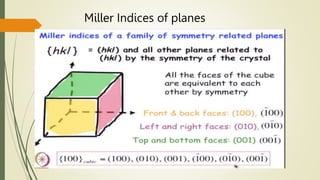
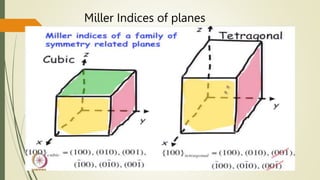
Miller Indices of planes
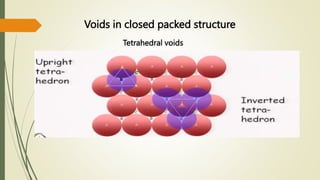
Voids in closed packed structure
Tetrahedral voids
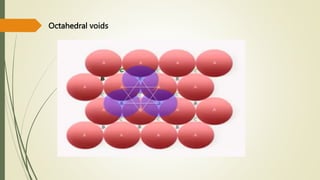
Octahedral voids
Size of the voids
Radius of the largest sphere that can fit inside the void without displacing
the spheres at the corners defining the void.
i. The largest sphere that can fit inside the tetrahedral void is 0.225 R
ii. The largest sphere that can fit inside the octahedral voids is 0.414 R
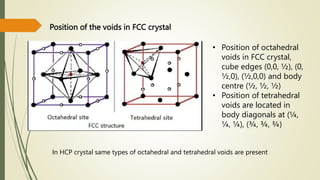
Position of the voids in FCC crystal
• Position of octahedral
voids in FCC crystal,
cube edges (0,0, ½), (0,
½,0), (½,0,0) and body
centre (½, ½, ½)
• Position of tetrahedral
voids are located in
body diagonals at (¼,
¼, ¼), (¾, ¾, ¾)
In HCP crystal same types of octahedral and tetrahedral voids are present
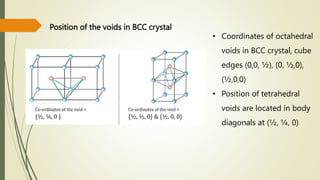
Position of the voids in BCC crystal
• Coordinates of octahedral
voids in BCC crystal, cube
edges (0,0, ½), (0, ½,0),
(½,0,0)
• Position of tetrahedral
voids are located in body
diagonals at (½, ¼, 0)
Structure of alloys
When the molten metal are melted together and crystalized, a single crystal structure
may form. In the unit cell of this crystal both the metal atoms are present in
proportion to their concentration. This structure is called as solid solution
It may be of three types
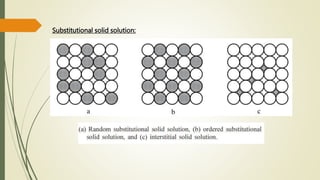
1. Random substitutional solid solution
2. Ordered substitutional solid solution
3. Interstitial solid solution
Structure of alloys
1. Solid solution
• Variation in composition
• Usually the crystal structure of the solution is that of one of the
components
2. Intermetallic compound
• Fixed composition
• Crystal structure different from either of the components
Structure of alloys
Examples:
Interstitial solid solution:
Austenite: Solid solution of C in -Fe (FCC)
Ferrite: solid solution of C in -Fe (BCC)
Substitutional solid solution:
-brass: Solid solution of Cu (FCC) and Zn (HCP) (Limited solubility)
Solid solution -brass has FCC structure
Cu and Ni exhibit the complete solubility
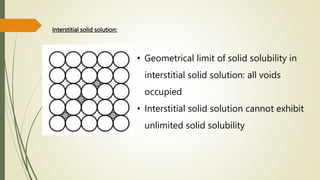
Interstitial solid solution:
• Geometrical limit of solid solubility in
interstitial solid solution: all voids
occupied
• Interstitial solid solution cannot exhibit
unlimited solid solubility
Substitutional solid solution:
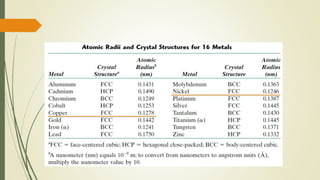
Hume Rothery’s rule
• The size difference between the parent atom and the solute atom
must be less than 15%
• The electronegativity difference between the metals must be small
• The crystal structure of metals and the valency of the atoms must be
the same.
Crystal imperfections
i. Ideal crystal consists of the periodic arrangement of atoms,
however, real crystals deviate from the ideality that is called as
crystal imperfections or defects.
ii. These defects controls the physical and mechanical properties of
the materials
Classifications of defects
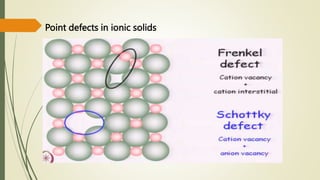
i. Zero-dimensional of point defects: Vacancy, interstitials
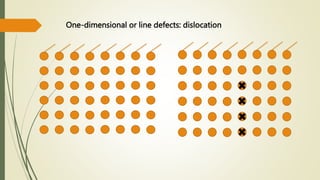
ii. One-dimensional or line defects: dislocation
iii. Two-dimensional or surface defects: free surface, grain boundary,
twin boundary, stacking fault
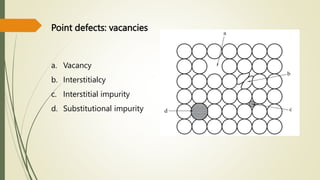
Point defects: vacancies
a. Vacancy
b. Interstitialcy
c. Interstitial impurity
d. Substitutional impurity
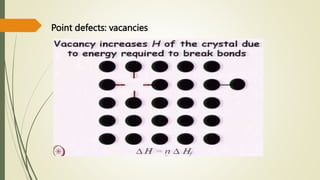
Point defects: vacancies
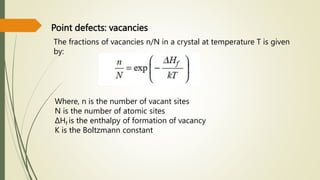
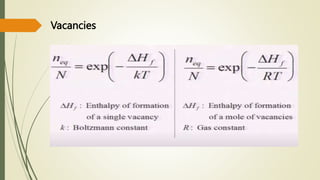
The fractions of vacancies n/N in a crystal at temperature T is given
by:
Where, n is the number of vacant sites
N is the number of atomic sites
ΔHf is the enthalpy of formation of vacancy
K is the Boltzmann constant
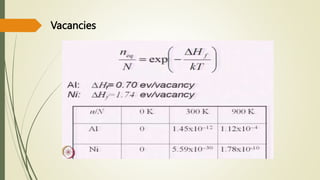
Vacancies
Vacancies
Contributions of vacancies to the thermal expansion
Point defects in ionic solids
One-dimensional or line defects: dislocation
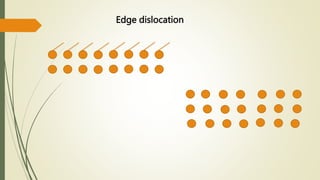
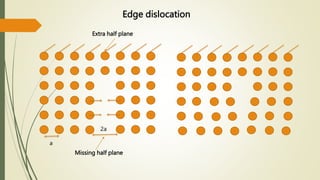
Edge dislocation
Missing half plane
Extra half plane
a
2a
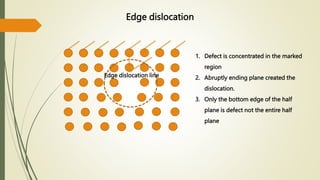
Edge dislocation
Edge dislocation
1. Defect is concentrated in the marked
region
2. Abruptly ending plane created the
dislocation.
3. Only the bottom edge of the half
plane is defect not the entire half
plane
Edge dislocation line
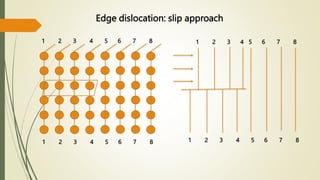
Edge dislocation: slip approach
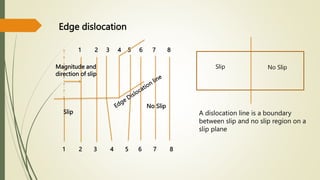
1 2 3 4 5 6 7 8
1 2 3 4 5 6 7 8 1 2 3 4 5 6 7 8
1 2 3 4 5 6 7 8
Edge dislocation
1 2 3 4 5 6 7 8
1 2 3 4 5 6 7 8
Slip
No Slip
Magnitude and
direction of slip
Slip No Slip
A dislocation line is a boundary
between slip and no slip region on a
slip plane
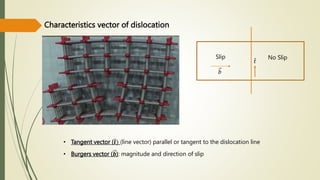
Characteristics vector of dislocation
• Tangent vector (𝒕) (line vector) parallel or tangent to the dislocation line
• Burgers vector (𝒃): magnitude and direction of slip
Slip No Slip
𝑡
𝑏
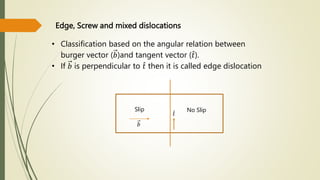
Edge, Screw and mixed dislocations
• Classification based on the angular relation between
burger vector (𝑏)and tangent vector (𝑡).
• If 𝑏 is perpendicular to 𝑡 then it is called edge dislocation
Slip No Slip
𝑡
𝑏
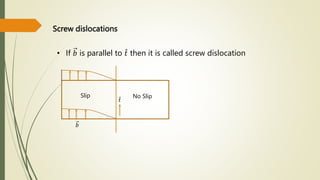
• If 𝑏 is parallel to 𝑡 then it is called screw dislocation
Screw dislocations
Slip No Slip
𝑡
𝑏
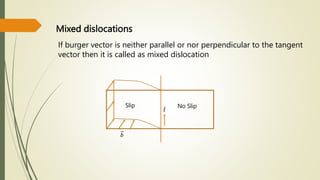
Mixed dislocations
Slip No Slip
𝑡
𝑏
If burger vector is neither parallel or nor perpendicular to the tangent
vector then it is called as mixed dislocation
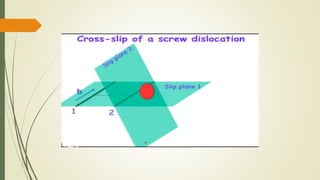
Screw dislocations
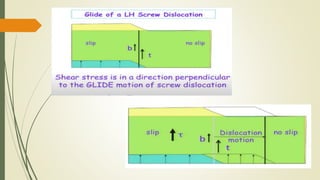
• If slip direction 𝑏 is parallel to dislocation line 𝑡 then it is called
screw dislocation
• If 𝑏 is perpendicular to 𝑡 then it is called edge dislocation (an
extra half plane is associated with the edge dislocation)
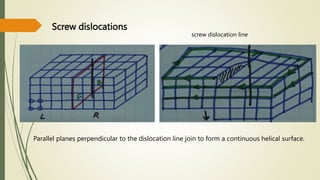
Screw dislocations
Parallel planes perpendicular to the dislocation line join to form a continuous helical surface.
screw dislocation line
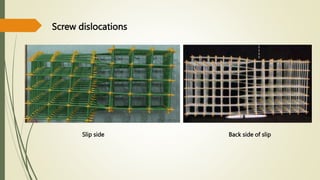
Screw dislocations
Slip side Back side of slip
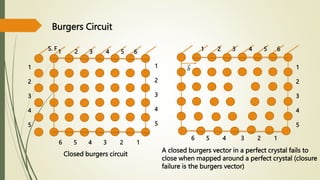
Burgers Circuit
1 2 3 4 5 6
6 5 4 3 2 1
1
2
3
4
5
1
2
3
4
5
S. F 1 2 3 4 5 6
1
2
3
4
5
6 5 4 3 2 1
Closed burgers circuit
A closed burgers vector in a perfect crystal fails to
close when mapped around a perfect crystal (closure
failure is the burgers vector)
𝑏
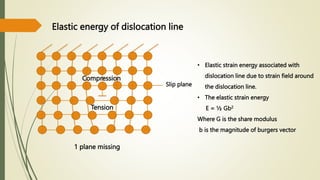
Elastic energy of dislocation line
Slip plane
1 plane missing
Compression
Tension
• Elastic strain energy associated with
dislocation line due to strain field around
the dislocation line.
• The elastic strain energy
E = ½ Gb2
Where G is the share modulus
b is the magnitude of burgers vector
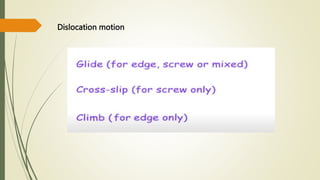
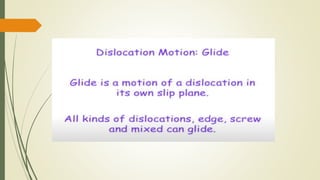
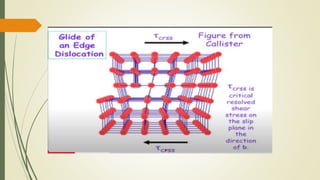
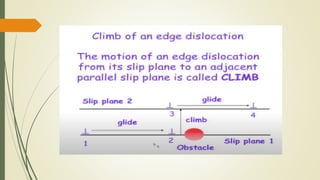
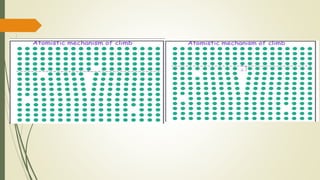
Dislocation motion
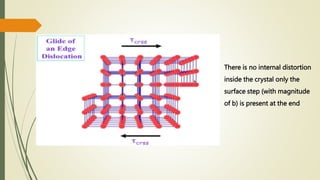
There is no internal distortion
inside the crystal only the
surface step (with magnitude
of b) is present at the end
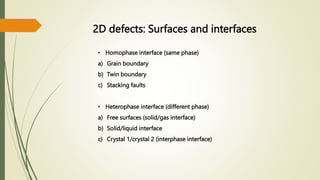
2D defects: Surfaces and interfaces
• Homophase interface (same phase)
a) Grain boundary
b) Twin boundary
c) Stacking faults
• Heterophase interface (different phase)
a) Free surfaces (solid/gas interface)
b) Solid/liquid interface
c) Crystal 1/crystal 2 (interphase interface)
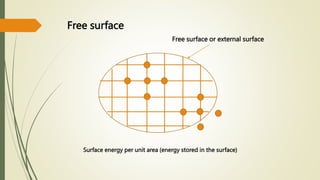
Free surface
Free surface or external surface
Surface energy per unit area (energy stored in the surface)
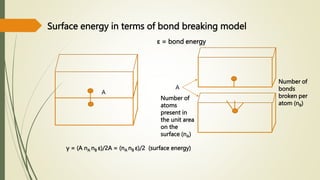
Surface energy in terms of bond breaking model
Number of
atoms
present in
the unit area
on the
surface (nA)
Number of
bonds
broken per
atom (nB)
ε = bond energy
A
A
γ = (A nA nB ε)/2A = (nA nB ε)/2 (surface energy)
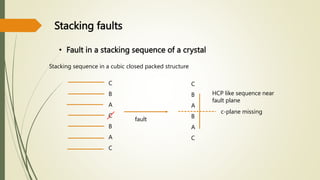
Stacking faults
• Fault in a stacking sequence of a crystal
Stacking sequence in a cubic closed packed structure
C
B
A
C
B
A
C
fault
C
B
A
B
A
C
c-plane missing
HCP like sequence near
fault plane
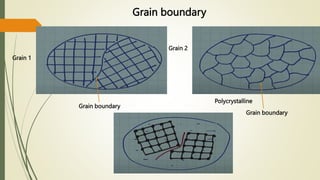
Grain boundary
Grain boundary
Grain 1
Grain 2
Polycrystalline
Grain boundary
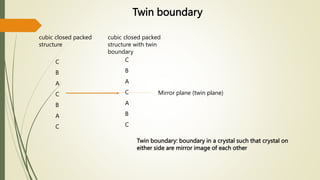
Twin boundary
C
B
A
C
B
A
C
cubic closed packed
structure with twin
boundary
C
B
A
C
A
B
C
cubic closed packed
structure
Mirror plane (twin plane)
Twin boundary: boundary in a crystal such that crystal on
either side are mirror image of each other
Crystalline Materials
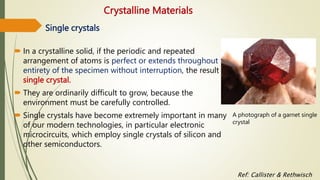
 In a crystalline solid, if the periodic and repeated
arrangement of atoms is perfect or extends throughout the
entirety of the specimen without interruption, the result is a
single crystal.
 They are ordinarily difficult to grow, because the
environment must be carefully controlled.
 Single crystals have become extremely important in many
of our modern technologies, in particular electronic
microcircuits, which employ single crystals of silicon and
other semiconductors.
A photograph of a garnet single
crystal
Single crystals
Ref: Callister & Rethwisch
Polycrystalline Materials
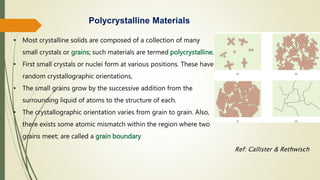
• Most crystalline solids are composed of a collection of many
small crystals or grains; such materials are termed polycrystalline.
• First small crystals or nuclei form at various positions. These have
random crystallographic orientations,
• The small grains grow by the successive addition from the
surrounding liquid of atoms to the structure of each.
• The crystallographic orientation varies from grain to grain. Also,
there exists some atomic mismatch within the region where two
grains meet; are called a grain boundary
Ref: Callister & Rethwisch
Noncrystalline materials
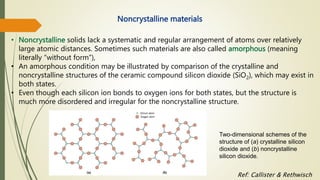
Two-dimensional schemes of the
structure of (a) crystalline silicon
dioxide and (b) noncrystalline
silicon dioxide.
Ref: Callister & Rethwisch
• Noncrystalline solids lack a systematic and regular arrangement of atoms over relatively
large atomic distances. Sometimes such materials are also called amorphous (meaning
literally “without form”),
• An amorphous condition may be illustrated by comparison of the crystalline and
noncrystalline structures of the ceramic compound silicon dioxide (SiO2), which may exist in
both states.
• Even though each silicon ion bonds to oxygen ions for both states, but the structure is
much more disordered and irregular for the noncrystalline structure.
Noncrystalline materials
 Whether a crystalline or amorphous solid forms depends on the ease with
which a random atomic structure in the liquid can transform to an ordered
state during solidification.
 Rapidly cooling favors the formation of a noncrystalline solid, because little
time is allowed for the ordering process.
 Metals normally form crystalline solids, some ceramic materials are crystalline,
the inorganic glasses are amorphous.
Ref: Callister & Rethwisch
Unit 1
Crystl Defects
 Surface Defects: Grain Boundaries
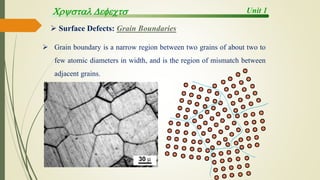
 Grain boundary is a narrow region between two grains of about two to
few atomic diameters in width, and is the region of mismatch between
adjacent grains.
Unit 1
Crystl Defects
100  Surface Defects: Grain Boundaries
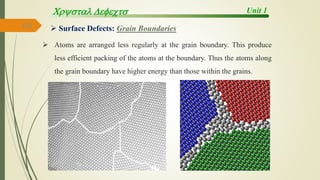
 Atoms are arranged less regularly at the grain boundary. This produce
less efficient packing of the atoms at the boundary. Thus the atoms along
the grain boundary have higher energy than those within the grains.
Unit 1
Crystl Defects
101  Surface Defects: Grain Boundaries
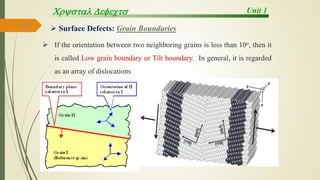
 If the orientation between two neighboring grains is less than 10o, then it
is called Low grain boundary or Tilt boundary. In general, it is regarded
as an array of dislocations
Unit 1
Crystl Defects
102  Surface Defects: Grain Boundaries
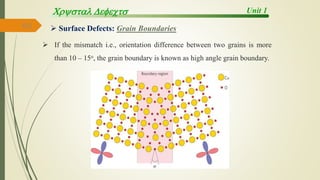
 If the mismatch i.e., orientation difference between two grains is more
than 10 – 15o, the grain boundary is known as high angle grain boundary.
Unit 1
Crystl Defects
103
Volume Defects:
 The Volume defects are caused due to conglomerations of vacancies in a
small region within crystal or the presence of foreign atoms of large sizes
compared on atomic scale.
 Foreign particle inclusions are also called as volume imperfections.
 The accumulation of vacancies produce voids, while the foreign atoms
produce dissymmetry within crystals. These defects affect properties of
metal.
Unit 1
Crystl Defects
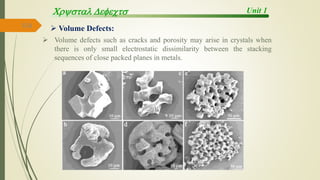
104  Volume Defects:
 Volume defects such as cracks and porosity may arise in crystals when
there is only small electrostatic dissimilarity between the stacking
sequences of close packed planes in metals.
Unit 1
Crystl Defects
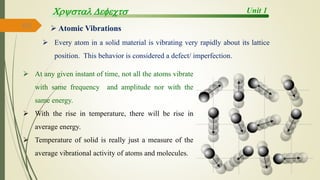
105  Atomic Vibrations
 Every atom in a solid material is vibrating very rapidly about its lattice
position. This behavior is considered a defect/ imperfection.
 At any given instant of time, not all the atoms vibrate
with same frequency and amplitude nor with the
same energy.
 With the rise in temperature, there will be rise in
average energy.
 Temperature of solid is really just a measure of the
average vibrational activity of atoms and molecules.
Crystl Defects
106
 Atomic Vibrations:
 At room temperature Vibration has a frequency of ~1013/sec, amplitude
of few thousands nanometers.
 Most of the properties and processes in solids are manifestations of this
vibrational atomic motion.
 Eg: Melting occurs when the vibrations are vigorous and large enough to
rupture large number of atomic bonds.
Polymorphism and allotropy
• Some metals, as well as nonmetals, may have more than one crystal
structure, a phenomenon known as polymorphism
• When found in elemental solids, the condition is often termed
allotropy
• Example
pure iron has a BCC crystal structure at room temperature, which
changes to FCC iron at 912 C. Most often a modification of the
density and other physical properties accompanies a polymorphic
transformation
Hexagonal Crystals
• The three and axes are all contained within a single plane (called the basal
plane) and are at 120 degree angles to one another.
• The z axis is perpendicular to this basal plane.
• Directional indices, will be denoted by four indices, as [uvtw];
Conversion from the three-index system to the four-index system
Crystallographic planes
• For crystals having hexagonal symmetry, it is desirable that equivalent
planes have the same indices; as with directions, this is accomplished by the
Miller–Bravais system
• This convention leads to the four-index (hkil) scheme. i is determined by the
sum of h and k through
i = -(h+k)
• We can convert the (hkl) plane to the (hkil) four index system plane
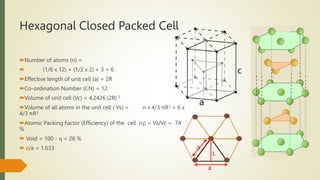
Hexagonal Closed Packed Cell
Number of atoms (n) =
 (1/6 x 12) + (1/2 x 2) + 3 = 6
Effective length of unit cell (a) = 2R
Co-ordination Number (CN) = 12
Volume of unit cell (Vc) = 4.2426 (2R) 3
Volume of all atoms in the unit cell ( Vs) = n x 4/3 πR3 = 6 x
4/3 πR3
Atomic Packing Factor (Efficiency) of the cell () = Vs/Vc = 74
%
 Void = 100 -  = 26 %
 c/a = 1.633
a
a
L
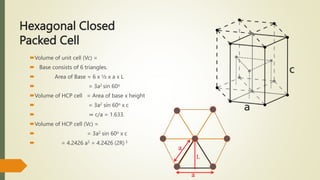
Hexagonal Closed
Packed Cell
Volume of unit cell (Vc) =
 Base consists of 6 triangles.
 Area of Base = 6 x ½ x a x L
 = 3a2 sin 60o
Volume of HCP cell = Area of base x height
 = 3a2 sin 60o x c
 ⇒ c/a = 1.633.
Volume of HCP cell (Vc) =
 = 3a2 sin 60o x c
 = 4.2426 a3 = 4.2426 (2R) 3
a
a
L

Materials Science notes ppt for 1st year mechanical engineering.pptx

  • 1.
    Materials Science (MM1101) Dr.Jichil Majhi Dept. of Metallurgical and Materials Engineering NIT Jamshedpur Email Id: Jichilmajhi.met@nitjsr.ac.in Ph. No.: 09658072304
  • 2.
    Materials  Materials aresubstances whose properties make them useful in structures, machines, devices or products to serve the purpose.  Importance of Materials – properties and applications  Material Science involves study of relationships between synthesis, processing, structure, properties and performance of materials that enables engineering function.  It also involves discovery and design of new materials.
  • 3.
    & Alloys Semiconductors silicon or germanium Biomaterials AdvancedMaterials Engineering Materials: Classification
  • 4.
    Classification of Materials: Metals  Metals have these typical physical properties:  Lustrous (shiny)  Hard  High density (are heavy for their size)  High tensile strength (resist being stretched)  High melting and boiling points  Good conductors of heat and electricity
  • 5.
    Classification of Materials: Ceramics High melting points (so they're heat resistant).  Great hardness and strength.  Considerable durability (they're long-lasting and hard-wearing).  Low electrical and thermal conductivity (they're good insulators).  Chemical inertness (they're unreactive with other chemicals).
  • 6.
    Classification of Materials:Polymers  Corrosion resistance and resistivity to chemicals,  Low electrical & Thermal conductivity,  Low density,  High strength to weight ratio, particularly when reinforced,  Noise reduction,  Wide choices of colors and transparencies,  Ease of manufacturing and complexity of design possibilities,  Relatively low cost.
  • 7.
    Crystal geometry • Crystal •Lattice • Motif • 7 crystal system • 14 Bravais lattice • Miller indices
  • 8.
    Crystal A 3D periodicarrangement of atoms in space in termed as crystal. Lattice A 3D periodic arrangement of points in space in termed as lattice. Crystal lattice A 3D periodic arrangement of atoms in space A 3D periodic arrangement of points in space Physical object It has some physical properties such as weight, density, electrical and thermal conductivity Geometrical concept It has only geometrical properties
  • 9.
    Relationship between crystaland lattice Crystal = lattice + Motif or basis Motif or basis: An atom or a group of atoms associated with each lattice point is called a motif or basis of the crystal Crystal = lattice (Underlying periodicity of crystal (How to repeat)) + Motif or basis (atom or group of atoms which is periodically repeated (what to repeat))
  • 10.
    Crystal = lattice+ Motif or basis
  • 11.
    Crystal Structure: UnitCell The smallest structural unit of a crystal that has all its symmetry and by repetition in three dimensions makes up its full lattice.
  • 12.
    Parameters of aUnit Cell  Unit cell is smallest repeatable entity that can be used to completely represent a crystal structure.  It can be considered that a unit cell is the building block of the crystal structure and defines the crystal structure by virtue of its geometry and the atom positions within.
  • 13.
    Parameters of aUnit Cell (lattice parameters) The type of atoms and their radii R, Cell dimensions (a, b and c) in terms of lattice spacing, Angle between the axis α, β, γ.
  • 14.
    Crystal Systems Only 7crystal systems have been identified. These 7 basic crystal systems are called Primitive lattices. Unit cell of a primitive lattice contains atoms only the corners.
  • 15.
    Crystal Systems Bravais showedthat there are 14 possible arrangement of points (atoms) in the space known as Bravai’s lattices.
  • 16.
    Important Parameters ofa Unit Cell Effective number of atoms per unit cell (n). For an atom that is shared with m adjacent unit cells, we only count a fraction of the atom, 1/m. n = (1/8 x 8) + 1 = 2
  • 17.
    Important Parameters ofa Unit Cell CN, the coordination number, which is the number of closest neighbours to which an atom is bonded. CN = 6 CN = 8
  • 18.
    Important Parameters ofa Unit Cell  APF, the atomic packing factor, which is the fraction of the volume of the cell actually occupied by the hard spheres.  APF = Sum of atomic volumes/Volume of cell.
  • 19.
    Crystal Structure ofMetals  Most of the metals crystallize into three forms of crystal systems:  1) Face-Centered Cubic Structure (FCC)  2) Body-Centered Cubic Structure (BCC)  3) Hexagonal Close Paced Structure (HCP)
  • 20.
    Number of atoms(n) = Effective length of unit cell (a) = Co-ordination Number (CN) = Volume of unit cell (Vc) = Volume of all atoms in the unit cell ( Vs) Atomic Packing Factor (Efficiency) of the cell () = Void = 100 -  = Simple Cubic Cell
  • 21.
    Simple Cubic Cell Numberof atoms (n) = 1/8 x 8 = 1 Effective length of unit cell (a) = 2R Co-ordination Number (CN) = 6 Volume of unit cell (Vc) = a3 = (2R)3 = 8R3 Volume of all atoms in the unit cell ( Vs) = n x 4/3 πR3 = 4/3 πR3 Atomic Packing Factor (Efficiency) of the cell ()= Vs/Vc = 52.4% Void = 100 -  = 47.6 % a R
  • 22.
    Body Centered CubicCell Number of atoms (n) = Effective length of unit cell (a) = Co-ordination Number (CN) = Volume of unit cell (Vc) = Volume of all atoms in the unit cell ( Vs) Atomic Packing Factor (Efficiency) of the cell () = Void = 100 -  = a 4R R a
  • 23.
    Body Centered CubicCell Number of atoms (n) = (1/8 x 8) + 1 = 2 Effective length of unit cell (a) = 4/3½ R Co-ordination Number (CN) = 8 Volume of unit cell (Vc) = a3 = (4/3½ R)3 Volume of all atoms in the unit cell ( Vs) = n x 4/3 πR3 = 8/3 πR3 Atomic Packing Factor (Efficiency) of the cell () = Vs/Vc = 68 % Void = 100 -  = 32 % a 4R R a
  • 24.
    Face Centered Cubic Cell Numberof atoms (n) = Effective length of unit cell (a) = Co-ordination Number (CN) = Volume of unit cell (Vc) = Volume of all atoms in the unit cell ( Vs) = Atomic Packing Factor (Efficiency) of the cell () =  Void = 100 -  =
  • 25.
    Face Centered CubicCell Number of atoms (n) =  (1/8 x 8) + (1/2 x 6 ) = 4 Effective length of unit cell (a) = 4/ 2½ R Co-ordination Number (CN) = 12 Volume of unit cell (Vc) = a3 = (4/2½ R)3 Volume of all atoms in the unit cell ( Vs) = n x 4/3 πR3 = 16/3 πR3 Atomic Packing Factor (Efficiency) of the cell () = Vs/Vc = 74 %  Void = 100 -  = 26 %
  • 26.
    Hexagonal Closed Packedcell Number of atoms (n) = Effective length of unit cell (a) = Co-ordination Number (CN) = Volume of unit cell (Vc) = Volume of all atoms in the unit cell ( Vs) = Atomic Packing Factor (Efficiency) of the cell () = Void = 100 -  = R R
  • 27.
  • 28.
    Miller Indices ofdirection Put in square brackets [1 0 0]
  • 29.
  • 30.
  • 31.
  • 32.
  • 33.
  • 34.
  • 35.
  • 36.
  • 44.
    Voids in closedpacked structure Tetrahedral voids
  • 45.
  • 46.
    Size of thevoids Radius of the largest sphere that can fit inside the void without displacing the spheres at the corners defining the void. i. The largest sphere that can fit inside the tetrahedral void is 0.225 R ii. The largest sphere that can fit inside the octahedral voids is 0.414 R
  • 47.
    Position of thevoids in FCC crystal • Position of octahedral voids in FCC crystal, cube edges (0,0, ½), (0, ½,0), (½,0,0) and body centre (½, ½, ½) • Position of tetrahedral voids are located in body diagonals at (¼, ¼, ¼), (¾, ¾, ¾) In HCP crystal same types of octahedral and tetrahedral voids are present
  • 48.
    Position of thevoids in BCC crystal • Coordinates of octahedral voids in BCC crystal, cube edges (0,0, ½), (0, ½,0), (½,0,0) • Position of tetrahedral voids are located in body diagonals at (½, ¼, 0)
  • 49.
    Structure of alloys Whenthe molten metal are melted together and crystalized, a single crystal structure may form. In the unit cell of this crystal both the metal atoms are present in proportion to their concentration. This structure is called as solid solution It may be of three types 1. Random substitutional solid solution 2. Ordered substitutional solid solution 3. Interstitial solid solution
  • 50.
    Structure of alloys 1.Solid solution • Variation in composition • Usually the crystal structure of the solution is that of one of the components 2. Intermetallic compound • Fixed composition • Crystal structure different from either of the components
  • 51.
    Structure of alloys Examples: Interstitialsolid solution: Austenite: Solid solution of C in -Fe (FCC) Ferrite: solid solution of C in -Fe (BCC) Substitutional solid solution: -brass: Solid solution of Cu (FCC) and Zn (HCP) (Limited solubility) Solid solution -brass has FCC structure Cu and Ni exhibit the complete solubility
  • 52.
    Interstitial solid solution: •Geometrical limit of solid solubility in interstitial solid solution: all voids occupied • Interstitial solid solution cannot exhibit unlimited solid solubility
  • 53.
  • 54.
    Hume Rothery’s rule •The size difference between the parent atom and the solute atom must be less than 15% • The electronegativity difference between the metals must be small • The crystal structure of metals and the valency of the atoms must be the same.
  • 56.
    Crystal imperfections i. Idealcrystal consists of the periodic arrangement of atoms, however, real crystals deviate from the ideality that is called as crystal imperfections or defects. ii. These defects controls the physical and mechanical properties of the materials
  • 57.
    Classifications of defects i.Zero-dimensional of point defects: Vacancy, interstitials ii. One-dimensional or line defects: dislocation iii. Two-dimensional or surface defects: free surface, grain boundary, twin boundary, stacking fault
  • 58.
    Point defects: vacancies a.Vacancy b. Interstitialcy c. Interstitial impurity d. Substitutional impurity
  • 59.
  • 60.
    Point defects: vacancies Thefractions of vacancies n/N in a crystal at temperature T is given by: Where, n is the number of vacant sites N is the number of atomic sites ΔHf is the enthalpy of formation of vacancy K is the Boltzmann constant
  • 61.
  • 62.
  • 63.
    Contributions of vacanciesto the thermal expansion
  • 64.
    Contributions of vacanciesto the thermal expansion
  • 65.
    Point defects inionic solids
  • 66.
    One-dimensional or linedefects: dislocation
  • 67.
    Edge dislocation Missing halfplane Extra half plane a 2a
  • 68.
  • 69.
    Edge dislocation 1. Defectis concentrated in the marked region 2. Abruptly ending plane created the dislocation. 3. Only the bottom edge of the half plane is defect not the entire half plane Edge dislocation line
  • 70.
    Edge dislocation: slipapproach 1 2 3 4 5 6 7 8 1 2 3 4 5 6 7 8 1 2 3 4 5 6 7 8 1 2 3 4 5 6 7 8
  • 71.
    Edge dislocation 1 23 4 5 6 7 8 1 2 3 4 5 6 7 8 Slip No Slip Magnitude and direction of slip Slip No Slip A dislocation line is a boundary between slip and no slip region on a slip plane
  • 72.
    Characteristics vector ofdislocation • Tangent vector (𝒕) (line vector) parallel or tangent to the dislocation line • Burgers vector (𝒃): magnitude and direction of slip Slip No Slip 𝑡 𝑏
  • 73.
    Edge, Screw andmixed dislocations • Classification based on the angular relation between burger vector (𝑏)and tangent vector (𝑡). • If 𝑏 is perpendicular to 𝑡 then it is called edge dislocation Slip No Slip 𝑡 𝑏
  • 74.
    • If 𝑏is parallel to 𝑡 then it is called screw dislocation Screw dislocations Slip No Slip 𝑡 𝑏
  • 75.
    Mixed dislocations Slip NoSlip 𝑡 𝑏 If burger vector is neither parallel or nor perpendicular to the tangent vector then it is called as mixed dislocation
  • 76.
    Screw dislocations • Ifslip direction 𝑏 is parallel to dislocation line 𝑡 then it is called screw dislocation • If 𝑏 is perpendicular to 𝑡 then it is called edge dislocation (an extra half plane is associated with the edge dislocation)
  • 77.
    Screw dislocations Parallel planesperpendicular to the dislocation line join to form a continuous helical surface. screw dislocation line
  • 78.
  • 79.
    Burgers Circuit 1 23 4 5 6 6 5 4 3 2 1 1 2 3 4 5 1 2 3 4 5 S. F 1 2 3 4 5 6 1 2 3 4 5 6 5 4 3 2 1 Closed burgers circuit A closed burgers vector in a perfect crystal fails to close when mapped around a perfect crystal (closure failure is the burgers vector) 𝑏
  • 80.
    Elastic energy ofdislocation line Slip plane 1 plane missing Compression Tension • Elastic strain energy associated with dislocation line due to strain field around the dislocation line. • The elastic strain energy E = ½ Gb2 Where G is the share modulus b is the magnitude of burgers vector
  • 81.
  • 84.
    There is nointernal distortion inside the crystal only the surface step (with magnitude of b) is present at the end
  • 89.
    2D defects: Surfacesand interfaces • Homophase interface (same phase) a) Grain boundary b) Twin boundary c) Stacking faults • Heterophase interface (different phase) a) Free surfaces (solid/gas interface) b) Solid/liquid interface c) Crystal 1/crystal 2 (interphase interface)
  • 90.
    Free surface Free surfaceor external surface Surface energy per unit area (energy stored in the surface)
  • 91.
    Surface energy interms of bond breaking model Number of atoms present in the unit area on the surface (nA) Number of bonds broken per atom (nB) ε = bond energy A A γ = (A nA nB ε)/2A = (nA nB ε)/2 (surface energy)
  • 92.
    Stacking faults • Faultin a stacking sequence of a crystal Stacking sequence in a cubic closed packed structure C B A C B A C fault C B A B A C c-plane missing HCP like sequence near fault plane
  • 93.
    Grain boundary Grain boundary Grain1 Grain 2 Polycrystalline Grain boundary
  • 94.
    Twin boundary C B A C B A C cubic closedpacked structure with twin boundary C B A C A B C cubic closed packed structure Mirror plane (twin plane) Twin boundary: boundary in a crystal such that crystal on either side are mirror image of each other
  • 95.
    Crystalline Materials  Ina crystalline solid, if the periodic and repeated arrangement of atoms is perfect or extends throughout the entirety of the specimen without interruption, the result is a single crystal.  They are ordinarily difficult to grow, because the environment must be carefully controlled.  Single crystals have become extremely important in many of our modern technologies, in particular electronic microcircuits, which employ single crystals of silicon and other semiconductors. A photograph of a garnet single crystal Single crystals Ref: Callister & Rethwisch
  • 96.
    Polycrystalline Materials • Mostcrystalline solids are composed of a collection of many small crystals or grains; such materials are termed polycrystalline. • First small crystals or nuclei form at various positions. These have random crystallographic orientations, • The small grains grow by the successive addition from the surrounding liquid of atoms to the structure of each. • The crystallographic orientation varies from grain to grain. Also, there exists some atomic mismatch within the region where two grains meet; are called a grain boundary Ref: Callister & Rethwisch
  • 97.
    Noncrystalline materials Two-dimensional schemesof the structure of (a) crystalline silicon dioxide and (b) noncrystalline silicon dioxide. Ref: Callister & Rethwisch • Noncrystalline solids lack a systematic and regular arrangement of atoms over relatively large atomic distances. Sometimes such materials are also called amorphous (meaning literally “without form”), • An amorphous condition may be illustrated by comparison of the crystalline and noncrystalline structures of the ceramic compound silicon dioxide (SiO2), which may exist in both states. • Even though each silicon ion bonds to oxygen ions for both states, but the structure is much more disordered and irregular for the noncrystalline structure.
  • 98.
    Noncrystalline materials  Whethera crystalline or amorphous solid forms depends on the ease with which a random atomic structure in the liquid can transform to an ordered state during solidification.  Rapidly cooling favors the formation of a noncrystalline solid, because little time is allowed for the ordering process.  Metals normally form crystalline solids, some ceramic materials are crystalline, the inorganic glasses are amorphous. Ref: Callister & Rethwisch
  • 99.
    Unit 1 Crystl Defects Surface Defects: Grain Boundaries  Grain boundary is a narrow region between two grains of about two to few atomic diameters in width, and is the region of mismatch between adjacent grains.
  • 100.
    Unit 1 Crystl Defects 100 Surface Defects: Grain Boundaries  Atoms are arranged less regularly at the grain boundary. This produce less efficient packing of the atoms at the boundary. Thus the atoms along the grain boundary have higher energy than those within the grains.
  • 101.
    Unit 1 Crystl Defects 101 Surface Defects: Grain Boundaries  If the orientation between two neighboring grains is less than 10o, then it is called Low grain boundary or Tilt boundary. In general, it is regarded as an array of dislocations
  • 102.
    Unit 1 Crystl Defects 102 Surface Defects: Grain Boundaries  If the mismatch i.e., orientation difference between two grains is more than 10 – 15o, the grain boundary is known as high angle grain boundary.
  • 103.
    Unit 1 Crystl Defects 103 VolumeDefects:  The Volume defects are caused due to conglomerations of vacancies in a small region within crystal or the presence of foreign atoms of large sizes compared on atomic scale.  Foreign particle inclusions are also called as volume imperfections.  The accumulation of vacancies produce voids, while the foreign atoms produce dissymmetry within crystals. These defects affect properties of metal.
  • 104.
    Unit 1 Crystl Defects 104 Volume Defects:  Volume defects such as cracks and porosity may arise in crystals when there is only small electrostatic dissimilarity between the stacking sequences of close packed planes in metals.
  • 105.
    Unit 1 Crystl Defects 105 Atomic Vibrations  Every atom in a solid material is vibrating very rapidly about its lattice position. This behavior is considered a defect/ imperfection.  At any given instant of time, not all the atoms vibrate with same frequency and amplitude nor with the same energy.  With the rise in temperature, there will be rise in average energy.  Temperature of solid is really just a measure of the average vibrational activity of atoms and molecules.
  • 106.
    Crystl Defects 106  AtomicVibrations:  At room temperature Vibration has a frequency of ~1013/sec, amplitude of few thousands nanometers.  Most of the properties and processes in solids are manifestations of this vibrational atomic motion.  Eg: Melting occurs when the vibrations are vigorous and large enough to rupture large number of atomic bonds.
  • 107.
    Polymorphism and allotropy •Some metals, as well as nonmetals, may have more than one crystal structure, a phenomenon known as polymorphism • When found in elemental solids, the condition is often termed allotropy • Example pure iron has a BCC crystal structure at room temperature, which changes to FCC iron at 912 C. Most often a modification of the density and other physical properties accompanies a polymorphic transformation
  • 108.
    Hexagonal Crystals • Thethree and axes are all contained within a single plane (called the basal plane) and are at 120 degree angles to one another. • The z axis is perpendicular to this basal plane. • Directional indices, will be denoted by four indices, as [uvtw]; Conversion from the three-index system to the four-index system
  • 109.
    Crystallographic planes • Forcrystals having hexagonal symmetry, it is desirable that equivalent planes have the same indices; as with directions, this is accomplished by the Miller–Bravais system • This convention leads to the four-index (hkil) scheme. i is determined by the sum of h and k through i = -(h+k) • We can convert the (hkl) plane to the (hkil) four index system plane
  • 110.
    Hexagonal Closed PackedCell Number of atoms (n) =  (1/6 x 12) + (1/2 x 2) + 3 = 6 Effective length of unit cell (a) = 2R Co-ordination Number (CN) = 12 Volume of unit cell (Vc) = 4.2426 (2R) 3 Volume of all atoms in the unit cell ( Vs) = n x 4/3 πR3 = 6 x 4/3 πR3 Atomic Packing Factor (Efficiency) of the cell () = Vs/Vc = 74 %  Void = 100 -  = 26 %  c/a = 1.633 a a L
  • 111.
    Hexagonal Closed Packed Cell Volumeof unit cell (Vc) =  Base consists of 6 triangles.  Area of Base = 6 x ½ x a x L  = 3a2 sin 60o Volume of HCP cell = Area of base x height  = 3a2 sin 60o x c  ⇒ c/a = 1.633. Volume of HCP cell (Vc) =  = 3a2 sin 60o x c  = 4.2426 a3 = 4.2426 (2R) 3 a a L