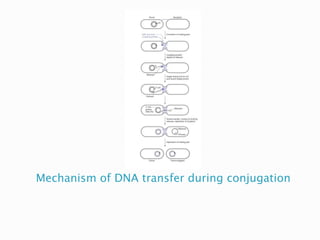
Plasmids can transfer genetic material between bacterial cells through a process called conjugation. Joshua Lederberg and Esther Lederberg first observed this process in 1946 when they found that mixing strains of E. coli resulted in new strains with combined genetic traits. Conjugation involves direct contact between a donor and recipient cell and allows for horizontal gene transfer of plasmids and genes they carry. Key genes called tra genes encode machinery for the process, including formation of a pilus for cell attachment and a channel for DNA transfer. Self-transmissible plasmids can transfer themselves while mobilizable plasmids require the proteins from a conjugative plasmid to be transferred. Conjugation plays a major role in spreading antibiotic resistance genes