M.Uma Maheshwari, 
Reg No. 13APBO10 
II M.Sc Botany
» Major substance in plants next to water 
» Building blocks 
» Constituent element of 
» Chlorophyll 
» Cytochromes 
» Alkaloids 
» Many vitamins 
» Plays important role in metabolism, growth, 
reproduction and heredity
 Atmospheric Nitrogen 
 78% of atmosphere 
 Plants cannot utilize this form 
 Some Bacteria, Blue Green Algae, leguminous plants 
 Nitrates, Nitrites and Ammonia 
 Nitrate is chief form 
Amino acids in the soil 
 Many soil organisms use this form 
 Higher plants can also taken by higher plants 
 Organic Nitrogenous compounds in insects 
 Insectivorous plants
 The conversion of free nitrogen into 
nitrogenous salts to make it available for 
absorption of plants
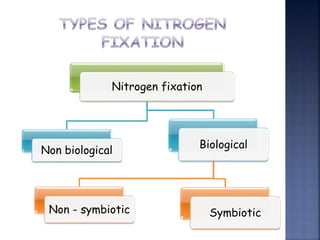
Nitrogen fixation 
Non biological Biological 
Non - symbiotic Symbiotic
 The micro-organisms do not take place 
 Found in rainy season during lightning 
1. N2 + O2 lightning 2 NO 
(Nitric oxide) 
2. 2NO + O2 oxidation 2NO2 
( Nitrogen per oxide) 
3. 2NO2 + H2O HNO2 + HNO3 
4. 4NO2 + 2H2O + O2 4HNO3 
(Nitric acid) 
5. CaO + 2HNO3 Ca (NO3)2 + H2O 
(Calcium nitrate) 
6. HNO3 + NH3 NH4NO3 
(Ammonium nitrate) 
7. HNO2 + NH3 NH4NO2 
(Ammonium nitrite)
 Fixation of atmospheric Nitrogen into 
nitrogenous salts with the help of micro-organisms 
 Two types 
 Symbiotic 
 Non-symbiotic
o Fixation carried out by free living micro-organisms 
o Aerobic, anaerobic and blue green algae 
o Bacteria: special type (nitrogen fixing 
bacteria) types - 
o Free living aerobic : Azotobacter, Beijerenckia 
o Free living anaerobic : Clostridium 
o Free living photosynthetic : Chlorobium, 
Rhodopseudomonas 
o Free living chemosynthetic :Desulfovibro,Thiobacillus
o Free living fungi: yeasts and Pillularia 
o Blue green algae: 
o unicellular – Gloeothece, Synechococcus 
o Filamentous (non heterocystous) -Oscillatoria 
o Filamentous (heterocystous) – Tolypothrix, 
Nostoc, Anabaena
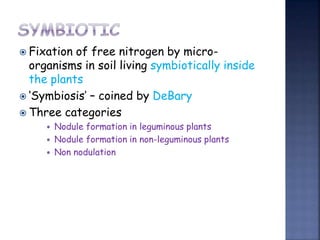
 Fixation of free nitrogen by micro-organisms 
in soil living symbiotically inside 
the plants 
 ‘Symbiosis’ – coined by DeBary 
 Three categories 
 Nodule formation in leguminous plants 
 Nodule formation in non-leguminous plants 
 Non nodulation
 2500 spp. Of family leguminosae ( Cicer 
arientium, Pisum, Cajanus, Arachis) produce 
root nodules with Rhizobium spp. 
 They fix Nitrogen only inside the root 
nodules 
 Association provides-food and shelter to 
bacteria 
-bacteria supply fixed 
nitrogen to plant 
 Nodules may buried in soil even after 
harvesting – continue nitrogen fixation
 Some other plants also produces root 
nodules 
 Causuarina equisetifolia – Frankia 
 Alnus – Frankia 
 Myrica gale – Frankia 
 Parasponia – Rhizobium 
 Leaf nodules are also noted 
 Dioscorea, Psychotria 
 Gymnosperms – root – Podocarpus, 
- leaves – Pavetta zinumermanniana, 
Chomelia
 Lichens - cyanobacteria 
 Anthoceros - Nostoc 
 Azolla – Anabaena azollae 
 Cycas – Nostoc and anabaene 
 Gunnera macrophylla - Nostoc 
 Digitaria, Maize and Sorghum – Spirillum 
notatum 
 Paspalum notatum – Azotobacter paspali
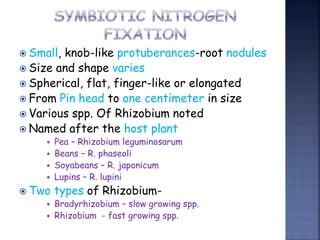
 Small, knob-like protuberances-root nodules 
 Size and shape varies 
 Spherical, flat, finger-like or elongated 
 From Pin head to one centimeter in size 
 Various spp. Of Rhizobium noted 
 Named after the host plant 
 Pea – Rhizobium leguminosarum 
 Beans – R. phaseoli 
 Soyabeans – R. japonicum 
 Lupins – R. lupini 
 Two types of Rhizobium- 
 Bradyrhizobium – slow growing spp. 
 Rhizobium - fast growing spp.
 Gram negative 
 Non spore forming 
 Micro-aerobic 
 Show a degree of specificity 
 The two partners (Bacteria and Host) 
recognized by chemical substance 
LECTINS - phytoagglutinins 
(carbohydrate containing plant protein)
 Root nodules formed due to infection of 
Rhizobium 
 Free living bacteria growing near root of 
legumes unable to fix nitrogen in free 
condition 
 Roots of the legumes secrete some growth 
factors helps in fast multiplication of 
bacteria 
 (E.g.) Pisum sativum secretes homo serine 
also carbohydrate containing protein 
Lectins over their surface
 This helps in recognition and attachment of 
rhizobial cells 
 Rhizobial cells have carbohydrate receptor 
on their surface 
 Lectins interact with the carbohydrate 
receptor of rhizobial cells 
 Occur between root hairs and young root 
hair 
 Bacteria enter the roots through soft 
infected root hairs 
 Tips are deformed and curved 
 Tubular infection thread is formed in the 
root hair cell and bacteria enters into it
 After entry, new cell wall is formed 
 Tubular infection contains 
mucopolysaccharides where bacteria 
embedded and start multiplication 
 It grows much and reaches the inner layers 
of cortex and the bacteria is released 
 It induces the cortical cells to multiply 
which result in the formation of nodule on 
the surface 
 The bacterial cells multiplies and colonize in 
the multiplying host cells
 After host cells are completely filled, 
bacterial cells becomes dormant-bacteroids 
 Float in leghaemoglobin – reddish pigment in 
cytoplasm of host cells 
- Efficient O2 scavenger 
- Maintains steady state of oxygen 
- Stimulates ATP production 
 Present studies indicates that leghaemoglobin 
is not essential 
 Nitrogenous compounds synthesized is 
translocated through vascular tissues 
 Groups of rhizobia surrounded by double 
membrane originated from host cell wall 
 Bacteroids lack firm wall (osmotically liable)
 Basic requirements for Nitrogen fixation 
 Nitrogenase and hydrogenase enzyme 
 Protective mechanism against Oxygen 
 Ferrodoxin 
 Hydrogen releasing system or electron 
donor (Pyruvic acid or glucose/sucrose) 
 Constant supply of ATP 
 Coenzymes and cofactors TPP, CoA, 
inorganic phosphate and Mg+2 
 Cobalt and Molybdenum 
 A carbon compound
 Plays key role 
 Active in anaerobic condition 
 Made up of two protein subunits 
 Non heme iron protein ( Fe-protein or dinitrogen 
reductase) 
 Iron molybdenum protein (Mo Fe-protein or 
dinitrogenase) 
 Fe protein reacts with ATP and reduces 
second subunit which ultimately reduces N2 
into ammonia 
N2 + 6H+ + 6e- 2NH3
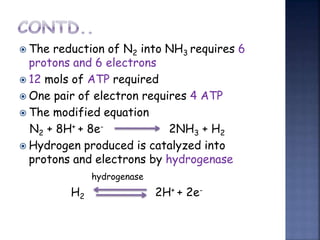
 The reduction of N2 into NH3 requires 6 
protons and 6 electrons 
 12 mols of ATP required 
 One pair of electron requires 4 ATP 
 The modified equation 
N2 + 8H+ + 8e- 2NH3 + H2 
 Hydrogen produced is catalyzed into 
protons and electrons by hydrogenase 
hydrogenase 
H2 2H+ + 2e-
 Glucose-6-phosphate acts as a electron donor 
Sucrose 
(synthesized 
in leaves) 
Sucrose ( in 
roots ) 
Glucose and 
fructose 
Glucose-6- 
phosphate 
 Glucose-6-phosphate is converted to 
phosphogluconic acid 
Glucose-6-phosphate + NADP+ + H2O 6-phosphogluconic acid + NADPH + H+ 
NADPH donates electrons to ferrodoxin. Protons 
released and ferrodoxin is reduced 
 Reduced ferrodoxin acts as electron carrier. 
Donate electron to Fe-protein to reduce it. 
Electrons released from ferrodoxin thus oxidized
 Reduced Fe-protein combines with ATP in the 
presence of Mg +2 
 Second sub unit is activated and reduced 
 It donates electrons to N2 to NH3 
 Enzyme set free after complete reduction of 
N2 to NH3 
Mo – N=NH 
Mo=N-NH2 
MoΞN+NH3 
NΞN 
Mo-NΞN 
Mo + NH3

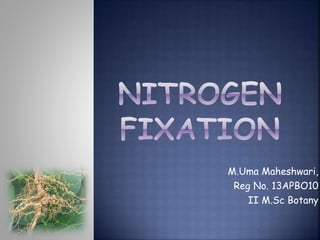
Nitrogen fixation

  • 1.
    M.Uma Maheshwari, RegNo. 13APBO10 II M.Sc Botany
  • 2.
    » Major substancein plants next to water » Building blocks » Constituent element of » Chlorophyll » Cytochromes » Alkaloids » Many vitamins » Plays important role in metabolism, growth, reproduction and heredity
  • 3.
     Atmospheric Nitrogen  78% of atmosphere  Plants cannot utilize this form  Some Bacteria, Blue Green Algae, leguminous plants  Nitrates, Nitrites and Ammonia  Nitrate is chief form Amino acids in the soil  Many soil organisms use this form  Higher plants can also taken by higher plants  Organic Nitrogenous compounds in insects  Insectivorous plants
  • 4.
     The conversionof free nitrogen into nitrogenous salts to make it available for absorption of plants
  • 5.
    Nitrogen fixation Nonbiological Biological Non - symbiotic Symbiotic
  • 6.
     The micro-organismsdo not take place  Found in rainy season during lightning 1. N2 + O2 lightning 2 NO (Nitric oxide) 2. 2NO + O2 oxidation 2NO2 ( Nitrogen per oxide) 3. 2NO2 + H2O HNO2 + HNO3 4. 4NO2 + 2H2O + O2 4HNO3 (Nitric acid) 5. CaO + 2HNO3 Ca (NO3)2 + H2O (Calcium nitrate) 6. HNO3 + NH3 NH4NO3 (Ammonium nitrate) 7. HNO2 + NH3 NH4NO2 (Ammonium nitrite)
  • 7.
     Fixation ofatmospheric Nitrogen into nitrogenous salts with the help of micro-organisms  Two types  Symbiotic  Non-symbiotic
  • 8.
    o Fixation carriedout by free living micro-organisms o Aerobic, anaerobic and blue green algae o Bacteria: special type (nitrogen fixing bacteria) types - o Free living aerobic : Azotobacter, Beijerenckia o Free living anaerobic : Clostridium o Free living photosynthetic : Chlorobium, Rhodopseudomonas o Free living chemosynthetic :Desulfovibro,Thiobacillus
  • 9.
    o Free livingfungi: yeasts and Pillularia o Blue green algae: o unicellular – Gloeothece, Synechococcus o Filamentous (non heterocystous) -Oscillatoria o Filamentous (heterocystous) – Tolypothrix, Nostoc, Anabaena
  • 10.
     Fixation offree nitrogen by micro-organisms in soil living symbiotically inside the plants  ‘Symbiosis’ – coined by DeBary  Three categories  Nodule formation in leguminous plants  Nodule formation in non-leguminous plants  Non nodulation
  • 11.
     2500 spp.Of family leguminosae ( Cicer arientium, Pisum, Cajanus, Arachis) produce root nodules with Rhizobium spp.  They fix Nitrogen only inside the root nodules  Association provides-food and shelter to bacteria -bacteria supply fixed nitrogen to plant  Nodules may buried in soil even after harvesting – continue nitrogen fixation
  • 12.
     Some otherplants also produces root nodules  Causuarina equisetifolia – Frankia  Alnus – Frankia  Myrica gale – Frankia  Parasponia – Rhizobium  Leaf nodules are also noted  Dioscorea, Psychotria  Gymnosperms – root – Podocarpus, - leaves – Pavetta zinumermanniana, Chomelia
  • 13.
     Lichens -cyanobacteria  Anthoceros - Nostoc  Azolla – Anabaena azollae  Cycas – Nostoc and anabaene  Gunnera macrophylla - Nostoc  Digitaria, Maize and Sorghum – Spirillum notatum  Paspalum notatum – Azotobacter paspali
  • 14.
     Small, knob-likeprotuberances-root nodules  Size and shape varies  Spherical, flat, finger-like or elongated  From Pin head to one centimeter in size  Various spp. Of Rhizobium noted  Named after the host plant  Pea – Rhizobium leguminosarum  Beans – R. phaseoli  Soyabeans – R. japonicum  Lupins – R. lupini  Two types of Rhizobium-  Bradyrhizobium – slow growing spp.  Rhizobium - fast growing spp.
  • 15.
     Gram negative  Non spore forming  Micro-aerobic  Show a degree of specificity  The two partners (Bacteria and Host) recognized by chemical substance LECTINS - phytoagglutinins (carbohydrate containing plant protein)
  • 16.
     Root nodulesformed due to infection of Rhizobium  Free living bacteria growing near root of legumes unable to fix nitrogen in free condition  Roots of the legumes secrete some growth factors helps in fast multiplication of bacteria  (E.g.) Pisum sativum secretes homo serine also carbohydrate containing protein Lectins over their surface
  • 17.
     This helpsin recognition and attachment of rhizobial cells  Rhizobial cells have carbohydrate receptor on their surface  Lectins interact with the carbohydrate receptor of rhizobial cells  Occur between root hairs and young root hair  Bacteria enter the roots through soft infected root hairs  Tips are deformed and curved  Tubular infection thread is formed in the root hair cell and bacteria enters into it
  • 21.
     After entry,new cell wall is formed  Tubular infection contains mucopolysaccharides where bacteria embedded and start multiplication  It grows much and reaches the inner layers of cortex and the bacteria is released  It induces the cortical cells to multiply which result in the formation of nodule on the surface  The bacterial cells multiplies and colonize in the multiplying host cells
  • 22.
     After hostcells are completely filled, bacterial cells becomes dormant-bacteroids  Float in leghaemoglobin – reddish pigment in cytoplasm of host cells - Efficient O2 scavenger - Maintains steady state of oxygen - Stimulates ATP production  Present studies indicates that leghaemoglobin is not essential  Nitrogenous compounds synthesized is translocated through vascular tissues  Groups of rhizobia surrounded by double membrane originated from host cell wall  Bacteroids lack firm wall (osmotically liable)
  • 23.
     Basic requirementsfor Nitrogen fixation  Nitrogenase and hydrogenase enzyme  Protective mechanism against Oxygen  Ferrodoxin  Hydrogen releasing system or electron donor (Pyruvic acid or glucose/sucrose)  Constant supply of ATP  Coenzymes and cofactors TPP, CoA, inorganic phosphate and Mg+2  Cobalt and Molybdenum  A carbon compound
  • 24.
     Plays keyrole  Active in anaerobic condition  Made up of two protein subunits  Non heme iron protein ( Fe-protein or dinitrogen reductase)  Iron molybdenum protein (Mo Fe-protein or dinitrogenase)  Fe protein reacts with ATP and reduces second subunit which ultimately reduces N2 into ammonia N2 + 6H+ + 6e- 2NH3
  • 25.
     The reductionof N2 into NH3 requires 6 protons and 6 electrons  12 mols of ATP required  One pair of electron requires 4 ATP  The modified equation N2 + 8H+ + 8e- 2NH3 + H2  Hydrogen produced is catalyzed into protons and electrons by hydrogenase hydrogenase H2 2H+ + 2e-
  • 26.
     Glucose-6-phosphate actsas a electron donor Sucrose (synthesized in leaves) Sucrose ( in roots ) Glucose and fructose Glucose-6- phosphate  Glucose-6-phosphate is converted to phosphogluconic acid Glucose-6-phosphate + NADP+ + H2O 6-phosphogluconic acid + NADPH + H+ NADPH donates electrons to ferrodoxin. Protons released and ferrodoxin is reduced  Reduced ferrodoxin acts as electron carrier. Donate electron to Fe-protein to reduce it. Electrons released from ferrodoxin thus oxidized
  • 27.
     Reduced Fe-proteincombines with ATP in the presence of Mg +2  Second sub unit is activated and reduced  It donates electrons to N2 to NH3  Enzyme set free after complete reduction of N2 to NH3 Mo – N=NH Mo=N-NH2 MoΞN+NH3 NΞN Mo-NΞN Mo + NH3