N. H. Shankar reddy
IInd M.Sc., (Plant Pathology)
Annamalai university
Generalized Transduction
Occurs during lytic cycle of virulent phage
During viral assembly, fragments of host DNA mistaken and any part of bacterial genome
can be transferred
 DNA fragment is transferred from one bacterium to another by a lytic bacteriophage that
carrying donor bacterial DNA due to an error in maturation during the lytic life cycle.
Transduction
Zinder and Lederberg’ s (1952)
Genetic recombination in which a DNA fragment is transferred from one
bacterium to another by a bacteriophage
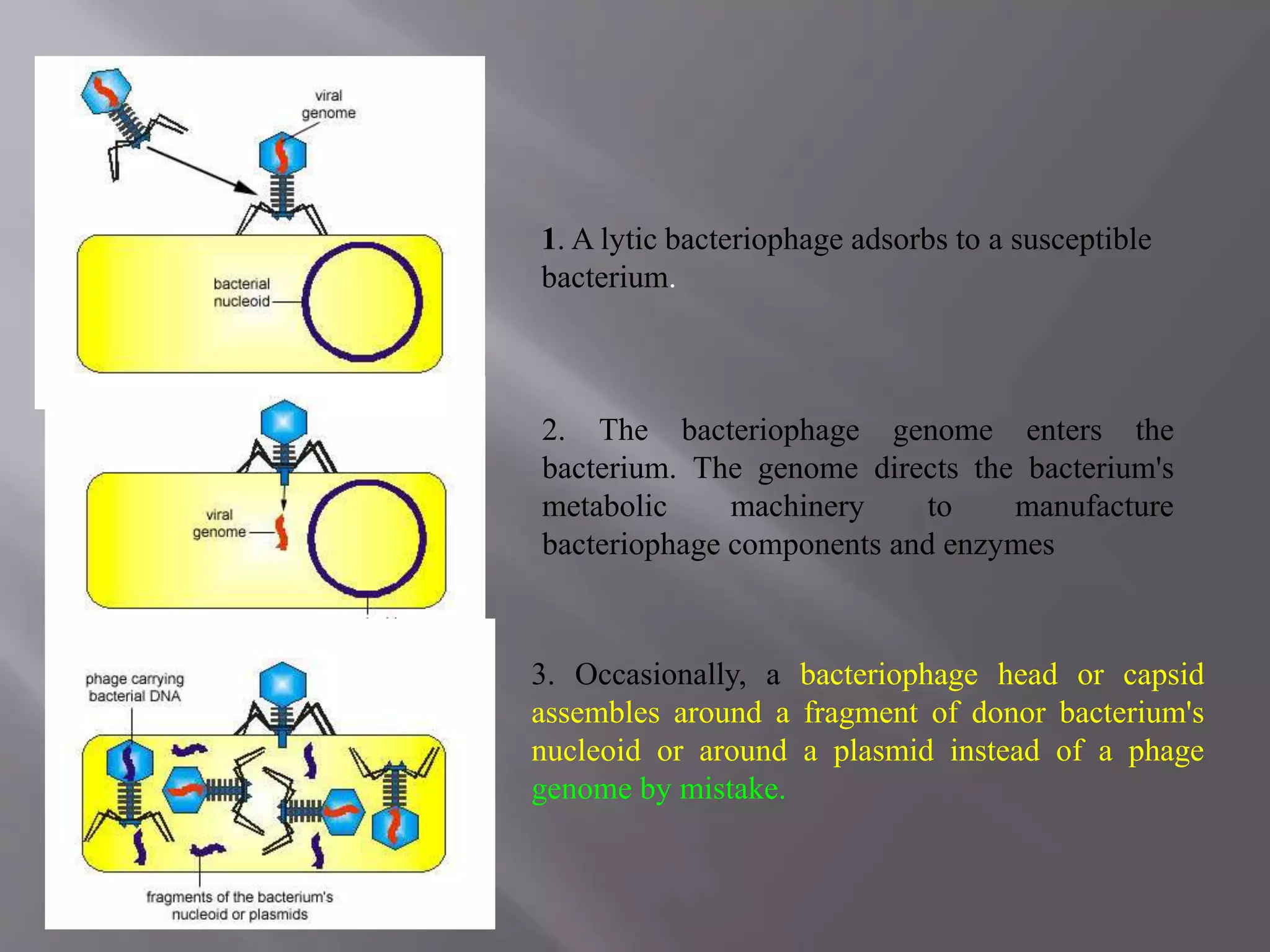
1. A lytic bacteriophage adsorbs to a susceptible
bacterium.
2. The bacteriophage genome enters the
bacterium. The genome directs the bacterium's
metabolic machinery to manufacture
bacteriophage components and enzymes
3. Occasionally, a bacteriophage head or capsid
assembles around a fragment of donor bacterium's
nucleoid or around a plasmid instead of a phage
genome by mistake.
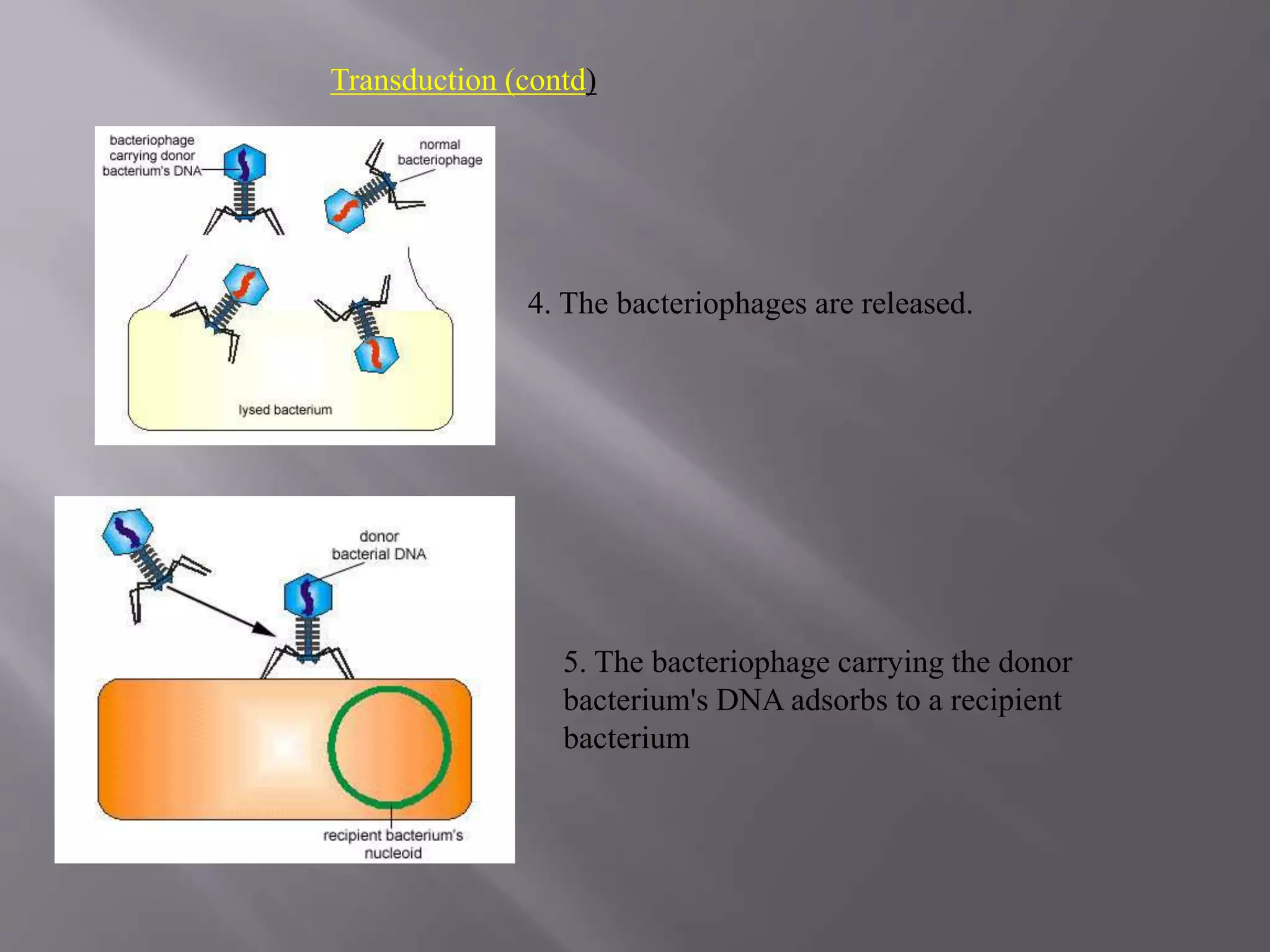
4. The bacteriophages are released.
5. The bacteriophage carrying the donor
bacterium's DNA adsorbs to a recipient
bacterium
Transduction (contd)
6. The bacteriophage inserts the donor
bacterium's DNA it is carrying into the
recipient bacterium.
7. The donor bacterium's DNA is exchanged for
some of the recipient's DNA.
Destruction of
the bacteria’s
DNA
Lysis
Replication of
the viral
genome
Production of
viral parts
Packaging
Infection
Specialized Transduction
Carried out only by temperate phages that have established lysogeny
Only specific portion of bacterial genome is transferred
A DNA fragment is transferred from one bacterium to another by a
temperate bacteriophage carrying donor bacterial DNA during the
lysogenic life cycle
Six steps in Specialised Transduction
1. A temperate bacteriophage adsorbs
to a susceptible bacterium and injects
its genome .
2. The bacteriophage inserts its genome into the
bacterium's nucleoid to become a prophage.
3. Occasionally during spontaneous induction, a
small piece of the donor bacterium's DNA is picked
up as part of the phage's genome in place of some
of the phage DNA which remains in the bacterium's
nucleoid.
4. As the bacteriophage replicates, the segment of
bacterial DNA replicates as part of the phage's
genome. Every phage now carries that segment of
bacterial DNA.
5. The bacteriophage adsorbs to a recipient
bacterium and injects its genome.
6. The bacteriophage genome carrying the
donor bacterial DNA inserts into the recipient
bacterium's nucleoid.
Temperate
Phage
Part of the
bacteria’s
DNA
Replication of
the viral
genome
Production of
viral parts
PackagingLysis
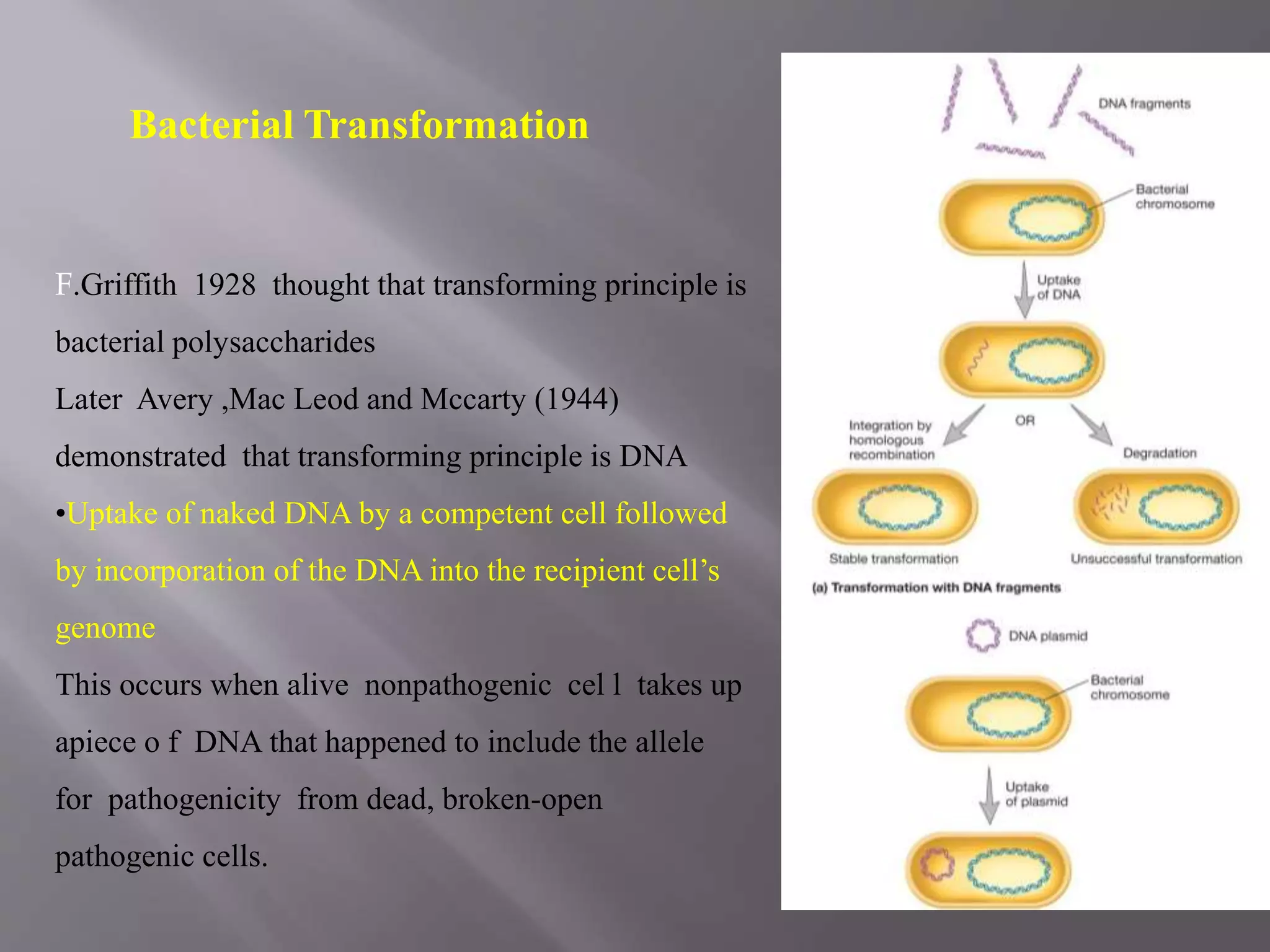
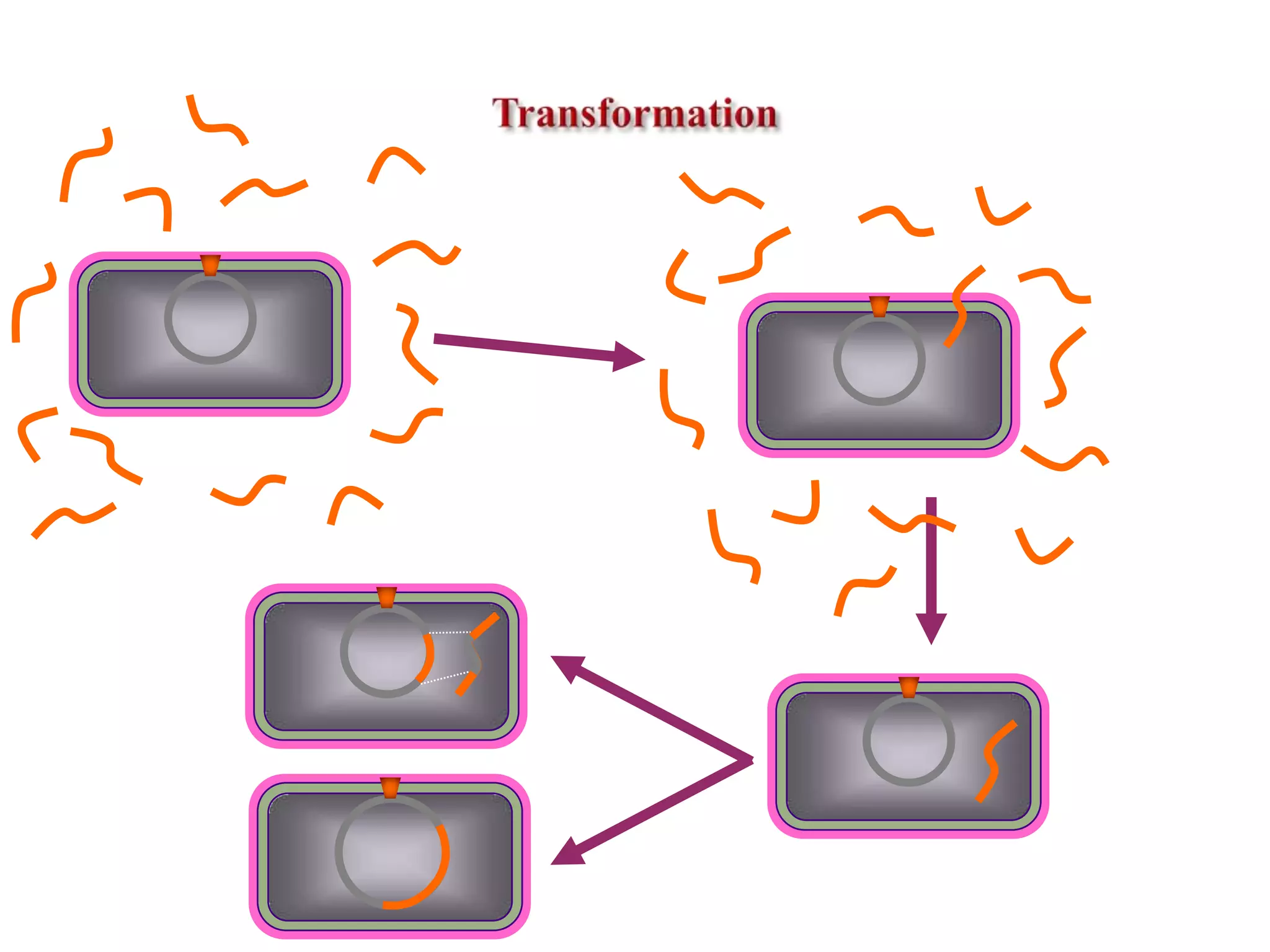
Bacterial Transformation
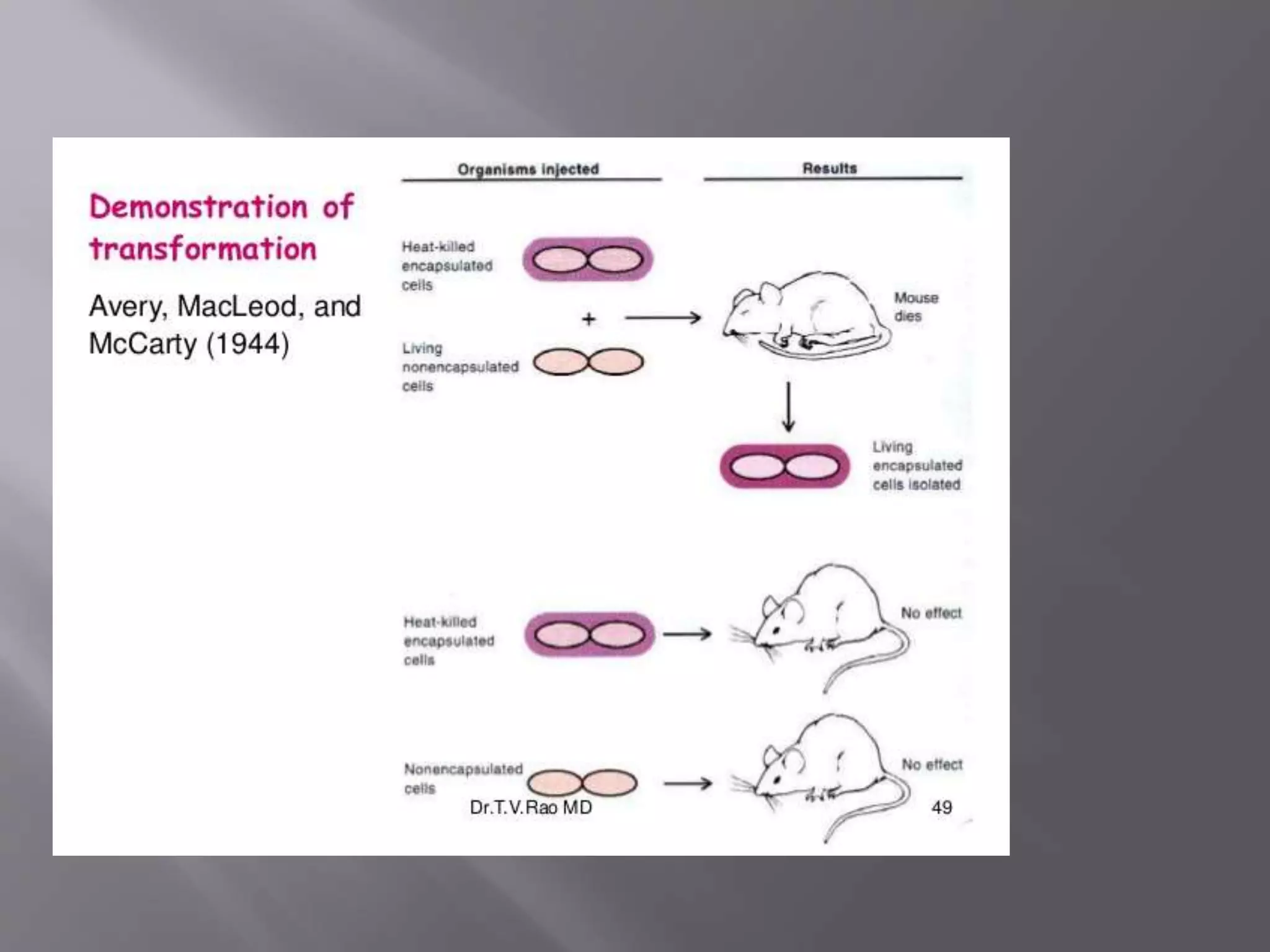
F.Griffith 1928 thought that transforming principle is
bacterial polysaccharides
Later Avery ,Mac Leod and Mccarty (1944)
demonstrated that transforming principle is DNA
•Uptake of naked DNA by a competent cell followed
by incorporation of the DNA into the recipient cell’s
genome
This occurs when alive nonpathogenic cel l takes up
apiece o f DNA that happened to include the allele
for pathogenicity from dead, broken-open
pathogenic cells.
Insertion
Crossing
over
DNA Uptake in Bacterial
Transformation
Protein system allows DNA to
move across cell walls
Gram-negatives
•PilQ aids in movement across
outer membrane
•Pilin complex (PilE) moves DNA
across periplasm and
peptidoglycan
•ComE is DNA binding protein
•N is nuclease that degrades one
strand
•ComA forms transmembrane
channel
–Similar system in Gram-pos
1. A donor bacterium dies and is degraded
2. A fragment of DNA from the dead
donor bacterium binds to DNA binding
proteins on the cell wall of a
competent, living recipient bacterium
3. The Rec A protein promotes genetic
exchange between a fragment of the donor's
DNA and the recipient's DNA
4. Exchange is complete
Bacterial Conjugation is genetic recombination in which there is a transfer of DNA
from a living donor bacterium to a recipient bacterium via direct contact
between donar cell to recipient cell . Often involves a sex pilus.
J. Lederberg and E. Tatum (1946) discovered in Escherichia coli
 direct cell to cell contact mediated by the F pilus
 –unidirectional DNA transfer from donor to recipient
 F factor plasmid contains own origin of replication ori V and origin of
transfer ori T . Bacterium containing F plasmid known as F + plasmid and
those lack F plasmid are called as F – plasmid . F plasmid is transferred
through conjugation from F + cell to F – cell. Transformed recipient cell get
new properties viz., antibiotics resisatance , xenobiotic tolerance and ability to
utilize new metabolite
The important loci play a major role in gene transfer
tra and trb loci
tra loci contains pilin gene and regulatory gene which together form pili
on the cell surface ,polymeric protein themselves attached to the surface
of the F – plasmid
Exact mechanism not yet known
The tra D enzyme located at the base of the pilus involve in DNA
exchange
State of Existence of Ti plasmid
I. F
+
conjugation
II. Hfr conjugation(High frequency recombination)
III. Primary F cells
IV. Secondary F cells
III. Resistance plasmid conjugation
I. F
+
conjugation
Recipient cells get complete copy of the F genome and become F+ cells .
Only one copy of the F plasmid exists in bacterial cell in free from or
integrated into bacterial chromosome
1. The F+ male has an F+ plasmid coding for a sex
pilus and can serve as a genetic donor
2. The sex pilus adheres to an F- female (recipient).
One strand of the F+ plasmid breaks . A bridge is
created between the two bacteria
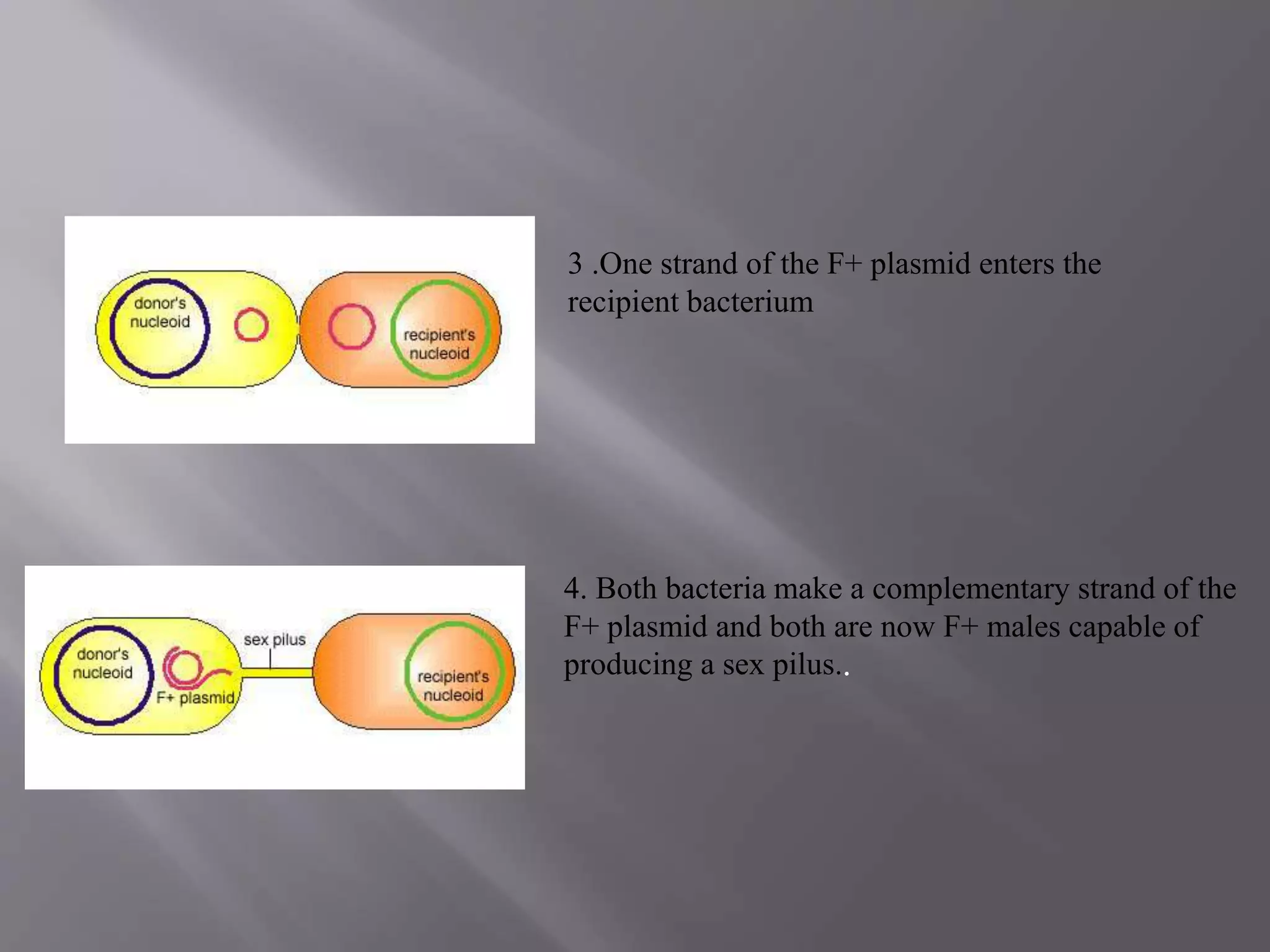
3 .One strand of the F+ plasmid enters the
recipient bacterium
4. Both bacteria make a complementary strand of the
F+ plasmid and both are now F+ males capable of
producing a sex pilus..
F plasmid
Mating
Bridge
F- bacteria
New
F+ bacteria
F+ bacteria
Original
F+ bacteria
 When F-plasmid DNA remains integrated into chromosomal DNA the bacterial
cell is called Hfr cells.
 The integration of F factor and chromosome (by crossing over ) occurs in about
once per 105 cells at each genaration
 During conjugation between Hfr cells and F – cells some part of the chromosomal
DNA get transferred along with plasmid DNA to the F – cells . The recipient
cells (F – cells ) become diploid for some homologous portion of its
chromosomal DNA which is called as partial zygote or merozygote
 The amount of chromosomal DNA to be transformed depends on the lenth of the
time remain in contact
 In E.coli the transfer of the entire bacterial chromosome takes about 100 minutes
1. An F+ plasmid inserts into the donor bacterium's
nucleoid to form an Hfr male.
2. The sex pilus adheres to an F- female
(recipient). One donor DNA strand breaks in
the middle of the inserted F+ plasmid.
3. The sex pilus retracts and a bridge forms
between the two bacteria. One donor DNA strand
begins to enter the recipient bacterium. The two
cells break apart easily so the only a portion of
the donor's DNA strand is usually transferred to
the recipient bacterium.
4. The donor bacterium makes a complementary
copy of the remaining DNA strand and remains
an Hfr male. The recipient bacterium makes a
complementary strand of the transferred donor
DNA.
5. The donor DNA fragment undergoes genetic
exchange with the recipient bacterium's DNA.
Transfer of
genetic material
F+ bacteria
F- bacteria
F plasmid
Integration
Hfr cell
F+ bacteria
F- bacteria
Crossing over Transfer of
genetic
Interruption
of
conjugation
Hfr cellF plasmid
Integration
Primary F + cells
Hfr cells reverse back back to F + cells and vice versa.
F genome in the bacteria converts its in to free form (F + state) from
integrated form(Hfr state ) .During reversion process from Hfr to F + form
it is not always possible to get back the original genome , F genome
contain certain segments of chromosomal DNA .The progeny of such cell
is called as Primary F + cells
II. Secondary F cells
The progeny developed from the conjugation between Primary F +
cells and F - cells is called as Secondary F cells
4 steped Resistant Plasmid Conjugation
1. The bacterium with an R-plasmid is multiple
antibiotic resistant and can produce a sex pilus
(serve as a genetic donor).
2. The sex pilus adheres to an F- female
(recipient). One strand of the R-plasmid breaks.
3. The sex pilus retracts and a bridge is created
between the two bacteria. One strand of the R-
plasmid enters the recipient bacterium.
4. Both bacteria make a complementary strand of
the R-plasmid and both are now multiple antibiotic
resistant and capable of producing a sex pilus.
Reproduction in bacteria

Reproduction in bacteria

  • 1.
    N. H. Shankarreddy IInd M.Sc., (Plant Pathology) Annamalai university
  • 2.
    Generalized Transduction Occurs duringlytic cycle of virulent phage During viral assembly, fragments of host DNA mistaken and any part of bacterial genome can be transferred  DNA fragment is transferred from one bacterium to another by a lytic bacteriophage that carrying donor bacterial DNA due to an error in maturation during the lytic life cycle. Transduction Zinder and Lederberg’ s (1952) Genetic recombination in which a DNA fragment is transferred from one bacterium to another by a bacteriophage
  • 3.
    1. A lyticbacteriophage adsorbs to a susceptible bacterium. 2. The bacteriophage genome enters the bacterium. The genome directs the bacterium's metabolic machinery to manufacture bacteriophage components and enzymes 3. Occasionally, a bacteriophage head or capsid assembles around a fragment of donor bacterium's nucleoid or around a plasmid instead of a phage genome by mistake.
  • 4.
    4. The bacteriophagesare released. 5. The bacteriophage carrying the donor bacterium's DNA adsorbs to a recipient bacterium Transduction (contd)
  • 5.
    Transduction (contd) 6. Thebacteriophage inserts the donor bacterium's DNA it is carrying into the recipient bacterium. 7. The donor bacterium's DNA is exchanged for some of the recipient's DNA.
  • 6.
    Destruction of the bacteria’s DNA Lysis Replicationof the viral genome Production of viral parts Packaging Infection
  • 7.
    Specialized Transduction Carried outonly by temperate phages that have established lysogeny Only specific portion of bacterial genome is transferred A DNA fragment is transferred from one bacterium to another by a temperate bacteriophage carrying donor bacterial DNA during the lysogenic life cycle
  • 8.
    Six steps inSpecialised Transduction 1. A temperate bacteriophage adsorbs to a susceptible bacterium and injects its genome . 2. The bacteriophage inserts its genome into the bacterium's nucleoid to become a prophage.
  • 9.
    3. Occasionally duringspontaneous induction, a small piece of the donor bacterium's DNA is picked up as part of the phage's genome in place of some of the phage DNA which remains in the bacterium's nucleoid. 4. As the bacteriophage replicates, the segment of bacterial DNA replicates as part of the phage's genome. Every phage now carries that segment of bacterial DNA.
  • 10.
    5. The bacteriophageadsorbs to a recipient bacterium and injects its genome. 6. The bacteriophage genome carrying the donor bacterial DNA inserts into the recipient bacterium's nucleoid.
  • 11.
    Temperate Phage Part of the bacteria’s DNA Replicationof the viral genome Production of viral parts PackagingLysis
  • 14.
    Bacterial Transformation F.Griffith 1928thought that transforming principle is bacterial polysaccharides Later Avery ,Mac Leod and Mccarty (1944) demonstrated that transforming principle is DNA •Uptake of naked DNA by a competent cell followed by incorporation of the DNA into the recipient cell’s genome This occurs when alive nonpathogenic cel l takes up apiece o f DNA that happened to include the allele for pathogenicity from dead, broken-open pathogenic cells.
  • 15.
  • 16.
    DNA Uptake inBacterial Transformation Protein system allows DNA to move across cell walls Gram-negatives •PilQ aids in movement across outer membrane •Pilin complex (PilE) moves DNA across periplasm and peptidoglycan •ComE is DNA binding protein •N is nuclease that degrades one strand •ComA forms transmembrane channel –Similar system in Gram-pos
  • 17.
    1. A donorbacterium dies and is degraded 2. A fragment of DNA from the dead donor bacterium binds to DNA binding proteins on the cell wall of a competent, living recipient bacterium
  • 18.
    3. The RecA protein promotes genetic exchange between a fragment of the donor's DNA and the recipient's DNA 4. Exchange is complete
  • 19.
    Bacterial Conjugation isgenetic recombination in which there is a transfer of DNA from a living donor bacterium to a recipient bacterium via direct contact between donar cell to recipient cell . Often involves a sex pilus. J. Lederberg and E. Tatum (1946) discovered in Escherichia coli  direct cell to cell contact mediated by the F pilus  –unidirectional DNA transfer from donor to recipient  F factor plasmid contains own origin of replication ori V and origin of transfer ori T . Bacterium containing F plasmid known as F + plasmid and those lack F plasmid are called as F – plasmid . F plasmid is transferred through conjugation from F + cell to F – cell. Transformed recipient cell get new properties viz., antibiotics resisatance , xenobiotic tolerance and ability to utilize new metabolite
  • 20.
    The important lociplay a major role in gene transfer tra and trb loci tra loci contains pilin gene and regulatory gene which together form pili on the cell surface ,polymeric protein themselves attached to the surface of the F – plasmid Exact mechanism not yet known The tra D enzyme located at the base of the pilus involve in DNA exchange
  • 21.
    State of Existenceof Ti plasmid I. F + conjugation II. Hfr conjugation(High frequency recombination) III. Primary F cells IV. Secondary F cells III. Resistance plasmid conjugation
  • 22.
    I. F + conjugation Recipient cellsget complete copy of the F genome and become F+ cells . Only one copy of the F plasmid exists in bacterial cell in free from or integrated into bacterial chromosome
  • 23.
    1. The F+male has an F+ plasmid coding for a sex pilus and can serve as a genetic donor 2. The sex pilus adheres to an F- female (recipient). One strand of the F+ plasmid breaks . A bridge is created between the two bacteria
  • 24.
    3 .One strandof the F+ plasmid enters the recipient bacterium 4. Both bacteria make a complementary strand of the F+ plasmid and both are now F+ males capable of producing a sex pilus..
  • 25.
    F plasmid Mating Bridge F- bacteria New F+bacteria F+ bacteria Original F+ bacteria
  • 26.
     When F-plasmidDNA remains integrated into chromosomal DNA the bacterial cell is called Hfr cells.  The integration of F factor and chromosome (by crossing over ) occurs in about once per 105 cells at each genaration  During conjugation between Hfr cells and F – cells some part of the chromosomal DNA get transferred along with plasmid DNA to the F – cells . The recipient cells (F – cells ) become diploid for some homologous portion of its chromosomal DNA which is called as partial zygote or merozygote  The amount of chromosomal DNA to be transformed depends on the lenth of the time remain in contact  In E.coli the transfer of the entire bacterial chromosome takes about 100 minutes
  • 27.
    1. An F+plasmid inserts into the donor bacterium's nucleoid to form an Hfr male. 2. The sex pilus adheres to an F- female (recipient). One donor DNA strand breaks in the middle of the inserted F+ plasmid.
  • 28.
    3. The sexpilus retracts and a bridge forms between the two bacteria. One donor DNA strand begins to enter the recipient bacterium. The two cells break apart easily so the only a portion of the donor's DNA strand is usually transferred to the recipient bacterium. 4. The donor bacterium makes a complementary copy of the remaining DNA strand and remains an Hfr male. The recipient bacterium makes a complementary strand of the transferred donor DNA.
  • 29.
    5. The donorDNA fragment undergoes genetic exchange with the recipient bacterium's DNA.
  • 30.
    Transfer of genetic material F+bacteria F- bacteria F plasmid Integration Hfr cell
  • 31.
    F+ bacteria F- bacteria Crossingover Transfer of genetic Interruption of conjugation Hfr cellF plasmid Integration
  • 32.
    Primary F +cells Hfr cells reverse back back to F + cells and vice versa. F genome in the bacteria converts its in to free form (F + state) from integrated form(Hfr state ) .During reversion process from Hfr to F + form it is not always possible to get back the original genome , F genome contain certain segments of chromosomal DNA .The progeny of such cell is called as Primary F + cells II. Secondary F cells The progeny developed from the conjugation between Primary F + cells and F - cells is called as Secondary F cells
  • 33.
    4 steped ResistantPlasmid Conjugation 1. The bacterium with an R-plasmid is multiple antibiotic resistant and can produce a sex pilus (serve as a genetic donor). 2. The sex pilus adheres to an F- female (recipient). One strand of the R-plasmid breaks.
  • 34.
    3. The sexpilus retracts and a bridge is created between the two bacteria. One strand of the R- plasmid enters the recipient bacterium. 4. Both bacteria make a complementary strand of the R-plasmid and both are now multiple antibiotic resistant and capable of producing a sex pilus.