BACTERIAL GENETICS
 Genetics is the study of
genes including the structure of genetic materials,
what information is stored in the genes,
 how the genes are expressed and
how the genetic information is transferred.
Genetics is also the study of heredity and variation.
 Genes are sequences of nucleotides (Phosphate group,
Pentose sugar and Nitrogenous base) within DNA that code
for functional proteins.
 The two essential functions of genetic material are
replication and
expression.
Structure of DNA
• The DNA molecule is composed of two chains of
nucleotides around each other in the form of “double helix”.
• Double-stranded DNA is helical, and the two strands in the
helix are anti-parallel.
• The backbone of each strand comprises of repeating units of
deoxyribose and phosphate residue.
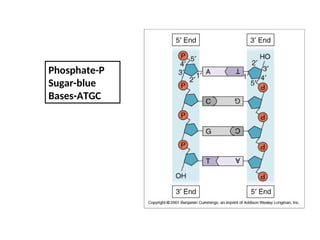
Phosphate-P
Sugar-blue
Bases-ATGC
The double helix is stabilized by
hydrogen bonds between purine and pyrimidine bases on
the opposite strands.
A on one strand pairs by two hydrogen bonds with T on
the opposite strand, or G pairs by three hydrogen bonds
with C.
The two strands of double-helical DNA are, therefore
complementary.
Structure of chromosome
 In contrast to the linear chromosomes found in eukaryotic
cells, most bacteria have single, covalently closed, circular
chromosomes.
 The chromosome of E coli has a length of approximately
1.35 mm, then looped and supercoiled to allow the
chromosome to fit into the small space inside the cell.
Codon
 A set of three base pairs which codes for a single amino
acid.
 redundant because more than one codon may exist for the
same amino acid (e.g. AGA, AGG, CGU, CGC, CGA and
CGG all code for arginine).
 3 codons (UAA, UAG and UGA) are nonsense codons and
they don’t code for any amino acid, but act as stop codons.
• The start codon (AUG) indicates the beginning of the
sequence to be translated, and the stop codons (UAA, UGA,
UAG) terminate the protein synthesis.
• With the exception of methionine, all amino acids are coded
by more than one codon.
Flow of genetic information
• The central dogma of molecular biology is that DNA carries
all genetic information.
• The flow of genetic information includes:
 the replication of DNA to make more DNA by DNA
polymerases.
 the transcription of the DNA into mRNA and
 the translation of mRNA into proteins (mRNA guided to
the ribosomes for protein translation).
Transformation:
 Involves the uptake of free or naked DNA released from
donor by a recipient.
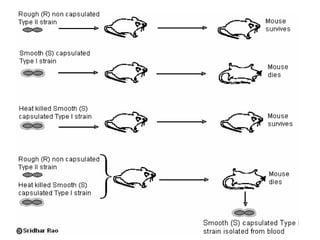
 The presence of a capsule around some strains of
pneumococci gives the colonies a glistening, smooth (S)
appearance while pneumococci lacking capsules have
produce rough (R) colonies.
 Strains of pneumococci with a capsule (type I) are virulent
and can kill a mouse whereas strains lacking it (type II) are
harmless.
The steps involved in transformation are:
1. A donor bacterium dies and is degraded.
2. A fragment of DNA from the dead donor bacterium binds
to DNA binding proteins on the cell wall of a competent,
living recipient bacterium.
3. Nuclease enzymes then cut the bound DNA into
fragments.
4. One strand is destroyed and the other penetrates the
recipient bacterium.
5. The RecA protein promotes genetic exchange
(recombination) between a fragment of the donor's DNA
and the recipient's DNA.
CONJUGATION:
 Bacterial conjugation is the transfer of DNA from a living
donor bacterium to a recipient bacterium.
 Plasmids are small autonomously replicating circular pieces of
double-stranded circular DNA.
 Conjugation involves the transfer of plasmids from donor
bacterium to recipient bacterium.
 Some plasmids are designated as F factor (F plasmid, fertility
factor or sex factor) because they carry genes that mediate their
own transfer.
 The F factor can replicate autonomously in the cell.
 These genes code for the production of the sex pilus and enzymes
necessary for conjugation.
 Cells possessing F plasmids are F+ (male) and act as donors.
 Those cells lacking this plasmid are F- (female) and act as
recipient.
 Each Gram negative F+ bacterium has 1 to 3 sex pili that bind to a
specific outer membrane protein on recipient bacteria to initiate
mating.
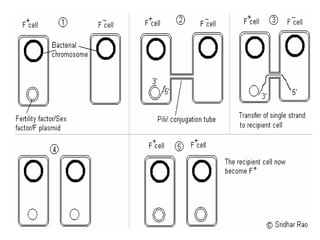
1. F+ conjugation:
This results in the transfer of an F+ plasmid (coding
only for a sex pilus) but not chromosomal DNA from
a male donor bacterium to a female recipient
bacterium.
During conjugation, no cytoplasm or cell material
except DNA passes from donor to recipient.
Following successful conjugation the recipient
becomes F+ and the donor remains F+.
2. Resistance plasmid conjugation:
Some Gram-negative bacteria harbor plasmids that contain
antibiotic resistance genes, such plasmids are called R
factors.
The R factor has two components, one that codes for self
transfer (like F factor) called RTF (resistance transfer
factor) and the other R determinant that contains genes
coding for antibiotic resistance.
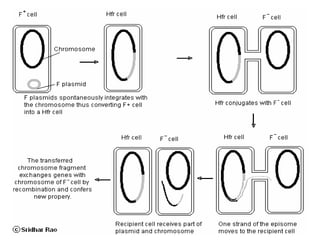
3. Hfr (high frequency recombinant) conjugation:
A plasmid that is capable of integrating into the
chromosome is called an episome.
If the F plasmid is integrated into the chromosome it is
called an Hfr cell.
Hfr cells are called so because they are able to transfer
chromosomal genes to recipient cells with high
frequency.
Transduction
 Bacteriophages are viruses that parasitize bacteria and use
their machinery for their own replication.
 During the process of replication inside the host bacteria the
bacterial chromosome or plasmid is incorrectly packaged into
the bacteriophage capsid.
 Thus newer progeny of phages may contain fragments of
host chromosome along with their own DNA or entirely host
chromosome.
 When such phage infects another bacterium, the bacterial
chromosome in the phage also gets transferred to the new
bacterium.
 This fragment may undergo recombination with the host
chromosome and confer new property to the bacterium.
 Life cycle of bacteriophage may either by:
 lytic (parasitized bacterial cell is killed with the release
of mature phages) or
lysogenic (the phage DNA gets incorporated into the
bacterial chromosome as prophage).
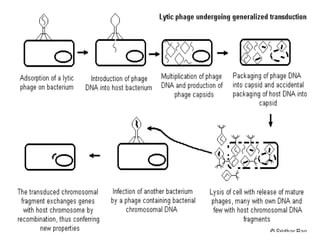
Following are the stages of transduction involving a lytic
phage:
1. A lytic bacteriophage adsorbs to a susceptible bacterium.
2. The bacteriophage genome enters the bacterium.
The phage DNA directs the bacterium's metabolic
machinery to manufacture bacteriophage components
and enzymes.
3. Occasionally during maturation, a bacteriophage capsid
incorporates a fragment of donor bacterium's chromosome
or a plasmid instead of a phage genome by mistake.
4. The bacteriophages are released with the lysis of bacterium.
5. The bacteriophage carrying the donor bacterium's DNA
adsorbs to another recipient bacterium.
6. The bacteriophage inserts the donor bacterium's DNA it is
carrying into the recipient bacterium.
7. The donor bacterium's DNA is exchanged by recombination
for some of the recipient's DNA.
 Two types of transduction are known;
o restricted transduction and
o generalized transduction.
 Generalized transduction can transfer any bacterial gene to the
recipient.
 This process may occur with phages (lytic phages) that degrade their
host DNA into pieces the size of viral genomes.
 In restricted transduction only those chromosomal genes that lie
adjacent to the prophage are transmitted.
PLASMIDS:
 Extrachromosomal elements found inside a bacterium.
 Not essential for the survival of the bacterium but they confer certain extra
advantages to the cell.
 Number and size:
 A bacterium can have no plasmids at all or have many plasmids (20-30) or
multiple copies of a plasmid.
 Their size can vary from 1 Kb to 400 Kb.
 Multiplication:
 Multiply independently of the chromosome and are inherited regularly by the
daughter cells.
 Those bacteria that possess transfer factor are called F+
, such
bacteria have sex pili on their surface.
 Those cells lacking this factor are designated F-.
 The F factor plasmid is transferred to other cells through
conjugation.
 An F-
cell will become F+
when it receives the fertility factor from
another F+
cell.
 R factor:
Code for the transmissible drug resistance
Contain genes that code for resistance to many antibiotics.
Transferred by conjugation and its transfer to other bacteria is
independent of the F factor.
Significance of plasmids:
1. Codes for resistance to several antibiotics.
2. Codes for the production of bacteriocins.
3. Codes for the production of toxins
4. Codes for resistance to heavy metals
5. To carry virulence determinant genes.
6. Codes resistance to UV light (DNA repair enzymes are
coded in the plasmid).
7. Codes for colonization factors that is necessary for their
attachment.
8. Contains genes coding for enzymes that allow bacteria
unique or unusual materials for carbon or energy
sources. Some strains are used for cleaning oil spillage.
Genetic mechanism of drug resistance:
 Antibiotic resistance in bacteria may either be intrinsic or
acquired.
 Intrinsic resistance means that the bacteria were resistant to the
antibiotic even before the antibiotic was introduced.
 Acquired resistance means that a bacterium that was previously
sensitive to an antibiotic has now turned resistant.
The physiological mechanisms of antibiotic resistance include:
 Inactivation of the antibiotic by enzymes produced by the
bacteria
 Alteration of target proteins such that the antibiotic doesn’t bind
or binds with decreased affinity
 Alteration of the membrane which decreases the permeability of
the antibiotic
 Active efflux of the antibiotic
 Development of alternate metabolic pathway to bypass the action
of antibiotic
Bacterial Metabolism
 The life-support processes of even the most structurally simple
organism involve a large number of complex biochemical
reactions.
 However, the reactions that are unique to bacteria are
fascinating because they allow microorganisms to do things
we cannot do.
 E.g. cellulose degradation
 Glycolysis
• The oxidation of glucose to pyruvic acid, is usually the first stage in
carbohydrate catabolism.
• Glycolysis is also called the Embden-Meyerhof pathway.
• The word glycolysis means splitting of sugar
• The enzymes of glycolysis catalyze the splitting of glucose, a six-
carbon sugar, into two three-carbon sugars.
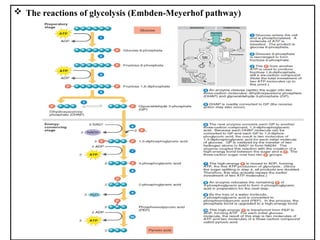
 Glycolysis consists of two basic stages:
 1. preparatory stage, two molecules of ATP are used as a six-carbon
glucose molecule is phosphorylated, restructured, and split into two
three-carbon compounds: glyceraldehyde 3-phosphate (GP) and
dihydroxyacetone phosphate (DHAP).
 2.energy-conserving stage, the two three-carbon molecules are
oxidized in several steps to two molecules of pyruvic acid.
 Because two molecules of ATP were needed to get glycolysis started
and four molecules of ATP are generated by the process, there is a net
gain of two molecules of ATP for each molecule of glucose that is
oxidized.
 The Pentose Phosphate Pathway
 The pentose phosphate pathway (or hexose monophosphate shunt) operates
simultaneously with glycolysis and provides a means for the breakdown of
five-carbon sugars (pentoses) as well as glucose.
 A key feature of this pathway is that it produces important intermediate
pentoses used in the synthesis of:
(1) Nucleic acids,
(2) Glucose from carbon dioxide in photosynthesis,
(3) Certain amino acids.
 The pathway is an important producer of the reduced coenzyme NADPH
from NADP+
.
 The pentose phosphate pathway yields a net gain of only one molecule of
ATP for each molecule of glucose oxidized.
 The Entner-Doudoroff Pathway
• Produces two molecules of NADPH and one molecule of ATP for use in
cellular biosynthetic reactions.
• Bacteria that have the enzymes for the Entner-Doudoroff pathway can
metabolize glucose without either glycolysis or the pentose phosphate
pathway.
 The reactions of glycolysis (Embden-Meyerhof pathway)
 Cellular Respiration
 After glucose has been broken down to pyruvic acid, the pyruvic acid can be
channeled into the next step of either fermentation or cellular respiration.
 Cellular respiration, or simply respiration, is defined as an ATP-generating
process in which molecules are oxidized and the final electron acceptor is (almost
always) an inorganic molecule.
 There are two types of respiration,
 aerobe, the final electron acceptor is O2
 anaerobe, the final electron acceptor is an inorganic molecule other than O2 or,
rarely, an organic molecule.
 Aerobic Respiration
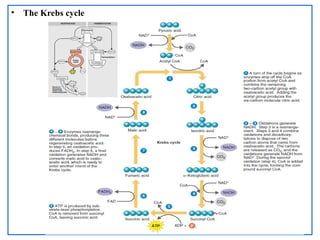
 The Krebs Cycle:
also called the tricarboxylic acid (TCA) cycle or
citric acid cycle,
 is a series of biochemical reactions in which the large amount of
potential chemical energy stored in acetyl CoA is released step by
step.
 a series of oxidations and reductions transfer that potential energy, in
the form of electrons, to electron carrier coenzymes, chiefly NAD+.
The pyruvic acid derivatives are oxidized; the coenzymes are
reduced.
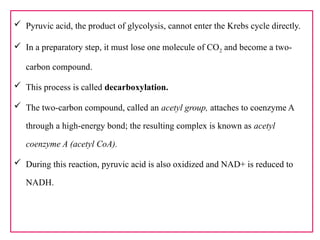
 Pyruvic acid, the product of glycolysis, cannot enter the Krebs cycle directly.
 In a preparatory step, it must lose one molecule of CO2 and become a two-
carbon compound.
 This process is called decarboxylation.
 The two-carbon compound, called an acetyl group, attaches to coenzyme A
through a high-energy bond; the resulting complex is known as acetyl
coenzyme A (acetyl CoA).
 During this reaction, pyruvic acid is also oxidized and NAD+ is reduced to
NADH.
• The Krebs cycle
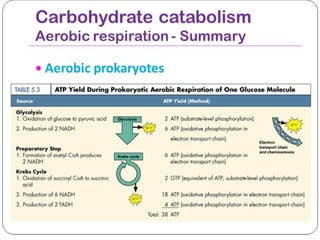
 ATP yield during prokaryotic aerobic respiration of one glucose molecule
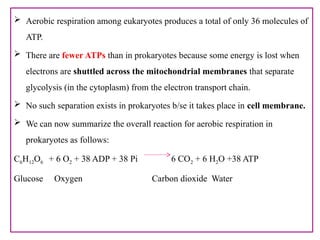
 Aerobic respiration among eukaryotes produces a total of only 36 molecules of
ATP.
 There are fewer ATPs than in prokaryotes because some energy is lost when
electrons are shuttled across the mitochondrial membranes that separate
glycolysis (in the cytoplasm) from the electron transport chain.
 No such separation exists in prokaryotes b/se it takes place in cell membrane.
 We can now summarize the overall reaction for aerobic respiration in
prokaryotes as follows:
C6H12O6 + 6 O2 + 38 ADP + 38 Pi 6 CO2 + 6 H2O +38 ATP
Glucose Oxygen Carbon dioxide Water
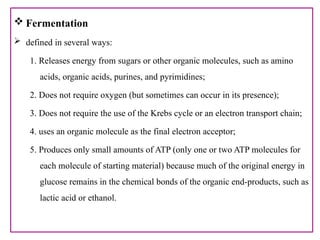
 Fermentation
 defined in several ways:
1. Releases energy from sugars or other organic molecules, such as amino
acids, organic acids, purines, and pyrimidines;
2. Does not require oxygen (but sometimes can occur in its presence);
3. Does not require the use of the Krebs cycle or an electron transport chain;
4. uses an organic molecule as the final electron acceptor;
5. Produces only small amounts of ATP (only one or two ATP molecules for
each molecule of starting material) because much of the original energy in
glucose remains in the chemical bonds of the organic end-products, such as
lactic acid or ethanol.
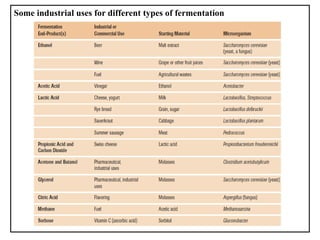
Some industrial uses for different types of fermentation
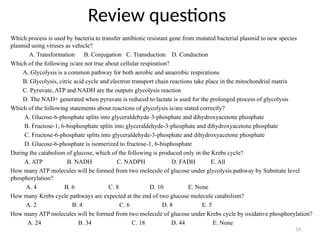
Review questions
Which process is used by bacteria to transfer antibiotic resistant gene from mutated bacterial plasmid to new species
plasmid using viruses as vehicle?
A. Transformation B. Conjugation C. Transduction D. Conduction
Which of the following is/are not true about cellular respiration?
A. Glycolysis is a common pathway for both aerobic and anaerobic respirations
B. Glycolysis, citric acid cycle and electron transport chain reactions take place in the mitochondrial matrix
C. Pyruvate, ATP and NADH are the outputs glycolysis reaction
D. The NAD+ generated when pyruvate is reduced to lactate is used for the prolonged process of glycolysis
Which of the following statements about reactions of glycolysis is/are stated correctly?
A. Glucose-6-phosphate splits into glyceraldehyde-3-phosphate and dihydroxyacetone phosphate
B. Fructose-1, 6-bisphosphate splits into glyceraldehyde-3-phosphate and dihydroxyacetone phosphate
C. Fructose-6-phosphate splits into glyceraldehyde-3-phosphate and dihydroxyacetone phosphate
D. Glucose-6-phosphate is isomerized to fructose-1, 6-bisphosphate
During the catabolism of glucose, which of the following is produced only in the Krebs cycle?
A. ATP B. NADH C. NADPH D. FADH E. All
How many ATP molecules will be formed from two molecule of glucose under glycolysis pathway by Substrate level
phosphorylation?
A. 4 B. 6 C. 8 D. 10 E. None
How many Krebs cycle pathways are expected at the end of two glucose molecule catabolism?
A. 2 B. 4 C. 6 D. 8 E. 5
How many ATP molecules will be formed from two molecule of glucose under Krebs cycle by oxidative phosphorylation?
A. 24 B. 34 C. 18 D. 44 E. None
54

Microbiology lecture note on bacterial genetic

  • 1.
    BACTERIAL GENETICS  Geneticsis the study of genes including the structure of genetic materials, what information is stored in the genes,  how the genes are expressed and how the genetic information is transferred. Genetics is also the study of heredity and variation.
  • 2.
     Genes aresequences of nucleotides (Phosphate group, Pentose sugar and Nitrogenous base) within DNA that code for functional proteins.  The two essential functions of genetic material are replication and expression.
  • 3.
    Structure of DNA •The DNA molecule is composed of two chains of nucleotides around each other in the form of “double helix”. • Double-stranded DNA is helical, and the two strands in the helix are anti-parallel. • The backbone of each strand comprises of repeating units of deoxyribose and phosphate residue.
  • 4.
  • 5.
    The double helixis stabilized by hydrogen bonds between purine and pyrimidine bases on the opposite strands. A on one strand pairs by two hydrogen bonds with T on the opposite strand, or G pairs by three hydrogen bonds with C. The two strands of double-helical DNA are, therefore complementary.
  • 6.
    Structure of chromosome In contrast to the linear chromosomes found in eukaryotic cells, most bacteria have single, covalently closed, circular chromosomes.  The chromosome of E coli has a length of approximately 1.35 mm, then looped and supercoiled to allow the chromosome to fit into the small space inside the cell.
  • 7.
    Codon  A setof three base pairs which codes for a single amino acid.  redundant because more than one codon may exist for the same amino acid (e.g. AGA, AGG, CGU, CGC, CGA and CGG all code for arginine).  3 codons (UAA, UAG and UGA) are nonsense codons and they don’t code for any amino acid, but act as stop codons. • The start codon (AUG) indicates the beginning of the sequence to be translated, and the stop codons (UAA, UGA, UAG) terminate the protein synthesis. • With the exception of methionine, all amino acids are coded by more than one codon.
  • 8.
    Flow of geneticinformation • The central dogma of molecular biology is that DNA carries all genetic information. • The flow of genetic information includes:  the replication of DNA to make more DNA by DNA polymerases.  the transcription of the DNA into mRNA and  the translation of mRNA into proteins (mRNA guided to the ribosomes for protein translation).
  • 11.
    Transformation:  Involves theuptake of free or naked DNA released from donor by a recipient.  The presence of a capsule around some strains of pneumococci gives the colonies a glistening, smooth (S) appearance while pneumococci lacking capsules have produce rough (R) colonies.  Strains of pneumococci with a capsule (type I) are virulent and can kill a mouse whereas strains lacking it (type II) are harmless.
  • 12.
    The steps involvedin transformation are: 1. A donor bacterium dies and is degraded. 2. A fragment of DNA from the dead donor bacterium binds to DNA binding proteins on the cell wall of a competent, living recipient bacterium. 3. Nuclease enzymes then cut the bound DNA into fragments. 4. One strand is destroyed and the other penetrates the recipient bacterium. 5. The RecA protein promotes genetic exchange (recombination) between a fragment of the donor's DNA and the recipient's DNA.
  • 14.
    CONJUGATION:  Bacterial conjugationis the transfer of DNA from a living donor bacterium to a recipient bacterium.  Plasmids are small autonomously replicating circular pieces of double-stranded circular DNA.  Conjugation involves the transfer of plasmids from donor bacterium to recipient bacterium.
  • 15.
     Some plasmidsare designated as F factor (F plasmid, fertility factor or sex factor) because they carry genes that mediate their own transfer.  The F factor can replicate autonomously in the cell.  These genes code for the production of the sex pilus and enzymes necessary for conjugation.
  • 16.
     Cells possessingF plasmids are F+ (male) and act as donors.  Those cells lacking this plasmid are F- (female) and act as recipient.  Each Gram negative F+ bacterium has 1 to 3 sex pili that bind to a specific outer membrane protein on recipient bacteria to initiate mating.
  • 17.
    1. F+ conjugation: Thisresults in the transfer of an F+ plasmid (coding only for a sex pilus) but not chromosomal DNA from a male donor bacterium to a female recipient bacterium. During conjugation, no cytoplasm or cell material except DNA passes from donor to recipient. Following successful conjugation the recipient becomes F+ and the donor remains F+.
  • 19.
    2. Resistance plasmidconjugation: Some Gram-negative bacteria harbor plasmids that contain antibiotic resistance genes, such plasmids are called R factors. The R factor has two components, one that codes for self transfer (like F factor) called RTF (resistance transfer factor) and the other R determinant that contains genes coding for antibiotic resistance.
  • 20.
    3. Hfr (highfrequency recombinant) conjugation: A plasmid that is capable of integrating into the chromosome is called an episome. If the F plasmid is integrated into the chromosome it is called an Hfr cell. Hfr cells are called so because they are able to transfer chromosomal genes to recipient cells with high frequency.
  • 22.
    Transduction  Bacteriophages areviruses that parasitize bacteria and use their machinery for their own replication.  During the process of replication inside the host bacteria the bacterial chromosome or plasmid is incorrectly packaged into the bacteriophage capsid.  Thus newer progeny of phages may contain fragments of host chromosome along with their own DNA or entirely host chromosome.
  • 23.
     When suchphage infects another bacterium, the bacterial chromosome in the phage also gets transferred to the new bacterium.  This fragment may undergo recombination with the host chromosome and confer new property to the bacterium.  Life cycle of bacteriophage may either by:  lytic (parasitized bacterial cell is killed with the release of mature phages) or lysogenic (the phage DNA gets incorporated into the bacterial chromosome as prophage).
  • 24.
    Following are thestages of transduction involving a lytic phage: 1. A lytic bacteriophage adsorbs to a susceptible bacterium. 2. The bacteriophage genome enters the bacterium. The phage DNA directs the bacterium's metabolic machinery to manufacture bacteriophage components and enzymes. 3. Occasionally during maturation, a bacteriophage capsid incorporates a fragment of donor bacterium's chromosome or a plasmid instead of a phage genome by mistake.
  • 25.
    4. The bacteriophagesare released with the lysis of bacterium. 5. The bacteriophage carrying the donor bacterium's DNA adsorbs to another recipient bacterium. 6. The bacteriophage inserts the donor bacterium's DNA it is carrying into the recipient bacterium. 7. The donor bacterium's DNA is exchanged by recombination for some of the recipient's DNA.
  • 27.
     Two typesof transduction are known; o restricted transduction and o generalized transduction.  Generalized transduction can transfer any bacterial gene to the recipient.  This process may occur with phages (lytic phages) that degrade their host DNA into pieces the size of viral genomes.  In restricted transduction only those chromosomal genes that lie adjacent to the prophage are transmitted.
  • 28.
    PLASMIDS:  Extrachromosomal elementsfound inside a bacterium.  Not essential for the survival of the bacterium but they confer certain extra advantages to the cell.  Number and size:  A bacterium can have no plasmids at all or have many plasmids (20-30) or multiple copies of a plasmid.  Their size can vary from 1 Kb to 400 Kb.  Multiplication:  Multiply independently of the chromosome and are inherited regularly by the daughter cells.
  • 30.
     Those bacteriathat possess transfer factor are called F+ , such bacteria have sex pili on their surface.  Those cells lacking this factor are designated F-.  The F factor plasmid is transferred to other cells through conjugation.  An F- cell will become F+ when it receives the fertility factor from another F+ cell.
  • 31.
     R factor: Codefor the transmissible drug resistance Contain genes that code for resistance to many antibiotics. Transferred by conjugation and its transfer to other bacteria is independent of the F factor.
  • 32.
    Significance of plasmids: 1.Codes for resistance to several antibiotics. 2. Codes for the production of bacteriocins. 3. Codes for the production of toxins 4. Codes for resistance to heavy metals 5. To carry virulence determinant genes. 6. Codes resistance to UV light (DNA repair enzymes are coded in the plasmid). 7. Codes for colonization factors that is necessary for their attachment. 8. Contains genes coding for enzymes that allow bacteria unique or unusual materials for carbon or energy sources. Some strains are used for cleaning oil spillage.
  • 33.
    Genetic mechanism ofdrug resistance:  Antibiotic resistance in bacteria may either be intrinsic or acquired.  Intrinsic resistance means that the bacteria were resistant to the antibiotic even before the antibiotic was introduced.  Acquired resistance means that a bacterium that was previously sensitive to an antibiotic has now turned resistant.
  • 34.
    The physiological mechanismsof antibiotic resistance include:  Inactivation of the antibiotic by enzymes produced by the bacteria  Alteration of target proteins such that the antibiotic doesn’t bind or binds with decreased affinity  Alteration of the membrane which decreases the permeability of the antibiotic  Active efflux of the antibiotic  Development of alternate metabolic pathway to bypass the action of antibiotic
  • 35.
    Bacterial Metabolism  Thelife-support processes of even the most structurally simple organism involve a large number of complex biochemical reactions.  However, the reactions that are unique to bacteria are fascinating because they allow microorganisms to do things we cannot do.  E.g. cellulose degradation
  • 41.
     Glycolysis • Theoxidation of glucose to pyruvic acid, is usually the first stage in carbohydrate catabolism. • Glycolysis is also called the Embden-Meyerhof pathway. • The word glycolysis means splitting of sugar • The enzymes of glycolysis catalyze the splitting of glucose, a six- carbon sugar, into two three-carbon sugars.
  • 42.
     Glycolysis consistsof two basic stages:  1. preparatory stage, two molecules of ATP are used as a six-carbon glucose molecule is phosphorylated, restructured, and split into two three-carbon compounds: glyceraldehyde 3-phosphate (GP) and dihydroxyacetone phosphate (DHAP).  2.energy-conserving stage, the two three-carbon molecules are oxidized in several steps to two molecules of pyruvic acid.  Because two molecules of ATP were needed to get glycolysis started and four molecules of ATP are generated by the process, there is a net gain of two molecules of ATP for each molecule of glucose that is oxidized.
  • 43.
     The PentosePhosphate Pathway  The pentose phosphate pathway (or hexose monophosphate shunt) operates simultaneously with glycolysis and provides a means for the breakdown of five-carbon sugars (pentoses) as well as glucose.  A key feature of this pathway is that it produces important intermediate pentoses used in the synthesis of: (1) Nucleic acids, (2) Glucose from carbon dioxide in photosynthesis, (3) Certain amino acids.  The pathway is an important producer of the reduced coenzyme NADPH from NADP+ .  The pentose phosphate pathway yields a net gain of only one molecule of ATP for each molecule of glucose oxidized.
  • 44.
     The Entner-DoudoroffPathway • Produces two molecules of NADPH and one molecule of ATP for use in cellular biosynthetic reactions. • Bacteria that have the enzymes for the Entner-Doudoroff pathway can metabolize glucose without either glycolysis or the pentose phosphate pathway.
  • 45.
     The reactionsof glycolysis (Embden-Meyerhof pathway)
  • 46.
     Cellular Respiration After glucose has been broken down to pyruvic acid, the pyruvic acid can be channeled into the next step of either fermentation or cellular respiration.  Cellular respiration, or simply respiration, is defined as an ATP-generating process in which molecules are oxidized and the final electron acceptor is (almost always) an inorganic molecule.  There are two types of respiration,  aerobe, the final electron acceptor is O2  anaerobe, the final electron acceptor is an inorganic molecule other than O2 or, rarely, an organic molecule.
  • 47.
     Aerobic Respiration The Krebs Cycle: also called the tricarboxylic acid (TCA) cycle or citric acid cycle,  is a series of biochemical reactions in which the large amount of potential chemical energy stored in acetyl CoA is released step by step.  a series of oxidations and reductions transfer that potential energy, in the form of electrons, to electron carrier coenzymes, chiefly NAD+. The pyruvic acid derivatives are oxidized; the coenzymes are reduced.
  • 48.
     Pyruvic acid,the product of glycolysis, cannot enter the Krebs cycle directly.  In a preparatory step, it must lose one molecule of CO2 and become a two- carbon compound.  This process is called decarboxylation.  The two-carbon compound, called an acetyl group, attaches to coenzyme A through a high-energy bond; the resulting complex is known as acetyl coenzyme A (acetyl CoA).  During this reaction, pyruvic acid is also oxidized and NAD+ is reduced to NADH.
  • 49.
  • 50.
     ATP yieldduring prokaryotic aerobic respiration of one glucose molecule
  • 51.
     Aerobic respirationamong eukaryotes produces a total of only 36 molecules of ATP.  There are fewer ATPs than in prokaryotes because some energy is lost when electrons are shuttled across the mitochondrial membranes that separate glycolysis (in the cytoplasm) from the electron transport chain.  No such separation exists in prokaryotes b/se it takes place in cell membrane.  We can now summarize the overall reaction for aerobic respiration in prokaryotes as follows: C6H12O6 + 6 O2 + 38 ADP + 38 Pi 6 CO2 + 6 H2O +38 ATP Glucose Oxygen Carbon dioxide Water
  • 52.
     Fermentation  definedin several ways: 1. Releases energy from sugars or other organic molecules, such as amino acids, organic acids, purines, and pyrimidines; 2. Does not require oxygen (but sometimes can occur in its presence); 3. Does not require the use of the Krebs cycle or an electron transport chain; 4. uses an organic molecule as the final electron acceptor; 5. Produces only small amounts of ATP (only one or two ATP molecules for each molecule of starting material) because much of the original energy in glucose remains in the chemical bonds of the organic end-products, such as lactic acid or ethanol.
  • 53.
    Some industrial usesfor different types of fermentation
  • 54.
    Review questions Which processis used by bacteria to transfer antibiotic resistant gene from mutated bacterial plasmid to new species plasmid using viruses as vehicle? A. Transformation B. Conjugation C. Transduction D. Conduction Which of the following is/are not true about cellular respiration? A. Glycolysis is a common pathway for both aerobic and anaerobic respirations B. Glycolysis, citric acid cycle and electron transport chain reactions take place in the mitochondrial matrix C. Pyruvate, ATP and NADH are the outputs glycolysis reaction D. The NAD+ generated when pyruvate is reduced to lactate is used for the prolonged process of glycolysis Which of the following statements about reactions of glycolysis is/are stated correctly? A. Glucose-6-phosphate splits into glyceraldehyde-3-phosphate and dihydroxyacetone phosphate B. Fructose-1, 6-bisphosphate splits into glyceraldehyde-3-phosphate and dihydroxyacetone phosphate C. Fructose-6-phosphate splits into glyceraldehyde-3-phosphate and dihydroxyacetone phosphate D. Glucose-6-phosphate is isomerized to fructose-1, 6-bisphosphate During the catabolism of glucose, which of the following is produced only in the Krebs cycle? A. ATP B. NADH C. NADPH D. FADH E. All How many ATP molecules will be formed from two molecule of glucose under glycolysis pathway by Substrate level phosphorylation? A. 4 B. 6 C. 8 D. 10 E. None How many Krebs cycle pathways are expected at the end of two glucose molecule catabolism? A. 2 B. 4 C. 6 D. 8 E. 5 How many ATP molecules will be formed from two molecule of glucose under Krebs cycle by oxidative phosphorylation? A. 24 B. 34 C. 18 D. 44 E. None 54