Microbial Genetics
2
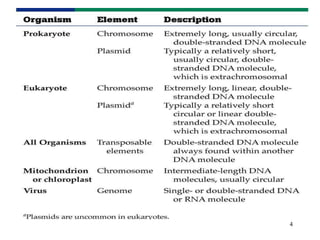
Bacteria possess two genetic structures: the
chromosome and the plasmid.
Both of these structures consist of a single circular
DNA double helix twisted counterclockwise about
its helical axis.
The plasmids are autonomous DNA molecules of
varying size localized in the cytoplasm.
Large plasmids are usually present in one to two
copies per cell, whereas small ones may be present
in 10, 40, or 100 copies.
Plasmids are not essential to a cell’s survival.
Many of them carry genes that code for certain
phenotypic characteristics of the host cell.
The following plasmid types are medically
relevant:
Virulence
bacterial virulence, e.g., enterotoxin genes
plasmids. Carry determinants of
or
hemolysin genes.
Resistance (R) plasmids. Carry genetic
information bearing on resistance to anti-infective
agents.
R plasmids may carry several R genes at once.
 Plasmids have also been described that carry both
virulence and resistance genes.
3
4
5
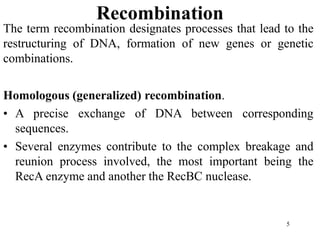
Recombination
The term recombination designates processes that lead to the
restructuring of DNA, formation of new genes or genetic
combinations.
Homologous (generalized) recombination.
• A precise exchange of DNA between corresponding
sequences.
• Several enzymes contribute to the complex breakage and
reunion process involved, the most important being the
RecA enzyme and another the RecBC nuclease.
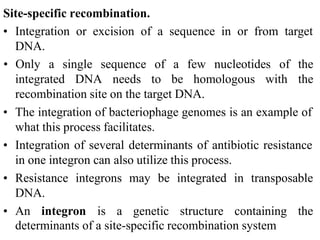
Site-specific recombination.
• Integration or excision of a sequence in or from target
DNA.
integrated DNA needs to be homologous with
• Only a single sequence of a few nucleotides of the
the
recombination site on the target DNA.
• The integration of bacteriophage genomes is an example of
what this process facilitates.
• Integration of several determinants of antibiotic resistance
in one integron can also utilize this process.
• Resistance integrons may be integrated in transposable
DNA.
• An integron is a genetic structure containing the
determinants of a site-specific recombination system
7
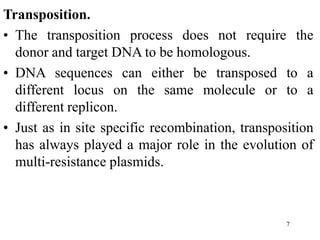
Transposition.
• The transposition process does not require the
donor and target DNA to be homologous.
• DNA sequences can either be transposed to a
different locus on the same molecule or to a
different replicon.
• Just as in site specific recombination, transposition
has always played a major role in the evolution of
multi-resistance plasmids.
8
Intercellular Mechanisms of Genetic Variability
• Although bacteria have no sexual heredity in the strict sense, they
do have mechanisms that allow for intercellular DNA transfer.
• These mechanisms, which involve a unilateral transfer of genetic
information from a donor cell to a receptor cell, are subsumed
under the term parasexuality
Transformation
• Transfer of “naked” DNA.
• In 1928, Griffith demonstrated that the ability to produce a certain
type of capsule could be transferred between different
pneumococci.
• Then Avery showed in 1944 that the transforming principle at
work was DNA.
• This transformation process has been observed mainly in the
genera Streptococcus, Neisseria, Helicobacter and Haemophilus.
9
Transduction
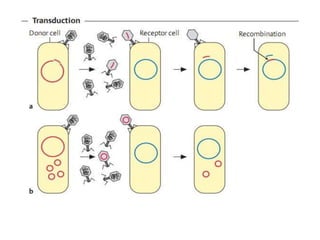
• Transfer of DNA from a donor to a receptor with the help
of transport bacteriophages.
• Bacteriophages are viruses that infect bacteria.
• During their replication process, DNA sequences from the
host bacterial cell may replace all or part of the genome in
the phage head.
• Such phage particles are then defective.
• They can still dock on receptor cells and inject their DNA,
but the infected bacterial cell will then neither produce new
phages nor be destroyed.
Conjugation
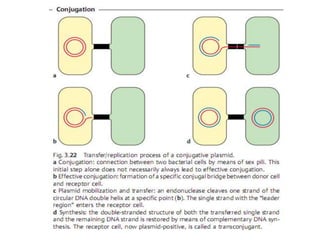
• Conjugation is the transfer of DNA from a donor to a
receptor in a conjugal process involving cell-to-cell
contact.
• Conjugation is made possible by two genetic elements:
 the conjugative plasmids and
 the conjugative transposons.
• In the conjugation process, the conjugative elements
themselves are what are primarily transferred.
• However, these elements can also mobilize chromosomal
genes or otherwise non-transferable plasmids.
• Conjugation is seen frequently in Gram-negative rods
(Enterobacteriaceae), in which the phenomenon has been
most thoroughly researched, and enterococci.
Conjugative resistance and virulence plasmids
Conjugative plasmids that carry determinants coding for antibiotic
resistance and/or virulence in addition to the tra genes and repA are
of considerable medical importance.
Three characteristics of conjugative plasmids promote a highly
efficient horizontal spread of these determinant factors among
different bacteria:
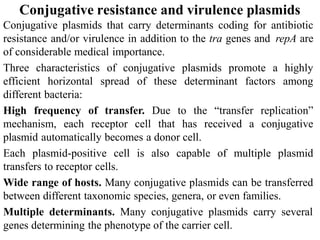
High frequency of transfer. Due to the “transfer replication”
mechanism, each receptor cell that has received a conjugative
plasmid automatically becomes a donor cell.
Each plasmid-positive cell is also capable of multiple plasmid
transfers to receptor cells.
Wide range of hosts. Many conjugative plasmids can be transferred
between different taxonomic species, genera, or even families.
Multiple determinants. Many conjugative plasmids carry several
genes determining the phenotype of the carrier cell.
Conjugative transposons
 These are DNA elements that are usually integrated into the
bacterial chromosome.
 They occur mainly in Gram-positive cocci, but have also
been found in Gram-negative bacteria (Bacteroides).
antibiotic resistance and
 Conjugative transposons may carry determinants for
thus contribute to horizontal
resistance transfer.
 In the transfer process, the transposon is first excised from
the chromosome and circularized.
 Then a single strand of the double helix is cut and the
linearized single strand is transferred into the receptor cell.
 Conjugative transposons are also capable of mobilizing non-
conjugative plasmids.
15
Restriction, Modification, and Gene Cloning
• The above descriptions of the mechanisms of genetic
variability might make the impression that genes pass freely
back and forth among the different bacterial species,
rendering the species definitions irrelevant. This is not the
case.
• A number of control mechanisms limit these genetic
exchange processes.
• Among the most important are restriction and modification.
• Restriction endonucleases can destroy foreign DNA that
bears no “fingerprint” (modification) signifying “self.”
• These modifications take the form of methylation of the
DNA bases by modification enzymes.
16
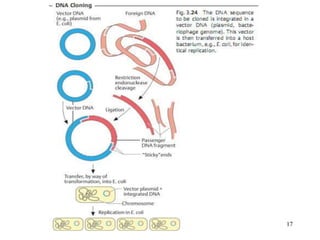
• Bacterial restriction endonucleases are valuable tools in
modern gene cloning techniques.
• The process is termed gene “cloning” because it involves
replication of DNA that has been manipulated in vitro in a
suitable host cell so as to produce identical copies of this
DNA: molecular clones or gene clones.
• The technique simplifies the replication of DNA, making
experimental manipulations easier.
• On the other hand, the bacteria can also be used to
synthesize gene products of the foreign genes.
• Such foreign proteins are called recombinant proteins.
• Bacterial plasmids often function in the role of vectors into
which the sequences to be cloned are inserted.
17
Bacteriophages
• Bacteriophages, or simply phages, are viruses that infect
bacteria.
• They are therefore obligate cell parasites. They possess
only one type of nucleic acid, either DNA or RNA, have
no enzymatic systems for energy supply and are unable to
synthesize proteins on their own.
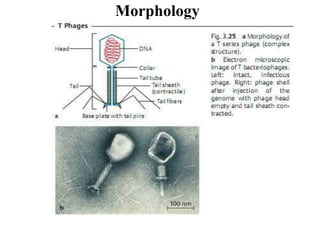
• They possess a protein shell surrounding the phage
genome, which with few exceptions is composed of DNA.
• A bacteriophage attaches to specific receptors on its host
bacteria and injects its genome through the cell wall.
• This forces the host cells to synthesize more
bacteriophages.
• The host cell lyses at the end of this reproductive pha3s5e.
• So-called temperate bacteriophages lysogenize the host
cells, whereby their genomes are integrated into the host
cell chromosomes as the so-called prophage.
• The phage genes are inactive in this stage, although the
prophage is duplicated synchronously with host cell
proliferation.
• The transition from prophage status to the lytic cycle is
termed spontaneous or artificial induction.
• Some genomes of temperate phages may carry genes
which have the capacity to change the phenotype of the
host cell.
• Integration of such a prophage into the chromosome is
known as lysogenic conversion.
Morphology
21
Composition
• Phages are made up of protein and nucleic acid.
• The proteins form the head, tail, and other morphological
elements, the function of which is to protect the phage genome.
• This element bears the genetic information, the structural genes
for the structural proteins as well as for other proteins (enzymes)
required to produce new phage particles.
• The nucleic acid in most phages is DNA, which occurs as a single
DNA double strand in, for example, T series phages.
• These phages are quite complex and have up to 100 different
genes.
• In spherical and filamentous phages, the genome consists of
single-stranded DNA (example: ΦX174).
• RNA phages are less common.
Reproduction
Adsorption. Attachment to cell surface involving specific interactions
between a phage protein at the end of the tail and a bacterial receptor.
Penetration. Injection of the phage genome into the host cell.
Enzymatic penetration of the wall by the tail tube tip and injection of
the nucleic acid through the tail tube.
Reproduction. Beginning with synthesis of early proteins (zero to two
minutes after injection), e.g., the phage-specific replicase that initiates
replication of the phage genome.
Then follows transcription of the late genes that code for the structural
proteins of the head and tail.
The new phage particles are assembled (assembly) in a maturation
process toward the end of the reproduction cycle.
Release. This step usually follows the lysis of the host cell with the
help of murein hydrolase coded by a phage gene that destroys the cell
wall.
The Importance of the Bacteriophages
Biological research: Bacteriophages are often used as models in
studies of fundamental biological processes:
 DNA replication,
 gene expression,
 gene regulation,
 viral morphogenesis,
 studies of the details, and function of supramolecular structures.
Genetic engineering: Vectors for gene cloning, adjuvants in
sequencing.
Therapy and prevention: Administration of suitable phage mixtures
in therapy and prevention of gastrointestinal infections.
In animal husbandry, a number of phages that attack only EHEC
(enterohemorrhagic E. coli) are used against EHEC infections.
Epidemiology: Bacterial typing. Strains of a bacterial species are
classified in phagovars (syn. lysotypes) based on their sensitivity to
typing bacteriophages.
Recognition of the bacterial strain responsible for an epidemic, making
it possible to follow up the chain of infection and identify the infection
sources.
This typing method has been established for
 Salmonella typhi,
 Salmonella paratyphi B,
 Staphylococcus aureus,
 Pseudomonas aeruginosa,
although it is now increasingly being replaced by new molecular
methods, in particular DNA typing.

Microbial Genetics class.pptx class notes

  • 1.
  • 2.
    2 Bacteria possess twogenetic structures: the chromosome and the plasmid. Both of these structures consist of a single circular DNA double helix twisted counterclockwise about its helical axis. The plasmids are autonomous DNA molecules of varying size localized in the cytoplasm. Large plasmids are usually present in one to two copies per cell, whereas small ones may be present in 10, 40, or 100 copies. Plasmids are not essential to a cell’s survival.
  • 3.
    Many of themcarry genes that code for certain phenotypic characteristics of the host cell. The following plasmid types are medically relevant: Virulence bacterial virulence, e.g., enterotoxin genes plasmids. Carry determinants of or hemolysin genes. Resistance (R) plasmids. Carry genetic information bearing on resistance to anti-infective agents. R plasmids may carry several R genes at once.  Plasmids have also been described that carry both virulence and resistance genes. 3
  • 4.
  • 5.
    5 Recombination The term recombinationdesignates processes that lead to the restructuring of DNA, formation of new genes or genetic combinations. Homologous (generalized) recombination. • A precise exchange of DNA between corresponding sequences. • Several enzymes contribute to the complex breakage and reunion process involved, the most important being the RecA enzyme and another the RecBC nuclease.
  • 6.
    Site-specific recombination. • Integrationor excision of a sequence in or from target DNA. integrated DNA needs to be homologous with • Only a single sequence of a few nucleotides of the the recombination site on the target DNA. • The integration of bacteriophage genomes is an example of what this process facilitates. • Integration of several determinants of antibiotic resistance in one integron can also utilize this process. • Resistance integrons may be integrated in transposable DNA. • An integron is a genetic structure containing the determinants of a site-specific recombination system
  • 7.
    7 Transposition. • The transpositionprocess does not require the donor and target DNA to be homologous. • DNA sequences can either be transposed to a different locus on the same molecule or to a different replicon. • Just as in site specific recombination, transposition has always played a major role in the evolution of multi-resistance plasmids.
  • 8.
    8 Intercellular Mechanisms ofGenetic Variability • Although bacteria have no sexual heredity in the strict sense, they do have mechanisms that allow for intercellular DNA transfer. • These mechanisms, which involve a unilateral transfer of genetic information from a donor cell to a receptor cell, are subsumed under the term parasexuality Transformation • Transfer of “naked” DNA. • In 1928, Griffith demonstrated that the ability to produce a certain type of capsule could be transferred between different pneumococci. • Then Avery showed in 1944 that the transforming principle at work was DNA. • This transformation process has been observed mainly in the genera Streptococcus, Neisseria, Helicobacter and Haemophilus.
  • 9.
    9 Transduction • Transfer ofDNA from a donor to a receptor with the help of transport bacteriophages. • Bacteriophages are viruses that infect bacteria. • During their replication process, DNA sequences from the host bacterial cell may replace all or part of the genome in the phage head. • Such phage particles are then defective. • They can still dock on receptor cells and inject their DNA, but the infected bacterial cell will then neither produce new phages nor be destroyed.
  • 11.
    Conjugation • Conjugation isthe transfer of DNA from a donor to a receptor in a conjugal process involving cell-to-cell contact. • Conjugation is made possible by two genetic elements:  the conjugative plasmids and  the conjugative transposons. • In the conjugation process, the conjugative elements themselves are what are primarily transferred. • However, these elements can also mobilize chromosomal genes or otherwise non-transferable plasmids. • Conjugation is seen frequently in Gram-negative rods (Enterobacteriaceae), in which the phenomenon has been most thoroughly researched, and enterococci.
  • 13.
    Conjugative resistance andvirulence plasmids Conjugative plasmids that carry determinants coding for antibiotic resistance and/or virulence in addition to the tra genes and repA are of considerable medical importance. Three characteristics of conjugative plasmids promote a highly efficient horizontal spread of these determinant factors among different bacteria: High frequency of transfer. Due to the “transfer replication” mechanism, each receptor cell that has received a conjugative plasmid automatically becomes a donor cell. Each plasmid-positive cell is also capable of multiple plasmid transfers to receptor cells. Wide range of hosts. Many conjugative plasmids can be transferred between different taxonomic species, genera, or even families. Multiple determinants. Many conjugative plasmids carry several genes determining the phenotype of the carrier cell.
  • 14.
    Conjugative transposons  Theseare DNA elements that are usually integrated into the bacterial chromosome.  They occur mainly in Gram-positive cocci, but have also been found in Gram-negative bacteria (Bacteroides). antibiotic resistance and  Conjugative transposons may carry determinants for thus contribute to horizontal resistance transfer.  In the transfer process, the transposon is first excised from the chromosome and circularized.  Then a single strand of the double helix is cut and the linearized single strand is transferred into the receptor cell.  Conjugative transposons are also capable of mobilizing non- conjugative plasmids.
  • 15.
    15 Restriction, Modification, andGene Cloning • The above descriptions of the mechanisms of genetic variability might make the impression that genes pass freely back and forth among the different bacterial species, rendering the species definitions irrelevant. This is not the case. • A number of control mechanisms limit these genetic exchange processes. • Among the most important are restriction and modification. • Restriction endonucleases can destroy foreign DNA that bears no “fingerprint” (modification) signifying “self.” • These modifications take the form of methylation of the DNA bases by modification enzymes.
  • 16.
    16 • Bacterial restrictionendonucleases are valuable tools in modern gene cloning techniques. • The process is termed gene “cloning” because it involves replication of DNA that has been manipulated in vitro in a suitable host cell so as to produce identical copies of this DNA: molecular clones or gene clones. • The technique simplifies the replication of DNA, making experimental manipulations easier. • On the other hand, the bacteria can also be used to synthesize gene products of the foreign genes. • Such foreign proteins are called recombinant proteins. • Bacterial plasmids often function in the role of vectors into which the sequences to be cloned are inserted.
  • 17.
  • 18.
    Bacteriophages • Bacteriophages, orsimply phages, are viruses that infect bacteria. • They are therefore obligate cell parasites. They possess only one type of nucleic acid, either DNA or RNA, have no enzymatic systems for energy supply and are unable to synthesize proteins on their own. • They possess a protein shell surrounding the phage genome, which with few exceptions is composed of DNA. • A bacteriophage attaches to specific receptors on its host bacteria and injects its genome through the cell wall. • This forces the host cells to synthesize more bacteriophages. • The host cell lyses at the end of this reproductive pha3s5e.
  • 19.
    • So-called temperatebacteriophages lysogenize the host cells, whereby their genomes are integrated into the host cell chromosomes as the so-called prophage. • The phage genes are inactive in this stage, although the prophage is duplicated synchronously with host cell proliferation. • The transition from prophage status to the lytic cycle is termed spontaneous or artificial induction. • Some genomes of temperate phages may carry genes which have the capacity to change the phenotype of the host cell. • Integration of such a prophage into the chromosome is known as lysogenic conversion.
  • 20.
  • 21.
    21 Composition • Phages aremade up of protein and nucleic acid. • The proteins form the head, tail, and other morphological elements, the function of which is to protect the phage genome. • This element bears the genetic information, the structural genes for the structural proteins as well as for other proteins (enzymes) required to produce new phage particles. • The nucleic acid in most phages is DNA, which occurs as a single DNA double strand in, for example, T series phages. • These phages are quite complex and have up to 100 different genes. • In spherical and filamentous phages, the genome consists of single-stranded DNA (example: ΦX174). • RNA phages are less common.
  • 22.
    Reproduction Adsorption. Attachment tocell surface involving specific interactions between a phage protein at the end of the tail and a bacterial receptor. Penetration. Injection of the phage genome into the host cell. Enzymatic penetration of the wall by the tail tube tip and injection of the nucleic acid through the tail tube. Reproduction. Beginning with synthesis of early proteins (zero to two minutes after injection), e.g., the phage-specific replicase that initiates replication of the phage genome. Then follows transcription of the late genes that code for the structural proteins of the head and tail. The new phage particles are assembled (assembly) in a maturation process toward the end of the reproduction cycle. Release. This step usually follows the lysis of the host cell with the help of murein hydrolase coded by a phage gene that destroys the cell wall.
  • 24.
    The Importance ofthe Bacteriophages Biological research: Bacteriophages are often used as models in studies of fundamental biological processes:  DNA replication,  gene expression,  gene regulation,  viral morphogenesis,  studies of the details, and function of supramolecular structures. Genetic engineering: Vectors for gene cloning, adjuvants in sequencing. Therapy and prevention: Administration of suitable phage mixtures in therapy and prevention of gastrointestinal infections. In animal husbandry, a number of phages that attack only EHEC (enterohemorrhagic E. coli) are used against EHEC infections.
  • 25.
    Epidemiology: Bacterial typing.Strains of a bacterial species are classified in phagovars (syn. lysotypes) based on their sensitivity to typing bacteriophages. Recognition of the bacterial strain responsible for an epidemic, making it possible to follow up the chain of infection and identify the infection sources. This typing method has been established for  Salmonella typhi,  Salmonella paratyphi B,  Staphylococcus aureus,  Pseudomonas aeruginosa, although it is now increasingly being replaced by new molecular methods, in particular DNA typing.