MICROBIAL GENETIC RECOMBINATIONS
Dr. A. T. Sharma
Assist. Professor
Nanded Pharmacy College, Nanded
Introduction
• Micro-organisms have an ability to acquire genes and
undergo the process of recombination
• Bacterial recombination: DNA transfer from a donor
bacterium to a recipient bacterium
• Exchange of genetic material between two different
chromosomes of different organisms
• Principles of recombination applicable to prokaryotes
but not to eukaryotes
• Eukaryotes exhibit a complete sexual life cycle
• In microbes, three kinds of recombination occur-
- Conjugation
- Transduction
- Transformation
Conjugation
• A defined and programed process – sexual mode of
genetic transfer
• In bacterial conjugation, only a portion of chromosome
from donor to recipient cell
• Unidirectional transfer – separation of cells and
changes in genetic organization
• Retrotransfer: from recipient to donor cell
• Genetic exchange through a conjugation tube
• Process first postulated by Joshua Lederberg and
Edward Tatum (1946) in E. coli (Nobel prize in 1958)
F+ and F- Cross
• Genetic transfer through a plasmid (F- plasmid, fertility
factor) – F-positive/F-plus/F+ cell/male cell – Donor cell
• F-negative/F-minus/F- cell/female cell – Recipient cell
• Bridge formation between a donor cell and recipient cell
through plasmid
• Plasmid is not integrated with bacterial chromosome
• F-plasmid has two loci (tra and trb), an origin of replication
(OriR) and an origin of transfer (OriT)
• tra locus: Codes for proteins to form pili and and other
proteins necessary for attachment and transfer of F-
plasmid
• Trb locus: codes for proteins necessary for channel creation
for DNA transfer
• OriR: Site of replication
• OriT: Site at which enzyme relaxase/relaxosome cuts the
DNA strand of F-plasmid
Steps:
• Production and projection of pilus from donor
cell – begins contact with recipient cell
• A direct contact between donor and recipient
cell
• Enzyme relaxase cuts one of the two strands
of plasmid (T-strand)
• Replication of single strands in two cells
forming double stranded DNA – both cells
work as a donor cells
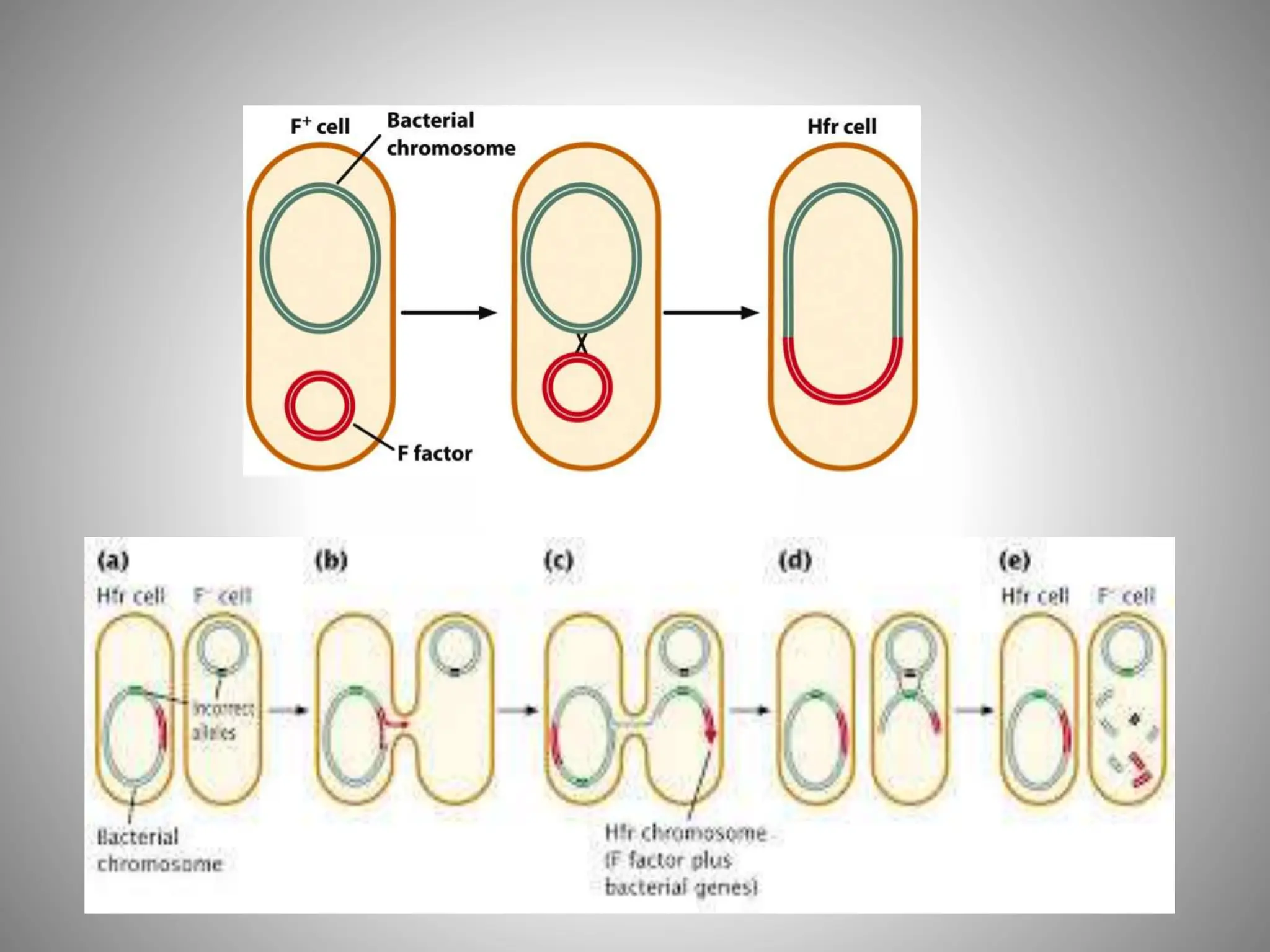
Hfr and F- Cross
• Hfr cell: A bacterial cell with F-plasmid integrated to its
chromosome
• F-plasmid together with bacterial chromosomal DNA forms
a rDNA called Hfr DNA
• During transfer, some portion of the donor DNA gets
transferred
Steps:
• Formation of sex pili for forming conjugation tube for cell to
cell contact
• Replication of Hfr DNA by rolling circle mechanism
• Breaking of circular Hfr DNA forming linear DNA
• Movement of a portion of F-plasmid to recipient cell
• Abrupt breaking of conjugation tube – only a part of Hfr
DNA transferred
• Transferred DNA integrate with recipient DNA – genetic
variability (Generally resultant cell is F- cell)
Transduction
• Genetic transfer through a non-replicating
bacteriophage (temperate phage)
• Discovered by Joshua Leaderberg and Nortor Zinder
(1952)
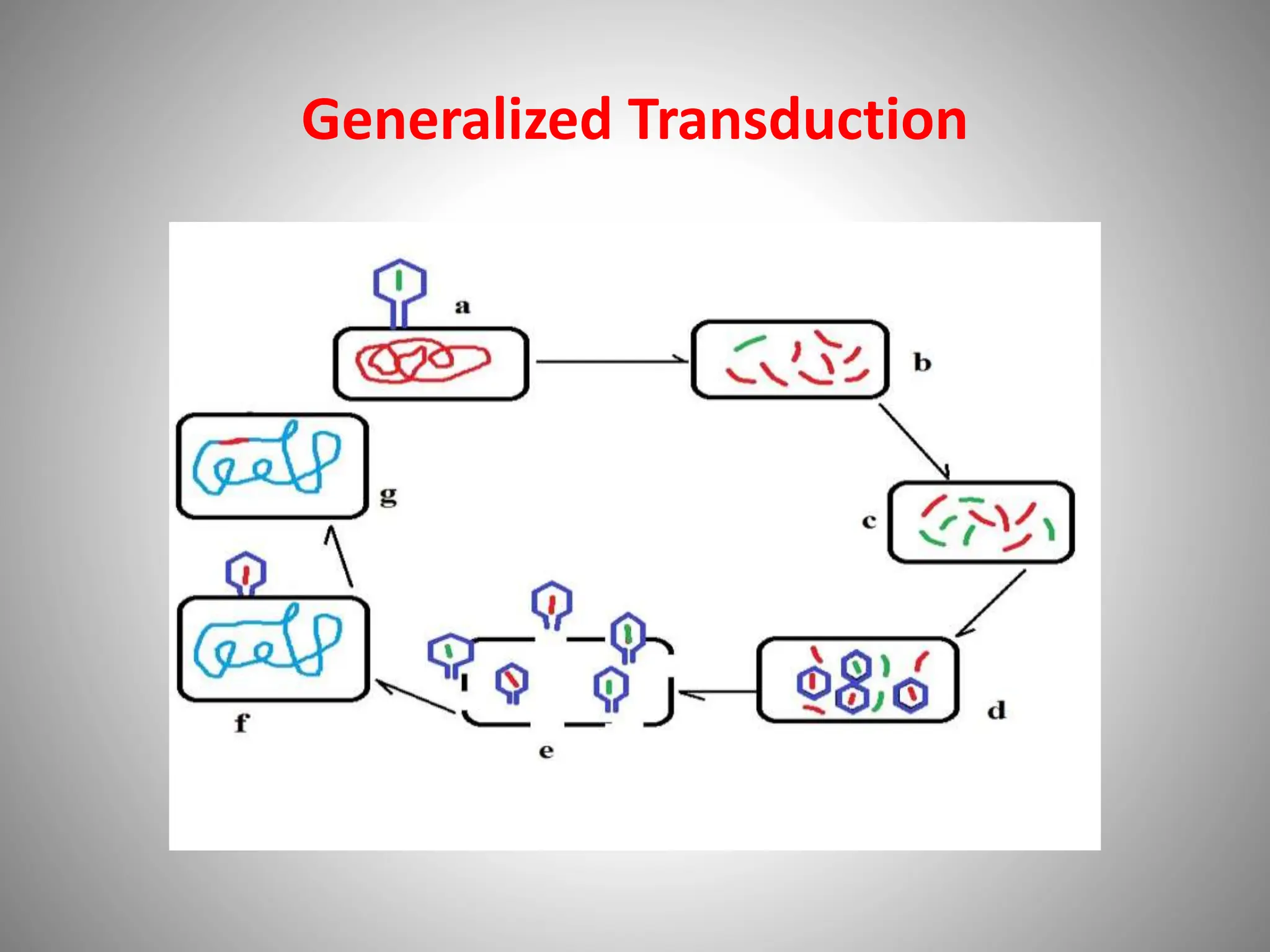
• A small bacterial DNA fragment incorporated in to an
attacking phage – infection to another bacteria, genetic
material transferred – genetic recombination
Types:
• Specialized transduction
• Generalized transduction
Specialized Transduction
Generalized Transduction
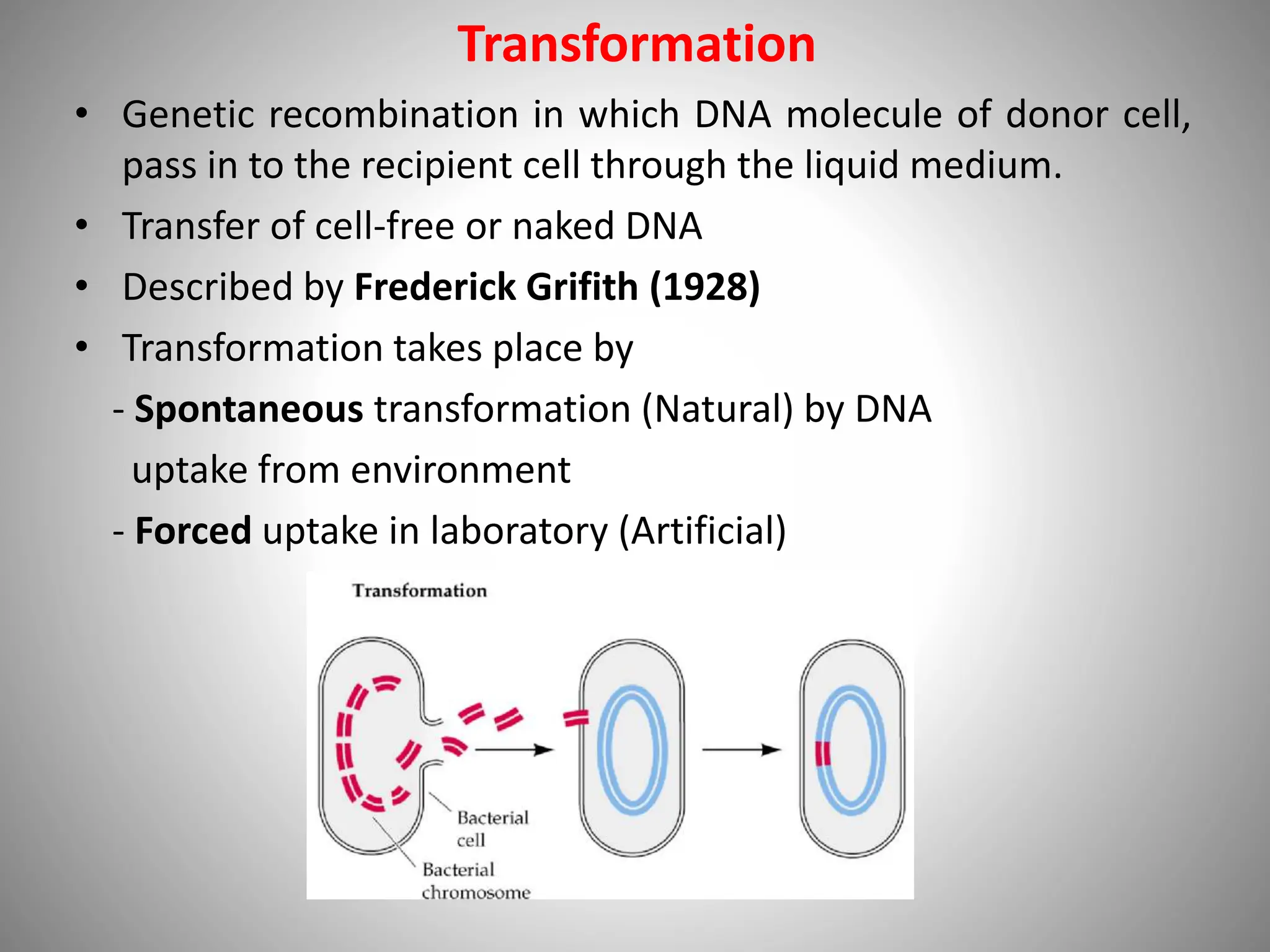
Transformation
• Genetic recombination in which DNA molecule of donor cell,
pass in to the recipient cell through the liquid medium.
• Transfer of cell-free or naked DNA
• Described by Frederick Grifith (1928)
• Transformation takes place by
- Spontaneous transformation (Natural) by DNA
uptake from environment
- Forced uptake in laboratory (Artificial)
Plasmids
• Term ‘Plasmid’ was first introduced by Joshua Lederberg (1952),
the American molecular biologist
• Plasmids are extra-chromosomal, self-replicating, double stranded
circular DNA molecules in a bacterial cell (it has its own origin of
replication)
Characteristics:
• Origin of replication
• Antibiotic resistance
• Metal/metalloid resistance
• Virulence determinants
• Bacteriocin production
• Biodegradative capabilities
• Symbiotic determinants
• Multiple cloning sites
• Promoter region
• Primer binding site
Applications of plasmids:
• Plasmids in gene therapy
• Plasmids in rDNA technology
Transposons (Transposable Elements – TEs)
• DNA sequences that are able to move from one
location to another in the genome
• Transposition (mobilization of TEs) was
discovered by Barbara McClintock during 1940
and 1950s
• Identified in all organisms, eukaryotes and
prokaryotes
• Play a role in genetic evolution
Types of Transposons
• Cut-and-Paste Transposons: They transpose
by excision (cutting) of the transposable
sequence from one position in the genome
and its insertion (pasting) to another position
within genome.
• Replicative Transposons: They transpose by a
mechanism which involves replication of
transposable sequence and this copy of DNA,
so formed, is inserted in to the target site
while the donor site remains unchanged.
• Retro Elements:
They transpose
through the process
of synthesis of DNA
from RNA by reverse
transcription and
insertion of DNA in
to the target DNA
site.
Significance
• Change the structural and functional
characteristics of genome
• Cause mutation
• Contribute in evolution
• Useful as cloning vector
• Searching and isolation of a particular gene
Thank you…!!!
(Disclaimer: The images and diagrams in this presentation
have been downloaded from the google source. I am grateful
to all the publishers & the google.)

MODES OF MICROBIAL GENETIC RECOMBINATIONS.pptx

  • 1.
    MICROBIAL GENETIC RECOMBINATIONS Dr.A. T. Sharma Assist. Professor Nanded Pharmacy College, Nanded
  • 2.
    Introduction • Micro-organisms havean ability to acquire genes and undergo the process of recombination • Bacterial recombination: DNA transfer from a donor bacterium to a recipient bacterium • Exchange of genetic material between two different chromosomes of different organisms • Principles of recombination applicable to prokaryotes but not to eukaryotes • Eukaryotes exhibit a complete sexual life cycle • In microbes, three kinds of recombination occur- - Conjugation - Transduction - Transformation
  • 3.
    Conjugation • A definedand programed process – sexual mode of genetic transfer • In bacterial conjugation, only a portion of chromosome from donor to recipient cell • Unidirectional transfer – separation of cells and changes in genetic organization • Retrotransfer: from recipient to donor cell • Genetic exchange through a conjugation tube • Process first postulated by Joshua Lederberg and Edward Tatum (1946) in E. coli (Nobel prize in 1958)
  • 4.
    F+ and F-Cross • Genetic transfer through a plasmid (F- plasmid, fertility factor) – F-positive/F-plus/F+ cell/male cell – Donor cell • F-negative/F-minus/F- cell/female cell – Recipient cell • Bridge formation between a donor cell and recipient cell through plasmid • Plasmid is not integrated with bacterial chromosome • F-plasmid has two loci (tra and trb), an origin of replication (OriR) and an origin of transfer (OriT) • tra locus: Codes for proteins to form pili and and other proteins necessary for attachment and transfer of F- plasmid • Trb locus: codes for proteins necessary for channel creation for DNA transfer • OriR: Site of replication • OriT: Site at which enzyme relaxase/relaxosome cuts the DNA strand of F-plasmid
  • 5.
    Steps: • Production andprojection of pilus from donor cell – begins contact with recipient cell • A direct contact between donor and recipient cell • Enzyme relaxase cuts one of the two strands of plasmid (T-strand) • Replication of single strands in two cells forming double stranded DNA – both cells work as a donor cells
  • 7.
    Hfr and F-Cross • Hfr cell: A bacterial cell with F-plasmid integrated to its chromosome • F-plasmid together with bacterial chromosomal DNA forms a rDNA called Hfr DNA • During transfer, some portion of the donor DNA gets transferred Steps: • Formation of sex pili for forming conjugation tube for cell to cell contact • Replication of Hfr DNA by rolling circle mechanism • Breaking of circular Hfr DNA forming linear DNA • Movement of a portion of F-plasmid to recipient cell • Abrupt breaking of conjugation tube – only a part of Hfr DNA transferred • Transferred DNA integrate with recipient DNA – genetic variability (Generally resultant cell is F- cell)
  • 9.
    Transduction • Genetic transferthrough a non-replicating bacteriophage (temperate phage) • Discovered by Joshua Leaderberg and Nortor Zinder (1952) • A small bacterial DNA fragment incorporated in to an attacking phage – infection to another bacteria, genetic material transferred – genetic recombination Types: • Specialized transduction • Generalized transduction
  • 10.
  • 11.
  • 12.
    Transformation • Genetic recombinationin which DNA molecule of donor cell, pass in to the recipient cell through the liquid medium. • Transfer of cell-free or naked DNA • Described by Frederick Grifith (1928) • Transformation takes place by - Spontaneous transformation (Natural) by DNA uptake from environment - Forced uptake in laboratory (Artificial)
  • 13.
    Plasmids • Term ‘Plasmid’was first introduced by Joshua Lederberg (1952), the American molecular biologist • Plasmids are extra-chromosomal, self-replicating, double stranded circular DNA molecules in a bacterial cell (it has its own origin of replication) Characteristics: • Origin of replication • Antibiotic resistance • Metal/metalloid resistance • Virulence determinants • Bacteriocin production • Biodegradative capabilities • Symbiotic determinants • Multiple cloning sites • Promoter region • Primer binding site
  • 14.
    Applications of plasmids: •Plasmids in gene therapy • Plasmids in rDNA technology Transposons (Transposable Elements – TEs) • DNA sequences that are able to move from one location to another in the genome • Transposition (mobilization of TEs) was discovered by Barbara McClintock during 1940 and 1950s • Identified in all organisms, eukaryotes and prokaryotes • Play a role in genetic evolution
  • 15.
    Types of Transposons •Cut-and-Paste Transposons: They transpose by excision (cutting) of the transposable sequence from one position in the genome and its insertion (pasting) to another position within genome.
  • 16.
    • Replicative Transposons:They transpose by a mechanism which involves replication of transposable sequence and this copy of DNA, so formed, is inserted in to the target site while the donor site remains unchanged.
  • 17.
    • Retro Elements: Theytranspose through the process of synthesis of DNA from RNA by reverse transcription and insertion of DNA in to the target DNA site.
  • 18.
    Significance • Change thestructural and functional characteristics of genome • Cause mutation • Contribute in evolution • Useful as cloning vector • Searching and isolation of a particular gene
  • 19.
    Thank you…!!! (Disclaimer: Theimages and diagrams in this presentation have been downloaded from the google source. I am grateful to all the publishers & the google.)