F PLASMID
SUBMITTED BY,
ATHIRA.B
DEPT: OF MICROBIOLOGY
SRM ARTS AND SCIENCE COLLEGE
KATTANGULATHUR
INTRODUCTION
 A plasmid is a small,circular,extrachromosomal double stranded DNA that has the
capacity to replicate independently.
 Discovered by Landerberg in1952
 It naturally occur in bacteria, and also they have low copy number(1-4 per cell)or a
high copy number(10-100 per cell).
 Sometimes present in archea and eukaryotes
 Genes carried in plasmid benefit the survival of the organism by providing them
with genetic advantages like antibiotic resisitance etc.under certain situation or
particular conditions
 They provide mechanism for horizontal gene transfer within a population of
microbes and thus provide a selective advantage under a given environmental state.
TYPES OF PLAMID
1 . ON THE BASIS OF FUNCTION
a. Fertility Plasmid (F-Plasmid)
b. Resistance Plasmid(R- Plasmid)
c. Col Plasmid
d. Degradative Plasmid
e. Virulence Plasmid
2. BY THEIR ABILITY TO TRANSFER TO OTHER BACTERIA
a. Conjugative Plasmid
b. Non-Conjugative Plasmids
c. Intremediate classes of plasmids
F- PLASMID
 F- Plasmid or fertility factor is a conjugative plasmid of Escherichia coli
 First plasmid discovered and has been significant in the development and
practice of bacterial genetics
 Like other plasmids, F plasmid have a circular structure and measure about
100kb
 F Plasmid plays an important role in reproduction given that they contain
genes that code for the production of sex pilus as well as enzymes required
for conjugation.
 F plasmid also contains genes that are involved in their own transfer,
therefore during conjugation they enhance their own transfer from one cell to
another.
 E.coli containing this F factor are known as F+ and those without are known
as F- .
STRUCTURE OF F-PLASMID
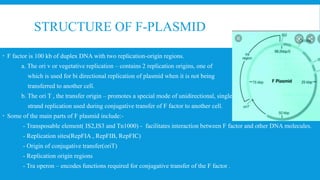
 F factor is 100 kb of duplex DNA with two replication-origin regions.
a. The ori v or vegetative replication – contains 2 replication origins, one of
which is used for bi directional replication of plasmid when it is not being
transferred to another cell.
b. The ori T , the transfer origin – promotes a special mode of unidirectional, single
strand replication used during conjugative transfer of F factor to another cell.
 Some of the main parts of F plasmid include:-
- Transposable element( IS2,IS3 and Tn1000) - facilitates interaction between F factor and other DNA molecules.
- Replication sites(RepFIA , RepFIB, RepFIC)
- Origin of conjugative transfer(oriT)
- Replication origin regions
- Tra operon – encodes functions required for conjugative transfer of the F factor .
REPLICATION OF F- PLAMID
 Replication of F plasmid is ROLLING CIRCLE REPLICATION(RCR)
 RCR is a mechanism adopted by certain plasmids,among other genetic elements, that represents
one of the simplest initiation strategies :-
- nicking by a replication initiator protein on one parental strand to generate the primer
for leading strand initiation and a single priming site for lagging strand synthesis
 All RCR plasmid genomes consists of a number of basic elements : leading strand initiation and
control, lagging strand origin.
 RCR has been mainly characterized in Gram – positive bacterial plasmids, although it has also
been described in Gram-negative bacterial or archeal plasmids.
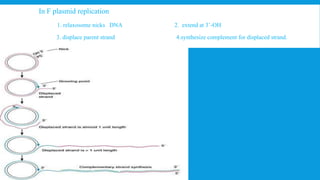
 In F plasmid replication
 1. relaxosome nicks DNA 2. extend at 3’-OH
3. displace parent strand 4.synthesize complement for displaced strand.
TRANSFER OF F PLASMID
 F plasmid transfer through conjugation method,which occurs due to the pilus known as F pilus.
 All the proteins that are associated with the F pilus are transcribed and translated from genes within the F
factor
 The F plasmid is not transferred to a F- cell via the F pilus, the F pilus merely pulls the two cells together
allowing a conjugative junction to form,which contain a pore that allows the DNA to pass from the F+
cell to the F- cell.
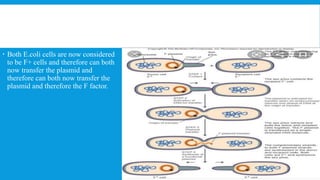
 During the transfer, the F plasmid unwinds and the outer strand breaks, which will be the one that is
transferred to the F- cell via the pore in the conjugative junction.
 Replication of the plasmid then takes place in order to make both single strands to DNA into double
stranded DNA plasmids.
 In the original F+ cell, the single strand merely undergoes rolling circle replication to once again become
double stranded.
 In the recipient cell, the linear single-stranded DNA is replicated into a double strand and becomes a
circular F plasmid containing the F factor.
 Both E.coli cells are now considered
to be F+ cells and therefore can both
now transfer the plasmid and
therefore can both now transfer the
plasmid and therefore the F factor.
THANK YOU

F plasmid

  • 1.
    F PLASMID SUBMITTED BY, ATHIRA.B DEPT:OF MICROBIOLOGY SRM ARTS AND SCIENCE COLLEGE KATTANGULATHUR
  • 2.
    INTRODUCTION  A plasmidis a small,circular,extrachromosomal double stranded DNA that has the capacity to replicate independently.  Discovered by Landerberg in1952  It naturally occur in bacteria, and also they have low copy number(1-4 per cell)or a high copy number(10-100 per cell).  Sometimes present in archea and eukaryotes  Genes carried in plasmid benefit the survival of the organism by providing them with genetic advantages like antibiotic resisitance etc.under certain situation or particular conditions  They provide mechanism for horizontal gene transfer within a population of microbes and thus provide a selective advantage under a given environmental state.
  • 3.
    TYPES OF PLAMID 1. ON THE BASIS OF FUNCTION a. Fertility Plasmid (F-Plasmid) b. Resistance Plasmid(R- Plasmid) c. Col Plasmid d. Degradative Plasmid e. Virulence Plasmid 2. BY THEIR ABILITY TO TRANSFER TO OTHER BACTERIA a. Conjugative Plasmid b. Non-Conjugative Plasmids c. Intremediate classes of plasmids
  • 4.
    F- PLASMID  F-Plasmid or fertility factor is a conjugative plasmid of Escherichia coli  First plasmid discovered and has been significant in the development and practice of bacterial genetics  Like other plasmids, F plasmid have a circular structure and measure about 100kb  F Plasmid plays an important role in reproduction given that they contain genes that code for the production of sex pilus as well as enzymes required for conjugation.  F plasmid also contains genes that are involved in their own transfer, therefore during conjugation they enhance their own transfer from one cell to another.  E.coli containing this F factor are known as F+ and those without are known as F- .
  • 5.
    STRUCTURE OF F-PLASMID F factor is 100 kb of duplex DNA with two replication-origin regions. a. The ori v or vegetative replication – contains 2 replication origins, one of which is used for bi directional replication of plasmid when it is not being transferred to another cell. b. The ori T , the transfer origin – promotes a special mode of unidirectional, single strand replication used during conjugative transfer of F factor to another cell.  Some of the main parts of F plasmid include:- - Transposable element( IS2,IS3 and Tn1000) - facilitates interaction between F factor and other DNA molecules. - Replication sites(RepFIA , RepFIB, RepFIC) - Origin of conjugative transfer(oriT) - Replication origin regions - Tra operon – encodes functions required for conjugative transfer of the F factor .
  • 6.
    REPLICATION OF F-PLAMID  Replication of F plasmid is ROLLING CIRCLE REPLICATION(RCR)  RCR is a mechanism adopted by certain plasmids,among other genetic elements, that represents one of the simplest initiation strategies :- - nicking by a replication initiator protein on one parental strand to generate the primer for leading strand initiation and a single priming site for lagging strand synthesis  All RCR plasmid genomes consists of a number of basic elements : leading strand initiation and control, lagging strand origin.  RCR has been mainly characterized in Gram – positive bacterial plasmids, although it has also been described in Gram-negative bacterial or archeal plasmids.
  • 7.
     In Fplasmid replication  1. relaxosome nicks DNA 2. extend at 3’-OH 3. displace parent strand 4.synthesize complement for displaced strand.
  • 8.
    TRANSFER OF FPLASMID  F plasmid transfer through conjugation method,which occurs due to the pilus known as F pilus.  All the proteins that are associated with the F pilus are transcribed and translated from genes within the F factor  The F plasmid is not transferred to a F- cell via the F pilus, the F pilus merely pulls the two cells together allowing a conjugative junction to form,which contain a pore that allows the DNA to pass from the F+ cell to the F- cell.  During the transfer, the F plasmid unwinds and the outer strand breaks, which will be the one that is transferred to the F- cell via the pore in the conjugative junction.  Replication of the plasmid then takes place in order to make both single strands to DNA into double stranded DNA plasmids.  In the original F+ cell, the single strand merely undergoes rolling circle replication to once again become double stranded.  In the recipient cell, the linear single-stranded DNA is replicated into a double strand and becomes a circular F plasmid containing the F factor.
  • 9.
     Both E.colicells are now considered to be F+ cells and therefore can both now transfer the plasmid and therefore can both now transfer the plasmid and therefore the F factor.
  • 10.