WELCOME
BACTERIAL
TRANSFORMATION
M.SRIDEVI,
Іst M.SC Microbiology.
INTRODUCTION
Transformation is the process in which genetic material is
transferred from one bacteria to another without involving any
intermediate organism.
A bacterial cell may incorporate in itself genetic material from
the medium also.
This is termed as “transformation”
Transformation was first discovered in bacteria by
Frederick griffith (1928).
He suggested that bacterial strains are capable of
transforming themselves by some factor , which he termed
“transforming principle”.
Sixteen years later , Oswald avery , colin Macleod and
Maclyn MC carty demonstrated that transforming principles
was DNA , which provided evidence that DNA is the
genetic material of the bacterial cell.
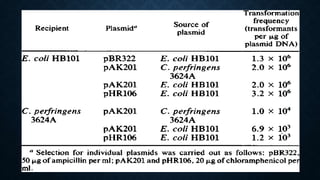
Transformation efficiency :
It refers to the number of transformants per microgram
of added DNA .
 EX: E. coli , transformation by plasmid, the
transformation efficiency is about 107 to 108 cell per
microgram.
Griffith experiment:
Griffith (1928) worked on bacterium Diplococcus pneumonia which
is associated with certain types of pneumonia. This bacteria occurs in
two forms.
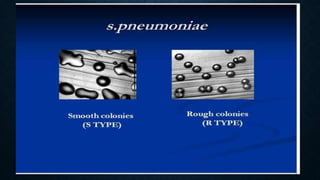
The first type has smooth (s) cells which secrete a covering capsule
of polysaccharide materials causing the colonies on agar to be
smooth & shiny .
This type is virulent. It produces pneumonia in mice.
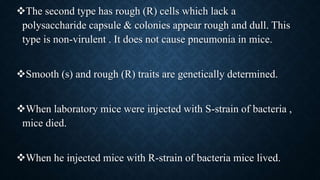
The second type has rough (R) cells which lack a
polysaccharide capsule & colonies appear rough and dull. This
type is non-virulent . It does not cause pneumonia in mice.
Smooth (s) and rough (R) traits are genetically determined.
When laboratory mice were injected with S-strain of bacteria ,
mice died.
When he injected mice with R-strain of bacteria mice lived.
When mice with were injected with heat killed S-strain of bacteria ,
mice lived.
When mice were injected with R strain + heat killed S strain of
bacteria , mice died.
Heat killed S-strain some low transformed R-strain to virulence .
This process was called “transformation”.

The agent that was responsible for transformation was called
“transforming principle”.
Competence :
The ability of bacterial cells to intake DNAs from the medium is
said to be competence.
Competence can be increased by physical or chemical treatment.
Competent bacterial cell can intake rDNAs with the size less than
15 kbp from the culture.
 The competence may be transient or few minutes in some sp.,
(streptococcus) while in others it can last for more than an
hour(bacillus).
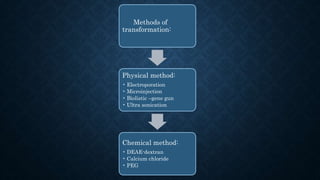
Methods of
transformation:
Physical method:
• Electroporation
• Microinjection
• Biolistic –gene gun
• Ultra sonication
Chemical method:
• DEAE-dextran
• Calcium chloride
• PEG
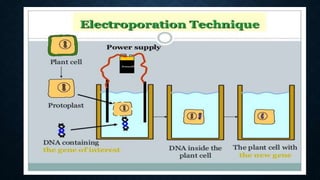
Physical method :(electroporation)
Electroporation is a process of changing the permeability of
cell membrane of cells to uptake macromolecules in the
medium.
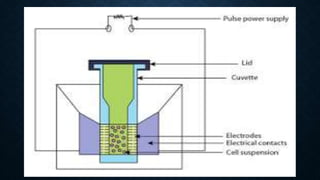
It is done with an electrical instrument called electroporator.
The electroporator creates electric current and sends it
through the electrodes.
 it generates 50-240 volts through the electrodes . The
aluminum electrodes conduct the electric pulse through the
medium in the cuvette.
Cont……..
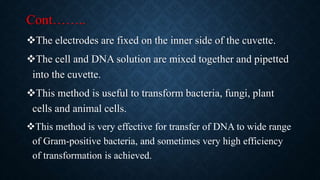
The electrodes are fixed on the inner side of the cuvette.
The cell and DNA solution are mixed together and pipetted
into the cuvette.
This method is useful to transform bacteria, fungi, plant
cells and animal cells.
This method is very effective for transfer of DNA to wide range
of Gram-positive bacteria, and sometimes very high efficiency
of transformation is achieved.
Principle:
The phospholipid bilayer of the plasma membrane has
hydrophobic interior , any polar molecules , including DNA ,
are unable to pass freely through the membrane.
The concept of electroporation capitalizes on the relatively
weak nature of the phospholipid bilayer’s hydrophobic
interior & hydrophilic exterior and its ability to reassemble
after disturbance spontaneously.
Chemical mediated transformation :(Calcium chloride)
To introduce rDNA into E .coli cells, the rDNA is added to the
bacterial culture and the culture is treated with 50 mM calcium
chloride (cacl2 ) solution at room temperature.
Cacl2 adheres the rDNA onto the surface of E.coli cells and It
modifies the bacterial cell wall to intake rDNA s.
The bacterial culture is then heated gently up to 42ᴼc to induce
E.coli cells to intake the rDNAs.
In this method calcium chloride is used and can be
performed in less than 3 hours.
Exponential phase cells are harvested & treated with cold
calcium chloride, which renders the cell competent or
suitable for taking up DNA .
The competent cells are then mixed with DNA and
subjected to a heat shock to promote uptake of DNA
presumably by affecting the physical state of the lipids in the
membrane.
Liposome mediated gene transformation:
A liposome is a small spherical vesicle made of
phospholipids.
It is formed when a lipid is agitated with water. It contains
many concentric layers of phospholipids.
In the liposome, polar heads face outward and the non-polar
tails face to the Centre.
The size of the liposomes varies from 25 nm to a few
microns in diameter.
Liposome fuses with cell membrane and discharges its
contents into the cell. Hence it is used as a gene transfer
system.
The rDNA , water and phosphatidyl choline are mixed
together in a test tube and the tube is shaken well.
During this process, lipid bilayers develop around the
rDNA present in water and form a liposome.
The liposomes in the tube are added to a culture of animal
cell.
Liposomes fuse with cell membrane and discharge their
contents into the cells.
As the inner lipid layer has nucleoproteins , cellular
enzymes do not attack it .
The inner lipid layer fuses with nuclear membrane and
discharges its contents into the nucleus.
The frequency of liposome fusion can be increased by the
addition of polyethylene glycol (PEG).
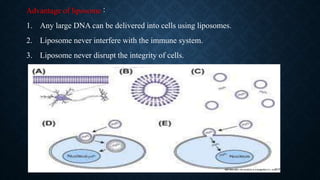
Advantage of liposome :
1. Any large DNA can be delivered into cells using liposomes.
2. Liposome never interfere with the immune system.
3. Liposome never disrupt the integrity of cells.
Molecular mechanism of transformation:
Notani and Setlow (1974) have described the mechanism of
bacterial transformation.
In S. pneumoniae the competent state is transient and
persists only for a short period.
The competent state is induced by the competence activator
protein.
It binds to the plasma membrane of receptor and triggers
the synthesis of 10 new proteins within 10 minutes.
The competence factor (CF) accelerates the process of
transport or leakage of autolysin molecules into the
periplasmic space.
Structural changes in competent cells induce numerous
vesicles called transformosome buds on the surface that
contains protein and facilitates the uptake of transforming
DNA.
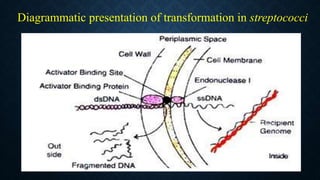
Diagrammatic presentation of transformation in streptococci
(a) DNA binding:
As a result of random collision, DNA comes first in the
contact of cell surface of competent bacteria .
First the DNA binding is reversible and takes for about
4-5 seconds.
Thereafter, it becomes irreversible permanently. For
about 2 minutes it remains in non-transforming state.
Thereafter, before 5 minutes it is converted into the
transforming state.
Cont…..
The period (about 10 minutes) during which no
transformation occurs in competent recipient cells is called
eclipse.
Both types of DNA, transforming and non-transforming,
bind to the cell surface where the receptor sites are
located.
 In H. influenzae transformosome bud forms the surface and
contains proteins that mediate DNA uptake.
In S. pneumoniae the CF induces the ability to bind DNA
molecules.
(b) Penetration:
The DNA molecules that bind permanently and enter the
recipient cells. DNA is also resistant to DNase degradation.
The nucleolytic enzymes located at the surface of
competent recipient cells act upon the donor DNA molecule
when it binds the cell membrane.
The endonuclease-1 of the recipient cells which is
associated with cell membrane acts as DNA translocase by
attacking and degrading one strand of the dsDNA.
Consequently only complementary single strand of DNA
enters into the recipient cells .
It has been confirmed by performing the experiments with
radiolabelling of donor DNA.
In B. subtilis degradation of one strand is being delayed.
Hence, both the strands enter the recipient cell.
 Successful transformation occurs with the donor DNA of
molecular weight between 30,00,000 and 8 million Dalton.
With increasing the concentration of donor DNA the number of
competent cells increases .
After penetration the donor DNA migrates from periphery of cell
to the bacterial DNA. This movement in different bacteria differs.
(c) Synapsis formation:
The single stranded DNA is coated with SSB proteins, which
maintain, the single stranded region in a replication fork .
The single strand of the donor DNA or portion of it is linearly
inserted into the recipient DNA.
The bacterial protein like E. coli RecA protein probably
facilitates the DNA pairing during recombination.
It causes the local unwinding of dsDNA of the recipient cell
from the 5′ end.
Base pairing that is synapsis occurs between the homologous
donor ssDNA and the recipient DNA.
Unwinding of the recipient DNA continues at the end of
assimilated DNA and allows the fraction of invading DNA to
increase base pairs. This process is called branch migration .
(d) Integration:
The endonuclease cuts the unpaired free end of donor DNA
or the recipient DNA. This process is called trimming.
The nick is sealed by DNA ligase . Consequently, a
heteroduplex region containing a mismatched base pairs
is formed .
If the mismatch repair occurs again, it depends whether the
unpaired base in the donor or recipient strand is removed.
After replication the heteroduplex forms the homo-duplexes,
one of these is of normal type and the second is transformed
duplex.
The donor genes differing from the recipient genes by a single
base pair create a mismatch when integrated initially. The hex
mismatch repair system (with LE markers) can correct either of
donor strands.
These two types of cells can be differentiated through plating
method by using the antibiotic markers.
Transformation
Transformation

Transformation

  • 1.
  • 2.
  • 3.
    INTRODUCTION Transformation is theprocess in which genetic material is transferred from one bacteria to another without involving any intermediate organism. A bacterial cell may incorporate in itself genetic material from the medium also. This is termed as “transformation”
  • 4.
    Transformation was firstdiscovered in bacteria by Frederick griffith (1928). He suggested that bacterial strains are capable of transforming themselves by some factor , which he termed “transforming principle”. Sixteen years later , Oswald avery , colin Macleod and Maclyn MC carty demonstrated that transforming principles was DNA , which provided evidence that DNA is the genetic material of the bacterial cell.
  • 5.
    Transformation efficiency : Itrefers to the number of transformants per microgram of added DNA .  EX: E. coli , transformation by plasmid, the transformation efficiency is about 107 to 108 cell per microgram.
  • 7.
    Griffith experiment: Griffith (1928)worked on bacterium Diplococcus pneumonia which is associated with certain types of pneumonia. This bacteria occurs in two forms. The first type has smooth (s) cells which secrete a covering capsule of polysaccharide materials causing the colonies on agar to be smooth & shiny . This type is virulent. It produces pneumonia in mice.
  • 8.
    The second typehas rough (R) cells which lack a polysaccharide capsule & colonies appear rough and dull. This type is non-virulent . It does not cause pneumonia in mice. Smooth (s) and rough (R) traits are genetically determined. When laboratory mice were injected with S-strain of bacteria , mice died. When he injected mice with R-strain of bacteria mice lived.
  • 10.
    When mice withwere injected with heat killed S-strain of bacteria , mice lived. When mice were injected with R strain + heat killed S strain of bacteria , mice died. Heat killed S-strain some low transformed R-strain to virulence . This process was called “transformation”.  The agent that was responsible for transformation was called “transforming principle”.
  • 12.
    Competence : The abilityof bacterial cells to intake DNAs from the medium is said to be competence. Competence can be increased by physical or chemical treatment. Competent bacterial cell can intake rDNAs with the size less than 15 kbp from the culture.  The competence may be transient or few minutes in some sp., (streptococcus) while in others it can last for more than an hour(bacillus).
  • 14.
    Methods of transformation: Physical method: •Electroporation • Microinjection • Biolistic –gene gun • Ultra sonication Chemical method: • DEAE-dextran • Calcium chloride • PEG
  • 15.
    Physical method :(electroporation) Electroporationis a process of changing the permeability of cell membrane of cells to uptake macromolecules in the medium. It is done with an electrical instrument called electroporator. The electroporator creates electric current and sends it through the electrodes.  it generates 50-240 volts through the electrodes . The aluminum electrodes conduct the electric pulse through the medium in the cuvette.
  • 16.
    Cont…….. The electrodes arefixed on the inner side of the cuvette. The cell and DNA solution are mixed together and pipetted into the cuvette. This method is useful to transform bacteria, fungi, plant cells and animal cells. This method is very effective for transfer of DNA to wide range of Gram-positive bacteria, and sometimes very high efficiency of transformation is achieved.
  • 17.
    Principle: The phospholipid bilayerof the plasma membrane has hydrophobic interior , any polar molecules , including DNA , are unable to pass freely through the membrane. The concept of electroporation capitalizes on the relatively weak nature of the phospholipid bilayer’s hydrophobic interior & hydrophilic exterior and its ability to reassemble after disturbance spontaneously.
  • 20.
    Chemical mediated transformation:(Calcium chloride) To introduce rDNA into E .coli cells, the rDNA is added to the bacterial culture and the culture is treated with 50 mM calcium chloride (cacl2 ) solution at room temperature. Cacl2 adheres the rDNA onto the surface of E.coli cells and It modifies the bacterial cell wall to intake rDNA s. The bacterial culture is then heated gently up to 42ᴼc to induce E.coli cells to intake the rDNAs.
  • 21.
    In this methodcalcium chloride is used and can be performed in less than 3 hours. Exponential phase cells are harvested & treated with cold calcium chloride, which renders the cell competent or suitable for taking up DNA . The competent cells are then mixed with DNA and subjected to a heat shock to promote uptake of DNA presumably by affecting the physical state of the lipids in the membrane.
  • 23.
    Liposome mediated genetransformation: A liposome is a small spherical vesicle made of phospholipids. It is formed when a lipid is agitated with water. It contains many concentric layers of phospholipids. In the liposome, polar heads face outward and the non-polar tails face to the Centre. The size of the liposomes varies from 25 nm to a few microns in diameter.
  • 24.
    Liposome fuses withcell membrane and discharges its contents into the cell. Hence it is used as a gene transfer system. The rDNA , water and phosphatidyl choline are mixed together in a test tube and the tube is shaken well. During this process, lipid bilayers develop around the rDNA present in water and form a liposome. The liposomes in the tube are added to a culture of animal cell.
  • 25.
    Liposomes fuse withcell membrane and discharge their contents into the cells. As the inner lipid layer has nucleoproteins , cellular enzymes do not attack it . The inner lipid layer fuses with nuclear membrane and discharges its contents into the nucleus. The frequency of liposome fusion can be increased by the addition of polyethylene glycol (PEG).
  • 26.
    Advantage of liposome: 1. Any large DNA can be delivered into cells using liposomes. 2. Liposome never interfere with the immune system. 3. Liposome never disrupt the integrity of cells.
  • 27.
    Molecular mechanism oftransformation: Notani and Setlow (1974) have described the mechanism of bacterial transformation. In S. pneumoniae the competent state is transient and persists only for a short period. The competent state is induced by the competence activator protein. It binds to the plasma membrane of receptor and triggers the synthesis of 10 new proteins within 10 minutes.
  • 28.
    The competence factor(CF) accelerates the process of transport or leakage of autolysin molecules into the periplasmic space. Structural changes in competent cells induce numerous vesicles called transformosome buds on the surface that contains protein and facilitates the uptake of transforming DNA.
  • 29.
    Diagrammatic presentation oftransformation in streptococci
  • 30.
    (a) DNA binding: Asa result of random collision, DNA comes first in the contact of cell surface of competent bacteria . First the DNA binding is reversible and takes for about 4-5 seconds. Thereafter, it becomes irreversible permanently. For about 2 minutes it remains in non-transforming state. Thereafter, before 5 minutes it is converted into the transforming state.
  • 31.
    Cont….. The period (about10 minutes) during which no transformation occurs in competent recipient cells is called eclipse. Both types of DNA, transforming and non-transforming, bind to the cell surface where the receptor sites are located.  In H. influenzae transformosome bud forms the surface and contains proteins that mediate DNA uptake.
  • 32.
    In S. pneumoniaethe CF induces the ability to bind DNA molecules. (b) Penetration: The DNA molecules that bind permanently and enter the recipient cells. DNA is also resistant to DNase degradation. The nucleolytic enzymes located at the surface of competent recipient cells act upon the donor DNA molecule when it binds the cell membrane.
  • 33.
    The endonuclease-1 ofthe recipient cells which is associated with cell membrane acts as DNA translocase by attacking and degrading one strand of the dsDNA. Consequently only complementary single strand of DNA enters into the recipient cells . It has been confirmed by performing the experiments with radiolabelling of donor DNA. In B. subtilis degradation of one strand is being delayed. Hence, both the strands enter the recipient cell.
  • 34.
     Successful transformationoccurs with the donor DNA of molecular weight between 30,00,000 and 8 million Dalton. With increasing the concentration of donor DNA the number of competent cells increases . After penetration the donor DNA migrates from periphery of cell to the bacterial DNA. This movement in different bacteria differs. (c) Synapsis formation: The single stranded DNA is coated with SSB proteins, which maintain, the single stranded region in a replication fork .
  • 35.
    The single strandof the donor DNA or portion of it is linearly inserted into the recipient DNA. The bacterial protein like E. coli RecA protein probably facilitates the DNA pairing during recombination. It causes the local unwinding of dsDNA of the recipient cell from the 5′ end. Base pairing that is synapsis occurs between the homologous donor ssDNA and the recipient DNA.
  • 36.
    Unwinding of therecipient DNA continues at the end of assimilated DNA and allows the fraction of invading DNA to increase base pairs. This process is called branch migration . (d) Integration: The endonuclease cuts the unpaired free end of donor DNA or the recipient DNA. This process is called trimming. The nick is sealed by DNA ligase . Consequently, a heteroduplex region containing a mismatched base pairs is formed .
  • 37.
    If the mismatchrepair occurs again, it depends whether the unpaired base in the donor or recipient strand is removed. After replication the heteroduplex forms the homo-duplexes, one of these is of normal type and the second is transformed duplex. The donor genes differing from the recipient genes by a single base pair create a mismatch when integrated initially. The hex mismatch repair system (with LE markers) can correct either of donor strands. These two types of cells can be differentiated through plating method by using the antibiotic markers.