GENETIC TRANSFER
AND MAPPING IN
BACTERIA AND
BACTERIOPHAGES
Chapter 8
Bacterial uniqueness
 Allelic changes can result in phenotypic
differences
 Can have loss of function mutations
Bacteria: differences from
eukaryotes
 Usually haploid for a gene
 Loss of function is not masked by a second
allele
 Genetic experiments involve transferring
genetic material (not setting up crosses-
although they can be mated)
 Three mechanisms for genetic transfer
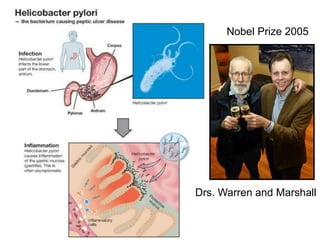
Drs. Warren and Marshall
Nobel Prize 2005
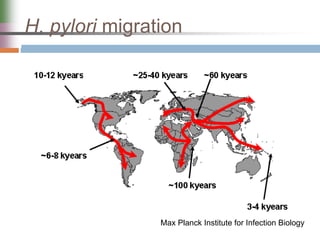
H. pylori migration
Max Planck Institute for Infection Biology
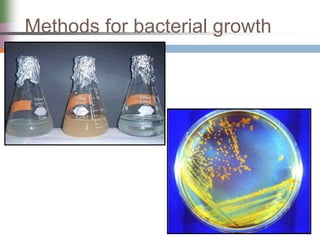
Methods for bacterial growth
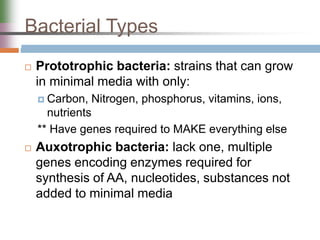
Bacterial Types
 Prototrophic bacteria: strains that can grow
in minimal media with only:
 Carbon, Nitrogen, phosphorus, vitamins, ions,
nutrients
** Have genes required to MAKE everything else
 Auxotrophic bacteria: lack one, multiple
genes encoding enzymes required for
synthesis of AA, nucleotides, substances not
added to minimal media
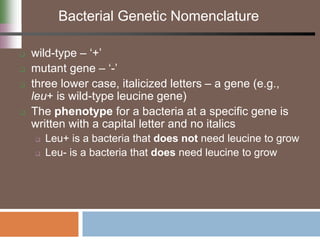
Bacterial Genetic Nomenclature
 wild-type – ‘+’
 mutant gene – ‘-’
 three lower case, italicized letters – a gene (e.g.,
leu+ is wild-type leucine gene)
 The phenotype for a bacteria at a specific gene is
written with a capital letter and no italics
 Leu+ is a bacteria that does not need leucine to grow
 Leu- is a bacteria that does need leucine to grow
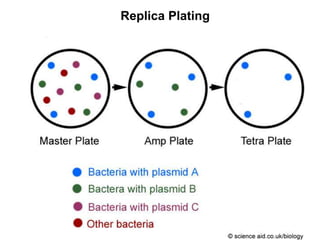
Replica Plating
WT WT
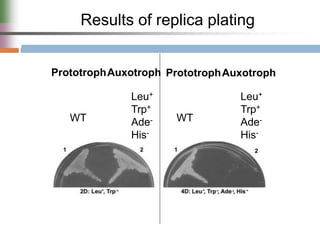
Leu+
Trp+
Ade-
His-
Leu+
Trp+
Ade-
His-
Results of replica plating
PrototrophAuxotroph PrototrophAuxotroph
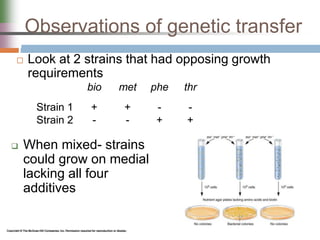
Observations of genetic transfer
 Look at 2 strains that had opposing growth
requirements
bio met phe thr
Strain 1
Strain 2
+
-
+
-
-
+
-
+
 When mixed- strains
could grow on medial
lacking all four
additives
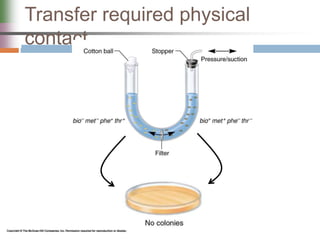
Transfer required physical
contact
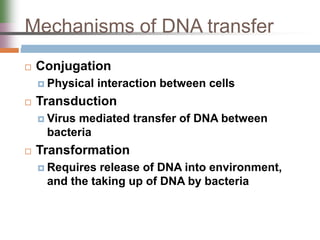
Mechanisms of DNA transfer
 Conjugation
 Physical interaction between cells
 Transduction
 Virus mediated transfer of DNA between
bacteria
 Transformation
 Requires release of DNA into environment,
and the taking up of DNA by bacteria
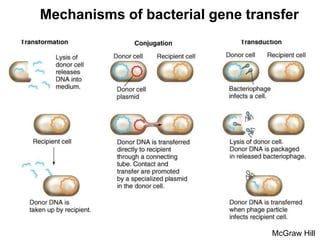
McGraw Hill
Mechanisms of bacterial gene transfer
Bacterial conjugation
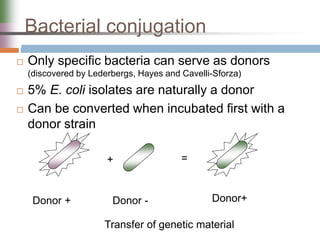
 Only specific bacteria can serve as donors
(discovered by Lederbergs, Hayes and Cavelli-Sforza)
 5% E. coli isolates are naturally a donor
 Can be converted when incubated first with a
donor strain
Donor + Donor -
+ =
Donor+
Transfer of genetic material
Conjugation mechanism
 Material called fertility factor (F factor), and is
encoded on a plasmid (extrachomosomal
DNA)
 Strains called F+ or F- to describe whether it
harbors plasmid
 Plasmids that are transmitted in this fashion:
conjugative plasmids
 Have genes that code for proteins required for
this transfer to occur
Conjugation apparatus
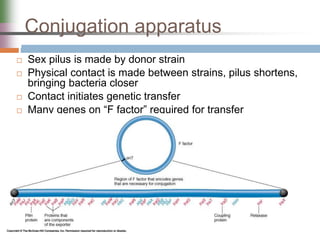
 Sex pilus is made by donor strain
 Physical contact is made between strains, pilus shortens,
bringing bacteria closer
 Contact initiates genetic transfer
 Many genes on “F factor” required for transfer
Mechanism of transfer
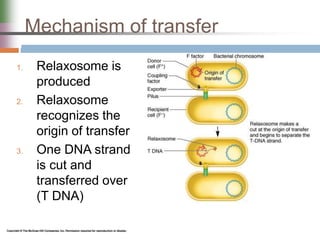
1. Relaxosome is
produced
2. Relaxosome
recognizes the
origin of transfer
3. One DNA strand
is cut and
transferred over
(T DNA)
Mechanism of transfer
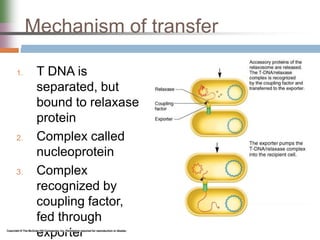
1. T DNA is
separated, but
bound to relaxase
protein
2. Complex called
nucleoprotein
3. Complex
recognized by
coupling factor,
fed through
exporter
F factor transfer
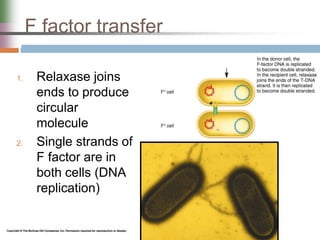
1. Relaxase joins
ends to produce
circular
molecule
2. Single strands of
F factor are in
both cells (DNA
replication)
Integration of DNA into
chromosome
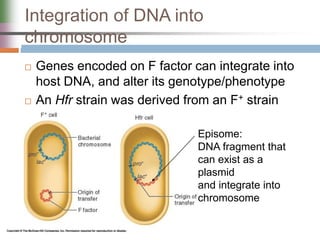
 Genes encoded on F factor can integrate into
host DNA, and alter its genotype/phenotype
 An Hfr strain was derived from an F+ strain
Episome:
DNA fragment that
can exist as a
plasmid
and integrate into
chromosome
Hfr strain
 E. coli strain discovered as Hfr (high frequency
of recombination)
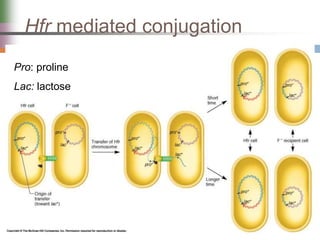
 Hfr strain transfers chromosomal DNA to F-
strains
 This transfer begins at the origin of transfer
 The amount of DNA transferred depends on
the time of conjugation
Hfr mediated conjugation
Pro: proline
Lac: lactose
Interrupted mating
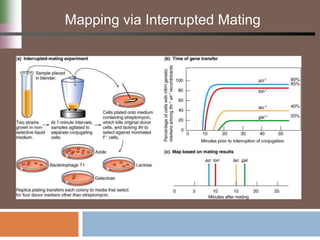
 The length of time a mating occurs, the more
DNA is transferred
 The Hfr DNA is transferred in a linear manner
 By mating for different times, you can get DNA
of several sizes, and determine the order of
the genes, and how far apart they are
(minutes)
Mapping via Interrupted Mating
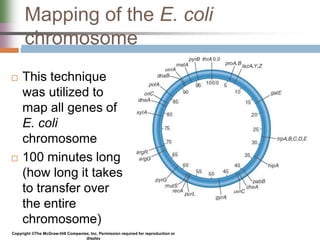
Mapping of the E. coli
chromosome
 This technique
was utilized to
map all genes of
E. coli
chromosome
 100 minutes long
(how long it takes
to transfer over
the entire
chromosome)
Copyright ©The McGraw-Hill Companies, Inc. Permission required for reproduction or
display
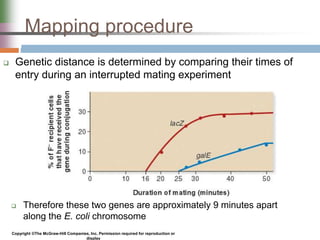
Mapping procedure
 Genetic distance is determined by comparing their times of
entry during an interrupted mating experiment
 Therefore these two genes are approximately 9 minutes apart
along the E. coli chromosome
Copyright ©The McGraw-Hill Companies, Inc. Permission required for reproduction or
display
Transformation
 Transformation is the process by which a
bacterium will take up extracellular DNA
 It was discovered by Frederick Griffith in 1928
while working with strains of Streptococcus
pneumoniae
 There are two types
 Natural transformation
 DNA uptake occurs without outside help
 Artificial transformation
 DNA uptake occurs with the help of special techniques
Natural Transformation
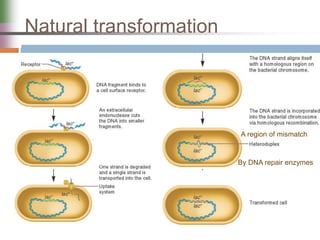
 Bacterial cells able to take up DNA are termed
competent cells
 They carry genes that encode proteins called
competence factors
 These proteins facilitate the binding, uptake and
subsequent corporation of the DNA into the bacterial
chromosome
Natural transformation
A region of mismatch
By DNA repair enzymes
Non-homologous recombination
 Sometimes, the DNA that enters the cell is not
homologous to any genes on the chromosome
 It may be incorporated at a random site on the
chromosome
 Like cotransduction, transformation mapping is
used for genes that are relatively close
together
Gene transfer
 Horizontal gene transfer is the transfer of
genes between two different species
 Vertical gene transfer is the transfer of genes
from mother to daughter cell or from parents to
offspring
 A sizable fraction of bacterial genes are
derived from horizontal gene transfer
 Roughly 17% of E. coli and S. typhimurium genes
during the past 100 million years
Horizontal Gene transfer
 The types of genes acquired through horizontal
gene transfer are quite varied and include
 Genes that confer the ability to cause disease
 Genes that confer antibiotic resistance
 Horizontal gene transfer has dramatically
contributed to the phenomenon of acquired
antibiotic resistance
 Bacterial resistance to antibiotics is a serious problem
worldwide
 In many countries, nearly 50% of Streptococcus
pneumoniae strains are resistant to penicillin
Virally encoded genes
 Viruses are not living
 However, they have unique biological structures
and functions, and therefore have traits
 Focus on bacteriophage T4
 Its genetic material contains several dozen genes
 These genes encode a variety of proteins needed for
the viral cycle
Transduction
 Transduction is the transfer of DNA from one bacterium
to another via a bacteriophage
 A bacteriophage is a virus that specifically attacks
bacterial cells
 Composed of genetic material surrounded by a protein
coat
 Bacteriophage have 2 life cycles
 Lytic
 Lysogenic
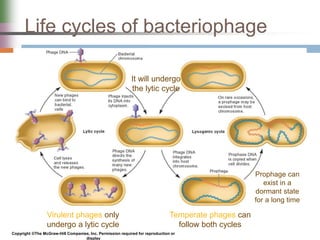
Life cycles of bacteriophage
Virulent phages only
undergo a lytic cycle
Temperate phages can
follow both cycles
Prophage can
exist in a
dormant state
for a long time
It will undergo
the lytic cycle
Copyright ©The McGraw-Hill Companies, Inc. Permission required for reproduction or
display
Types of transduction
 Generalized
 Produce some phage particles with DNA only
from host origin, from any part of chromosome
(P22)
 Specialized
 Produced particles with both phage and host
DNA, linked in a single DNA molecule, from a
specific region of the chromosome (E. coli phage
)
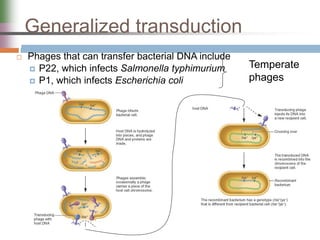
Generalized transduction
 Phages that can transfer bacterial DNA include
 P22, which infects Salmonella typhimurium
 P1, which infects Escherichia coli
Temperate
phages
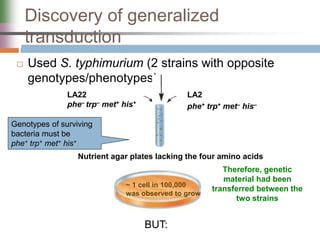
Discovery of generalized
transduction
 Used S. typhimurium (2 strains with opposite
genotypes/phenotypes)
~ 1 cell in 100,000
was observed to grow
Nutrient agar plates lacking the four amino acids
LA22
phe– trp– met+ his+
LA2
phe+ trp+ met– his–
Genotypes of surviving
bacteria must be
phe+ trp+ met+ his+
Therefore, genetic
material had been
transferred between the
two strains
BUT:
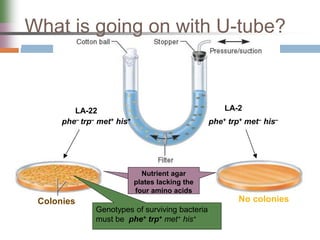
What is going on with U-tube?
Nutrient agar
plates lacking the
four amino acids
No colonies
phe– trp– met+ his+ phe+ trp+ met– his–
LA-22 LA-2
Colonies
Genotypes of surviving bacteria
must be phe+ trp+ met+ his+
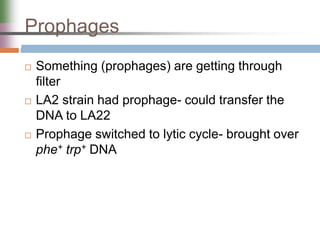
Prophages
 Something (prophages) are getting through
filter
 LA2 strain had prophage- could transfer the
DNA to LA22
 Prophage switched to lytic cycle- brought over
phe+ trp+ DNA
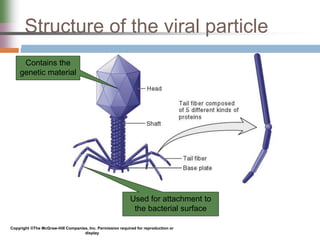
Structure of the viral particle
Copyright ©The McGraw-Hill Companies, Inc. Permission required for reproduction or
display
Contains the
genetic material
Used for attachment to
the bacterial surface
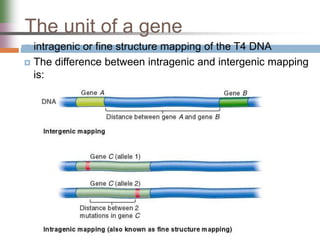
The unit of a gene
 intragenic or fine structure mapping of the T4 DNA
 The difference between intragenic and intergenic mapping
is:
Viral phenotypes
 In order to study “viral specific genes”, need to
examine phenotypes these genes impart
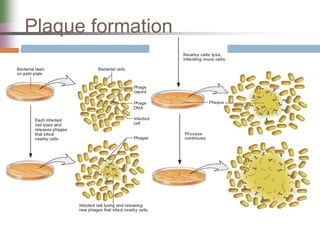
 One phenotype: plaque formation
 Lytic phages lyse bacteria in regions within the
lawn of organims, producing zones of
clearance
Plaque formation

Genetic Analysis and Mapping in Bacteria and Bacteriophages

  • 1.
    GENETIC TRANSFER AND MAPPINGIN BACTERIA AND BACTERIOPHAGES Chapter 8
  • 3.
    Bacterial uniqueness  Allelicchanges can result in phenotypic differences  Can have loss of function mutations
  • 4.
    Bacteria: differences from eukaryotes Usually haploid for a gene  Loss of function is not masked by a second allele  Genetic experiments involve transferring genetic material (not setting up crosses- although they can be mated)  Three mechanisms for genetic transfer
  • 5.
    Drs. Warren andMarshall Nobel Prize 2005
  • 6.
    H. pylori migration MaxPlanck Institute for Infection Biology
  • 7.
  • 8.
    Bacterial Types  Prototrophicbacteria: strains that can grow in minimal media with only:  Carbon, Nitrogen, phosphorus, vitamins, ions, nutrients ** Have genes required to MAKE everything else  Auxotrophic bacteria: lack one, multiple genes encoding enzymes required for synthesis of AA, nucleotides, substances not added to minimal media
  • 9.
    Bacterial Genetic Nomenclature wild-type – ‘+’  mutant gene – ‘-’  three lower case, italicized letters – a gene (e.g., leu+ is wild-type leucine gene)  The phenotype for a bacteria at a specific gene is written with a capital letter and no italics  Leu+ is a bacteria that does not need leucine to grow  Leu- is a bacteria that does need leucine to grow
  • 10.
  • 11.
    WT WT Leu+ Trp+ Ade- His- Leu+ Trp+ Ade- His- Results ofreplica plating PrototrophAuxotroph PrototrophAuxotroph
  • 12.
    Observations of genetictransfer  Look at 2 strains that had opposing growth requirements bio met phe thr Strain 1 Strain 2 + - + - - + - +  When mixed- strains could grow on medial lacking all four additives
  • 13.
  • 14.
    Mechanisms of DNAtransfer  Conjugation  Physical interaction between cells  Transduction  Virus mediated transfer of DNA between bacteria  Transformation  Requires release of DNA into environment, and the taking up of DNA by bacteria
  • 15.
    McGraw Hill Mechanisms ofbacterial gene transfer
  • 16.
    Bacterial conjugation  Onlyspecific bacteria can serve as donors (discovered by Lederbergs, Hayes and Cavelli-Sforza)  5% E. coli isolates are naturally a donor  Can be converted when incubated first with a donor strain Donor + Donor - + = Donor+ Transfer of genetic material
  • 17.
    Conjugation mechanism  Materialcalled fertility factor (F factor), and is encoded on a plasmid (extrachomosomal DNA)  Strains called F+ or F- to describe whether it harbors plasmid  Plasmids that are transmitted in this fashion: conjugative plasmids  Have genes that code for proteins required for this transfer to occur
  • 18.
    Conjugation apparatus  Sexpilus is made by donor strain  Physical contact is made between strains, pilus shortens, bringing bacteria closer  Contact initiates genetic transfer  Many genes on “F factor” required for transfer
  • 19.
    Mechanism of transfer 1.Relaxosome is produced 2. Relaxosome recognizes the origin of transfer 3. One DNA strand is cut and transferred over (T DNA)
  • 20.
    Mechanism of transfer 1.T DNA is separated, but bound to relaxase protein 2. Complex called nucleoprotein 3. Complex recognized by coupling factor, fed through exporter
  • 21.
    F factor transfer 1.Relaxase joins ends to produce circular molecule 2. Single strands of F factor are in both cells (DNA replication)
  • 22.
    Integration of DNAinto chromosome  Genes encoded on F factor can integrate into host DNA, and alter its genotype/phenotype  An Hfr strain was derived from an F+ strain Episome: DNA fragment that can exist as a plasmid and integrate into chromosome
  • 23.
    Hfr strain  E.coli strain discovered as Hfr (high frequency of recombination)  Hfr strain transfers chromosomal DNA to F- strains  This transfer begins at the origin of transfer  The amount of DNA transferred depends on the time of conjugation
  • 24.
    Hfr mediated conjugation Pro:proline Lac: lactose
  • 25.
    Interrupted mating  Thelength of time a mating occurs, the more DNA is transferred  The Hfr DNA is transferred in a linear manner  By mating for different times, you can get DNA of several sizes, and determine the order of the genes, and how far apart they are (minutes)
  • 26.
  • 27.
    Mapping of theE. coli chromosome  This technique was utilized to map all genes of E. coli chromosome  100 minutes long (how long it takes to transfer over the entire chromosome) Copyright ©The McGraw-Hill Companies, Inc. Permission required for reproduction or display
  • 28.
    Mapping procedure  Geneticdistance is determined by comparing their times of entry during an interrupted mating experiment  Therefore these two genes are approximately 9 minutes apart along the E. coli chromosome Copyright ©The McGraw-Hill Companies, Inc. Permission required for reproduction or display
  • 29.
    Transformation  Transformation isthe process by which a bacterium will take up extracellular DNA  It was discovered by Frederick Griffith in 1928 while working with strains of Streptococcus pneumoniae  There are two types  Natural transformation  DNA uptake occurs without outside help  Artificial transformation  DNA uptake occurs with the help of special techniques
  • 30.
    Natural Transformation  Bacterialcells able to take up DNA are termed competent cells  They carry genes that encode proteins called competence factors  These proteins facilitate the binding, uptake and subsequent corporation of the DNA into the bacterial chromosome
  • 31.
    Natural transformation A regionof mismatch By DNA repair enzymes
  • 32.
    Non-homologous recombination  Sometimes,the DNA that enters the cell is not homologous to any genes on the chromosome  It may be incorporated at a random site on the chromosome  Like cotransduction, transformation mapping is used for genes that are relatively close together
  • 33.
    Gene transfer  Horizontalgene transfer is the transfer of genes between two different species  Vertical gene transfer is the transfer of genes from mother to daughter cell or from parents to offspring  A sizable fraction of bacterial genes are derived from horizontal gene transfer  Roughly 17% of E. coli and S. typhimurium genes during the past 100 million years
  • 34.
    Horizontal Gene transfer The types of genes acquired through horizontal gene transfer are quite varied and include  Genes that confer the ability to cause disease  Genes that confer antibiotic resistance  Horizontal gene transfer has dramatically contributed to the phenomenon of acquired antibiotic resistance  Bacterial resistance to antibiotics is a serious problem worldwide  In many countries, nearly 50% of Streptococcus pneumoniae strains are resistant to penicillin
  • 35.
    Virally encoded genes Viruses are not living  However, they have unique biological structures and functions, and therefore have traits  Focus on bacteriophage T4  Its genetic material contains several dozen genes  These genes encode a variety of proteins needed for the viral cycle
  • 36.
    Transduction  Transduction isthe transfer of DNA from one bacterium to another via a bacteriophage  A bacteriophage is a virus that specifically attacks bacterial cells  Composed of genetic material surrounded by a protein coat  Bacteriophage have 2 life cycles  Lytic  Lysogenic
  • 37.
    Life cycles ofbacteriophage Virulent phages only undergo a lytic cycle Temperate phages can follow both cycles Prophage can exist in a dormant state for a long time It will undergo the lytic cycle Copyright ©The McGraw-Hill Companies, Inc. Permission required for reproduction or display
  • 38.
    Types of transduction Generalized  Produce some phage particles with DNA only from host origin, from any part of chromosome (P22)  Specialized  Produced particles with both phage and host DNA, linked in a single DNA molecule, from a specific region of the chromosome (E. coli phage )
  • 39.
    Generalized transduction  Phagesthat can transfer bacterial DNA include  P22, which infects Salmonella typhimurium  P1, which infects Escherichia coli Temperate phages
  • 40.
    Discovery of generalized transduction Used S. typhimurium (2 strains with opposite genotypes/phenotypes) ~ 1 cell in 100,000 was observed to grow Nutrient agar plates lacking the four amino acids LA22 phe– trp– met+ his+ LA2 phe+ trp+ met– his– Genotypes of surviving bacteria must be phe+ trp+ met+ his+ Therefore, genetic material had been transferred between the two strains BUT:
  • 41.
    What is goingon with U-tube? Nutrient agar plates lacking the four amino acids No colonies phe– trp– met+ his+ phe+ trp+ met– his– LA-22 LA-2 Colonies Genotypes of surviving bacteria must be phe+ trp+ met+ his+
  • 42.
    Prophages  Something (prophages)are getting through filter  LA2 strain had prophage- could transfer the DNA to LA22  Prophage switched to lytic cycle- brought over phe+ trp+ DNA
  • 43.
    Structure of theviral particle Copyright ©The McGraw-Hill Companies, Inc. Permission required for reproduction or display Contains the genetic material Used for attachment to the bacterial surface
  • 44.
    The unit ofa gene  intragenic or fine structure mapping of the T4 DNA  The difference between intragenic and intergenic mapping is:
  • 45.
    Viral phenotypes  Inorder to study “viral specific genes”, need to examine phenotypes these genes impart  One phenotype: plaque formation  Lytic phages lyse bacteria in regions within the lawn of organims, producing zones of clearance
  • 46.