Conflict
What Do You Think?
     When you hear the word . . .
              CONFLICT
     What do you think and what images
      come to you . . .


                                          Page 2
Introduction


    Definition
       – Opposition
       – Incompatible behavior
       – opposed interaction
       – Block another party from reaching her or his goals
Introduction
     Key elements
        – Interdependence with another party
        – Perception of incompatible goals
     Conflict events
        – Disagreements
        – Debates
        – Disputes
        – Preventing someone from reaching
          valued goals
Introduction
     Conflict is not always bad for an
      organization
     Do not need to reduce all conflict
     An inevitable part of organization
      life
     Needed for growth and survival
     Conflict management includes
      increasing and decreasing conflict
     Major management responsibility
Definition


     A situation in which someone
      believes that his or her own needs
      have been denied.
     “Conflict is a predictable social
      phenomenon and should be
      channeled to useful purposes.”


                                           Page 6
Symptoms Of Conflict
     Tensions.
     No desire to communicate.
     Work not done properly.
     Disastrous meetings.
     Anger occurs quickly and easily.


                                         Page 7
Symptoms Of Conflict
     Failing productivity.
     Slipping morale.
     Absenteeism.
     Accidents.
     Escalating costs.
     Shouting.
     Bad times.


                              Page 8
Levels and Types
of Conflict

   Level of conflict            Type of conflict


   Organization        Within and between organizations


      Group            Within and between groups


    Individual         Within and between individuals
Levels and Types
of Conflict
     Intraorganization conflict
        – Conflict that occurs within an
          organization
        – At interfaces of organization functions
        – Can occur along the vertical and
          horizontal dimensions of the
          organization
            • Vertical conflict: between
              managers and subordinates
            • Horizontal conflict: between
              departments and work groups
Levels and Types
of Conflict
     Intragroup conflict
        – Conflict among members of a group
        – Early stages of group development
        – Ways of doing tasks or reaching
          group's goals

     Intergroup conflict: between two
      or more groups
Levels and Types
of Conflict
     Interpersonal conflict
        – Between two or more people
        – Differences in views about what should
          be done
        – Efforts to get more resources
        – Differences in orientation to work and
          time in different parts of an
          organization
Levels and Types
of Conflict
     Intrapersonal conflict
        – Occurs within an individual
           • Threat to a person’s values
           • Feeling of unfair treatment
           • Multiple and contradictory sources
             of socialization
           • Related to the Theory of Cognitive
             Dissonance
Levels and Types
of Conflict
     Interorganization conflict
        – Between two or more organizations
        – Not competition
        – Examples: suppliers and
          distributors, especially with the close
          links now possible
Toward Conflict Management
     Conflict management is defined as
      “the opportunity to improve
      situations and strengthen
      relationships” .
         –proactive conflict management
        –collaborative conflict
      management
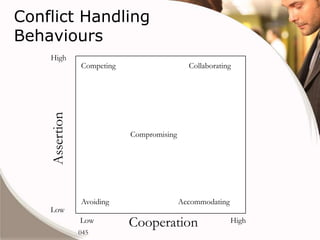
Conflict Handling
Behaviours
    High
           Competing                    Collaborating


                       Compromising


           Avoiding                   Accommodating
    Low
           Low         Cooperation                    High
           045
Toward Conflict Management
     Blake and Mouton’s Conflict Grid
Toward Conflict Management
     Blake and Mouton (1970) proposed
      a grid that shows various conflict
      approaches.
        – The 1,1 style is the hands-off
          approach, also called avoidance.
        – The 1,9 position, also called
          accommodation, is excessively person-
          oriented.
Toward Conflict Management


     – The 5,5 position represents a
       willingness to compromise.
     – The 9,1 is the bullheaded
       approach, also called competing.
     – The optimum style for reducing conflict
       is the 9,9 approach, also called
       collaboration.
Avoiding
Physical of mental withdrawal
Low concern for either parties
Lose-Lose situation
2. Smoothing/Accomodating
Accommodating the other parties
  interest
Lose-win situation
3.Forcing/competing:
Using power
Skills, tactics
To achieve, domination
Aggression
Win-lose situation
4.compromising:
Search for middle group
Willing to give up something
In exchange for gain
Moderate degree of concern
No clear outcome
5. Collaboration:
Facing the conflict directly
Mutual satisfaction
Problem solving
Win-Win out come

Conflict

  • 1.
  • 2.
    What Do YouThink?  When you hear the word . . . CONFLICT  What do you think and what images come to you . . . Page 2
  • 3.
    Introduction  Definition – Opposition – Incompatible behavior – opposed interaction – Block another party from reaching her or his goals
  • 4.
    Introduction  Key elements – Interdependence with another party – Perception of incompatible goals  Conflict events – Disagreements – Debates – Disputes – Preventing someone from reaching valued goals
  • 5.
    Introduction  Conflict is not always bad for an organization  Do not need to reduce all conflict  An inevitable part of organization life  Needed for growth and survival  Conflict management includes increasing and decreasing conflict  Major management responsibility
  • 6.
    Definition  A situation in which someone believes that his or her own needs have been denied.  “Conflict is a predictable social phenomenon and should be channeled to useful purposes.” Page 6
  • 7.
    Symptoms Of Conflict  Tensions.  No desire to communicate.  Work not done properly.  Disastrous meetings.  Anger occurs quickly and easily. Page 7
  • 8.
    Symptoms Of Conflict  Failing productivity.  Slipping morale.  Absenteeism.  Accidents.  Escalating costs.  Shouting.  Bad times. Page 8
  • 9.
    Levels and Types ofConflict Level of conflict Type of conflict Organization Within and between organizations Group Within and between groups Individual Within and between individuals
  • 10.
    Levels and Types ofConflict  Intraorganization conflict – Conflict that occurs within an organization – At interfaces of organization functions – Can occur along the vertical and horizontal dimensions of the organization • Vertical conflict: between managers and subordinates • Horizontal conflict: between departments and work groups
  • 11.
    Levels and Types ofConflict  Intragroup conflict – Conflict among members of a group – Early stages of group development – Ways of doing tasks or reaching group's goals  Intergroup conflict: between two or more groups
  • 12.
    Levels and Types ofConflict  Interpersonal conflict – Between two or more people – Differences in views about what should be done – Efforts to get more resources – Differences in orientation to work and time in different parts of an organization
  • 13.
    Levels and Types ofConflict  Intrapersonal conflict – Occurs within an individual • Threat to a person’s values • Feeling of unfair treatment • Multiple and contradictory sources of socialization • Related to the Theory of Cognitive Dissonance
  • 14.
    Levels and Types ofConflict  Interorganization conflict – Between two or more organizations – Not competition – Examples: suppliers and distributors, especially with the close links now possible
  • 15.
    Toward Conflict Management  Conflict management is defined as “the opportunity to improve situations and strengthen relationships” . –proactive conflict management –collaborative conflict management
  • 16.
    Conflict Handling Behaviours High Competing Collaborating Compromising Avoiding Accommodating Low Low Cooperation High 045
  • 17.
    Toward Conflict Management  Blake and Mouton’s Conflict Grid
  • 18.
    Toward Conflict Management  Blake and Mouton (1970) proposed a grid that shows various conflict approaches. – The 1,1 style is the hands-off approach, also called avoidance. – The 1,9 position, also called accommodation, is excessively person- oriented.
  • 19.
    Toward Conflict Management – The 5,5 position represents a willingness to compromise. – The 9,1 is the bullheaded approach, also called competing. – The optimum style for reducing conflict is the 9,9 approach, also called collaboration.
  • 20.
    Avoiding Physical of mentalwithdrawal Low concern for either parties Lose-Lose situation
  • 21.
    2. Smoothing/Accomodating Accommodating theother parties interest Lose-win situation
  • 22.
    3.Forcing/competing: Using power Skills, tactics Toachieve, domination Aggression Win-lose situation
  • 23.
    4.compromising: Search for middlegroup Willing to give up something In exchange for gain Moderate degree of concern No clear outcome
  • 24.
    5. Collaboration: Facing theconflict directly Mutual satisfaction Problem solving Win-Win out come