CONFILCT AND CONFLICT RESOLUTION
Agenda
• Introduction to Conflict
• Definition of Conflict
• Nature of Conflict
• Views on Conflict
• Types of Conflict
• Aspects of Conflict
• Relationship b/w org. performance and conflict
• Postivie and Negative Conflict
• Process of Conflict
• Levels of Conflict
• Conflict Resolution in Groups and different problem
solving strategies.
Introduction
• The concept of conflict , being an outcome
of behaviors, is an integral part of human life.
Where ever there is interaction, there is
conflict.
• Conflict can be considered as an expression
of hostility(unfriendliness or opposition),
negative attitudes, antagonism, aggression,
rivalry and misunderstanding.
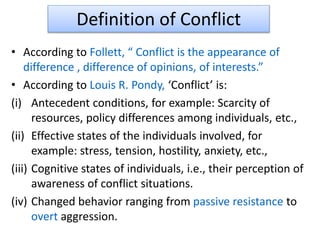
Definition of Conflict
• According to Follett, “ Conflict is the appearance of
difference , difference of opinions, of interests.”
• According to Louis R. Pondy, ‘Conflict’ is:
(i) Antecedent conditions, for example: Scarcity of
resources, policy differences among individuals, etc.,
(ii) Effective states of the individuals involved, for
example: stress, tension, hostility, anxiety, etc.,
(iii) Cognitive states of individuals, i.e., their perception of
awareness of conflict situations.
(iv) Changed behavior ranging from passive resistance to
overt aggression.
• It is a process that begins when one party
perceives that another party has negatively
affected, or is about to negatively affect
something that the first party cares about.
• Conflict is a psychological state of mind when
people are in a dilemma whether to do or not
to do a thing, is a state of conflict.
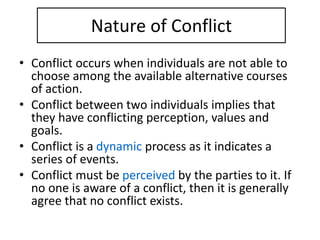
Nature of Conflict
• Conflict occurs when individuals are not able to
choose among the available alternative courses
of action.
• Conflict between two individuals implies that
they have conflicting perception, values and
goals.
• Conflict is a dynamic process as it indicates a
series of events.
• Conflict must be perceived by the parties to it. If
no one is aware of a conflict, then it is generally
agree that no conflict exists.
Views on conflict
• Traditional view: The early approach to conflict assumed that all
conflict was bad. Conflict was viewed negatively, and it was used
synonymously with such terms as violence, destruction.
• Human Relations view: The human relations position argued that
conflict was a natural occurrence in all groups and organizations.
Since conflict was inevitable(which cannot be avoided) it is accepted
and there are even times when conflict may benefit a group’s
performance.
• Interactionist View( Modern View): This view is based on the belief
that conflict is not only a positive force in a group but is also
necessary for a group to perform effectively. This approach
encourages group leaders to maintain an ongoing minimum level of
conflict – enough to keep the group viable, self-critical and creative.
Types of conflict
• Functional – support the goals of the group and improves
its performance.
• Dysfunctional – conflict that hinders group performance.
• The functional conflicts can be differentiated from the
dysfunctional conflicts on the basis of the following three
attributes:
(i) Task Conflict: Related to content and goals of the work.
(ii) Relationship Conflict: Focuses on interpersonal
relationships.
(iii) Process Conflict: Process conflict relates to how the work
gets done.
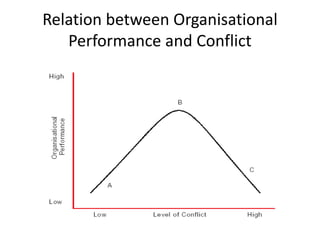
Relation between Organisational
Performance and Conflict
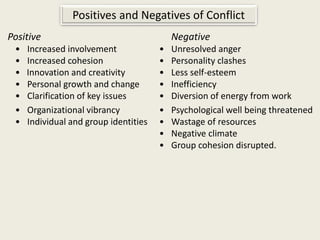
Positive Negative
• Increased involvement • Unresolved anger
• Increased cohesion • Personality clashes
• Innovation and creativity • Less self-esteem
• Personal growth and change • Inefficiency
• Clarification of key issues • Diversion of energy from work
• Organizational vibrancy • Psychological well being threatened
• Individual and group identities • Wastage of resources
• Negative climate
• Group cohesion disrupted.
Positives and Negatives of Conflict
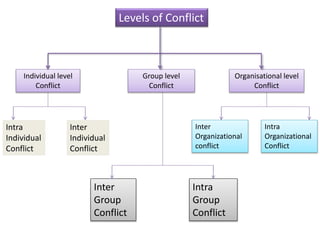
Levels of Conflict
Individual level
Conflict
Group level
Conflict
Organisational level
Conflict
Intra
Individual
Conflict
Inter
Individual
Conflict
Inter
Group
Conflict
Intra
Group
Conflict
Inter
Organizational
conflict
Intra
Organizational
Conflict
• Intra Individual Conflict: These conflicts arise within a person
and are of psychological nature. These conflicts are generally
related to the goals a person wants to achieve or roles in the
manner he wants to achieve.
• Inter individual Conflict: Inter personal conflict arise
between two individuals having competition for achieving
scarce things, such as status, power, position, promotion or
resources.
• Intra Group Conflict (With in the group): Intra group conflict
refers to disputes among some or all of a group’s members,
which often affect the group’s performance. Family run
business can be especially prone to severe intra-group and
other types of conflicts. These conflicts typically become
more intense when an owner-founder approaches
retirement, actually retires or dies. The way the two sons of
the late Dhirubhai Ambani are fighting on ownership and
control of Reliance Industries is a typical example.
• Inter group Conflicts (Between groups): Inter group
conflict arises out of the interaction of various groups.
Inter group conflict is also called organisational conflict,
refers to the conflict between groups, departments, or
sections in an organisation. Conflict between groups is
frequent and highly visible.
Conflict Resolution in Groups
• Resolving Intra-Group Conflict : Conflict with
in a family can be resolved if the members
recognize and respect roles of family
members. All the members need to realise
that dived they fall, united they stand.
Probably a family friend may intervene to
resolve the dispute if the members fail to
resolve the conflict themselves.
Key points to remember
• Be a model of calm and control
• Don't give in to emotional outbursts
• Don't assume people are being difficult intentionally
• Find a quiet place in to resolve conflicts....privately
Set some ground rules for the discussion:
• No raising of voices
• This is not a debate
• Speak only for yourself..."I" phrases
• Confront the issues, not the people
• Maintain or enhance self-esteem
conflictresolution-130913120253-phpapp02.pptx

conflictresolution-130913120253-phpapp02.pptx

  • 1.
  • 2.
    Agenda • Introduction toConflict • Definition of Conflict • Nature of Conflict • Views on Conflict • Types of Conflict • Aspects of Conflict • Relationship b/w org. performance and conflict • Postivie and Negative Conflict • Process of Conflict • Levels of Conflict • Conflict Resolution in Groups and different problem solving strategies.
  • 3.
    Introduction • The conceptof conflict , being an outcome of behaviors, is an integral part of human life. Where ever there is interaction, there is conflict. • Conflict can be considered as an expression of hostility(unfriendliness or opposition), negative attitudes, antagonism, aggression, rivalry and misunderstanding.
  • 4.
    Definition of Conflict •According to Follett, “ Conflict is the appearance of difference , difference of opinions, of interests.” • According to Louis R. Pondy, ‘Conflict’ is: (i) Antecedent conditions, for example: Scarcity of resources, policy differences among individuals, etc., (ii) Effective states of the individuals involved, for example: stress, tension, hostility, anxiety, etc., (iii) Cognitive states of individuals, i.e., their perception of awareness of conflict situations. (iv) Changed behavior ranging from passive resistance to overt aggression.
  • 5.
    • It isa process that begins when one party perceives that another party has negatively affected, or is about to negatively affect something that the first party cares about. • Conflict is a psychological state of mind when people are in a dilemma whether to do or not to do a thing, is a state of conflict.
  • 6.
    Nature of Conflict •Conflict occurs when individuals are not able to choose among the available alternative courses of action. • Conflict between two individuals implies that they have conflicting perception, values and goals. • Conflict is a dynamic process as it indicates a series of events. • Conflict must be perceived by the parties to it. If no one is aware of a conflict, then it is generally agree that no conflict exists.
  • 7.
    Views on conflict •Traditional view: The early approach to conflict assumed that all conflict was bad. Conflict was viewed negatively, and it was used synonymously with such terms as violence, destruction. • Human Relations view: The human relations position argued that conflict was a natural occurrence in all groups and organizations. Since conflict was inevitable(which cannot be avoided) it is accepted and there are even times when conflict may benefit a group’s performance. • Interactionist View( Modern View): This view is based on the belief that conflict is not only a positive force in a group but is also necessary for a group to perform effectively. This approach encourages group leaders to maintain an ongoing minimum level of conflict – enough to keep the group viable, self-critical and creative.
  • 8.
    Types of conflict •Functional – support the goals of the group and improves its performance. • Dysfunctional – conflict that hinders group performance. • The functional conflicts can be differentiated from the dysfunctional conflicts on the basis of the following three attributes: (i) Task Conflict: Related to content and goals of the work. (ii) Relationship Conflict: Focuses on interpersonal relationships. (iii) Process Conflict: Process conflict relates to how the work gets done.
  • 9.
  • 10.
    Positive Negative • Increasedinvolvement • Unresolved anger • Increased cohesion • Personality clashes • Innovation and creativity • Less self-esteem • Personal growth and change • Inefficiency • Clarification of key issues • Diversion of energy from work • Organizational vibrancy • Psychological well being threatened • Individual and group identities • Wastage of resources • Negative climate • Group cohesion disrupted. Positives and Negatives of Conflict
  • 11.
    Levels of Conflict Individuallevel Conflict Group level Conflict Organisational level Conflict Intra Individual Conflict Inter Individual Conflict Inter Group Conflict Intra Group Conflict Inter Organizational conflict Intra Organizational Conflict
  • 12.
    • Intra IndividualConflict: These conflicts arise within a person and are of psychological nature. These conflicts are generally related to the goals a person wants to achieve or roles in the manner he wants to achieve. • Inter individual Conflict: Inter personal conflict arise between two individuals having competition for achieving scarce things, such as status, power, position, promotion or resources. • Intra Group Conflict (With in the group): Intra group conflict refers to disputes among some or all of a group’s members, which often affect the group’s performance. Family run business can be especially prone to severe intra-group and other types of conflicts. These conflicts typically become more intense when an owner-founder approaches retirement, actually retires or dies. The way the two sons of the late Dhirubhai Ambani are fighting on ownership and control of Reliance Industries is a typical example.
  • 13.
    • Inter groupConflicts (Between groups): Inter group conflict arises out of the interaction of various groups. Inter group conflict is also called organisational conflict, refers to the conflict between groups, departments, or sections in an organisation. Conflict between groups is frequent and highly visible.
  • 14.
    Conflict Resolution inGroups • Resolving Intra-Group Conflict : Conflict with in a family can be resolved if the members recognize and respect roles of family members. All the members need to realise that dived they fall, united they stand. Probably a family friend may intervene to resolve the dispute if the members fail to resolve the conflict themselves.
  • 15.
    Key points toremember • Be a model of calm and control • Don't give in to emotional outbursts • Don't assume people are being difficult intentionally • Find a quiet place in to resolve conflicts....privately Set some ground rules for the discussion: • No raising of voices • This is not a debate • Speak only for yourself..."I" phrases • Confront the issues, not the people • Maintain or enhance self-esteem