ORGANIZATIONAL
CONFLICTS
CONCEPT OF CONFLICT
• Conflict is having different meanings to different persons. Some
say conflict is a disagreement between individuals/groups or
may be viewed as a perception of disagreement in the
individuals.
• Thomas defined Conflict as “ Conflict is a process that
begins when one party perceives that another party
has negatively affected, or is about to negatively
affect ,something that the first party cares about.”
• As per Newstrom & Davis “Conflict is any situation which two or
more parties feel themselves in opposition .It is an
interpersonal process that arises from disagreements over the
goals or the methods to accomplish those goals.”
On the basis of the definition we can derive various
features:
1. Conflict arises because of incompatibility of two or more aspects
of an element : it may be goals ,interests, methods of working or
any other feature.
2. Conflicts occur when an individual is not able to choose among
the available courses of action.
3. Conflict is a dynamic process as it indicates a series of events.
4. If no one is aware of conflict ,it is generally agreed that conflict
does not exist even though there may be incompatibility in some
respect.
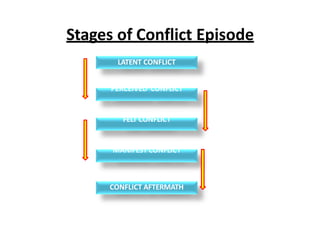
Stages of Conflict Episode
LATENT CONFLICT
PERCEIVED CONFLICT
FELT CONFLICT
MANIFEST CONFLICT
CONFLICT AFTERMATH
1.LATENT CONFLICT
1. Each conflict begins with latent(hidden)
conflict.
2. In this stage the conflict has not taken a
shape, therefore it is not noticeable.
3. It may occur in subconscious mind.
2.Perceived Conflict
• Parties to the conflict may perceiveabout
incompatibility of the past history of conflict
,though sometimes this perception may be
wrong.
• This stage of conflict occurs due to
misunderstanding of parties ,caused due to
lack of communication.
3.Felt Conflict
• At this stage parties to the conflict feel that
they have some conflict among themselves.
• Felt conflict differs from perceived conflict .
• For example inconsistency in demands from
the organization and individual needs may
create internalization of conflict situation.
4.Manifest Conflict
• This is the stage when two parties to the conflict
show variety of conflict-ful behavior such as
open aggression, withdrawal etc
5.Conflict Aftermath
⚫At this stage attempts are made to resolve the conflict
through conflict resolution mechanism.
⚫If the conflict is resolved properly then a basis of
cooperative behavior is established between the parties.
Issues involved in Conflict
1. Facts: Conflict may occur because of
disagreement
2. Goals: Sometimes there may be disagreement
over the goals which two parties want to
achieve.
3. Methods: Even if goals are perceived to be same
there may be difference over the methods,
procedures ,strategies.
4. Values: There may be difference over the values-
ethical standards, fairness justice etc.
Positive and Negative aspects of Conflict
• In general the opinion of common person about conflict is
negative. The reason behind this is they have seen the
conflicts between two groups in an organization.
• There are three approaches for looking at consequences of
conflicts
– TRADITIONAL VIEW
– HUMAN RELATIONS VIEW
– INTERACTIONIST VIEW
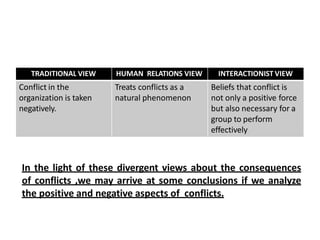
TRADITIONAL VIEW HUMAN RELATIONS VIEW INTERACTIONIST VIEW
Conflict in the Treats conflicts as a Beliefs that conflict is
organization is taken natural phenomenon not only a positive force
negatively. but also necessary for a
group to perform
effectively
In the light of these divergent views about the consequences
of conflicts ,we may arrive at some conclusions if we analyze
the positive and negative aspects of conflicts.
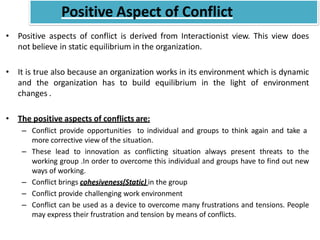
Positive Aspect of Conflict
• Positive aspects of conflict is derived from Interactionist view. This view does
not believe in static equilibrium in the organization.
• It is true also because an organization works in its environment which is dynamic
and the organization has to build equilibrium in the light of environment
changes .
• The positive aspects of conflicts are:
– Conflict provide opportunities to individual and groups to think again and take a
more corrective view of the situation.
– These lead to innovation as conflicting situation always present threats to the
working group .In order to overcome this individual and groups have to find out new
ways of working.
– Conflict brings cohesiveness(Static) in the group
– Conflict provide challenging work environment
– Conflict can be used as a device to overcome many frustrations and tensions. People
may express their frustration and tension by means of conflicts.
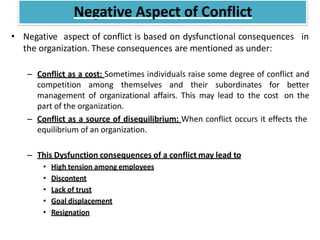
• Negative aspect of conflict is based on dysfunctional consequences in
the organization. These consequences are mentioned as under:
– Conflict as a cost: Sometimes individuals raise some degree of conflict and
competition among themselves and their subordinates for better
management of organizational affairs. This may lead to the cost on the
part of the organization.
– Conflict as a source of disequilibrium: When conflict occurs it effects the
equilibrium of an organization.
– This Dysfunction consequences of a conflict may lead to
• High tension among employees
• Discontent
• Lack of trust
• Goal displacement
• Resignation
Negative Aspect of Conflict
LEVELS OF CONFLICT
• For an effective management it is
necessary to understand the conflict at
all the levels namely:
–Individual Level Conflict
–Group Level Conflict
–Organizational Level Conflict
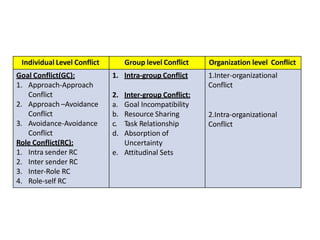
Individual Level Conflict Group level Conflict Organization level Conflict
Goal Conflict(GC):
1. Approach-Approach
Conflict
2. Approach –Avoidance
Conflict
3. Avoidance-Avoidance
Conflict
Role Conflict(RC):
1. Intra sender RC
2. Inter sender RC
3. Inter-Role RC
4. Role-self RC
1. Intra-group Conflict
2. Inter-group Conflict:
a. Goal Incompatibility
b. Resource Sharing
c. Task Relationship
d. Absorption of
Uncertainty
e. Attitudinal Sets
1.Inter-organizational
Conflict
2.Intra-organizational
Conflict
• The analysis of Individual level conflict starts at the
individual level itself. Thus, an individual experiences
two types of conflict in himself : goal conflict, role
conflict.
1. GOAL CONFLICT: Goal conflict occurs when two or
more goal block each other. There can be three(3)
alternatives of goal conflicts and they are:
a. Approach-Approach Conflict
b. Approach-Avoidance Conflict
c. Avoidance-Avoidance Conflict
Individual Level Conflict
Approach-Approach Conflict
• In this situation the individual is caught
between trying to decide upon one or another
of two attractive goals which are mutually
exclusive.
• The problem comes when the desirability's are
roughly equal.
• Approach-Approach Conflict can be analyzed
in terms of Festinger’s
• theory of Cognitive Dissonance.
• “Dissonance” is a psychological state where an
individual feel discomfort or conflict when
he/she is faced with two or more alternatives
to a decision.
• In this situation, the individual has both Positive and
Negative feelings about trying a goal because goal
possesses both attractive and repulsive characteristics.
• For example: Managers engaged in long term planning
and developed a goal plan .As the time gets nearer for the
implementation of the plan ,the negative aspects of plan
seem to appear much grater as compare to that at the
beginning. Manager in such situation may reach the point
where approach equals avoidance.
• The result is a great deal of internal conflict & stress.
Approach-Avoidance Conflict
• This is the position where the individual must choose
between two mutually exclusive goals, each of which
possesses unattractive qualities.
• Unless other alternatives are available such conflict has a
tendency to stay unresolved.
Avoidance-Avoidance Conflict
2.ROLE CONFLICT(RC)
• It is known to all that an individual perform number of roles in the
organization and his/her organizational role is most important for
that individual.
• When expectations of role are materially different or opposite
from behavior anticipated by in individual then he tends to be in
role conflict.
• Role conflict is of four types:
1. Intra -sender RC
2. Inter -sender RC
3. Inter-Role RC
4. Role-self RC
1.Intra sender RC: Where the expectations from a
single member of a role set may be incomplete. This
happens when a person is called upon to perform a
work within specified limit but it cannot be possible
to do the work within that limit.
2.Inter sender RC: The expectations sent from one
sender are in conflict with those from one or more
other senders.
3.Inter-Role Conflict: When an individual occupies two
or more roles simultaneously and the expectations
associated with those different roles are incompatible.
4.Role-Self RC: It occurs when role requirements violate
the need, values or capacities of the person.
• Conflict may occur at group level. A group
constitutes two or more persons who interact
in such a way that each person influences and is
influenced by others.
• In this interaction process there may be two
types of conflict
1. Intra - group conflict( Within the group itself)
2. Inter-group Conflict(Between the groups)
Group Level Conflict
Intergroup conflict
• Intergroup conflict occurs between the groups.
• There are various factors responsible for
Intergroup conflict and they are(5):
– Goal Incompatibility
– Resource Sharing: Two or more groups sharing from
common resource pool.
– Task relationship: (group exceeds its authority) Staff
departments influence in decision making process
well in excess of the advisory roles assigned to them.
–Absorption of uncertainty: Uncertainty is the
gap between what is known and what needs to
be known to make correct decisions. A rule set
by the A/c department for travelling expenses
to be incurred by Mkt deptt. And if the Mkt
deptt finds the rules framed by A/c deptt. is
inadequate then the conflict arises.
–Attitudinal Sets: The set of attitudes that a
members of various groups hold towards each
other.
Conflict occurs with
same goals or with
• Inter-organizational Conflict:
other organization perusing
government agency.
• Intra-organizational Conflict: Conflict occurs within
the organization.:
“The boss wants more production, subordinates
want more considerations. Customers want faster
deliveries, peers request schedule delay. Consultants
suggest change, subordinate resist change. The rule
book provide formula ;the staff says it will not work.”
Organization Level Conflict
CONFLICT RESOLUTION
• Whenever Conflict arise ,these have to be resolved by some
specific actions known as Conflict Resolutions Actions. Some
major action of conflict resolution take place in the following
ways:
1. Problem Solving
2. Avoidance
3. Smoothing
4. Compromise
5. Confrontation
1. Problem Solving
emphasizes the attaining of the
• It is the most positive technique because it
common
interests of both conflicting parties.
• Questions of who is right or wrong is usually
but sharing and communicating are
in order to find areas of common
avoided
required
interest.
• This technique is applied when conflict is based
on misunderstanding.
2. Avoidance
• In this technique the parties in the conflict are
suggested to withdraw or conceal the
incompatibility.
• This method is more correctly
conflicts rather than solving
conflicts.
for avoiding
the actual
3.Smoothing
• It is a process of playing down differences that
exist between individuals or groups while
emphasizing common interests.
• Differences are suppressed and similarities are
accentuate d or highlighted in smoothing
process.
• This is also not a long term solution for the
conflicts.
4.Compromise
• It is a well accepted technique for resolving conflicts.
• There is neither a looser or a winner.
• In this method the external or third party intervention
is entertained.
• A compromise achieve by third party intervention is
called as mediation and without the intervention of
the external parties is called as bargaining.
• This is an effective method to solve conflict between
management and workers.
5.Confrontation
• If the parties takes a rigid stand then the
methods discussed above may not bring
resolution of conflict between parties.
• In such case the parties
confrontation to settle
are left to
the conflict
themselves.
• The parties concerned may settle their score
by applying their strength against each other.
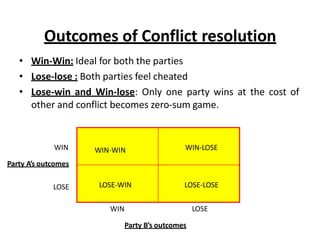
Outcomes of Conflict resolution
• Win-Win: Ideal for both the parties
• Lose-lose : Both parties feel cheated
• Lose-win and Win-lose: Only one party wins at the cost of
other and conflict becomes zero-sum game.
WIN-WIN WIN-LOSE
LOSE-WIN LOSE-LOSE
WIN
Party A’s outcomes
LOSE
LOSE
WIN
Party B’s outcomes
Methodology of conflict resolution
• Managerial Grid
• Sensitivity Training
• Transactional Analysis
• Team building Interventions
• MBO
Grid Training
• Grid training is an outgrowth of the managerial grid
approach to leadership (Blacke and Mouton, 1978). It
is an instrumental approach to laboratory training.
• Sensitivity training is supplemented with
administered instruments (Benny, Bradford
Lippitt, 1964).
self-
and
• The analysis of these instruments helps in group
development and in the learning of group members.
• This technique is widely used and has proved
effective.
Grid training for OD is completed in six
phases. They are:
1. Laboratory-seminar training, which aims at acquainting participants with concepts
and material used in grid training;
2. A team development phase, involving the coming together of members from the
same department to chart out as to how they will attain a 9 x 9 position on the
grid;
3. Inter-group development aims at overall OD. During this phase, conflict
situations between groups are identified and analyzed;
4. Organization goal setting is based on participative management, where
participants contribute to and agree upon important goals for the
organization;
5. Goal attainment aims at achieving goals which were set during the phase
organizational goal setting; and
6. Stabilization involves the evaluation of the overall program and making
suggestions for changes if appropriate.
of
Sensitivity training
• This has many applications and is still used widely, even
though new techniques have emerged (Lewin, 1981).
• Sensitivity training (Benny, Bradford and Lippitt, 1964)
basically aims at:
– Growth in effective membership;
– Developing ability to learn;
– Stimulating to give help; and
– Developing insights to be sensitive to group processes.
• These process variables - in a systems sense - interact and
are interdependent.
Team building
• Team building has been considered the most
popular OD technique in recent years, so much
so that it has replaced sensitivity training.
• It aims at improving overall performance, tends
to be more task-oriented, and can be used with
family groups (members from the same unit) as
well as special groups (such as task forces,
committees and inter-departmental groups).
There are five major elements involved in team
building (French and Bell, 1978):
1. Problem solving, decision making, role clarification and
goal setting for accomplishing the assigned tasks.
2. Building and maintaining effective inter-personal
relationships.
3. Understanding and managing group processes and
culture.
4. Role analysis techniques for role clarification and
definition.
5. Role negotiation techniques.
Transactional Analysis
widely used by
• Transactional analysis is
management practitioners to analyzes group
dynamics and inter-personal communications.
• It deals with aspects of identity, maturation,
insight and awareness (Berne, 1964).
• As a tool for OD, it attempts to help people
understand their egos - both their own and
those of others - to allow them to interact in a
more meaningful manner with one another
(Huse, 1975).
• It attempts to identify people’s dominant ego
states and help people understand and analyze
their transactions with others. It is quite effective
if applied in the early stage of the diagnostic
phase.
Transactional Analysis
Negotiation & Conflict Resolution
• Often, negotiations occur in the process of
conflict resolution.
• Negotiations are viewed as a process in which
two or more parties attempt to reach
acceptable agreement in a situation
characterised by some level of disagreement.
• Negotiations include a combination of
compromise, collaboration and possibly some
coercion on vital issues.
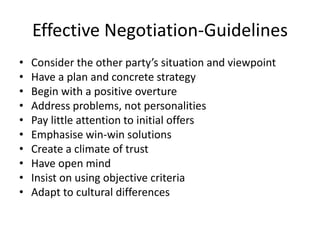
Effective Negotiation-Guidelines
• Consider the other party’s situation and viewpoint
• Have a plan and concrete strategy
• Begin with a positive overture
• Address problems, not personalities
• Pay little attention to initial offers
• Emphasise win-win solutions
• Create a climate of trust
• Have open mind
• Insist on using objective criteria
• Adapt to cultural differences

Conflict.pptx

  • 1.
  • 2.
    CONCEPT OF CONFLICT •Conflict is having different meanings to different persons. Some say conflict is a disagreement between individuals/groups or may be viewed as a perception of disagreement in the individuals. • Thomas defined Conflict as “ Conflict is a process that begins when one party perceives that another party has negatively affected, or is about to negatively affect ,something that the first party cares about.” • As per Newstrom & Davis “Conflict is any situation which two or more parties feel themselves in opposition .It is an interpersonal process that arises from disagreements over the goals or the methods to accomplish those goals.”
  • 3.
    On the basisof the definition we can derive various features: 1. Conflict arises because of incompatibility of two or more aspects of an element : it may be goals ,interests, methods of working or any other feature. 2. Conflicts occur when an individual is not able to choose among the available courses of action. 3. Conflict is a dynamic process as it indicates a series of events. 4. If no one is aware of conflict ,it is generally agreed that conflict does not exist even though there may be incompatibility in some respect.
  • 4.
    Stages of ConflictEpisode LATENT CONFLICT PERCEIVED CONFLICT FELT CONFLICT MANIFEST CONFLICT CONFLICT AFTERMATH
  • 5.
    1.LATENT CONFLICT 1. Eachconflict begins with latent(hidden) conflict. 2. In this stage the conflict has not taken a shape, therefore it is not noticeable. 3. It may occur in subconscious mind.
  • 6.
    2.Perceived Conflict • Partiesto the conflict may perceiveabout incompatibility of the past history of conflict ,though sometimes this perception may be wrong. • This stage of conflict occurs due to misunderstanding of parties ,caused due to lack of communication.
  • 7.
    3.Felt Conflict • Atthis stage parties to the conflict feel that they have some conflict among themselves. • Felt conflict differs from perceived conflict . • For example inconsistency in demands from the organization and individual needs may create internalization of conflict situation.
  • 8.
    4.Manifest Conflict • Thisis the stage when two parties to the conflict show variety of conflict-ful behavior such as open aggression, withdrawal etc 5.Conflict Aftermath ⚫At this stage attempts are made to resolve the conflict through conflict resolution mechanism. ⚫If the conflict is resolved properly then a basis of cooperative behavior is established between the parties.
  • 9.
    Issues involved inConflict 1. Facts: Conflict may occur because of disagreement 2. Goals: Sometimes there may be disagreement over the goals which two parties want to achieve. 3. Methods: Even if goals are perceived to be same there may be difference over the methods, procedures ,strategies. 4. Values: There may be difference over the values- ethical standards, fairness justice etc.
  • 10.
    Positive and Negativeaspects of Conflict • In general the opinion of common person about conflict is negative. The reason behind this is they have seen the conflicts between two groups in an organization. • There are three approaches for looking at consequences of conflicts – TRADITIONAL VIEW – HUMAN RELATIONS VIEW – INTERACTIONIST VIEW
  • 11.
    TRADITIONAL VIEW HUMANRELATIONS VIEW INTERACTIONIST VIEW Conflict in the Treats conflicts as a Beliefs that conflict is organization is taken natural phenomenon not only a positive force negatively. but also necessary for a group to perform effectively In the light of these divergent views about the consequences of conflicts ,we may arrive at some conclusions if we analyze the positive and negative aspects of conflicts.
  • 12.
    Positive Aspect ofConflict • Positive aspects of conflict is derived from Interactionist view. This view does not believe in static equilibrium in the organization. • It is true also because an organization works in its environment which is dynamic and the organization has to build equilibrium in the light of environment changes . • The positive aspects of conflicts are: – Conflict provide opportunities to individual and groups to think again and take a more corrective view of the situation. – These lead to innovation as conflicting situation always present threats to the working group .In order to overcome this individual and groups have to find out new ways of working. – Conflict brings cohesiveness(Static) in the group – Conflict provide challenging work environment – Conflict can be used as a device to overcome many frustrations and tensions. People may express their frustration and tension by means of conflicts.
  • 13.
    • Negative aspectof conflict is based on dysfunctional consequences in the organization. These consequences are mentioned as under: – Conflict as a cost: Sometimes individuals raise some degree of conflict and competition among themselves and their subordinates for better management of organizational affairs. This may lead to the cost on the part of the organization. – Conflict as a source of disequilibrium: When conflict occurs it effects the equilibrium of an organization. – This Dysfunction consequences of a conflict may lead to • High tension among employees • Discontent • Lack of trust • Goal displacement • Resignation Negative Aspect of Conflict
  • 14.
    LEVELS OF CONFLICT •For an effective management it is necessary to understand the conflict at all the levels namely: –Individual Level Conflict –Group Level Conflict –Organizational Level Conflict
  • 15.
    Individual Level ConflictGroup level Conflict Organization level Conflict Goal Conflict(GC): 1. Approach-Approach Conflict 2. Approach –Avoidance Conflict 3. Avoidance-Avoidance Conflict Role Conflict(RC): 1. Intra sender RC 2. Inter sender RC 3. Inter-Role RC 4. Role-self RC 1. Intra-group Conflict 2. Inter-group Conflict: a. Goal Incompatibility b. Resource Sharing c. Task Relationship d. Absorption of Uncertainty e. Attitudinal Sets 1.Inter-organizational Conflict 2.Intra-organizational Conflict
  • 16.
    • The analysisof Individual level conflict starts at the individual level itself. Thus, an individual experiences two types of conflict in himself : goal conflict, role conflict. 1. GOAL CONFLICT: Goal conflict occurs when two or more goal block each other. There can be three(3) alternatives of goal conflicts and they are: a. Approach-Approach Conflict b. Approach-Avoidance Conflict c. Avoidance-Avoidance Conflict Individual Level Conflict
  • 17.
    Approach-Approach Conflict • Inthis situation the individual is caught between trying to decide upon one or another of two attractive goals which are mutually exclusive. • The problem comes when the desirability's are roughly equal. • Approach-Approach Conflict can be analyzed in terms of Festinger’s • theory of Cognitive Dissonance. • “Dissonance” is a psychological state where an individual feel discomfort or conflict when he/she is faced with two or more alternatives to a decision.
  • 18.
    • In thissituation, the individual has both Positive and Negative feelings about trying a goal because goal possesses both attractive and repulsive characteristics. • For example: Managers engaged in long term planning and developed a goal plan .As the time gets nearer for the implementation of the plan ,the negative aspects of plan seem to appear much grater as compare to that at the beginning. Manager in such situation may reach the point where approach equals avoidance. • The result is a great deal of internal conflict & stress. Approach-Avoidance Conflict
  • 19.
    • This isthe position where the individual must choose between two mutually exclusive goals, each of which possesses unattractive qualities. • Unless other alternatives are available such conflict has a tendency to stay unresolved. Avoidance-Avoidance Conflict
  • 20.
    2.ROLE CONFLICT(RC) • Itis known to all that an individual perform number of roles in the organization and his/her organizational role is most important for that individual. • When expectations of role are materially different or opposite from behavior anticipated by in individual then he tends to be in role conflict. • Role conflict is of four types: 1. Intra -sender RC 2. Inter -sender RC 3. Inter-Role RC 4. Role-self RC
  • 21.
    1.Intra sender RC:Where the expectations from a single member of a role set may be incomplete. This happens when a person is called upon to perform a work within specified limit but it cannot be possible to do the work within that limit. 2.Inter sender RC: The expectations sent from one sender are in conflict with those from one or more other senders. 3.Inter-Role Conflict: When an individual occupies two or more roles simultaneously and the expectations associated with those different roles are incompatible. 4.Role-Self RC: It occurs when role requirements violate the need, values or capacities of the person.
  • 22.
    • Conflict mayoccur at group level. A group constitutes two or more persons who interact in such a way that each person influences and is influenced by others. • In this interaction process there may be two types of conflict 1. Intra - group conflict( Within the group itself) 2. Inter-group Conflict(Between the groups) Group Level Conflict
  • 23.
    Intergroup conflict • Intergroupconflict occurs between the groups. • There are various factors responsible for Intergroup conflict and they are(5): – Goal Incompatibility – Resource Sharing: Two or more groups sharing from common resource pool. – Task relationship: (group exceeds its authority) Staff departments influence in decision making process well in excess of the advisory roles assigned to them.
  • 24.
    –Absorption of uncertainty:Uncertainty is the gap between what is known and what needs to be known to make correct decisions. A rule set by the A/c department for travelling expenses to be incurred by Mkt deptt. And if the Mkt deptt finds the rules framed by A/c deptt. is inadequate then the conflict arises. –Attitudinal Sets: The set of attitudes that a members of various groups hold towards each other.
  • 25.
    Conflict occurs with samegoals or with • Inter-organizational Conflict: other organization perusing government agency. • Intra-organizational Conflict: Conflict occurs within the organization.: “The boss wants more production, subordinates want more considerations. Customers want faster deliveries, peers request schedule delay. Consultants suggest change, subordinate resist change. The rule book provide formula ;the staff says it will not work.” Organization Level Conflict
  • 26.
    CONFLICT RESOLUTION • WheneverConflict arise ,these have to be resolved by some specific actions known as Conflict Resolutions Actions. Some major action of conflict resolution take place in the following ways: 1. Problem Solving 2. Avoidance 3. Smoothing 4. Compromise 5. Confrontation
  • 27.
    1. Problem Solving emphasizesthe attaining of the • It is the most positive technique because it common interests of both conflicting parties. • Questions of who is right or wrong is usually but sharing and communicating are in order to find areas of common avoided required interest. • This technique is applied when conflict is based on misunderstanding.
  • 28.
    2. Avoidance • Inthis technique the parties in the conflict are suggested to withdraw or conceal the incompatibility. • This method is more correctly conflicts rather than solving conflicts. for avoiding the actual
  • 29.
    3.Smoothing • It isa process of playing down differences that exist between individuals or groups while emphasizing common interests. • Differences are suppressed and similarities are accentuate d or highlighted in smoothing process. • This is also not a long term solution for the conflicts.
  • 30.
    4.Compromise • It isa well accepted technique for resolving conflicts. • There is neither a looser or a winner. • In this method the external or third party intervention is entertained. • A compromise achieve by third party intervention is called as mediation and without the intervention of the external parties is called as bargaining. • This is an effective method to solve conflict between management and workers.
  • 31.
    5.Confrontation • If theparties takes a rigid stand then the methods discussed above may not bring resolution of conflict between parties. • In such case the parties confrontation to settle are left to the conflict themselves. • The parties concerned may settle their score by applying their strength against each other.
  • 32.
    Outcomes of Conflictresolution • Win-Win: Ideal for both the parties • Lose-lose : Both parties feel cheated • Lose-win and Win-lose: Only one party wins at the cost of other and conflict becomes zero-sum game. WIN-WIN WIN-LOSE LOSE-WIN LOSE-LOSE WIN Party A’s outcomes LOSE LOSE WIN Party B’s outcomes
  • 33.
    Methodology of conflictresolution • Managerial Grid • Sensitivity Training • Transactional Analysis • Team building Interventions • MBO
  • 34.
    Grid Training • Gridtraining is an outgrowth of the managerial grid approach to leadership (Blacke and Mouton, 1978). It is an instrumental approach to laboratory training. • Sensitivity training is supplemented with administered instruments (Benny, Bradford Lippitt, 1964). self- and • The analysis of these instruments helps in group development and in the learning of group members. • This technique is widely used and has proved effective.
  • 35.
    Grid training forOD is completed in six phases. They are: 1. Laboratory-seminar training, which aims at acquainting participants with concepts and material used in grid training; 2. A team development phase, involving the coming together of members from the same department to chart out as to how they will attain a 9 x 9 position on the grid; 3. Inter-group development aims at overall OD. During this phase, conflict situations between groups are identified and analyzed; 4. Organization goal setting is based on participative management, where participants contribute to and agree upon important goals for the organization; 5. Goal attainment aims at achieving goals which were set during the phase organizational goal setting; and 6. Stabilization involves the evaluation of the overall program and making suggestions for changes if appropriate. of
  • 36.
    Sensitivity training • Thishas many applications and is still used widely, even though new techniques have emerged (Lewin, 1981). • Sensitivity training (Benny, Bradford and Lippitt, 1964) basically aims at: – Growth in effective membership; – Developing ability to learn; – Stimulating to give help; and – Developing insights to be sensitive to group processes. • These process variables - in a systems sense - interact and are interdependent.
  • 37.
    Team building • Teambuilding has been considered the most popular OD technique in recent years, so much so that it has replaced sensitivity training. • It aims at improving overall performance, tends to be more task-oriented, and can be used with family groups (members from the same unit) as well as special groups (such as task forces, committees and inter-departmental groups).
  • 38.
    There are fivemajor elements involved in team building (French and Bell, 1978): 1. Problem solving, decision making, role clarification and goal setting for accomplishing the assigned tasks. 2. Building and maintaining effective inter-personal relationships. 3. Understanding and managing group processes and culture. 4. Role analysis techniques for role clarification and definition. 5. Role negotiation techniques.
  • 39.
    Transactional Analysis widely usedby • Transactional analysis is management practitioners to analyzes group dynamics and inter-personal communications. • It deals with aspects of identity, maturation, insight and awareness (Berne, 1964).
  • 40.
    • As atool for OD, it attempts to help people understand their egos - both their own and those of others - to allow them to interact in a more meaningful manner with one another (Huse, 1975). • It attempts to identify people’s dominant ego states and help people understand and analyze their transactions with others. It is quite effective if applied in the early stage of the diagnostic phase. Transactional Analysis
  • 41.
    Negotiation & ConflictResolution • Often, negotiations occur in the process of conflict resolution. • Negotiations are viewed as a process in which two or more parties attempt to reach acceptable agreement in a situation characterised by some level of disagreement. • Negotiations include a combination of compromise, collaboration and possibly some coercion on vital issues.
  • 42.
    Effective Negotiation-Guidelines • Considerthe other party’s situation and viewpoint • Have a plan and concrete strategy • Begin with a positive overture • Address problems, not personalities • Pay little attention to initial offers • Emphasise win-win solutions • Create a climate of trust • Have open mind • Insist on using objective criteria • Adapt to cultural differences