CONFLICT MANAGEMENT
- Mausham Banerjee
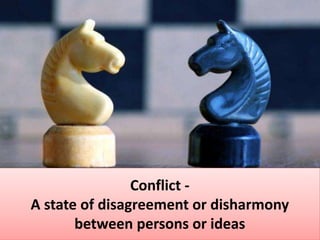
Conflict -
A state of disagreement or disharmony
between persons or ideas
Working together isn’t always
easy
The Employee Development Systems survey found
that 81% of HR professionals had seen employees
resign as a result of conflict, and 77% have noticed
increased absenteeism, resulting in increased
business costs.
In fact, "research shows that 60-80% of all difficulties in
organizations stem from strained relationships between
employees, not from deficits in individual employee’s skill or
motivation."
Top 4 Causes of Conflict in the
Workplace
1. Personality differences
2. Non-Compliance with Rules and Policies
3. Misunderstandings
4. Competition
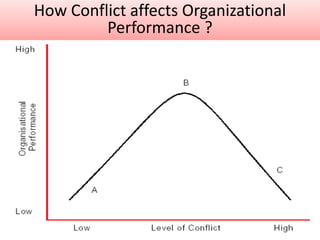
How Conflict affects Organizational
Performance ?
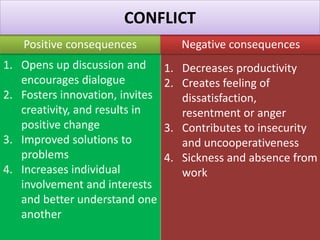
1. Opens up discussion and
encourages dialogue
2. Fosters innovation, invites
creativity, and results in
positive change
3. Improved solutions to
problems
4. Increases individual
involvement and interests
and better understand one
another
1. Decreases productivity
2. Creates feeling of
dissatisfaction,
resentment or anger
3. Contributes to insecurity
and uncooperativeness
4. Sickness and absence from
work
Positive consequences Negative consequences
CONFLICT
How to manage conflict ?
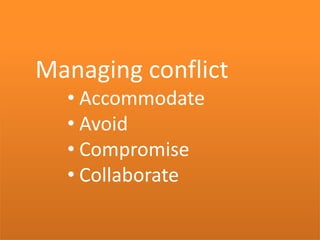
Managing conflict
• Accommodate
• Avoid
• Compromise
• Collaborate
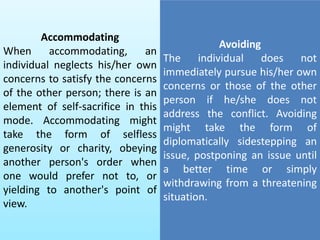
Accommodating
When accommodating, an
individual neglects his/her own
concerns to satisfy the concerns
of the other person; there is an
element of self-sacrifice in this
mode. Accommodating might
take the form of selfless
generosity or charity, obeying
another person's order when
one would prefer not to, or
yielding to another's point of
view.
Avoiding
The individual does not
immediately pursue his/her own
concerns or those of the other
person if he/she does not
address the conflict. Avoiding
might take the form of
diplomatically sidestepping an
issue, postponing an issue until
a better time or simply
withdrawing from a threatening
situation.
Compromising
The objective is to find some
expedient, mutually acceptable
solution which partially satisfies
both parties. Compromising
might mean splitting the
difference, exchanging
concessions, or seeking a quick
middle-ground position.
Collaborating
The opposite of avoiding,
collaborating involves an
attempt to work with the other
person to find some solution
which fully satisfies the
concerns of both. It means
digging into an issue to identify
the underlying concerns of the
two individuals and to find a
solution which meets both sets
of concerns. This is clearly the
most effective approach of
conflict management.
Improving relationship in workplace
to reduce conflicts
JOHARI WINDOW
The Johari window is a psychological tool created by
Joseph Luft and Harry Ingham in 1955 in the United
States. It can be used to help people understand and
improve interpersonal communication and
relationships. The Johari Window Concept and
communication model helps improve understanding
between individuals within a team or in a group
setting. It can be used to improve a group's
relationship with other groups.
Key ideas behind the tool
• Individuals can build trust between themselves by
disclosing information about themselves; and
• They can learn about themselves and come to
terms with personal issues with the help of
feedback from others.
• Taking Feedback Once the ice is broken and your
levels of confidence and self- esteem rises, it is
easier to invite others to comment on your blind
spots.
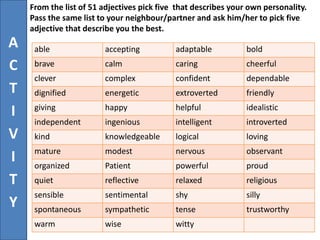
A
C
T
I
V
I
T
Y
From the list of 51 adjectives pick five that describes your own personality.
Pass the same list to your neighbour/partner and ask him/her to pick five
adjective that describe you the best.
able accepting adaptable bold
brave calm caring cheerful
clever complex confident dependable
dignified energetic extroverted friendly
giving happy helpful idealistic
independent ingenious intelligent introverted
kind knowledgeable logical loving
mature modest nervous observant
organized Patient powerful proud
quiet reflective relaxed religious
sensible sentimental shy silly
spontaneous sympathetic tense trustworthy
warm wise witty
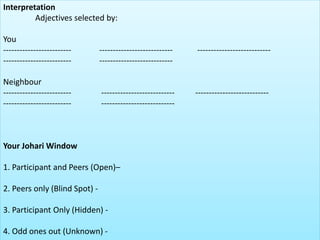
Interpretation
Adjectives selected by:
You
------------------------- --------------------------- ---------------------------
------------------------- ---------------------------
Neighbour
------------------------- --------------------------- ---------------------------
------------------------- ---------------------------
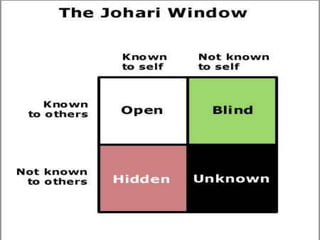
Your Johari Window
1. Participant and Peers (Open)–
2. Peers only (Blind Spot) -
3. Participant Only (Hidden) -
4. Odd ones out (Unknown) -
When you have to deal with conflict tackle the
emotional issues first then address values and interests
Thank you !!

Conflict management

  • 1.
  • 2.
    Conflict - A stateof disagreement or disharmony between persons or ideas
  • 3.
  • 4.
    The Employee DevelopmentSystems survey found that 81% of HR professionals had seen employees resign as a result of conflict, and 77% have noticed increased absenteeism, resulting in increased business costs. In fact, "research shows that 60-80% of all difficulties in organizations stem from strained relationships between employees, not from deficits in individual employee’s skill or motivation."
  • 5.
    Top 4 Causesof Conflict in the Workplace 1. Personality differences 2. Non-Compliance with Rules and Policies 3. Misunderstandings 4. Competition
  • 6.
    How Conflict affectsOrganizational Performance ?
  • 7.
    1. Opens updiscussion and encourages dialogue 2. Fosters innovation, invites creativity, and results in positive change 3. Improved solutions to problems 4. Increases individual involvement and interests and better understand one another 1. Decreases productivity 2. Creates feeling of dissatisfaction, resentment or anger 3. Contributes to insecurity and uncooperativeness 4. Sickness and absence from work Positive consequences Negative consequences CONFLICT
  • 8.
    How to manageconflict ?
  • 9.
    Managing conflict • Accommodate •Avoid • Compromise • Collaborate
  • 10.
    Accommodating When accommodating, an individualneglects his/her own concerns to satisfy the concerns of the other person; there is an element of self-sacrifice in this mode. Accommodating might take the form of selfless generosity or charity, obeying another person's order when one would prefer not to, or yielding to another's point of view. Avoiding The individual does not immediately pursue his/her own concerns or those of the other person if he/she does not address the conflict. Avoiding might take the form of diplomatically sidestepping an issue, postponing an issue until a better time or simply withdrawing from a threatening situation.
  • 11.
    Compromising The objective isto find some expedient, mutually acceptable solution which partially satisfies both parties. Compromising might mean splitting the difference, exchanging concessions, or seeking a quick middle-ground position. Collaborating The opposite of avoiding, collaborating involves an attempt to work with the other person to find some solution which fully satisfies the concerns of both. It means digging into an issue to identify the underlying concerns of the two individuals and to find a solution which meets both sets of concerns. This is clearly the most effective approach of conflict management.
  • 12.
    Improving relationship inworkplace to reduce conflicts
  • 13.
    JOHARI WINDOW The Johariwindow is a psychological tool created by Joseph Luft and Harry Ingham in 1955 in the United States. It can be used to help people understand and improve interpersonal communication and relationships. The Johari Window Concept and communication model helps improve understanding between individuals within a team or in a group setting. It can be used to improve a group's relationship with other groups.
  • 15.
    Key ideas behindthe tool • Individuals can build trust between themselves by disclosing information about themselves; and • They can learn about themselves and come to terms with personal issues with the help of feedback from others. • Taking Feedback Once the ice is broken and your levels of confidence and self- esteem rises, it is easier to invite others to comment on your blind spots.
  • 16.
    A C T I V I T Y From the listof 51 adjectives pick five that describes your own personality. Pass the same list to your neighbour/partner and ask him/her to pick five adjective that describe you the best. able accepting adaptable bold brave calm caring cheerful clever complex confident dependable dignified energetic extroverted friendly giving happy helpful idealistic independent ingenious intelligent introverted kind knowledgeable logical loving mature modest nervous observant organized Patient powerful proud quiet reflective relaxed religious sensible sentimental shy silly spontaneous sympathetic tense trustworthy warm wise witty
  • 17.
    Interpretation Adjectives selected by: You ---------------------------------------------------- --------------------------- ------------------------- --------------------------- Neighbour ------------------------- --------------------------- --------------------------- ------------------------- --------------------------- Your Johari Window 1. Participant and Peers (Open)– 2. Peers only (Blind Spot) - 3. Participant Only (Hidden) - 4. Odd ones out (Unknown) -
  • 18.
    When you haveto deal with conflict tackle the emotional issues first then address values and interests
  • 19.

Editor's Notes