Organizational Behavior 
Presentation on 
Conflicts 
By : Shilpi Panchal 
MBA IInd Semester 
Oriental College of Management
What is Conflict..? 
 Conflict is a state of opposition between persons or groups or 
organizations. 
 It is a disagreement between people that may be the result of 
different: 
 Ideas 
 Perspectives 
 Priorities 
 Preferences 
 Beliefs 
 Values 
 Goals 
 Organizational structures
Definitions of Conflict 
• According to Wood Et Al: 
– “Conflict occurs when disagreement exist in a social 
situation over issues of substance or whenever emotional 
antagonisms create frictions between individuals or 
groups.” 
• According to Litterer: 
– “Conflict is a type of behavior which occurs when two or 
more parties are in opposition or in battle as a result of 
perceived relative deprivation from the activities of or 
interaction with another person or group.”
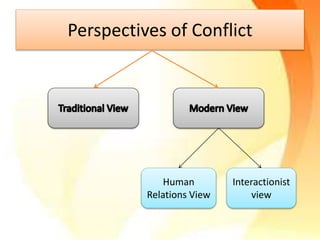
Perspectives of Conflict 
Human 
Relations View 
Interactionist 
view
Conflict Perspectives (contd.) 
 The Traditional Perspective: 
• The belief that all conflict is harmful and must be 
avoided. 
• This approach assumes that all conflicts hamper 
performance. 
• Conflicts occur due to poor communication, lack of 
openness and trust between people, and the failure of 
managers to be open to their employees.
Conflict Perspectives (contd.) 
 The Human Relations Perspective: 
• The belief that conflicts occur naturally in all 
groups and organizations. 
• It is natural and cannot be avoided, hence it 
should be accepted. 
• It cannot be removed and there are even times 
when conflict may benefit a group’s performance.
Conflict Perspectives (contd.) 
 The Inter-actionist Perspective: 
• The belief that conflict is not only a positive force in a 
group but that it is also an absolute necessity for a 
group to perform effectively. 
• This approach encourages conflict because it believes 
that a peaceful and cooperative group may become 
constant and may not respond to the need for 
change and innovation.
Levels of Conflict 
Individual 
Group 
Organizational
 Individual level: 
 Inter-personal conflict: 
 Between two or more people. 
 Differences in views about what should be done. 
 Efforts to get more resources. 
 Differences in orientation to work and time in different 
parts of an organization. 
 Intra-personal conflict: 
 Occurs within an individual. 
 Threat to a person’s values. 
 Feeling of unfair treatment.
 Group Level: 
 Inter-group conflict: 
 Between two or more groups 
 Intra-group conflict: 
 Conflict among members of a group 
 Early stages of group development 
 Ways of doing tasks or reaching group's goals
 Organizational level: 
 Inter-organization conflict: 
 Between two or more organization 
 Examples: suppliers and distributors, especially with the 
close links 
 Intra-organization conflict: 
 Conflict that occurs within an organization 
 Can occur along the vertical and horizontal dimensions of 
the organization: 
• Vertical conflict: between managers and subordinates 
• Horizontal conflict: between departments and work 
groups
The Conflict Process
The Conflict Process (contd.) 
I. Potential opposition or incompatibility: 
 This stage indicates the presence of conditions that create 
opportunities for conflict to arise. They need not lead directly 
to conflict, but any of these conditions is necessary or present 
if conflict is to the surface.
 Causes of Conflicts: 
o Communication 
o Structure 
o Personal variables- 
• Misunderstanding 
• Personality clashes 
• Competition for resources 
• Lack of cooperation 
• Differences over methods or style 
• Low performance 
• Value or goal differences
II. Cognition and Personalization: 
 If conditions cited in Stage I negatively affect something that 
one party cares about, then the potential for opposition or 
incompatibility becomes actualized in this stage.
III. Intentions: 
 Interventions intervene between people’s perceptions and 
emotions and their overt behavior. These intensions are 
decisions to act in a given way. 
 Dimensions of Conflict-Handling Intentions:
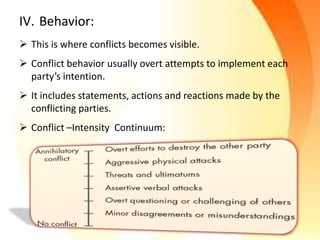
IV. Behavior: 
 This is where conflicts becomes visible. 
 Conflict behavior usually overt attempts to implement each 
party’s intention. 
 It includes statements, actions and reactions made by the 
conflicting parties. 
 Conflict –Intensity Continuum:
V. Outcomes: 
 The action–reaction interplay among the conflicting parties 
results in consequences. It may results as an improvement 
(functional) or may be hindrance (dysfunctional) to the 
groups performance. 
Functional 
Outcomes 
Dysfunctional 
Outcomes
The Effect of Conflict on Organization 
Performance
Conflict Management 
• Conflict management is defined as “the opportunity to 
improve situations and strengthen relationships”. 
• The central purpose of this conflict and their willingness to 
work together constructively now and in the future. 
• Ideally, ideas and information begin to flow between the 
parties and collaborative solutions emerge.
Steps of Conflict Resolution
Conflicts

Conflicts

  • 1.
    Organizational Behavior Presentationon Conflicts By : Shilpi Panchal MBA IInd Semester Oriental College of Management
  • 2.
    What is Conflict..?  Conflict is a state of opposition between persons or groups or organizations.  It is a disagreement between people that may be the result of different:  Ideas  Perspectives  Priorities  Preferences  Beliefs  Values  Goals  Organizational structures
  • 3.
    Definitions of Conflict • According to Wood Et Al: – “Conflict occurs when disagreement exist in a social situation over issues of substance or whenever emotional antagonisms create frictions between individuals or groups.” • According to Litterer: – “Conflict is a type of behavior which occurs when two or more parties are in opposition or in battle as a result of perceived relative deprivation from the activities of or interaction with another person or group.”
  • 4.
    Perspectives of Conflict Human Relations View Interactionist view
  • 5.
    Conflict Perspectives (contd.)  The Traditional Perspective: • The belief that all conflict is harmful and must be avoided. • This approach assumes that all conflicts hamper performance. • Conflicts occur due to poor communication, lack of openness and trust between people, and the failure of managers to be open to their employees.
  • 6.
    Conflict Perspectives (contd.)  The Human Relations Perspective: • The belief that conflicts occur naturally in all groups and organizations. • It is natural and cannot be avoided, hence it should be accepted. • It cannot be removed and there are even times when conflict may benefit a group’s performance.
  • 7.
    Conflict Perspectives (contd.)  The Inter-actionist Perspective: • The belief that conflict is not only a positive force in a group but that it is also an absolute necessity for a group to perform effectively. • This approach encourages conflict because it believes that a peaceful and cooperative group may become constant and may not respond to the need for change and innovation.
  • 8.
    Levels of Conflict Individual Group Organizational
  • 10.
     Individual level:  Inter-personal conflict:  Between two or more people.  Differences in views about what should be done.  Efforts to get more resources.  Differences in orientation to work and time in different parts of an organization.  Intra-personal conflict:  Occurs within an individual.  Threat to a person’s values.  Feeling of unfair treatment.
  • 11.
     Group Level:  Inter-group conflict:  Between two or more groups  Intra-group conflict:  Conflict among members of a group  Early stages of group development  Ways of doing tasks or reaching group's goals
  • 12.
     Organizational level:  Inter-organization conflict:  Between two or more organization  Examples: suppliers and distributors, especially with the close links  Intra-organization conflict:  Conflict that occurs within an organization  Can occur along the vertical and horizontal dimensions of the organization: • Vertical conflict: between managers and subordinates • Horizontal conflict: between departments and work groups
  • 13.
  • 14.
    The Conflict Process(contd.) I. Potential opposition or incompatibility:  This stage indicates the presence of conditions that create opportunities for conflict to arise. They need not lead directly to conflict, but any of these conditions is necessary or present if conflict is to the surface.
  • 15.
     Causes ofConflicts: o Communication o Structure o Personal variables- • Misunderstanding • Personality clashes • Competition for resources • Lack of cooperation • Differences over methods or style • Low performance • Value or goal differences
  • 16.
    II. Cognition andPersonalization:  If conditions cited in Stage I negatively affect something that one party cares about, then the potential for opposition or incompatibility becomes actualized in this stage.
  • 17.
    III. Intentions: Interventions intervene between people’s perceptions and emotions and their overt behavior. These intensions are decisions to act in a given way.  Dimensions of Conflict-Handling Intentions:
  • 18.
    IV. Behavior: This is where conflicts becomes visible.  Conflict behavior usually overt attempts to implement each party’s intention.  It includes statements, actions and reactions made by the conflicting parties.  Conflict –Intensity Continuum:
  • 19.
    V. Outcomes: The action–reaction interplay among the conflicting parties results in consequences. It may results as an improvement (functional) or may be hindrance (dysfunctional) to the groups performance. Functional Outcomes Dysfunctional Outcomes
  • 20.
    The Effect ofConflict on Organization Performance
  • 21.
    Conflict Management •Conflict management is defined as “the opportunity to improve situations and strengthen relationships”. • The central purpose of this conflict and their willingness to work together constructively now and in the future. • Ideally, ideas and information begin to flow between the parties and collaborative solutions emerge.
  • 22.