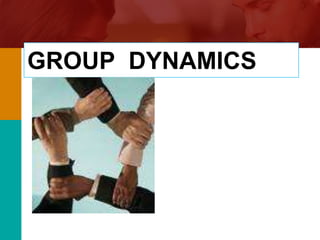
GROUP DYNAMICS
What is a group?

• Two or more individuals interacting who
  have come together to achieve a
  particular goal.
• Two or more interacting individuals with
  a stable pattern of relationship between
  them who perceive themselves as a
  group.
   Group
     – Two or more people
       who interact with each
       other to accomplish
       certain goals or meet
       certain needs.


                                15-3
   Team
     – A group whose members work intensely with each
       other to achieve a specific, common goal or
       objective.
     – All teams are groups but not all groups are teams.
        • Teams often are difficult to form.
        • It takes time for members to learn how to work
          together.


                                                            15-4
   Two characteristics distinguish
    teams from groups
      – Intensity with which team members
        work together
      – Presence of a specific, overriding team
        goal or objective


                                                  15-5
Reasons for joining groups
1. security: group reduces
insecurity and standing alone
syndrome.
2. Status : recognition and
status same as that of group
  
3. Self-Esteem: Self
importance
4.Affiliation: Fulfills need of
affection
5. Power: There is power in
number
6. Goal achievement: pool of
talent, skills and knowledege
Groups’ and Teams’ Contributions to
Organizational Effectiveness


Figure 15.1
                                      15-12
The Types of Group in
Organizations


  Figure 15.2
                        15-13
The Types of Groups and
Teams
     Formal Group

       – A group that managers
         establish to achieve
         organization goals.


                                 15-14
Formal Groups
     Cross-functional teams
        – composed of members from different
          departments

     Cross-cultural teams
        – composed of members from different
          cultures or countries


                                               15-15
The Types of Groups and
Teams
     Informal Group
        – A group that managers or
          nonmanagerial employees form to help
          achieve their own goals or to meet
          their own needs.


                                                 15-16
The Types of Groups and
Teams
   Type of Team
   Top-management     A group composed of the CEO, the president,
   team               and the heads of the most important
                      departments
   Research and       A team whose members have the expertise
   development team   and experience needed to develop new
                      products
   Command groups     A group composed of subordinates who
                      report to the same supervisor, also called a
                      department or unit,
   Task forces        A committee of managers or nonmanagerial
                      employees from various departments or
                      divisions who meet to solve a specific,
                      mutual problem; also called an “ad hoc”
                      committee

                                                                     15-17
The Types of Groups and
Teams
  Type of Team
  Self-managed work   A group of employees who supervise their
  team                own activities and monitor the quality of the
                      goods and services they provide.
  Virtual team        A team whose members rarely or never meet
                      face to face and interact by using various
                      forms of information technology such as
                      email, computer networks, telephone, fax and
                      video conferences.
  Friendship group    An informal group composed of employees
                      who enjoy each other’s company and
                      socialize with each other.
  Interest group      An informal group composed of employees
                      seeking to achieve a common goal related to
                      their membership in an organization.

                                                                      15-18
Virtual Teams

     A team whose members rarely meet face-to-
      face
     Interact by using various forms of information
      technology
     Email, computer
      networks, telephone, fax, and
      videoconferences


                                                   15-19
Friendship Groups

  An informal group composed of employees who
    enjoy one another’s company and
    socialize with
    one another


                                                15-20
Interest Groups

  An informal group of employees seeking to
    achieve a common goal related to their
    membership in an organization


                                              15-21
Group Size
     Advantage of small groups
        – Interact more with each other and
          easier to coordinate their efforts
        – More motivated, satisfied, and
          committed
        – Easier to share information
        – Better able to see the importance of
          their personal contributions


                                                 15-22
Group Size
     Advantages of large groups
        – More resources at their disposal to
          achieve group goals
        – Enables managers to obtain division of
          labor advantages


                                                   15-23
Group Size
     Disadvantages of large groups
        – Problem of communication and
          coordination
        – Lower level of motivation
        – Members might not think their efforts
          are really needed


                                                  15-24
The Stages of Group
Development


 Figure 15.4
                      15-25
STAGES OF GROUP
FORMATION
    STAGE -I
   FORMING: CONFUSION- not
   certain about purpose, task and
   leadership.
   STAGE II
STORMING:
conflict and confrontation(disagreements).
STAGE III
NORMING: settling down, coop, collaboration
STAGE IV
PERFORMING: group fully functional, devoted to
  task at hand.
STAGE V
ADJOURNING: end of group/ new modified group


          happy
                                       sad


    depressed
Stages of Group Development

     Forming
       – Group members get to know each other and reach
         common goals.
     Storming
       – Group members disagree on direction and
         leadership. Managers need to be sure the conflict
         stays focused.
     Norming
       – Close ties and consensus begin to develop between
         group members.


                                                             15-31
Stages of Group Development

     Performing
        – The group begins to do its real work.

     Adjourning
        – Only for task forces that are temporary.
        – Note that these steps take time!


                                                     15-32
Group Norms
     Group Norms
       – Shared guidelines or rules for behavior
         that most group members follow
       – Managers should encourage members
         to develop norms that contribute to
         group performance and the attainment
         of group goals


                                                   15-33
Group Cohesiveness

    The degree to which members are attracted
     to their group
    Three major consequences
       – Level of participation
       – Level of conformity to group norms
       – Emphasis on group goal accomplishment


                                                 15-34
Sources and Consequences of
Group Cohesiveness


  Figure 15.6
                              15-35
Factors Leading to Group
Cohesiveness
   Factor
   Group Size          Smaller groups allow for high cohesiveness;
                       Low cohesiveness groups with many
                       members can benefit from splitting into two
                       groups.

   Managed Diversity   Diverse groups often come up with better
                       solutions.

   Group Identity      Encouraging a group to adopt a unique
                       identity and engage in competition with
                       others can increase cohesiveness.

   Success             Cohesiveness increases with success;
                       finding ways for a group to have some small
                       successes increases cohesiveness.


                                                                     15-36
   Social loafing
      – The human tendency to put forth less effort in a
        group than individually.
      – Results in possibly lower group performance and
        failure to
        attain group
        goals


                                                           15-37
Managing Groups and Teams
for High Performance
     Reducing social loafing:
        – Make individual efforts identifiable and
          accountable.
        – Emphasize the valuable contributions
          of individual members.
        – Keep group size at an appropriate
          level.


                                                     15-38
Three Ways to Reduce Social
Loafing


 Figure 15.7
                              15-39
Any questions?
Thank you

Group dynamics

  • 1.
  • 2.
    What is agroup? • Two or more individuals interacting who have come together to achieve a particular goal. • Two or more interacting individuals with a stable pattern of relationship between them who perceive themselves as a group.
  • 3.
    Group – Two or more people who interact with each other to accomplish certain goals or meet certain needs. 15-3
  • 4.
    Team – A group whose members work intensely with each other to achieve a specific, common goal or objective. – All teams are groups but not all groups are teams. • Teams often are difficult to form. • It takes time for members to learn how to work together. 15-4
  • 5.
    Two characteristics distinguish teams from groups – Intensity with which team members work together – Presence of a specific, overriding team goal or objective 15-5
  • 6.
    Reasons for joininggroups 1. security: group reduces insecurity and standing alone syndrome.
  • 7.
    2. Status :recognition and status same as that of group 
  • 8.
  • 9.
  • 10.
    5. Power: Thereis power in number
  • 11.
    6. Goal achievement:pool of talent, skills and knowledege
  • 12.
    Groups’ and Teams’Contributions to Organizational Effectiveness Figure 15.1 15-12
  • 13.
    The Types ofGroup in Organizations Figure 15.2 15-13
  • 14.
    The Types ofGroups and Teams  Formal Group – A group that managers establish to achieve organization goals. 15-14
  • 15.
    Formal Groups  Cross-functional teams – composed of members from different departments  Cross-cultural teams – composed of members from different cultures or countries 15-15
  • 16.
    The Types ofGroups and Teams  Informal Group – A group that managers or nonmanagerial employees form to help achieve their own goals or to meet their own needs. 15-16
  • 17.
    The Types ofGroups and Teams Type of Team Top-management A group composed of the CEO, the president, team and the heads of the most important departments Research and A team whose members have the expertise development team and experience needed to develop new products Command groups A group composed of subordinates who report to the same supervisor, also called a department or unit, Task forces A committee of managers or nonmanagerial employees from various departments or divisions who meet to solve a specific, mutual problem; also called an “ad hoc” committee 15-17
  • 18.
    The Types ofGroups and Teams Type of Team Self-managed work A group of employees who supervise their team own activities and monitor the quality of the goods and services they provide. Virtual team A team whose members rarely or never meet face to face and interact by using various forms of information technology such as email, computer networks, telephone, fax and video conferences. Friendship group An informal group composed of employees who enjoy each other’s company and socialize with each other. Interest group An informal group composed of employees seeking to achieve a common goal related to their membership in an organization. 15-18
  • 19.
    Virtual Teams  A team whose members rarely meet face-to- face  Interact by using various forms of information technology  Email, computer networks, telephone, fax, and videoconferences 15-19
  • 20.
    Friendship Groups An informal group composed of employees who enjoy one another’s company and socialize with one another 15-20
  • 21.
    Interest Groups An informal group of employees seeking to achieve a common goal related to their membership in an organization 15-21
  • 22.
    Group Size  Advantage of small groups – Interact more with each other and easier to coordinate their efforts – More motivated, satisfied, and committed – Easier to share information – Better able to see the importance of their personal contributions 15-22
  • 23.
    Group Size  Advantages of large groups – More resources at their disposal to achieve group goals – Enables managers to obtain division of labor advantages 15-23
  • 24.
    Group Size  Disadvantages of large groups – Problem of communication and coordination – Lower level of motivation – Members might not think their efforts are really needed 15-24
  • 25.
    The Stages ofGroup Development Figure 15.4 15-25
  • 26.
    STAGES OF GROUP FORMATION STAGE -I FORMING: CONFUSION- not certain about purpose, task and leadership.
  • 27.
    STAGE II STORMING: conflict and confrontation(disagreements).
  • 28.
    STAGE III NORMING: settlingdown, coop, collaboration
  • 29.
    STAGE IV PERFORMING: groupfully functional, devoted to task at hand.
  • 30.
    STAGE V ADJOURNING: endof group/ new modified group happy sad depressed
  • 31.
    Stages of GroupDevelopment  Forming – Group members get to know each other and reach common goals.  Storming – Group members disagree on direction and leadership. Managers need to be sure the conflict stays focused.  Norming – Close ties and consensus begin to develop between group members. 15-31
  • 32.
    Stages of GroupDevelopment  Performing – The group begins to do its real work.  Adjourning – Only for task forces that are temporary. – Note that these steps take time! 15-32
  • 33.
    Group Norms  Group Norms – Shared guidelines or rules for behavior that most group members follow – Managers should encourage members to develop norms that contribute to group performance and the attainment of group goals 15-33
  • 34.
    Group Cohesiveness  The degree to which members are attracted to their group  Three major consequences – Level of participation – Level of conformity to group norms – Emphasis on group goal accomplishment 15-34
  • 35.
    Sources and Consequencesof Group Cohesiveness Figure 15.6 15-35
  • 36.
    Factors Leading toGroup Cohesiveness Factor Group Size Smaller groups allow for high cohesiveness; Low cohesiveness groups with many members can benefit from splitting into two groups. Managed Diversity Diverse groups often come up with better solutions. Group Identity Encouraging a group to adopt a unique identity and engage in competition with others can increase cohesiveness. Success Cohesiveness increases with success; finding ways for a group to have some small successes increases cohesiveness. 15-36
  • 37.
    Social loafing – The human tendency to put forth less effort in a group than individually. – Results in possibly lower group performance and failure to attain group goals 15-37
  • 38.
    Managing Groups andTeams for High Performance  Reducing social loafing: – Make individual efforts identifiable and accountable. – Emphasize the valuable contributions of individual members. – Keep group size at an appropriate level. 15-38
  • 39.
    Three Ways toReduce Social Loafing Figure 15.7 15-39
  • 40.
  • 41.