PROCESSES OF ORGANIZATIONAL CONFLICT
 
Conflict Defined Is a process that begins when one party perceives that another party has negatively affected, or is about to negatively affect, something that the first party cares about. Encompasses a wide range of conflicts that people experience in organizations Incompatibility of goals Differences over interpretations of facts Disagreements based on behavioral expectations
Transitions in Conflict Thought Causes: Poor communication Lack of openness Failure to respond to employee needs Traditional View of Conflict The belief that all conflict is harmful and must be avoided.
Transitions in Conflict Thought (cont’d) Interactionist View of Conflict The belief that conflict is not only a positive force in a group but that it is absolutely necessary for a group to perform effectively. Human Relations View of Conflict The belief that conflict is a natural and inevitable outcome in any group.
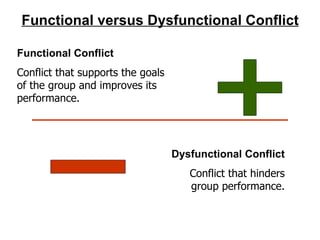
Functional Conflict Conflict that supports the goals of the group and improves its performance. Dysfunctional Conflict Conflict that hinders group performance. Functional versus Dysfunctional Conflict
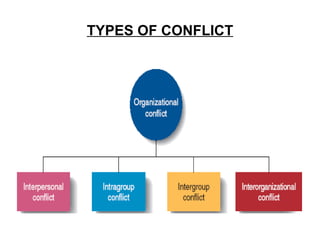
TYPES OF CONFLICT
Organizational Conflict The discord that arises when goals, interests or values of different individuals or groups are  incompatible  and those people  block or thwart  each other’s efforts  to achieve their  objectives. Conflict is inevitable given the wide range of goals for the different stakeholder in the organization.
Interpersonal Conflict Conflict between individuals due to differences in their goals or values. Intragroup Conflict Conflict within a group or team.
Intergroup Conflict Conflict between two or more teams, groups or departments. Managers play a key role in resolution of this conflict Interorganizational Conflict Conflict that arises across organizations.
Deutsch  has suggested 5 types of conflicts involving issues underlying conflicts such as control over resources, values, beliefs, and the nature of relationship between parties- VERIDICAL CONFLICT : this type of conflict exists objectively and is perceived accurately. CONTINGENT CONFLICT-  here, the existence of the conflict is dependent upon readily rearranged circumstances, but this is not recognized by the conflicting parties. 3. MISATTRIBUTED CONFLICT- in  this type, the conflict is between the wrong parties, and as a consequence, over the wrong issues.
4.  LATENT CONFLICT-  this is, in effect, a conflict that should be occurring but is not. 5.  FALSE CONFLICT-  this is the occurrence of conflict when there is no objective basis for it.
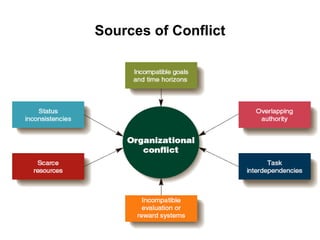
Sources of Conflict
Different Goals and Time Horizons Different groups have differing goals and focus. Overlapping Authority Two or more managers claim authority for the same activities which leads to conflict between the managers and workers.
Task Interdependencies One member of a group or a group fails to finish a task that another member or group depends on, causing the waiting worker or group to fall behind. Different Evaluation or Reward Systems A group is rewarded for achieving a goal, but another interdependent group is rewarded for achieving a goal that conflicts with the first group .
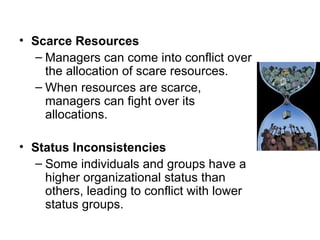
Scarce Resources Managers can come into conflict over the allocation of scare resources. When resources are scarce, managers can fight over its allocations. Status Inconsistencies Some individuals and groups have a higher organizational status than others, leading to conflict with lower status groups.
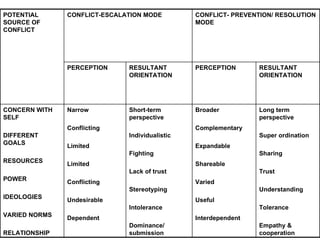
POTENTIAL SOURCE OF CONFLICT CONFLICT-ESCALATION MODE CONFLICT- PREVENTION/ RESOLUTION MODE PERCEPTION RESULTANT ORIENTATION PERCEPTION RESULTANT ORIENTATION CONCERN WITH SELF DIFFERENT GOALS RESOURCES POWER IDEOLOGIES VARIED NORMS RELATIONSHIP Narrow Conflicting Limited Limited Conflicting Undesirable Dependent Short-term perspective Individualistic Fighting Lack of trust Stereotyping Intolerance Dominance/ submission Broader Complementary Expandable Shareable Varied Useful Interdependent Long term perspective Super ordination Sharing Trust Understanding Tolerance Empathy & cooperation
To summarize, if people in a group perceive their own concern to be of higher priority, want their own goals met at all costs, fight over available resources, distrust those in power, stereotype those with conflicting ideologies, refuse to tolerate varied norms, and attempt to dominate the group, conflict will surely escalate. On the other hand, conflict will not arise if group members attempt to see differences as opportunities to prevent or resolve conflicts, consider the broader group concerns, realize that goals can be complementary, subordinate their own goals with team goals, share resources, trust those in power, share the functions of leaderships, attempt to understand separate ideologies, tolerate varied norms , and cooperate with and have empathy for others. Conflicts cannot be resolved unless people are willing to take a position that involves some risk.
STRATEGIES TO REDUCE CONFLICT There are 4 major types of strategies to reduce conflict AVOIDANCE : simply ignoring the conflict or imposing the solution.  This may be appropriate if the conflict is trivial or if quick action is needed. 2.DEFFUSION : here, the attempt is made to deactivate the conflict and cool off the emotions and hostilities of the group involved.
3.  CONTAINMENT:  in this strategy, some conflict is allowed to surface, but it is carefully contained by spelling out which issues are to discussed and how they have to be resolved. 4. CONFRONTATION:  under this strategy, which is at the other end of the continuum from avoidance, all the issues are brought into the open, and the conflicting groups directly confront the issues in an attempt to reach a mutually satisfactory solution.
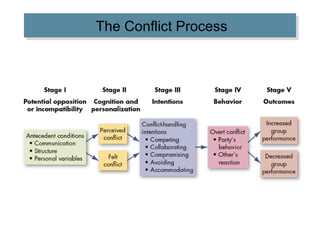
The Conflict Process
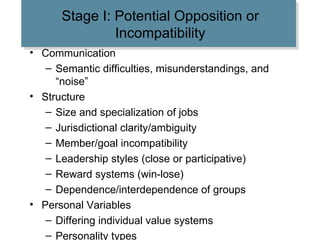
Stage I: Potential Opposition or Incompatibility Communication Semantic difficulties, misunderstandings, and “noise” Structure Size and specialization of jobs Jurisdictional clarity/ambiguity Member/goal incompatibility Leadership styles (close or participative) Reward systems (win-lose) Dependence/interdependence of groups Personal Variables Differing individual value systems Personality types
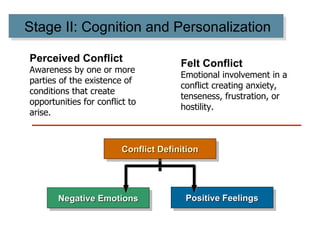
Stage II: Cognition and Personalization Conflict Definition Perceived Conflict Awareness by one or more parties of the existence of conditions that create opportunities for conflict to arise. Felt Conflict Emotional involvement in a conflict creating anxiety, tenseness, frustration, or hostility. Positive Feelings Negative Emotions
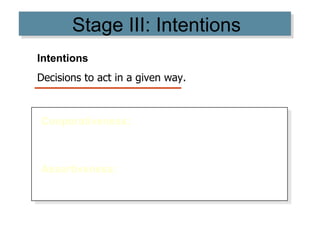
Stage III: Intentions Cooperativeness: Attempting to satisfy the other party’s concerns. Assertiveness: Attempting to satisfy one’s own concerns. Intentions Decisions to act in a given way.
Stage III: Intentions (cont’d) Competing A desire to satisfy one’s interests, regardless of the impact on the other party to the conflict. Collaborating A situation in which the parties to a conflict each desire to satisfy fully the concerns of all parties. Avoiding The desire to withdraw from or suppress a conflict.
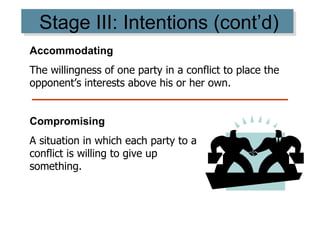
Stage III: Intentions (cont’d) Accommodating The willingness of one party in a conflict to place the opponent’s interests above his or her own. Compromising A situation in which each party to a conflict is willing to give up something.
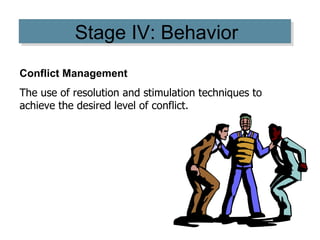
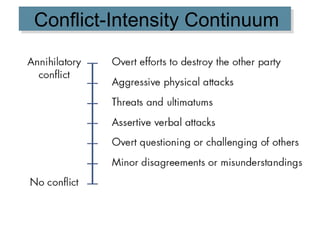
Stage IV: Behavior Conflict Management The use of resolution and stimulation techniques to achieve the desired level of conflict.
Conflict-Intensity Continuum
Conflict Management Techniques Conflict Resolution Techniques Problem solving Superordinate goals Expansion of resources Avoidance Smoothing Compromise Authoritative command Altering the structural variables
Conflict Management Techniques Conflict Resolution Techniques Communication Bringing in outsiders Restructuring the organization Appointing a devil’s advocate
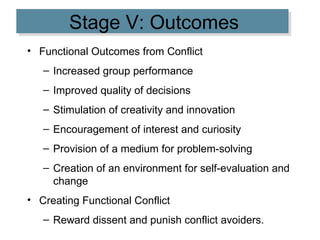
Stage V: Outcomes Functional Outcomes from Conflict Increased group performance Improved quality of decisions Stimulation of creativity and innovation Encouragement of interest and curiosity Provision of a medium for problem-solving Creation of an environment for self-evaluation and change Creating Functional Conflict Reward dissent and punish conflict avoiders.
Stage V: Outcomes Dysfunctional Outcomes from Conflict Development of discontent Reduced group effectiveness Retarded communication Reduced group cohesiveness Infighting among group members overcomes group goals
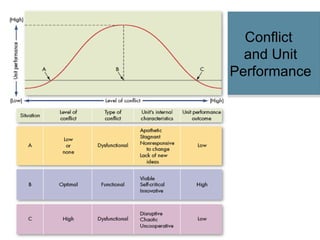
Conflict  and Unit Performance
CONCLUSION Conflicts are part of life, in fact, some conflicts are useful( functional), contributing to growth and development. Conflicts occur when the concerns are narrow, different goals are seen as conflicting, resources and power are perceived as limited, differences in values and norms are regarded as undesirable, and some individuals or groups are dependent on others. Conflicts can be presented through the participatory mode of management.
REFERENCES Luthans,F(1977).Organizational Behaviour,McGraw Hill, New York Robbins,Stephen,P,(1989), Organizational behavior, (4 th  edn), Prentice Hall, N.Delhi. Pareek.U, Understanding Organizational Behavior (2 nd  edn.) Oxford University

Unit iv conflict & its mgmt

  • 1.
  • 2.
  • 3.
    Conflict Defined Isa process that begins when one party perceives that another party has negatively affected, or is about to negatively affect, something that the first party cares about. Encompasses a wide range of conflicts that people experience in organizations Incompatibility of goals Differences over interpretations of facts Disagreements based on behavioral expectations
  • 4.
    Transitions in ConflictThought Causes: Poor communication Lack of openness Failure to respond to employee needs Traditional View of Conflict The belief that all conflict is harmful and must be avoided.
  • 5.
    Transitions in ConflictThought (cont’d) Interactionist View of Conflict The belief that conflict is not only a positive force in a group but that it is absolutely necessary for a group to perform effectively. Human Relations View of Conflict The belief that conflict is a natural and inevitable outcome in any group.
  • 6.
    Functional Conflict Conflictthat supports the goals of the group and improves its performance. Dysfunctional Conflict Conflict that hinders group performance. Functional versus Dysfunctional Conflict
  • 7.
  • 8.
    Organizational Conflict Thediscord that arises when goals, interests or values of different individuals or groups are incompatible and those people block or thwart each other’s efforts to achieve their objectives. Conflict is inevitable given the wide range of goals for the different stakeholder in the organization.
  • 9.
    Interpersonal Conflict Conflictbetween individuals due to differences in their goals or values. Intragroup Conflict Conflict within a group or team.
  • 10.
    Intergroup Conflict Conflictbetween two or more teams, groups or departments. Managers play a key role in resolution of this conflict Interorganizational Conflict Conflict that arises across organizations.
  • 11.
    Deutsch hassuggested 5 types of conflicts involving issues underlying conflicts such as control over resources, values, beliefs, and the nature of relationship between parties- VERIDICAL CONFLICT : this type of conflict exists objectively and is perceived accurately. CONTINGENT CONFLICT- here, the existence of the conflict is dependent upon readily rearranged circumstances, but this is not recognized by the conflicting parties. 3. MISATTRIBUTED CONFLICT- in this type, the conflict is between the wrong parties, and as a consequence, over the wrong issues.
  • 12.
    4. LATENTCONFLICT- this is, in effect, a conflict that should be occurring but is not. 5. FALSE CONFLICT- this is the occurrence of conflict when there is no objective basis for it.
  • 13.
  • 14.
    Different Goals andTime Horizons Different groups have differing goals and focus. Overlapping Authority Two or more managers claim authority for the same activities which leads to conflict between the managers and workers.
  • 15.
    Task Interdependencies Onemember of a group or a group fails to finish a task that another member or group depends on, causing the waiting worker or group to fall behind. Different Evaluation or Reward Systems A group is rewarded for achieving a goal, but another interdependent group is rewarded for achieving a goal that conflicts with the first group .
  • 16.
    Scarce Resources Managerscan come into conflict over the allocation of scare resources. When resources are scarce, managers can fight over its allocations. Status Inconsistencies Some individuals and groups have a higher organizational status than others, leading to conflict with lower status groups.
  • 17.
    POTENTIAL SOURCE OFCONFLICT CONFLICT-ESCALATION MODE CONFLICT- PREVENTION/ RESOLUTION MODE PERCEPTION RESULTANT ORIENTATION PERCEPTION RESULTANT ORIENTATION CONCERN WITH SELF DIFFERENT GOALS RESOURCES POWER IDEOLOGIES VARIED NORMS RELATIONSHIP Narrow Conflicting Limited Limited Conflicting Undesirable Dependent Short-term perspective Individualistic Fighting Lack of trust Stereotyping Intolerance Dominance/ submission Broader Complementary Expandable Shareable Varied Useful Interdependent Long term perspective Super ordination Sharing Trust Understanding Tolerance Empathy & cooperation
  • 18.
    To summarize, ifpeople in a group perceive their own concern to be of higher priority, want their own goals met at all costs, fight over available resources, distrust those in power, stereotype those with conflicting ideologies, refuse to tolerate varied norms, and attempt to dominate the group, conflict will surely escalate. On the other hand, conflict will not arise if group members attempt to see differences as opportunities to prevent or resolve conflicts, consider the broader group concerns, realize that goals can be complementary, subordinate their own goals with team goals, share resources, trust those in power, share the functions of leaderships, attempt to understand separate ideologies, tolerate varied norms , and cooperate with and have empathy for others. Conflicts cannot be resolved unless people are willing to take a position that involves some risk.
  • 19.
    STRATEGIES TO REDUCECONFLICT There are 4 major types of strategies to reduce conflict AVOIDANCE : simply ignoring the conflict or imposing the solution. This may be appropriate if the conflict is trivial or if quick action is needed. 2.DEFFUSION : here, the attempt is made to deactivate the conflict and cool off the emotions and hostilities of the group involved.
  • 20.
    3. CONTAINMENT: in this strategy, some conflict is allowed to surface, but it is carefully contained by spelling out which issues are to discussed and how they have to be resolved. 4. CONFRONTATION: under this strategy, which is at the other end of the continuum from avoidance, all the issues are brought into the open, and the conflicting groups directly confront the issues in an attempt to reach a mutually satisfactory solution.
  • 21.
  • 22.
    Stage I: PotentialOpposition or Incompatibility Communication Semantic difficulties, misunderstandings, and “noise” Structure Size and specialization of jobs Jurisdictional clarity/ambiguity Member/goal incompatibility Leadership styles (close or participative) Reward systems (win-lose) Dependence/interdependence of groups Personal Variables Differing individual value systems Personality types
  • 23.
    Stage II: Cognitionand Personalization Conflict Definition Perceived Conflict Awareness by one or more parties of the existence of conditions that create opportunities for conflict to arise. Felt Conflict Emotional involvement in a conflict creating anxiety, tenseness, frustration, or hostility. Positive Feelings Negative Emotions
  • 24.
    Stage III: IntentionsCooperativeness: Attempting to satisfy the other party’s concerns. Assertiveness: Attempting to satisfy one’s own concerns. Intentions Decisions to act in a given way.
  • 25.
    Stage III: Intentions(cont’d) Competing A desire to satisfy one’s interests, regardless of the impact on the other party to the conflict. Collaborating A situation in which the parties to a conflict each desire to satisfy fully the concerns of all parties. Avoiding The desire to withdraw from or suppress a conflict.
  • 26.
    Stage III: Intentions(cont’d) Accommodating The willingness of one party in a conflict to place the opponent’s interests above his or her own. Compromising A situation in which each party to a conflict is willing to give up something.
  • 27.
    Stage IV: BehaviorConflict Management The use of resolution and stimulation techniques to achieve the desired level of conflict.
  • 28.
  • 29.
    Conflict Management TechniquesConflict Resolution Techniques Problem solving Superordinate goals Expansion of resources Avoidance Smoothing Compromise Authoritative command Altering the structural variables
  • 30.
    Conflict Management TechniquesConflict Resolution Techniques Communication Bringing in outsiders Restructuring the organization Appointing a devil’s advocate
  • 31.
    Stage V: OutcomesFunctional Outcomes from Conflict Increased group performance Improved quality of decisions Stimulation of creativity and innovation Encouragement of interest and curiosity Provision of a medium for problem-solving Creation of an environment for self-evaluation and change Creating Functional Conflict Reward dissent and punish conflict avoiders.
  • 32.
    Stage V: OutcomesDysfunctional Outcomes from Conflict Development of discontent Reduced group effectiveness Retarded communication Reduced group cohesiveness Infighting among group members overcomes group goals
  • 33.
    Conflict andUnit Performance
  • 34.
    CONCLUSION Conflicts arepart of life, in fact, some conflicts are useful( functional), contributing to growth and development. Conflicts occur when the concerns are narrow, different goals are seen as conflicting, resources and power are perceived as limited, differences in values and norms are regarded as undesirable, and some individuals or groups are dependent on others. Conflicts can be presented through the participatory mode of management.
  • 35.
    REFERENCES Luthans,F(1977).Organizational Behaviour,McGrawHill, New York Robbins,Stephen,P,(1989), Organizational behavior, (4 th edn), Prentice Hall, N.Delhi. Pareek.U, Understanding Organizational Behavior (2 nd edn.) Oxford University