CONFLICT
Meaning And Definition
 Conflicts refers to demonstration of anger, revolt, negative
behavior, violence, and misconception.
 It is a result of differences in opinions of people or groups
working within an organization
 Conflicts can arise within an organization or between two
organizations or between organization and external environment.
According to Joe Kelly, “Conflict is defined as oppositions or
disputes between persons, groups or ideas”
According to Peterson, “Conflict is defined as an
interpersonal process that occurs whenever the actions of one
person interfere with the actions of another”
Nature of Conflict
• Conflicts are Unavoidable
Conflicts are inevitable. They arise as a result of differences in
thoughts, goals, outlooks and viewpoints of people working
together in an organizational setup. It is the mangers responsibility
to handle conflicts both as an arbitrator and as a member.
• Conflicts are Generally Small
Conflicts are just small outburst which constantly affects the
working relationship.
• Conflict have Multiple Dimensions
Conflicts are multi dimensional and have numerous types.
Conflicts involves collision of power.
 Conflicts are pervasive
Conflicts are widespread and omnipresent. Knowledge related
to oneself , other people, truth, growth, development and the
potential to build a heaven or hell for oneself comes within
conflict.
• Conflicts is Disturbing
In an organizational setup, conflict is considered as a disturbing
element as it hampers the routine work. Conflict makes it difficult
for the concerned employees or groups to work together.
• Conflicts Involve Discrepancies
It is a well known fact that conflicts arise due to certain extent of
discrepancy between the parties involved in the conflict. The
reasons are :
o Facts : The discrepancies take place due to variance in the
definition of the issue or people do not have complete
information and facts.
.
o Goals : The differences in goals might be the reason behind
discrepancy
o Methods : At times, employees might have different views
about the strategies and processes to be followed for
accomplishment of mutually accepted goal.
o Values : Moral values can also lead to discrepancy.
Individuals might have different opinions about the manner in
which power is exercised or the definition of justice, equality etc.
Conflict management
• Conflict management is the practice of being able to identify and
handle conflicts sensibly, fairly, and efficiently. Since conflicts in a
business are a natural part of the workplace.
• It is important that there are people who understand conflicts and
know how to resolve them. This is important in today's market more
than ever.
• Unmanaged or poorly managed conflicts generate a breakdown in
trust and lost productivity.
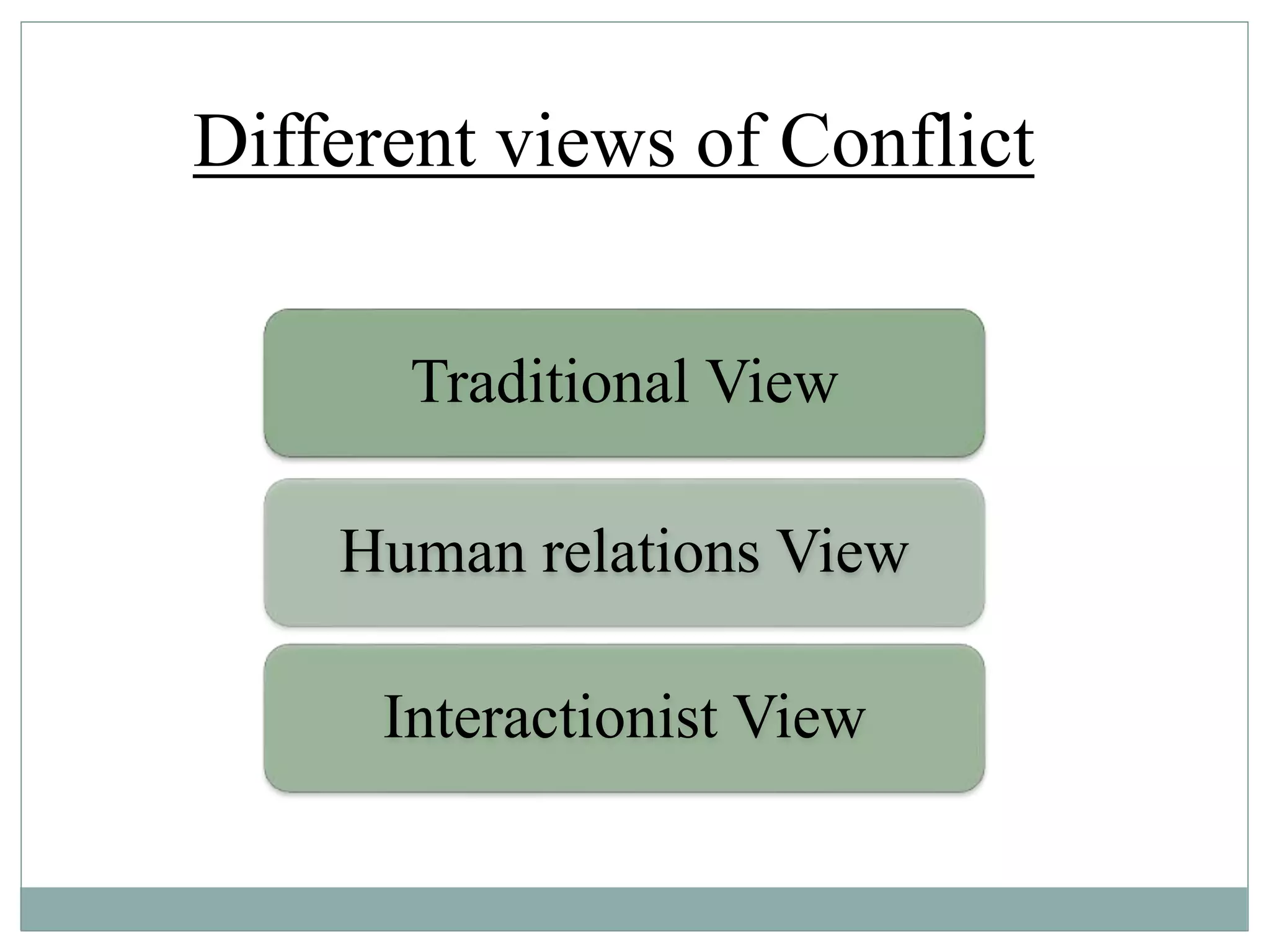
Different views of Conflict
Traditional View
Interactionist View
Human relations View
 The Traditional View of Conflict
The traditional view is the early approach to conflict which assumed
that all conflict was bad and to be avoided.
The conflict was treated negatively and discussed with such terms as
violence, destruction, and irrationality to reinforce its negative
implication.
The conflict was a dysfunctional outcome; resulting from poor
communication, lack of transparency and trust between people.
 The Human Relations View of Conflict
The human relations view of conflict treats conflict as a natural
and inevitable phenomenon and, so can’t be eliminated
completely from any organization.
Here, the conflict was seen in a positive light as it was suggested
that conflict may lead to an improvement in a group’s
performance. But it is similar to the interactionist view of the
conflict.
 The Interactionist View of Conflict
While the human relations view accepted conflict, the
interactionist view encourages conflicts on the grounds that a
harmonious, peaceful and cooperative group.
So the major contribution of the interactionist view is
encouraging group leaders to sustain an ongoing minimum level
of conflict enough to keep the group viable, self-critical and
inspired.
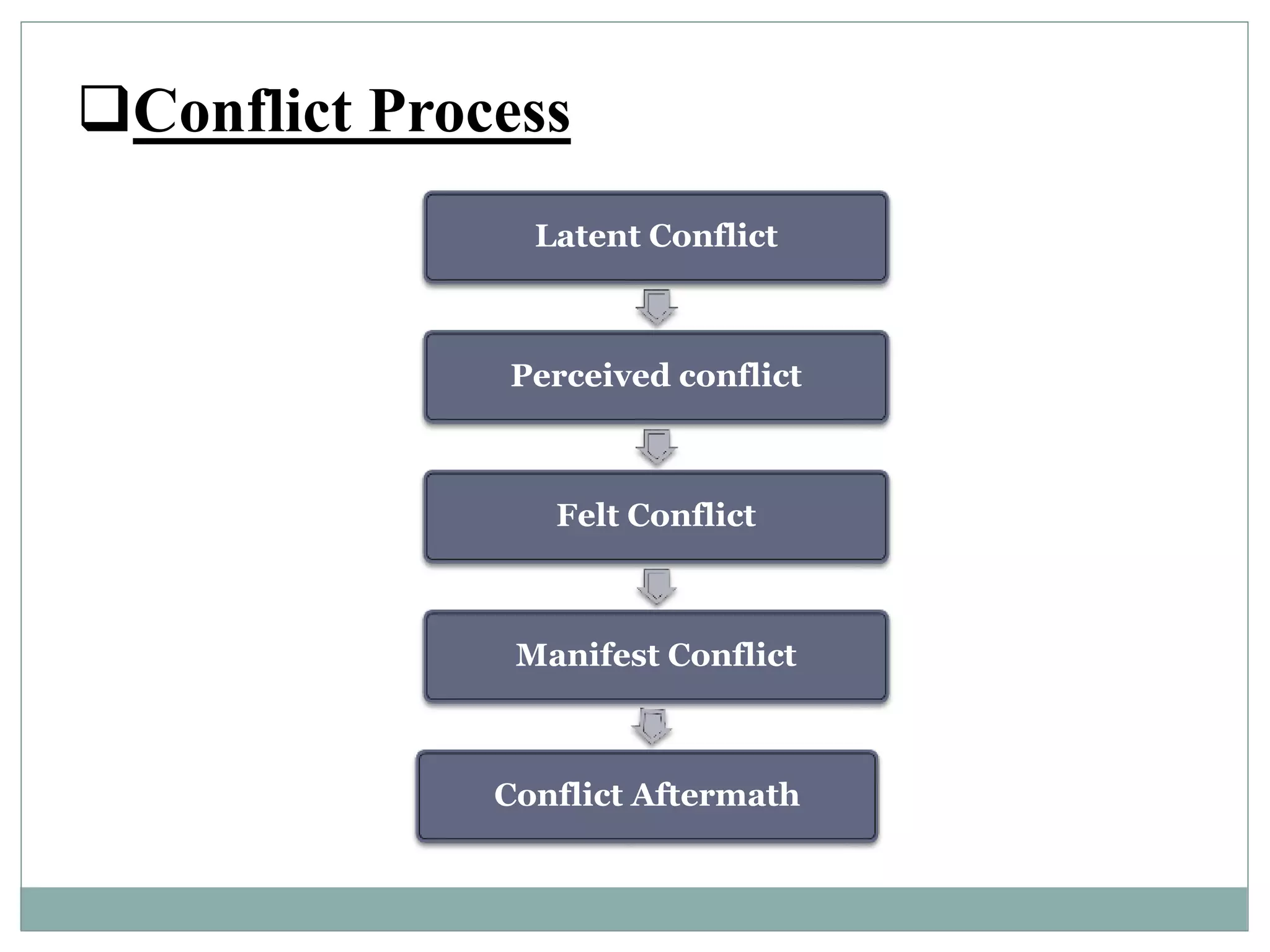
Latent Conflict
Perceived conflict
Felt Conflict
Manifest Conflict
Conflict Aftermath
Conflict Process
 Latent Conflict
The first stage of conflict is latent conflict in which the factors
that could become a cause of potential conflict exist. These are
the dry for autonomy, divergence of goals, role conflict and the
competition for scarce resources.
 Perceived conflict
Sometimes a conflict arises even if no latent conflict is present.
In this stage one party perceived the others to be likely frustrate
his or her goals. Such conflict can be resolved by improving
communication between the groups. It is used to result from the
parties misunderstanding each other’s true position.
 Felt conflict
Felt conflict is the stage when the conflict is not only perceived but
actually felt and cognized. This is the stage when the concerned
parties become sensitive towards the project and start focusing on
the disparity in the outlook.
Such emotions are crucial because negative emotions adversely
effect the trust.
 Manifest Conflict
Manifest conflict is the stage when the two parties engage in
behaviors which evoke responses from each other. The most
obvious of these responses are open aggression, apathy,
sabotage, withdrawal and perfect obedience to rules.
 Conflict Aftermath
The aftermath of a conflict may have positive or negative
repercussion for the organization depending upon the how conflict
is resolved. If the conflict is genuinely resolved to the satisfaction
of all participants, the basis for more cooperative relationship may
be laid
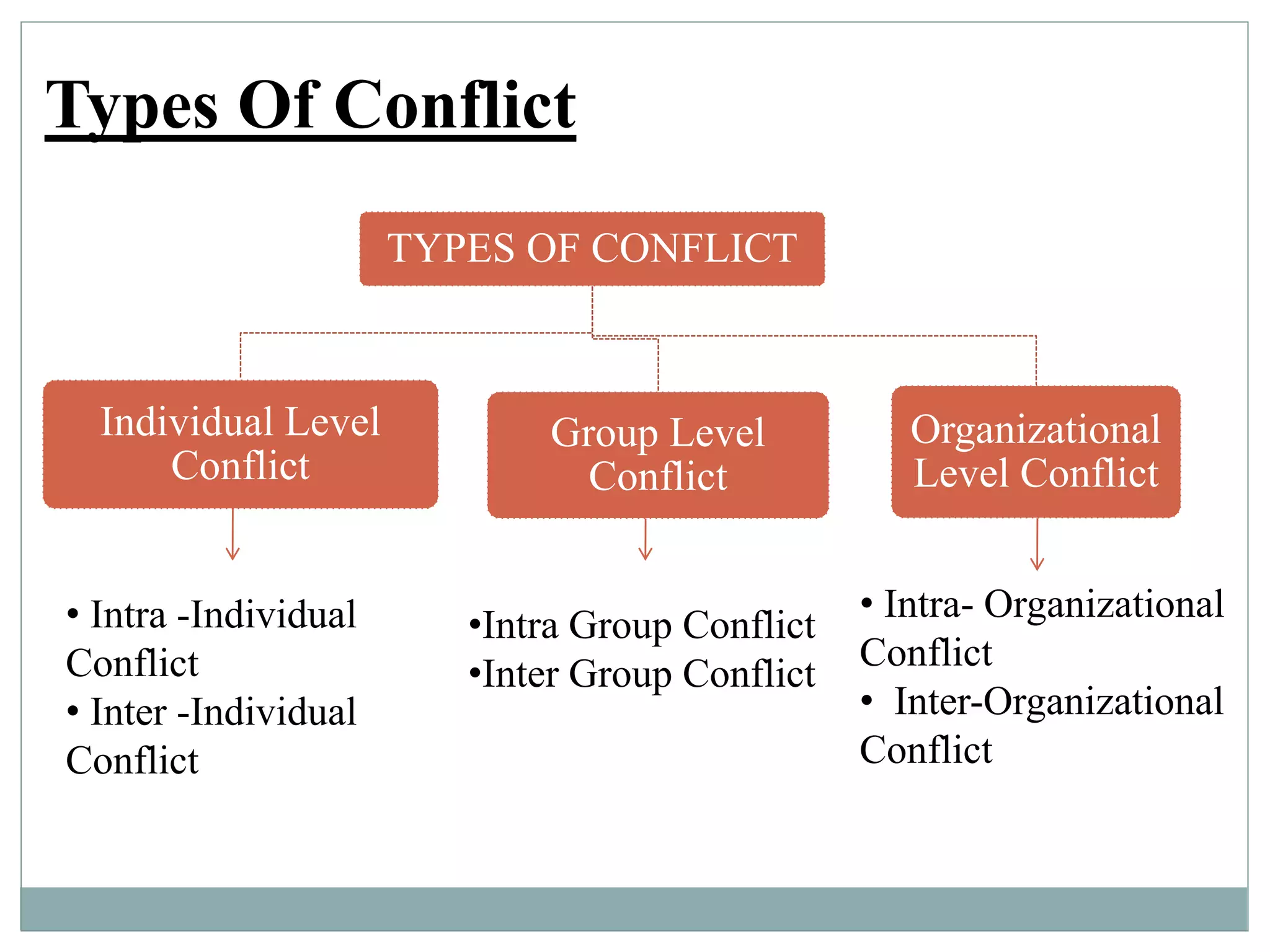
TYPES OF CONFLICT
Individual Level
Conflict
Group Level
Conflict
Organizational
Level Conflict
• Intra -Individual
Conflict
• Inter -Individual
Conflict
•Intra Group Conflict
•Inter Group Conflict
• Intra- Organizational
Conflict
• Inter-Organizational
Conflict
Types Of Conflict
 Individual Level Conflict
Management should keep in mind that all individuals have
conflict within themselves. Conflict arises within an individual
whenever his drives and motives are blocked or he is confronted
with competing roles and goals and he is unable to take
decisions. There are two types
 Intra -Individual Conflict
 Inter -Individual Conflict
Within every individual there are usually
• A number of competing needs and roles
• A variety of ways that drives and roles can be expressed
• Many types of barriers that can occur between the drive
and the goal
• Both negative and positive aspects attached to desired
goals
 Intra Individual conflict
i. Conflict Originating from Frustration
ii. Conflict Originating from Goals
iii. Conflict Originating from Role
Intra Individual Conflicts are of Three Kinds. They are :
Conflict Originating from Frustration:
When an individual is unable to do what he wants to do, he becomes
frustrated. Frustration is the highest level of dissatisfaction which, in
turn, generates conflict in the individual.
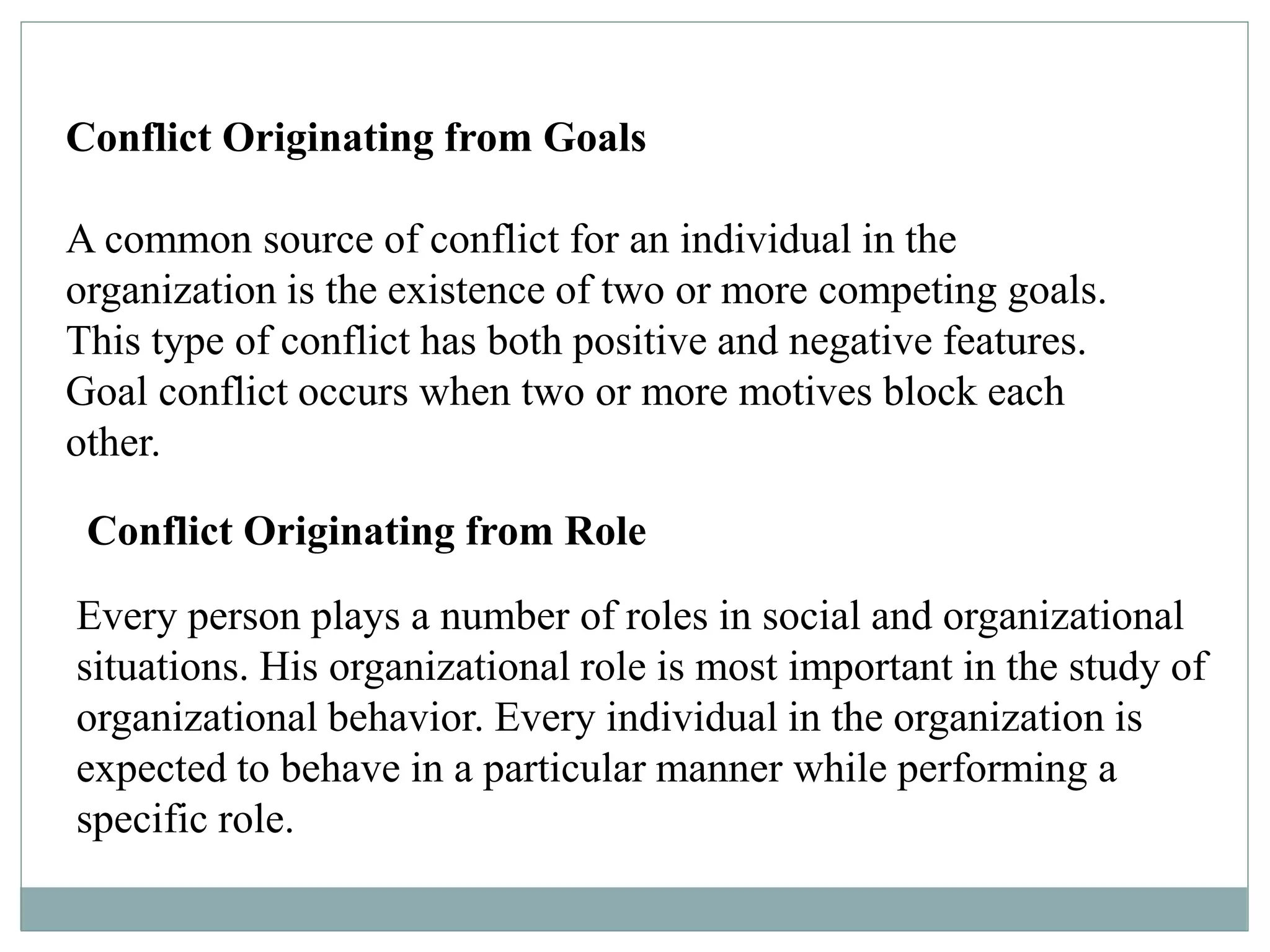
Conflict Originating from Goals
A common source of conflict for an individual in the
organization is the existence of two or more competing goals.
This type of conflict has both positive and negative features.
Goal conflict occurs when two or more motives block each
other.
Conflict Originating from Role
Every person plays a number of roles in social and organizational
situations. His organizational role is most important in the study of
organizational behavior. Every individual in the organization is
expected to behave in a particular manner while performing a
specific role.
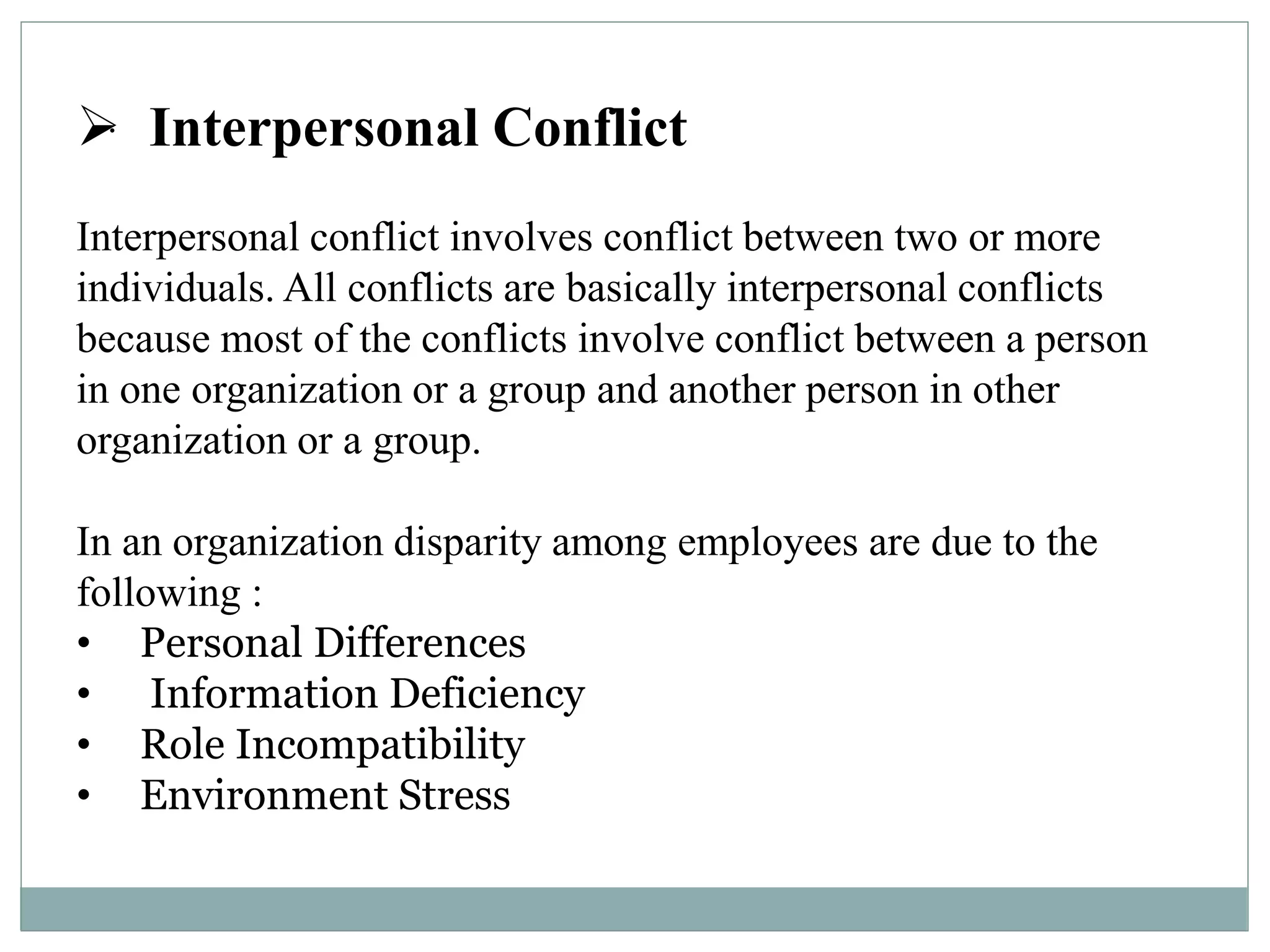
. Interpersonal Conflict
Interpersonal conflict involves conflict between two or more
individuals. All conflicts are basically interpersonal conflicts
because most of the conflicts involve conflict between a person
in one organization or a group and another person in other
organization or a group.
In an organization disparity among employees are due to the
following :
• Personal Differences
• Information Deficiency
• Role Incompatibility
• Environment Stress
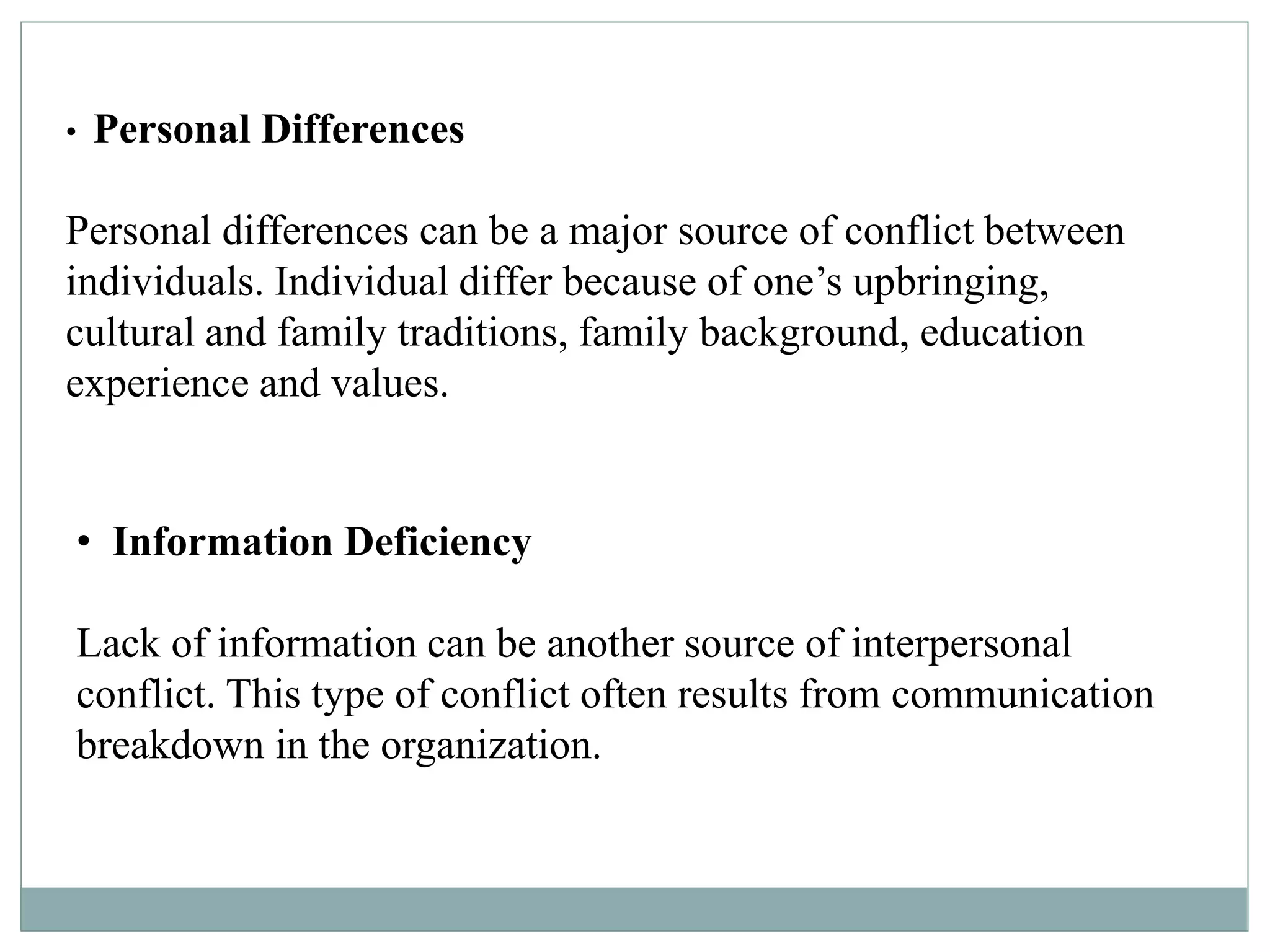
• Personal Differences
Personal differences can be a major source of conflict between
individuals. Individual differ because of one’s upbringing,
cultural and family traditions, family background, education
experience and values.
• Information Deficiency
Lack of information can be another source of interpersonal
conflict. This type of conflict often results from communication
breakdown in the organization.
•Role Incompatibility
Another source of interpersonal conflict can be role in
compatibility. In today’s inter functional organizations, many
managers have functions and tasks that are interdependent and
the individual roles of these managers may be incompatible
•Environment Stress
The interpersonal conflict can also be due to environmental
stress. Stress from environment arises because of scarce or
shrinking resources, downsizing, competitive pressures and high
degree of uncertainty.
 Group Level Conflict
A group consists of two or more persons who are in interaction with
each other, have a well defined structure of role and status relations
and have a system values and norms of behavior for the smooth
working of the group.
Groups not only affect the behavior of their members, rather they
have impact on other groups and the organization as a whole.
In this process of interaction, two types of conflict arises
(A) Intra group
(B) Inter group.
 Intra Group Conflict
Intra group conflict arises when differences crop up between the
members of the group. The individual may want to remain in the
group for social needs but may disagree with the group methods.
Intra-group conflict may arise in three ways.
(i) When the group faces a new problem
(ii) When new values are imported from the social environment
into the group and
(iii) When a person’s extra group role comes into conflict with his
intra group role.
Causes of intergroup conflict may be summarized under
four heads:
(i) Absence of joint decision making
(ii) Difference in goals
(iii) Difference in perception
(iv) Difference in goals as well as perception.
Inter Group Conflict
 Organizational Level Conflict
• The organization level conflict can be between the buyer and
seller organization, between union and organizations employing
the members.
• Managers must try to live with this type of conflict. If the
conflict is properly handled it can be constructive in achieving
the results.
Organizational Level are of two types
• Intra-Organizational Conflict
• Inter-Organizational Conflict
 Intra-Organizational Conflict
Organizational conflicts arises due to various reasons
Hierarchical Conflict
The hierarchical conflict is that conflict which exists among different
levels of organization. For example, the middle level management
may conflict with the top or lower level management.
Functional Conflict
When conflict exists between various functional departments of the
organization, it is called functional conflict. For example, the
production department may be in conflict with the marketing
department.
• Line-Staff Conflict
Line Staff Conflict may be stated as the conflict between
members of line and members of staff. Since the members of staff
do not have any authority over the persons in line conflict is
generated.
• Formal-Informal Conflict
When the Conflict exists between the formal and informal
organizations, it is known as formal-informal conflict.
Organizational conflicts though completely not avoidable could
be prevented and settled to effect organizational effectiveness.
 Inter-Organizational Conflict
When organization interact with each other, conflicts arises
between them. Inter-Organizational Conflict comprises of :
 Conflicts among organization with similar goals.
 Conflicts among government organizations and agencies.
 Conflict among corporate office and production units.
Thank You

Conflict Management, Conflict process

  • 1.
  • 2.
    Meaning And Definition Conflicts refers to demonstration of anger, revolt, negative behavior, violence, and misconception.  It is a result of differences in opinions of people or groups working within an organization  Conflicts can arise within an organization or between two organizations or between organization and external environment.
  • 3.
    According to JoeKelly, “Conflict is defined as oppositions or disputes between persons, groups or ideas” According to Peterson, “Conflict is defined as an interpersonal process that occurs whenever the actions of one person interfere with the actions of another”
  • 4.
    Nature of Conflict •Conflicts are Unavoidable Conflicts are inevitable. They arise as a result of differences in thoughts, goals, outlooks and viewpoints of people working together in an organizational setup. It is the mangers responsibility to handle conflicts both as an arbitrator and as a member. • Conflicts are Generally Small Conflicts are just small outburst which constantly affects the working relationship.
  • 5.
    • Conflict haveMultiple Dimensions Conflicts are multi dimensional and have numerous types. Conflicts involves collision of power.  Conflicts are pervasive Conflicts are widespread and omnipresent. Knowledge related to oneself , other people, truth, growth, development and the potential to build a heaven or hell for oneself comes within conflict.
  • 6.
    • Conflicts isDisturbing In an organizational setup, conflict is considered as a disturbing element as it hampers the routine work. Conflict makes it difficult for the concerned employees or groups to work together. • Conflicts Involve Discrepancies It is a well known fact that conflicts arise due to certain extent of discrepancy between the parties involved in the conflict. The reasons are : o Facts : The discrepancies take place due to variance in the definition of the issue or people do not have complete information and facts. .
  • 7.
    o Goals :The differences in goals might be the reason behind discrepancy o Methods : At times, employees might have different views about the strategies and processes to be followed for accomplishment of mutually accepted goal. o Values : Moral values can also lead to discrepancy. Individuals might have different opinions about the manner in which power is exercised or the definition of justice, equality etc.
  • 8.
    Conflict management • Conflictmanagement is the practice of being able to identify and handle conflicts sensibly, fairly, and efficiently. Since conflicts in a business are a natural part of the workplace. • It is important that there are people who understand conflicts and know how to resolve them. This is important in today's market more than ever. • Unmanaged or poorly managed conflicts generate a breakdown in trust and lost productivity.
  • 9.
    Different views ofConflict Traditional View Interactionist View Human relations View
  • 10.
     The TraditionalView of Conflict The traditional view is the early approach to conflict which assumed that all conflict was bad and to be avoided. The conflict was treated negatively and discussed with such terms as violence, destruction, and irrationality to reinforce its negative implication. The conflict was a dysfunctional outcome; resulting from poor communication, lack of transparency and trust between people.
  • 11.
     The HumanRelations View of Conflict The human relations view of conflict treats conflict as a natural and inevitable phenomenon and, so can’t be eliminated completely from any organization. Here, the conflict was seen in a positive light as it was suggested that conflict may lead to an improvement in a group’s performance. But it is similar to the interactionist view of the conflict.
  • 12.
     The InteractionistView of Conflict While the human relations view accepted conflict, the interactionist view encourages conflicts on the grounds that a harmonious, peaceful and cooperative group. So the major contribution of the interactionist view is encouraging group leaders to sustain an ongoing minimum level of conflict enough to keep the group viable, self-critical and inspired.
  • 13.
    Latent Conflict Perceived conflict FeltConflict Manifest Conflict Conflict Aftermath Conflict Process
  • 14.
     Latent Conflict Thefirst stage of conflict is latent conflict in which the factors that could become a cause of potential conflict exist. These are the dry for autonomy, divergence of goals, role conflict and the competition for scarce resources.  Perceived conflict Sometimes a conflict arises even if no latent conflict is present. In this stage one party perceived the others to be likely frustrate his or her goals. Such conflict can be resolved by improving communication between the groups. It is used to result from the parties misunderstanding each other’s true position.
  • 15.
     Felt conflict Feltconflict is the stage when the conflict is not only perceived but actually felt and cognized. This is the stage when the concerned parties become sensitive towards the project and start focusing on the disparity in the outlook. Such emotions are crucial because negative emotions adversely effect the trust.  Manifest Conflict Manifest conflict is the stage when the two parties engage in behaviors which evoke responses from each other. The most obvious of these responses are open aggression, apathy, sabotage, withdrawal and perfect obedience to rules.
  • 16.
     Conflict Aftermath Theaftermath of a conflict may have positive or negative repercussion for the organization depending upon the how conflict is resolved. If the conflict is genuinely resolved to the satisfaction of all participants, the basis for more cooperative relationship may be laid
  • 17.
    TYPES OF CONFLICT IndividualLevel Conflict Group Level Conflict Organizational Level Conflict • Intra -Individual Conflict • Inter -Individual Conflict •Intra Group Conflict •Inter Group Conflict • Intra- Organizational Conflict • Inter-Organizational Conflict Types Of Conflict
  • 18.
     Individual LevelConflict Management should keep in mind that all individuals have conflict within themselves. Conflict arises within an individual whenever his drives and motives are blocked or he is confronted with competing roles and goals and he is unable to take decisions. There are two types  Intra -Individual Conflict  Inter -Individual Conflict
  • 19.
    Within every individualthere are usually • A number of competing needs and roles • A variety of ways that drives and roles can be expressed • Many types of barriers that can occur between the drive and the goal • Both negative and positive aspects attached to desired goals  Intra Individual conflict
  • 20.
    i. Conflict Originatingfrom Frustration ii. Conflict Originating from Goals iii. Conflict Originating from Role Intra Individual Conflicts are of Three Kinds. They are : Conflict Originating from Frustration: When an individual is unable to do what he wants to do, he becomes frustrated. Frustration is the highest level of dissatisfaction which, in turn, generates conflict in the individual.
  • 21.
    Conflict Originating fromGoals A common source of conflict for an individual in the organization is the existence of two or more competing goals. This type of conflict has both positive and negative features. Goal conflict occurs when two or more motives block each other. Conflict Originating from Role Every person plays a number of roles in social and organizational situations. His organizational role is most important in the study of organizational behavior. Every individual in the organization is expected to behave in a particular manner while performing a specific role.
  • 22.
    . Interpersonal Conflict Interpersonalconflict involves conflict between two or more individuals. All conflicts are basically interpersonal conflicts because most of the conflicts involve conflict between a person in one organization or a group and another person in other organization or a group. In an organization disparity among employees are due to the following : • Personal Differences • Information Deficiency • Role Incompatibility • Environment Stress
  • 23.
    • Personal Differences Personaldifferences can be a major source of conflict between individuals. Individual differ because of one’s upbringing, cultural and family traditions, family background, education experience and values. • Information Deficiency Lack of information can be another source of interpersonal conflict. This type of conflict often results from communication breakdown in the organization.
  • 24.
    •Role Incompatibility Another sourceof interpersonal conflict can be role in compatibility. In today’s inter functional organizations, many managers have functions and tasks that are interdependent and the individual roles of these managers may be incompatible •Environment Stress The interpersonal conflict can also be due to environmental stress. Stress from environment arises because of scarce or shrinking resources, downsizing, competitive pressures and high degree of uncertainty.
  • 25.
     Group LevelConflict A group consists of two or more persons who are in interaction with each other, have a well defined structure of role and status relations and have a system values and norms of behavior for the smooth working of the group. Groups not only affect the behavior of their members, rather they have impact on other groups and the organization as a whole. In this process of interaction, two types of conflict arises (A) Intra group (B) Inter group.
  • 26.
     Intra GroupConflict Intra group conflict arises when differences crop up between the members of the group. The individual may want to remain in the group for social needs but may disagree with the group methods. Intra-group conflict may arise in three ways. (i) When the group faces a new problem (ii) When new values are imported from the social environment into the group and (iii) When a person’s extra group role comes into conflict with his intra group role.
  • 27.
    Causes of intergroupconflict may be summarized under four heads: (i) Absence of joint decision making (ii) Difference in goals (iii) Difference in perception (iv) Difference in goals as well as perception. Inter Group Conflict
  • 28.
     Organizational LevelConflict • The organization level conflict can be between the buyer and seller organization, between union and organizations employing the members. • Managers must try to live with this type of conflict. If the conflict is properly handled it can be constructive in achieving the results. Organizational Level are of two types • Intra-Organizational Conflict • Inter-Organizational Conflict
  • 29.
     Intra-Organizational Conflict Organizationalconflicts arises due to various reasons Hierarchical Conflict The hierarchical conflict is that conflict which exists among different levels of organization. For example, the middle level management may conflict with the top or lower level management. Functional Conflict When conflict exists between various functional departments of the organization, it is called functional conflict. For example, the production department may be in conflict with the marketing department.
  • 30.
    • Line-Staff Conflict LineStaff Conflict may be stated as the conflict between members of line and members of staff. Since the members of staff do not have any authority over the persons in line conflict is generated. • Formal-Informal Conflict When the Conflict exists between the formal and informal organizations, it is known as formal-informal conflict. Organizational conflicts though completely not avoidable could be prevented and settled to effect organizational effectiveness.
  • 31.
     Inter-Organizational Conflict Whenorganization interact with each other, conflicts arises between them. Inter-Organizational Conflict comprises of :  Conflicts among organization with similar goals.  Conflicts among government organizations and agencies.  Conflict among corporate office and production units.
  • 32.