This project has received funding from the European Union’s Horizon 2020
research and innovation programme under grant agreement No 869993.
Concentrations
Concentrations
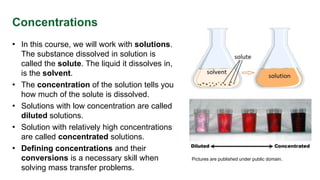
• In this course, we will work with solutions.
The substance dissolved in solution is
called the solute. The liquid it dissolves in,
is the solvent.
• The concentration of the solution tells you
how much of the solute is dissolved.
• Solutions with low concentration are called
diluted solutions.
• Solution with relatively high concentrations
are called concentrated solutions.
• Defining concentrations and their
conversions is a necessary skill when
solving mass transfer problems.
Pictures are published under public domain.
Units of concentration
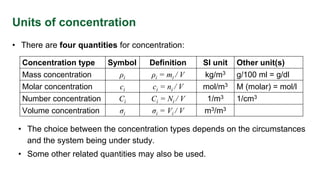
• There are four quantities for concentration:
• The choice between the concentration types depends on the circumstances
and the system being under study.
• Some other related quantities may also be used.
Concentration type Symbol Definition SI unit Other unit(s)
Mass concentration ρi ρi = mi / V kg/m3 g/100 ml = g/dl
Molar concentration ci ci = ni / V mol/m3 M (molar) = mol/l
Number concentration Ci Ci = Ni / V 1/m3 1/cm3
Volume concentration σi σi = Vi / V m3/m3
Related quantities
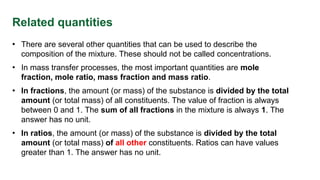
• There are several other quantities that can be used to describe the
composition of the mixture. These should not be called concentrations.
• In mass transfer processes, the most important quantities are mole
fraction, mole ratio, mass fraction and mass ratio.
• In fractions, the amount (or mass) of the substance is divided by the total
amount (or total mass) of all constituents. The value of fraction is always
between 0 and 1. The sum of all fractions in the mixture is always 1. The
answer has no unit.
• In ratios, the amount (or mass) of the substance is divided by the total
amount (or total mass) of all other constituents. Ratios can have values
greater than 1. The answer has no unit.
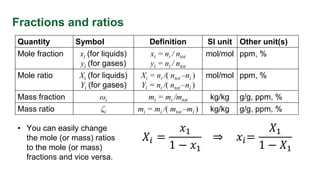
Fractions and ratios
Quantity Symbol Definition SI unit Other unit(s)
Mole fraction xi (for liquids)
yi (for gases)
xi = ni / ntot
yi = ni / ntot
mol/mol ppm, %
Mole ratio Xi (for liquids)
Yi (for gases)
Xi = ni /( ntot –ni )
Yi = ni /( ntot –ni )
mol/mol ppm, %
Mass fraction ωi mi = mi /mtot kg/kg g/g, ppm, %
Mass ratio ζi mi = mi /( mtot –mi ) kg/kg g/g, ppm, %
• You can easily change
the mole (or mass) ratios
to the mole (or mass)
fractions and vice versa.
𝑋𝑖 =
𝑥1
1 − 𝑥1
⇒ 𝑥𝑖=
𝑋1
1 − 𝑋1
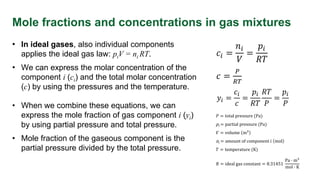
Mole fractions and concentrations in gas mixtures
• In ideal gases, also individual components
applies the ideal gas law: piV = ni RT.
• We can express the molar concentration of the
component i (ci) and the total molar concentration
(c) by using the pressures and the temperature.
𝑐𝑖 =
𝑛𝑖
𝑉
=
𝑝𝑖
𝑅𝑇
𝑐 =
𝑃
𝑅𝑇
• When we combine these equations, we can
express the mole fraction of gas component i (yi)
by using partial pressure and total pressure.
• Mole fraction of the gaseous component is the
partial pressure divided by the total pressure.
𝑦𝑖 =
𝑐𝑖
𝑐
=
𝑝𝑖
𝑅𝑇
𝑅𝑇
𝑃
=
𝑝𝑖
𝑃
𝑃 = total pressure (Pa)
pi = partial pressure (Pa)
𝑉 = volume m3
ni = amount of component 𝑖 mol
𝑇 = temperature (K)
𝑅 = ideal gas constant = 8.31451
Pa ∙ m3
mol ∙ K
This project has received funding from the European Union’s Horizon 2020
research and innovation programme under grant agreement No 869993.
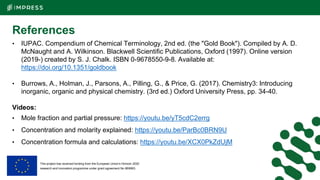
References
• IUPAC. Compendium of Chemical Terminology, 2nd ed. (the "Gold Book"). Compiled by A. D.
McNaught and A. Wilkinson. Blackwell Scientific Publications, Oxford (1997). Online version
(2019-) created by S. J. Chalk. ISBN 0-9678550-9-8. Available at:
https://doi.org/10.1351/goldbook
• Burrows, A., Holman, J., Parsons, A., Pilling, G., & Price, G. (2017). Chemistry3: Introducing
inorganic, organic and physical chemistry. (3rd ed.) Oxford University Press, pp. 34-40.
Videos:
• Mole fraction and partial pressure: https://youtu.be/yT5cdC2errg
• Concentration and molarity explained: https://youtu.be/ParBc0BRN9U
• Concentration formula and calculations: https://youtu.be/XCX0PkZdUjM

Concentrations

  • 1.
    This project hasreceived funding from the European Union’s Horizon 2020 research and innovation programme under grant agreement No 869993. Concentrations
  • 2.
    Concentrations • In thiscourse, we will work with solutions. The substance dissolved in solution is called the solute. The liquid it dissolves in, is the solvent. • The concentration of the solution tells you how much of the solute is dissolved. • Solutions with low concentration are called diluted solutions. • Solution with relatively high concentrations are called concentrated solutions. • Defining concentrations and their conversions is a necessary skill when solving mass transfer problems. Pictures are published under public domain.
  • 3.
    Units of concentration •There are four quantities for concentration: • The choice between the concentration types depends on the circumstances and the system being under study. • Some other related quantities may also be used. Concentration type Symbol Definition SI unit Other unit(s) Mass concentration ρi ρi = mi / V kg/m3 g/100 ml = g/dl Molar concentration ci ci = ni / V mol/m3 M (molar) = mol/l Number concentration Ci Ci = Ni / V 1/m3 1/cm3 Volume concentration σi σi = Vi / V m3/m3
  • 4.
    Related quantities • Thereare several other quantities that can be used to describe the composition of the mixture. These should not be called concentrations. • In mass transfer processes, the most important quantities are mole fraction, mole ratio, mass fraction and mass ratio. • In fractions, the amount (or mass) of the substance is divided by the total amount (or total mass) of all constituents. The value of fraction is always between 0 and 1. The sum of all fractions in the mixture is always 1. The answer has no unit. • In ratios, the amount (or mass) of the substance is divided by the total amount (or total mass) of all other constituents. Ratios can have values greater than 1. The answer has no unit.
  • 5.
    Fractions and ratios QuantitySymbol Definition SI unit Other unit(s) Mole fraction xi (for liquids) yi (for gases) xi = ni / ntot yi = ni / ntot mol/mol ppm, % Mole ratio Xi (for liquids) Yi (for gases) Xi = ni /( ntot –ni ) Yi = ni /( ntot –ni ) mol/mol ppm, % Mass fraction ωi mi = mi /mtot kg/kg g/g, ppm, % Mass ratio ζi mi = mi /( mtot –mi ) kg/kg g/g, ppm, % • You can easily change the mole (or mass) ratios to the mole (or mass) fractions and vice versa. 𝑋𝑖 = 𝑥1 1 − 𝑥1 ⇒ 𝑥𝑖= 𝑋1 1 − 𝑋1
  • 6.
    Mole fractions andconcentrations in gas mixtures • In ideal gases, also individual components applies the ideal gas law: piV = ni RT. • We can express the molar concentration of the component i (ci) and the total molar concentration (c) by using the pressures and the temperature. 𝑐𝑖 = 𝑛𝑖 𝑉 = 𝑝𝑖 𝑅𝑇 𝑐 = 𝑃 𝑅𝑇 • When we combine these equations, we can express the mole fraction of gas component i (yi) by using partial pressure and total pressure. • Mole fraction of the gaseous component is the partial pressure divided by the total pressure. 𝑦𝑖 = 𝑐𝑖 𝑐 = 𝑝𝑖 𝑅𝑇 𝑅𝑇 𝑃 = 𝑝𝑖 𝑃 𝑃 = total pressure (Pa) pi = partial pressure (Pa) 𝑉 = volume m3 ni = amount of component 𝑖 mol 𝑇 = temperature (K) 𝑅 = ideal gas constant = 8.31451 Pa ∙ m3 mol ∙ K
  • 7.
    This project hasreceived funding from the European Union’s Horizon 2020 research and innovation programme under grant agreement No 869993. References • IUPAC. Compendium of Chemical Terminology, 2nd ed. (the "Gold Book"). Compiled by A. D. McNaught and A. Wilkinson. Blackwell Scientific Publications, Oxford (1997). Online version (2019-) created by S. J. Chalk. ISBN 0-9678550-9-8. Available at: https://doi.org/10.1351/goldbook • Burrows, A., Holman, J., Parsons, A., Pilling, G., & Price, G. (2017). Chemistry3: Introducing inorganic, organic and physical chemistry. (3rd ed.) Oxford University Press, pp. 34-40. Videos: • Mole fraction and partial pressure: https://youtu.be/yT5cdC2errg • Concentration and molarity explained: https://youtu.be/ParBc0BRN9U • Concentration formula and calculations: https://youtu.be/XCX0PkZdUjM