This project has received funding from the European Union’s Horizon 2020
research and innovation programme under grant agreement No 869993.
Introduction
to distillation
Distillation
• Distillation is a widely used mass transfer
operation to separate components of liquid
mixtures.
• The basic objective of distillation is to separate
a liquid mixture into two or more streams,
different in composition, by using selective
boiling and condensation.
• The separation is based upon the different
boiling points or relative volatilities of the
components.
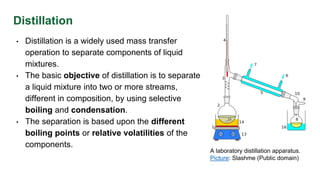
A laboratory distillation apparatus.
Picture: Slashme (Public domain)
Applications
• Distillation is one of the oldest mass transfer
operations.
• The early use of distillation was the production
of alcoholic beverages.
• Distillation is the most important operation in
petroleum refinery. It is used to transform
crude oil into useful products such as gasoline
or petrol, kerosene, diesel oil and fuel oils.
• Distillation can also be used to increase the
purity of a product e.g. purifying water.
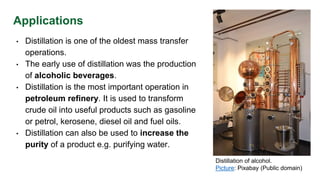
Distillation of alcohol.
Picture: Pixabay (Public domain)
Distillation in industry
• Distillation is the most common mass transfer
operation in petrochemical industries, process
industries and chemical plants.
• Distillation consumes enormous amount of
energy for heating and cooling.
• In industrial settings, distillation is usually
undertaken in continuous columns, where
the feed stream is continuous.
• A distillation column may use either trays
(plates) or packed internals or both to bring
the gas and liquid into contact.
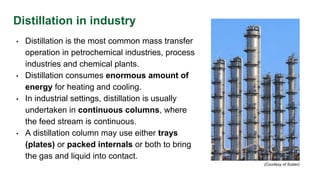
(Courtesy of Sulzer)
Tray column (plate column)
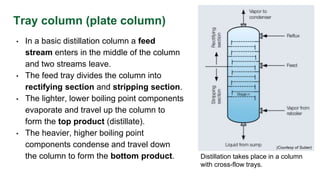
• In a basic distillation column a feed
stream enters in the middle of the column
and two streams leave.
• The feed tray divides the column into
rectifying section and stripping section.
• The lighter, lower boiling point components
evaporate and travel up the column to
form the top product (distillate).
• The heavier, higher boiling point
components condense and travel down
the column to form the bottom product. Distillation takes place in a column
with cross-flow trays.
(Courtesy of Sulzer)
Condenser and reboiler
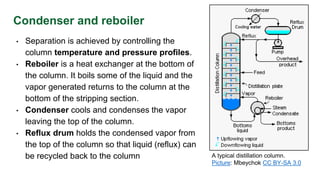
• Separation is achieved by controlling the
column temperature and pressure profiles.
• Reboiler is a heat exchanger at the bottom of
the column. It boils some of the liquid and the
vapor generated returns to the column at the
bottom of the stripping section.
• Condenser cools and condenses the vapor
leaving the top of the column.
• Reflux drum holds the condensed vapor from
the top of the column so that liquid (reflux) can
be recycled back to the column A typical distillation column.
Picture: Mbeychok CC BY-SA 3.0
Liquid/gas contact on the tray
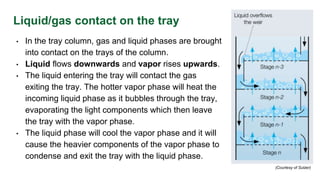
• In the tray column, gas and liquid phases are brought
into contact on the trays of the column.
• Liquid flows downwards and vapor rises upwards.
• The liquid entering the tray will contact the gas
exiting the tray. The hotter vapor phase will heat the
incoming liquid phase as it bubbles through the tray,
evaporating the light components which then leave
the tray with the vapor phase.
• The liquid phase will cool the vapor phase and it will
cause the heavier components of the vapor phase to
condense and exit the tray with the liquid phase.
(Courtesy of Sulzer)
This project has received funding from the European Union’s Horizon 2020
research and innovation programme under grant agreement No 869993.
References
Distillation fundamentals. Neutrium. Available at: https://neutrium.net/unit-operations/distillation-
fundamentals/ [Assessed: 10 June, 2021].
Dutta, B. K. 2007. Principles of mass transfer and separation processes. New Delhi: Prentice-Hall,
pp. 319-321.
Hipple, Jack. 2017. Chemical Engineering for Non-Chemical Engineers. American Institute of
Chemical Engineers, pp. 141-145.
Videos:
• Multistage distillation column demonstration: https://youtu.be/vg_buVDDEgc (2:15)
• Separating liquids by distillation: https://youtu.be/Vz2la3947I0 (5:56)

0.2 Introduction to Distillation

  • 1.
    This project hasreceived funding from the European Union’s Horizon 2020 research and innovation programme under grant agreement No 869993. Introduction to distillation
  • 2.
    Distillation • Distillation isa widely used mass transfer operation to separate components of liquid mixtures. • The basic objective of distillation is to separate a liquid mixture into two or more streams, different in composition, by using selective boiling and condensation. • The separation is based upon the different boiling points or relative volatilities of the components. A laboratory distillation apparatus. Picture: Slashme (Public domain)
  • 3.
    Applications • Distillation isone of the oldest mass transfer operations. • The early use of distillation was the production of alcoholic beverages. • Distillation is the most important operation in petroleum refinery. It is used to transform crude oil into useful products such as gasoline or petrol, kerosene, diesel oil and fuel oils. • Distillation can also be used to increase the purity of a product e.g. purifying water. Distillation of alcohol. Picture: Pixabay (Public domain)
  • 4.
    Distillation in industry •Distillation is the most common mass transfer operation in petrochemical industries, process industries and chemical plants. • Distillation consumes enormous amount of energy for heating and cooling. • In industrial settings, distillation is usually undertaken in continuous columns, where the feed stream is continuous. • A distillation column may use either trays (plates) or packed internals or both to bring the gas and liquid into contact. (Courtesy of Sulzer)
  • 5.
    Tray column (platecolumn) • In a basic distillation column a feed stream enters in the middle of the column and two streams leave. • The feed tray divides the column into rectifying section and stripping section. • The lighter, lower boiling point components evaporate and travel up the column to form the top product (distillate). • The heavier, higher boiling point components condense and travel down the column to form the bottom product. Distillation takes place in a column with cross-flow trays. (Courtesy of Sulzer)
  • 6.
    Condenser and reboiler •Separation is achieved by controlling the column temperature and pressure profiles. • Reboiler is a heat exchanger at the bottom of the column. It boils some of the liquid and the vapor generated returns to the column at the bottom of the stripping section. • Condenser cools and condenses the vapor leaving the top of the column. • Reflux drum holds the condensed vapor from the top of the column so that liquid (reflux) can be recycled back to the column A typical distillation column. Picture: Mbeychok CC BY-SA 3.0
  • 7.
    Liquid/gas contact onthe tray • In the tray column, gas and liquid phases are brought into contact on the trays of the column. • Liquid flows downwards and vapor rises upwards. • The liquid entering the tray will contact the gas exiting the tray. The hotter vapor phase will heat the incoming liquid phase as it bubbles through the tray, evaporating the light components which then leave the tray with the vapor phase. • The liquid phase will cool the vapor phase and it will cause the heavier components of the vapor phase to condense and exit the tray with the liquid phase. (Courtesy of Sulzer)
  • 8.
    This project hasreceived funding from the European Union’s Horizon 2020 research and innovation programme under grant agreement No 869993. References Distillation fundamentals. Neutrium. Available at: https://neutrium.net/unit-operations/distillation- fundamentals/ [Assessed: 10 June, 2021]. Dutta, B. K. 2007. Principles of mass transfer and separation processes. New Delhi: Prentice-Hall, pp. 319-321. Hipple, Jack. 2017. Chemical Engineering for Non-Chemical Engineers. American Institute of Chemical Engineers, pp. 141-145. Videos: • Multistage distillation column demonstration: https://youtu.be/vg_buVDDEgc (2:15) • Separating liquids by distillation: https://youtu.be/Vz2la3947I0 (5:56)