

This project has received funding from the European Union’s Horizon 2020
research and innovation programme under grant agreement No 869993.
Plate
efficiencies
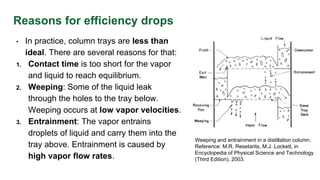
Reasons for efficiency drops
• In practice, column trays are less than
ideal. There are several reasons for that:
1. Contact time is too short for the vapor
and liquid to reach equilibrium.
2. Weeping: Some of the liquid leak
through the holes to the tray below.
Weeping occurs at low vapor velocities.
3. Entrainment: The vapor entrains
droplets of liquid and carry them into the
tray above. Entrainment is caused by
high vapor flow rates.
Weeping and entrainment in a distillation column.
Reference: M.R. Resetarits, M.J. Lockett, in
Encyclopedia of Physical Science and Technology
(Third Edition), 2003.
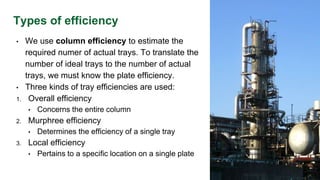
Types of efficiency
• We use column efficiency to estimate the
required numer of actual trays. To translate the
number of ideal trays to the number of actual
trays, we must know the plate efficiency.
• Three kinds of tray efficiencies are used:
1. Overall efficiency
• Concerns the entire column
2. Murphree efficiency
• Determines the efficiency of a single tray
3. Local efficiency
• Pertains to a specific location on a single plate
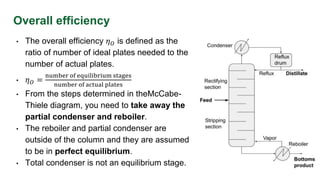
Overall efficiency
• The overall efficiency 𝜂𝑂 is defined as the
ratio of number of ideal plates needed to the
number of actual plates.
• 𝜂𝑂 =
number of equilibrium stages
number of actual plates
• From the steps determined in theMcCabe-
Thiele diagram, you need to take away the
partial condenser and reboiler.
• The reboiler and partial condenser are
outside of the column and they are assumed
to be in perfect equilibrium.
• Total condenser is not an equilibrium stage.
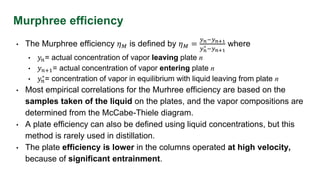
Murphree efficiency
• The Murphree efficiency 𝜂𝑀 is defined by 𝜂𝑀 =
𝑦𝑛−𝑦𝑛+1
𝑦𝑛
∗ −𝑦𝑛+1
where
• 𝑦𝑛= actual concentration of vapor leaving plate n
• 𝑦𝑛+1= actual concentration of vapor entering plate n
• 𝑦𝑛
∗= concentration of vapor in equilibrium with liquid leaving from plate n
• Most empirical correlations for the Murhree efficiency are based on the
samples taken of the liquid on the plates, and the vapor compositions are
determined from the McCabe-Thiele diagram.
• A plate efficiency can also be defined using liquid concentrations, but this
method is rarely used in distillation.
• The plate efficiency is lower in the columns operated at high velocity,
because of significant entrainment.
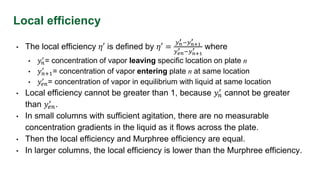
Local efficiency
• The local efficiency 𝜂′ is defined by 𝜂′ =
𝑦𝑛
′ −𝑦𝑛+1
′
𝑦𝑒𝑛
′ −𝑦𝑛+1
′ where
• 𝑦𝑛
′ = concentration of vapor leaving specific location on plate n
• 𝑦𝑛+1
′
= concentration of vapor entering plate n at same location
• 𝑦𝑒𝑛
′ = concentration of vapor in equilibrium with liquid at same location
• Local efficiency cannot be greater than 1, because 𝑦𝑛
′
cannot be greater
than 𝑦𝑒𝑛
′
.
• In small columns with sufficient agitation, there are no measurable
concentration gradients in the liquid as it flows across the plate.
• Then the local efficiency and Murphree efficiency are equal.
• In larger columns, the local efficiency is lower than the Murphree efficiency.
Murphee efficiency and McCabe-Thiele diagram
• The Murphree efficiency can be used in
the McCabe-Thiele diagram.
• Triangle ABC represents an ideal plate
and triangle ADE the actual plate.
• The Murphree efficiency is the ratio
AD/AB.
• The effective equilibrium curve 𝑦𝑒
′ can
be calculated from the equation
• 𝑦𝑒
′ = 𝑦 + 𝜂𝑀(𝑦𝑒 − 𝑦)
• Position of the equilibrium curve 𝑦𝑒
′ is
depended on both the operating line
and the true equilibrium curve.
A
B C
D E
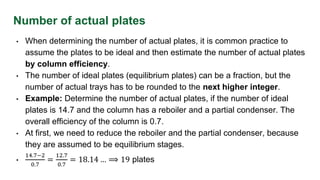
Number of actual plates
• When determining the number of actual plates, it is common practice to
assume the plates to be ideal and then estimate the number of actual plates
by column efficiency.
• The number of ideal plates (equilibrium plates) can be a fraction, but the
number of actual trays has to be rounded to the next higher integer.
• Example: Determine the number of actual plates, if the number of ideal
plates is 14.7 and the column has a reboiler and a partial condenser. The
overall efficiency of the column is 0.7.
• At first, we need to reduce the reboiler and the partial condenser, because
they are assumed to be equilibrium stages.
•
14.7−2
0.7
=
12.7
0.7
= 18.14 … ⟹ 19 plates
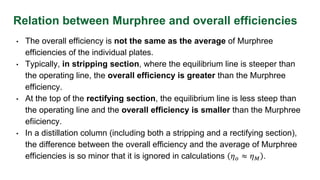
Relation between Murphree and overall efficiencies
• The overall efficiency is not the same as the average of Murphree
efficiencies of the individual plates.
• Typically, in stripping section, where the equilibrium line is steeper than
the operating line, the overall efficiency is greater than the Murphree
efficiency.
• At the top of the rectifying section, the equilibrium line is less steep than
the operating line and the overall efficiency is smaller than the Murphree
efiiciency.
• In a distillation column (including both a stripping and a rectifying section),
the difference between the overall efficiency and the average of Murphree
efficiencies is so minor that it is ignored in calculations 𝜂𝑜 ≈ 𝜂𝑀 .
This project has received funding from the European Union’s Horizon 2020
research and innovation programme under grant agreement No 869993.
References
Corripio, A. B. 2013. Binary Distillation Design. pp. 49-50.
Dutta, B. K. 2007. Principles of mass transfer and separation processes. New Delhi: Prentice-Hall,
pp. 371-373.
McCabe, W. L., Smith, J. C. & Harriott,, P. 2005. Unit Operations of Chemical Engineering. 7 th
Edition. New York: McGraw-Hill, pp. 712-722.
Videos:
• Flux units & tray efficency: https://youtu.be/HOGREUb49bA (7:22)
• Murphee efficiency: https://youtu.be/n1o2k_Ez-08 (6:22)
• Flooding and entrainment in a Distillation tray: https://youtu.be/q7u3NkpeatY (1:01)

2.4 Plate efficiencies

  • 1.
    This project hasreceived funding from the European Union’s Horizon 2020 research and innovation programme under grant agreement No 869993. Plate efficiencies
  • 2.
    Reasons for efficiencydrops • In practice, column trays are less than ideal. There are several reasons for that: 1. Contact time is too short for the vapor and liquid to reach equilibrium. 2. Weeping: Some of the liquid leak through the holes to the tray below. Weeping occurs at low vapor velocities. 3. Entrainment: The vapor entrains droplets of liquid and carry them into the tray above. Entrainment is caused by high vapor flow rates. Weeping and entrainment in a distillation column. Reference: M.R. Resetarits, M.J. Lockett, in Encyclopedia of Physical Science and Technology (Third Edition), 2003.
  • 3.
    Types of efficiency •We use column efficiency to estimate the required numer of actual trays. To translate the number of ideal trays to the number of actual trays, we must know the plate efficiency. • Three kinds of tray efficiencies are used: 1. Overall efficiency • Concerns the entire column 2. Murphree efficiency • Determines the efficiency of a single tray 3. Local efficiency • Pertains to a specific location on a single plate
  • 4.
    Overall efficiency • Theoverall efficiency 𝜂𝑂 is defined as the ratio of number of ideal plates needed to the number of actual plates. • 𝜂𝑂 = number of equilibrium stages number of actual plates • From the steps determined in theMcCabe- Thiele diagram, you need to take away the partial condenser and reboiler. • The reboiler and partial condenser are outside of the column and they are assumed to be in perfect equilibrium. • Total condenser is not an equilibrium stage.
  • 5.
    Murphree efficiency • TheMurphree efficiency 𝜂𝑀 is defined by 𝜂𝑀 = 𝑦𝑛−𝑦𝑛+1 𝑦𝑛 ∗ −𝑦𝑛+1 where • 𝑦𝑛= actual concentration of vapor leaving plate n • 𝑦𝑛+1= actual concentration of vapor entering plate n • 𝑦𝑛 ∗= concentration of vapor in equilibrium with liquid leaving from plate n • Most empirical correlations for the Murhree efficiency are based on the samples taken of the liquid on the plates, and the vapor compositions are determined from the McCabe-Thiele diagram. • A plate efficiency can also be defined using liquid concentrations, but this method is rarely used in distillation. • The plate efficiency is lower in the columns operated at high velocity, because of significant entrainment.
  • 6.
    Local efficiency • Thelocal efficiency 𝜂′ is defined by 𝜂′ = 𝑦𝑛 ′ −𝑦𝑛+1 ′ 𝑦𝑒𝑛 ′ −𝑦𝑛+1 ′ where • 𝑦𝑛 ′ = concentration of vapor leaving specific location on plate n • 𝑦𝑛+1 ′ = concentration of vapor entering plate n at same location • 𝑦𝑒𝑛 ′ = concentration of vapor in equilibrium with liquid at same location • Local efficiency cannot be greater than 1, because 𝑦𝑛 ′ cannot be greater than 𝑦𝑒𝑛 ′ . • In small columns with sufficient agitation, there are no measurable concentration gradients in the liquid as it flows across the plate. • Then the local efficiency and Murphree efficiency are equal. • In larger columns, the local efficiency is lower than the Murphree efficiency.
  • 7.
    Murphee efficiency andMcCabe-Thiele diagram • The Murphree efficiency can be used in the McCabe-Thiele diagram. • Triangle ABC represents an ideal plate and triangle ADE the actual plate. • The Murphree efficiency is the ratio AD/AB. • The effective equilibrium curve 𝑦𝑒 ′ can be calculated from the equation • 𝑦𝑒 ′ = 𝑦 + 𝜂𝑀(𝑦𝑒 − 𝑦) • Position of the equilibrium curve 𝑦𝑒 ′ is depended on both the operating line and the true equilibrium curve. A B C D E
  • 8.
    Number of actualplates • When determining the number of actual plates, it is common practice to assume the plates to be ideal and then estimate the number of actual plates by column efficiency. • The number of ideal plates (equilibrium plates) can be a fraction, but the number of actual trays has to be rounded to the next higher integer. • Example: Determine the number of actual plates, if the number of ideal plates is 14.7 and the column has a reboiler and a partial condenser. The overall efficiency of the column is 0.7. • At first, we need to reduce the reboiler and the partial condenser, because they are assumed to be equilibrium stages. • 14.7−2 0.7 = 12.7 0.7 = 18.14 … ⟹ 19 plates
  • 9.
    Relation between Murphreeand overall efficiencies • The overall efficiency is not the same as the average of Murphree efficiencies of the individual plates. • Typically, in stripping section, where the equilibrium line is steeper than the operating line, the overall efficiency is greater than the Murphree efficiency. • At the top of the rectifying section, the equilibrium line is less steep than the operating line and the overall efficiency is smaller than the Murphree efiiciency. • In a distillation column (including both a stripping and a rectifying section), the difference between the overall efficiency and the average of Murphree efficiencies is so minor that it is ignored in calculations 𝜂𝑜 ≈ 𝜂𝑀 .
  • 10.
    This project hasreceived funding from the European Union’s Horizon 2020 research and innovation programme under grant agreement No 869993. References Corripio, A. B. 2013. Binary Distillation Design. pp. 49-50. Dutta, B. K. 2007. Principles of mass transfer and separation processes. New Delhi: Prentice-Hall, pp. 371-373. McCabe, W. L., Smith, J. C. & Harriott,, P. 2005. Unit Operations of Chemical Engineering. 7 th Edition. New York: McGraw-Hill, pp. 712-722. Videos: • Flux units & tray efficency: https://youtu.be/HOGREUb49bA (7:22) • Murphee efficiency: https://youtu.be/n1o2k_Ez-08 (6:22) • Flooding and entrainment in a Distillation tray: https://youtu.be/q7u3NkpeatY (1:01)