 Role of chemistry in different fields of life;
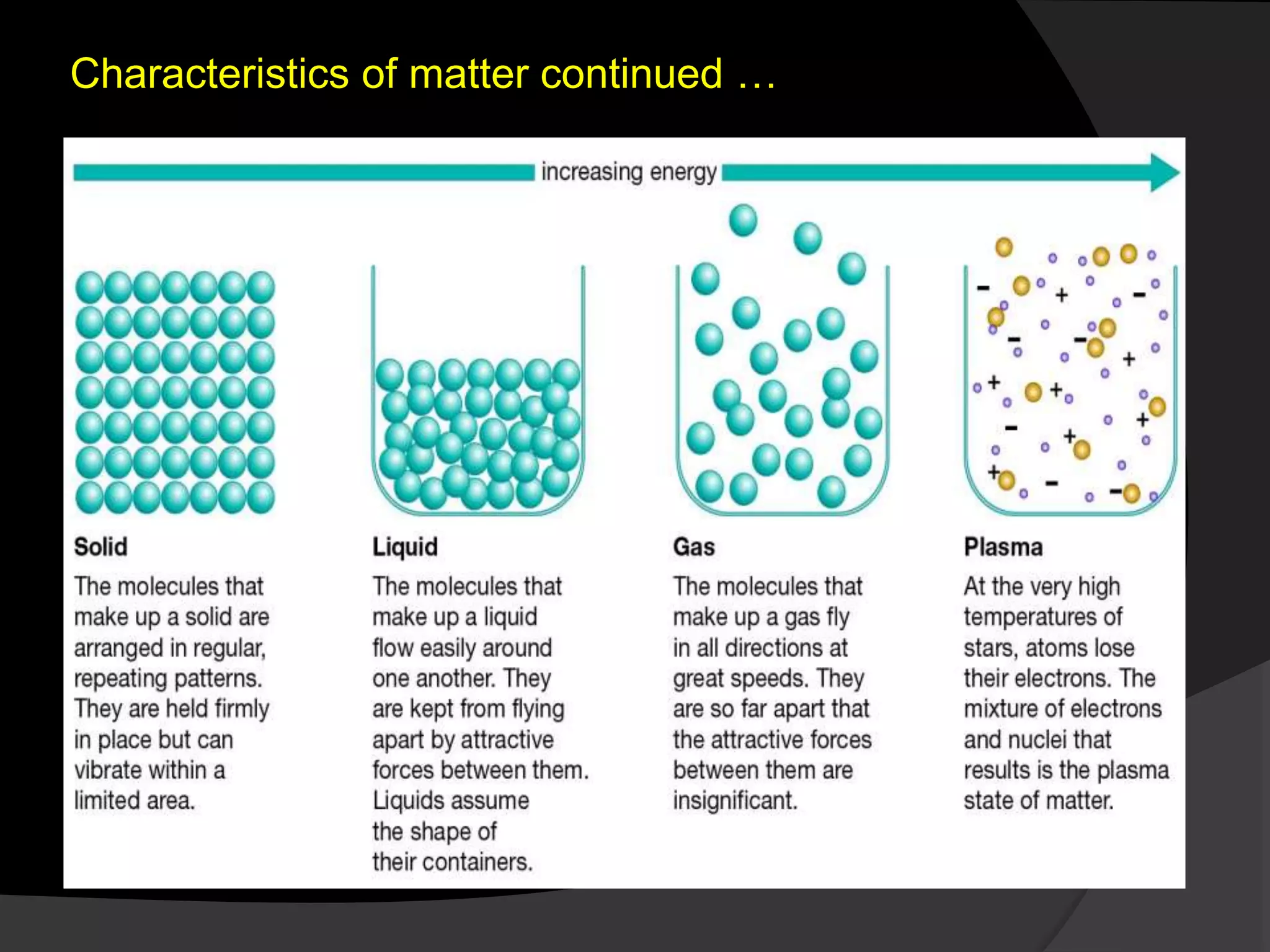
 Characteristics of three states of matter;
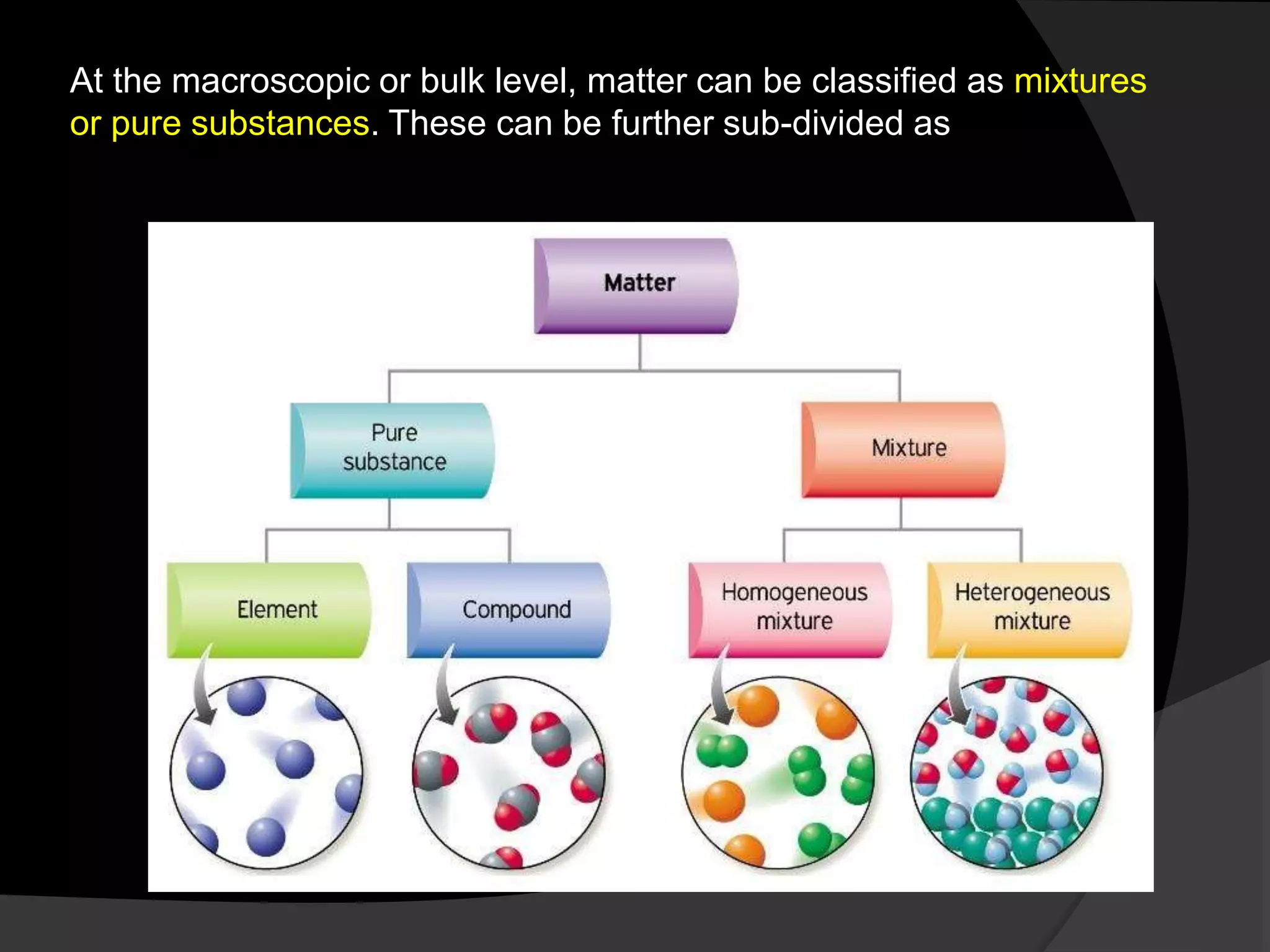
 Classify different substances into elements, compounds and mixtures;
 Define SI base units and list some commonly used prefixes;
 Precision and accuracy;
 Scientific notations and significant figures;
 Various laws of chemical combination;
 Atomic mass, molecular mass and formula mass;
 Mole concept;
 Calculate the mass per cent of different elements constituting a compound;
 Determine empirical formula and molecular formula for a compound;
 Stoichiometric calculations; limiting reagent, excess reagent;
 Concentration terms like molarity, molality, mole fraction etc.
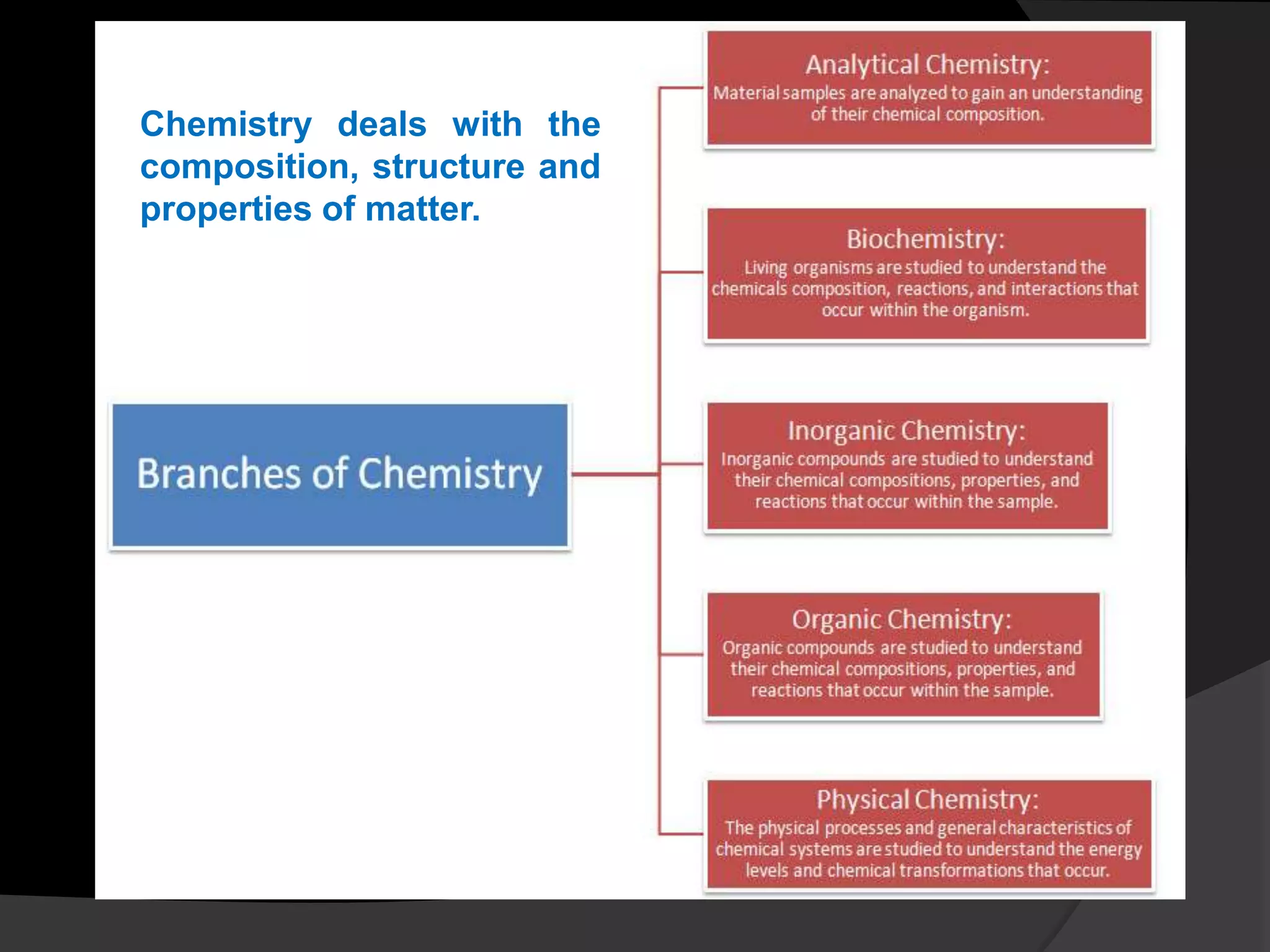
Chemistry deals with the
composition, structure and
properties of matter.
Chemistry is an interdisciplinary subject :-
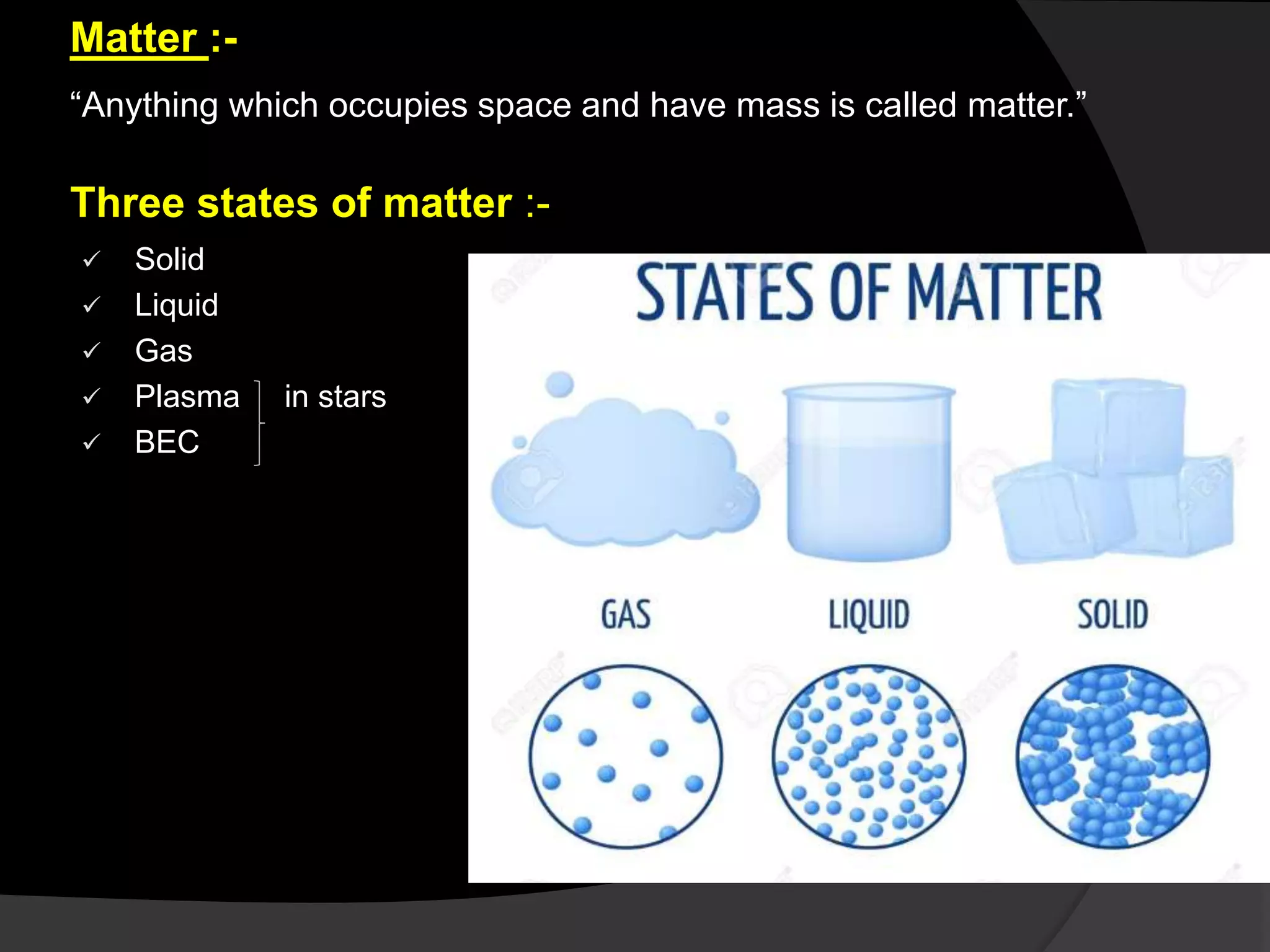
Matter :-
“Anything which occupies space and have mass is called matter.”
Three states of matter :-
 Solid
 Liquid
 Gas
 Plasma in stars
 BEC
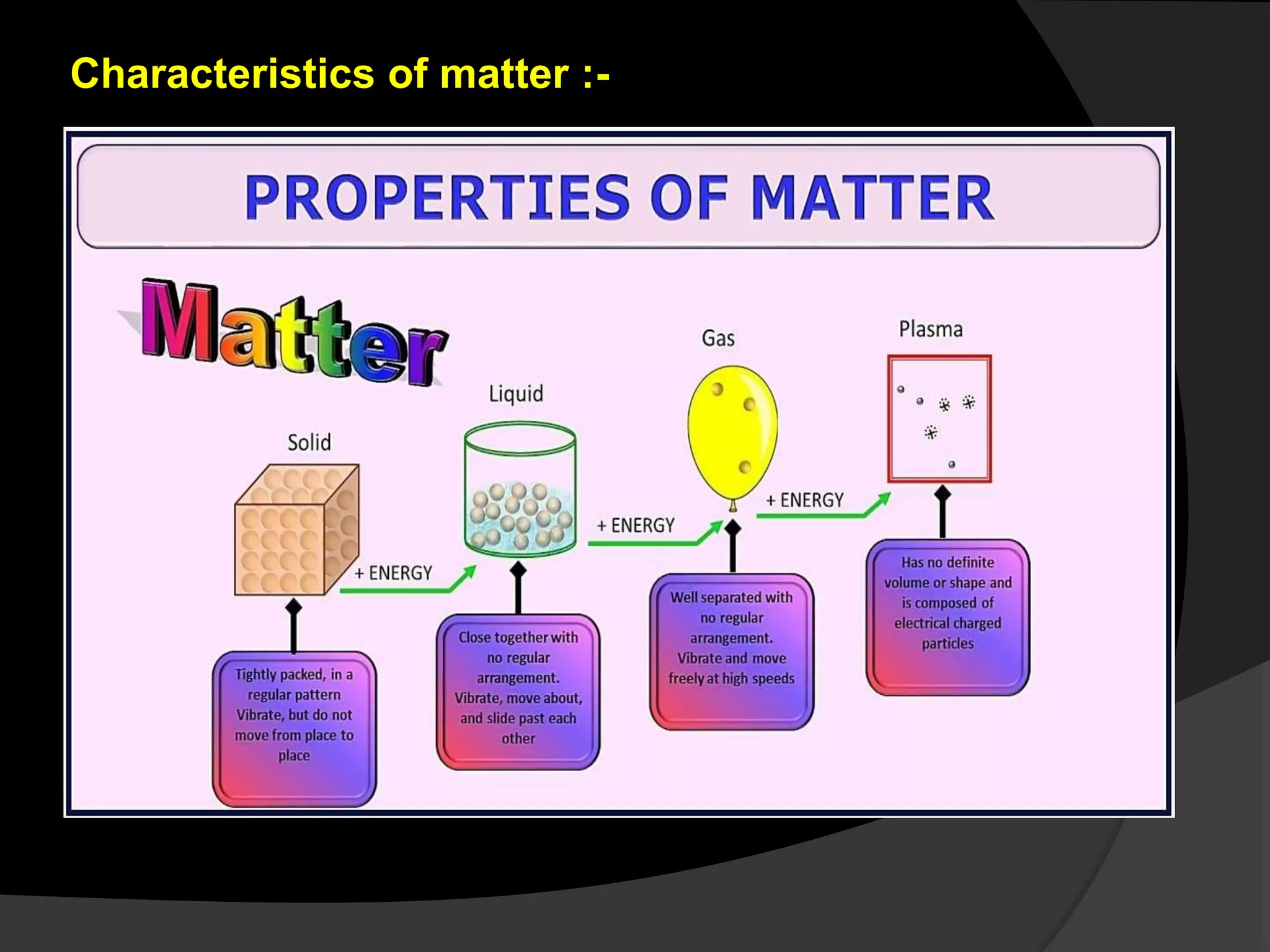
Characteristics of matter :-
Characteristics of matter continued …
At the macroscopic or bulk level, matter can be classified as mixtures
or pure substances. These can be further sub-divided as
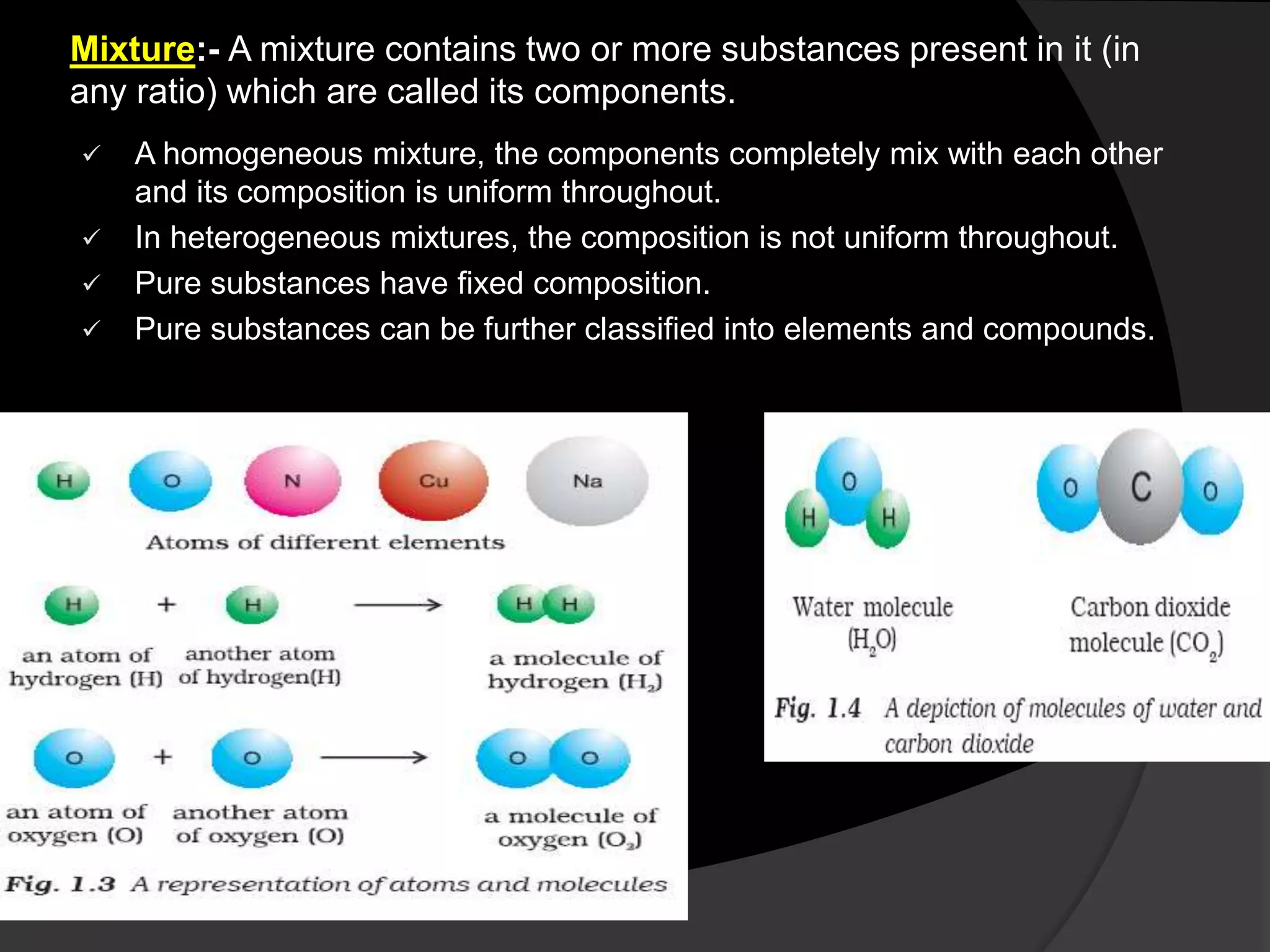
Mixture:- A mixture contains two or more substances present in it (in
any ratio) which are called its components.
 A homogeneous mixture, the components completely mix with each other
and its composition is uniform throughout.
 In heterogeneous mixtures, the composition is not uniform throughout.
 Pure substances have fixed composition.
 Pure substances can be further classified into elements and compounds.
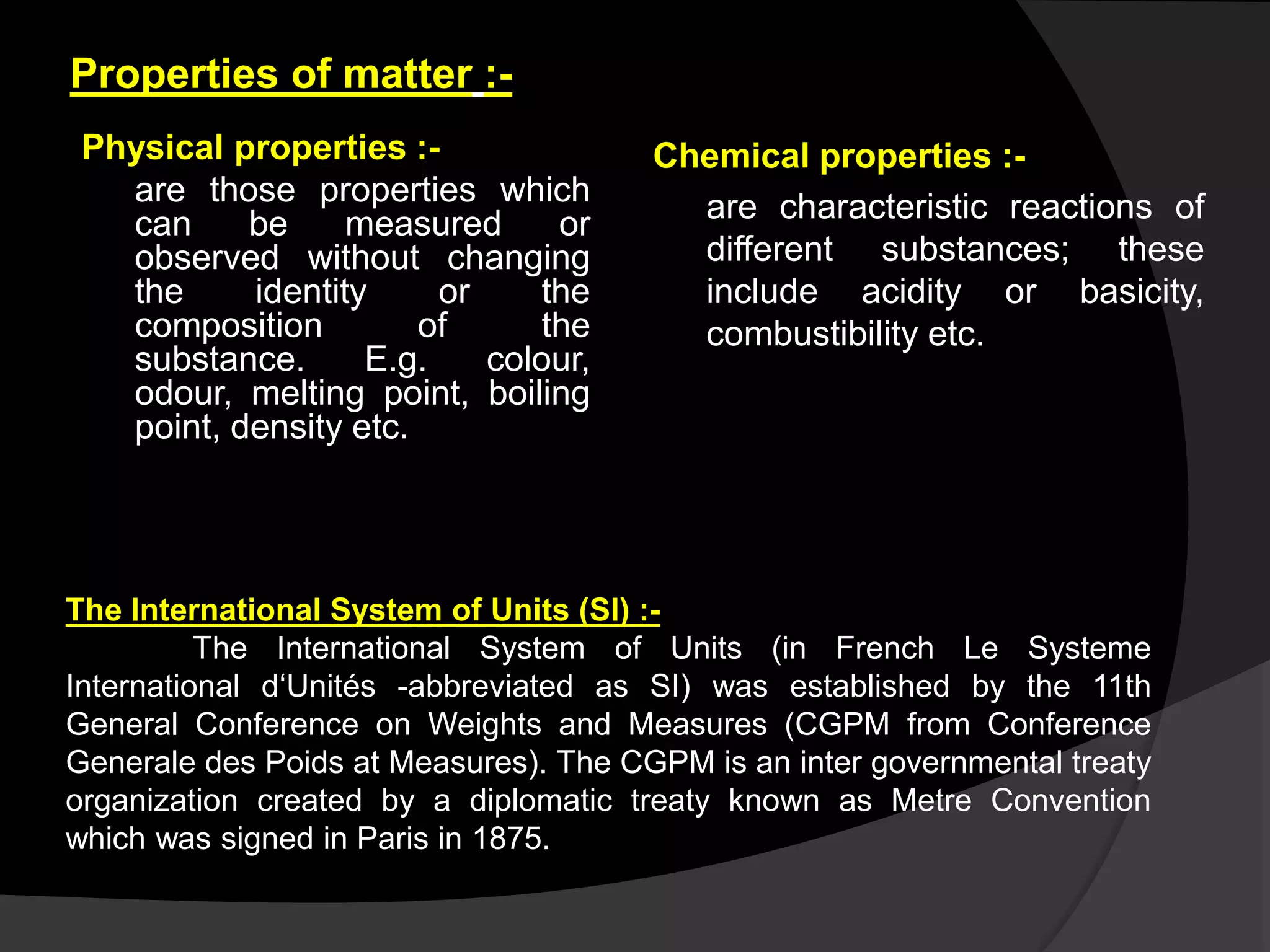
Properties of matter :-
Physical properties :-
are those properties which
can be measured or
observed without changing
the identity or the
composition of the
substance. E.g. colour,
odour, melting point, boiling
point, density etc.
Chemical properties :-
are characteristic reactions of
different substances; these
include acidity or basicity,
combustibility etc.
The International System of Units (SI) :-
The International System of Units (in French Le Systeme
International d‘Unités -abbreviated as SI) was established by the 11th
General Conference on Weights and Measures (CGPM from Conference
Generale des Poids at Measures). The CGPM is an inter governmental treaty
organization created by a diplomatic treaty known as Metre Convention
which was signed in Paris in 1875.
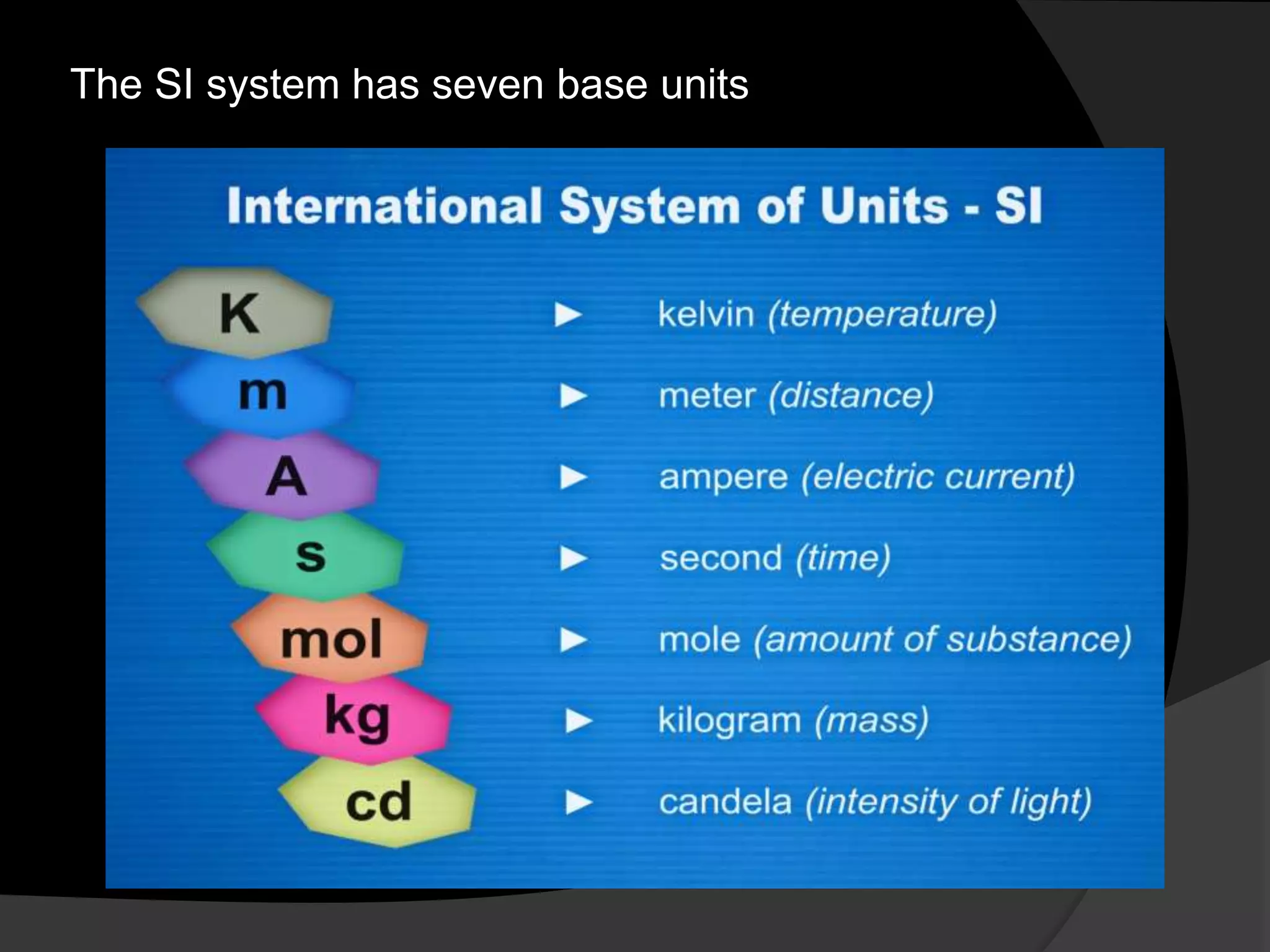
The SI system has seven base units
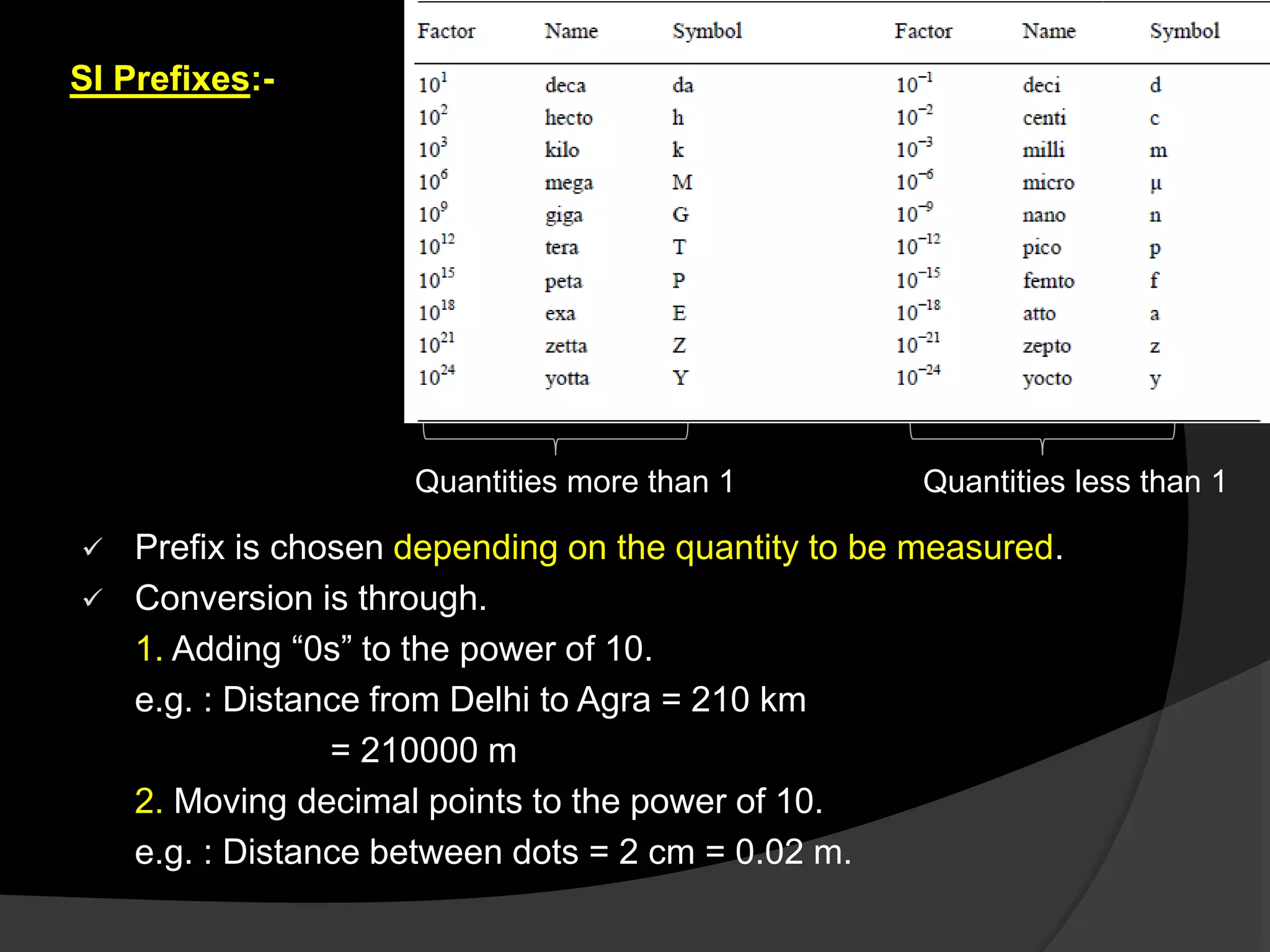
SI Prefixes:-
 Prefix is chosen depending on the quantity to be measured.
 Conversion is through.
1. Adding “0s” to the power of 10.
e.g. : Distance from Delhi to Agra = 210 km
= 210000 m
2. Moving decimal points to the power of 10.
e.g. : Distance between dots = 2 cm = 0.02 m.
Quantities more than 1 Quantities less than 1
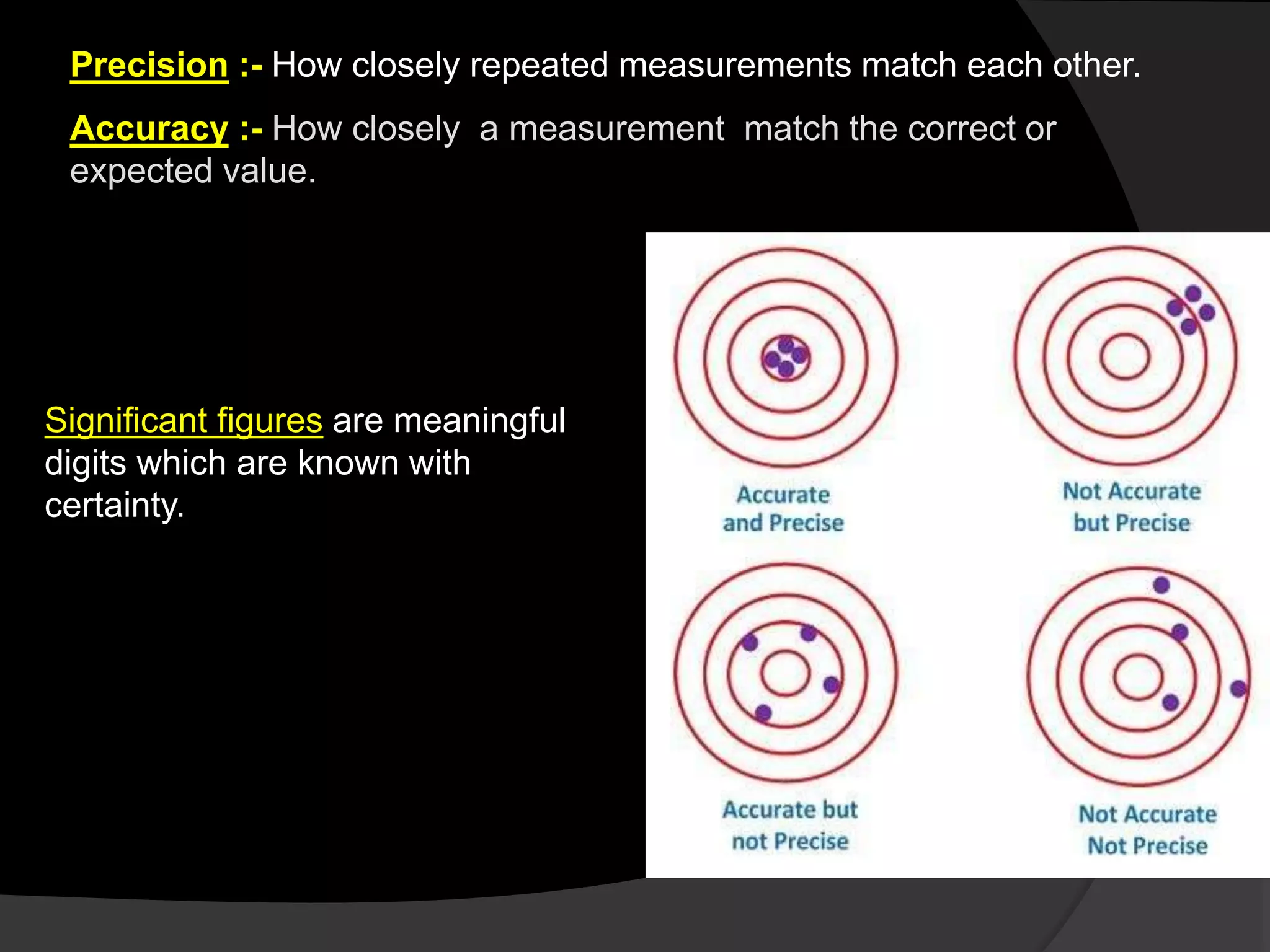
Accuracy :- How closely a measurement match the correct or
expected value.
Precision :- How closely repeated measurements match each other.
Significant figures are meaningful
digits which are known with
certainty.
Rules for Identification of significant figures :-
 Non zero digits are significant.
e.g. 245, 3 significant figures.
 Zeroes in the middle of a number are significant.
e.g. 101, 3 significant figures.
 Zeroes to the right of a digit after a decimal point are significant.
e.g. 0.1200, 4 significant figures.
 Zeroes between decimal point and a number are not significant.
e.g. 0.00150, 3 significant figures.
 Upon addition and subtraction with significant figures, the result
cannot have more figures to the right of the decimal point than
either of the original numbers.
 In multiplication and division with significant numbers, the answer
cannot have more significant figures than any of the original
numbers. e.g. A person weighing 75.3 kg gains 21% of his weight
in a month. What will be his total weight gain?
 Law of conservation of mass
 Law of definite proportion
 Law of multiple proportion
 Law of combining volumes (Gay Lussac’s Law)
 Avogadro's Law
LAWS OF CHEMICAL COMBINATIONS
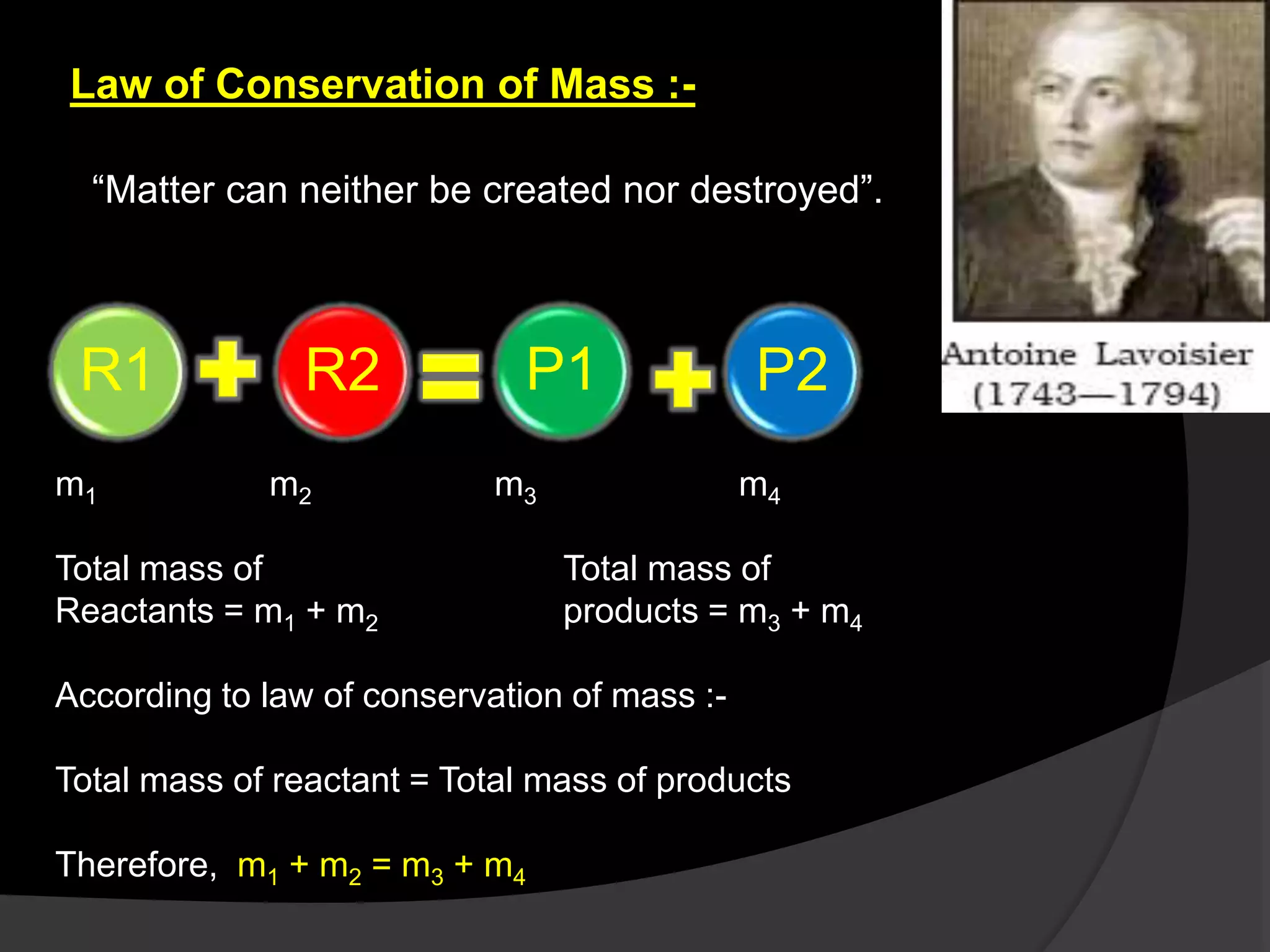
Law of Conservation of Mass :-
“Matter can neither be created nor destroyed”.
R1 R2 P1 P2
m1 m2 m3 m4
Total mass of Total mass of
Reactants = m1 + m2 products = m3 + m4
According to law of conservation of mass :-
Total mass of reactant = Total mass of products
Therefore, m1 + m2 = m3 + m4
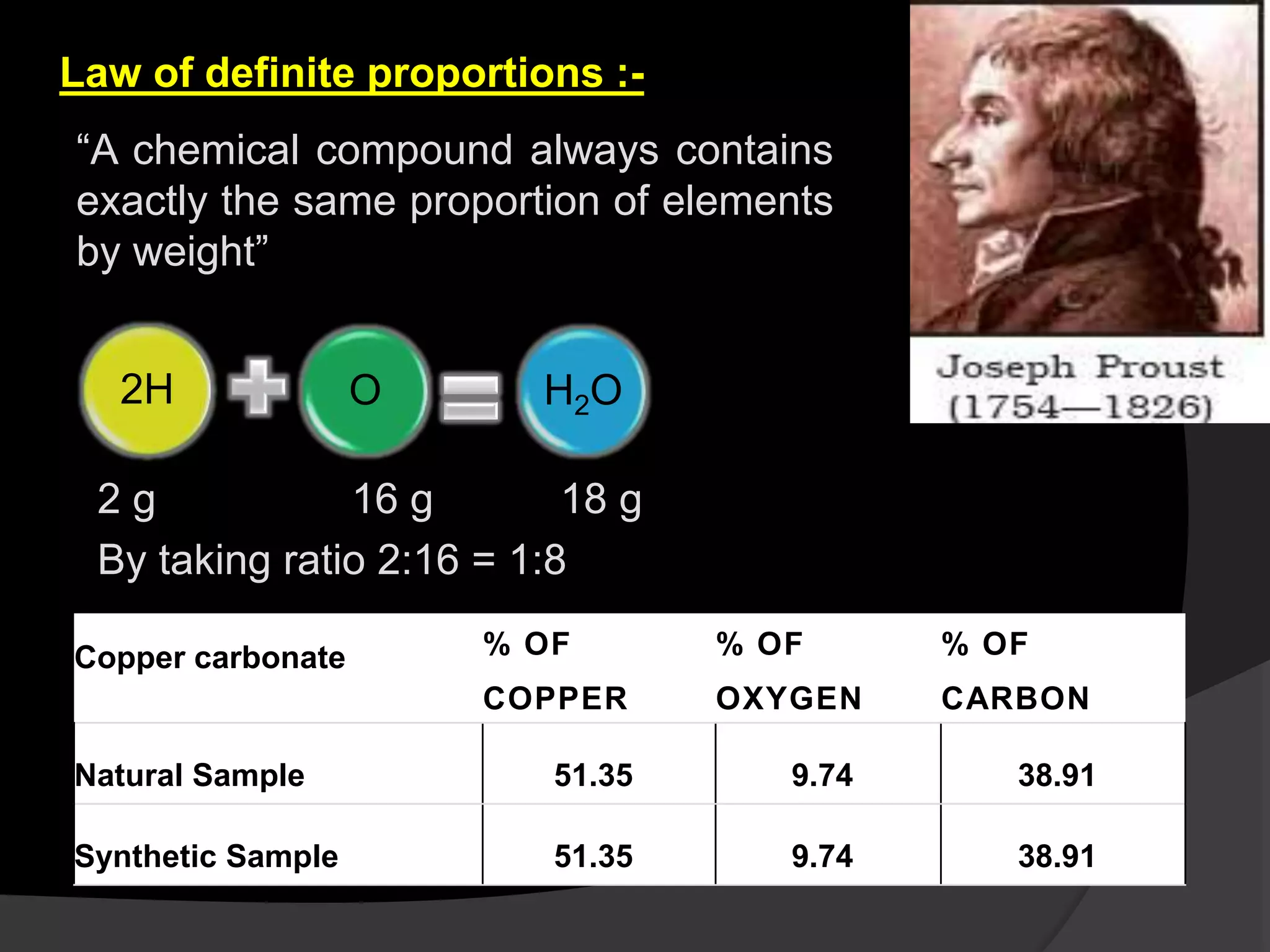
Law of definite proportions :-
“A chemical compound always contains
exactly the same proportion of elements
by weight”
2 g 16 g 18 g
By taking ratio 2:16 = 1:8
2H O H2O
Copper carbonate % OF
COPPER
% OF
OXYGEN
% OF
CARBON
Natural Sample 51.35 9.74 38.91
Synthetic Sample 51.35 9.74 38.91
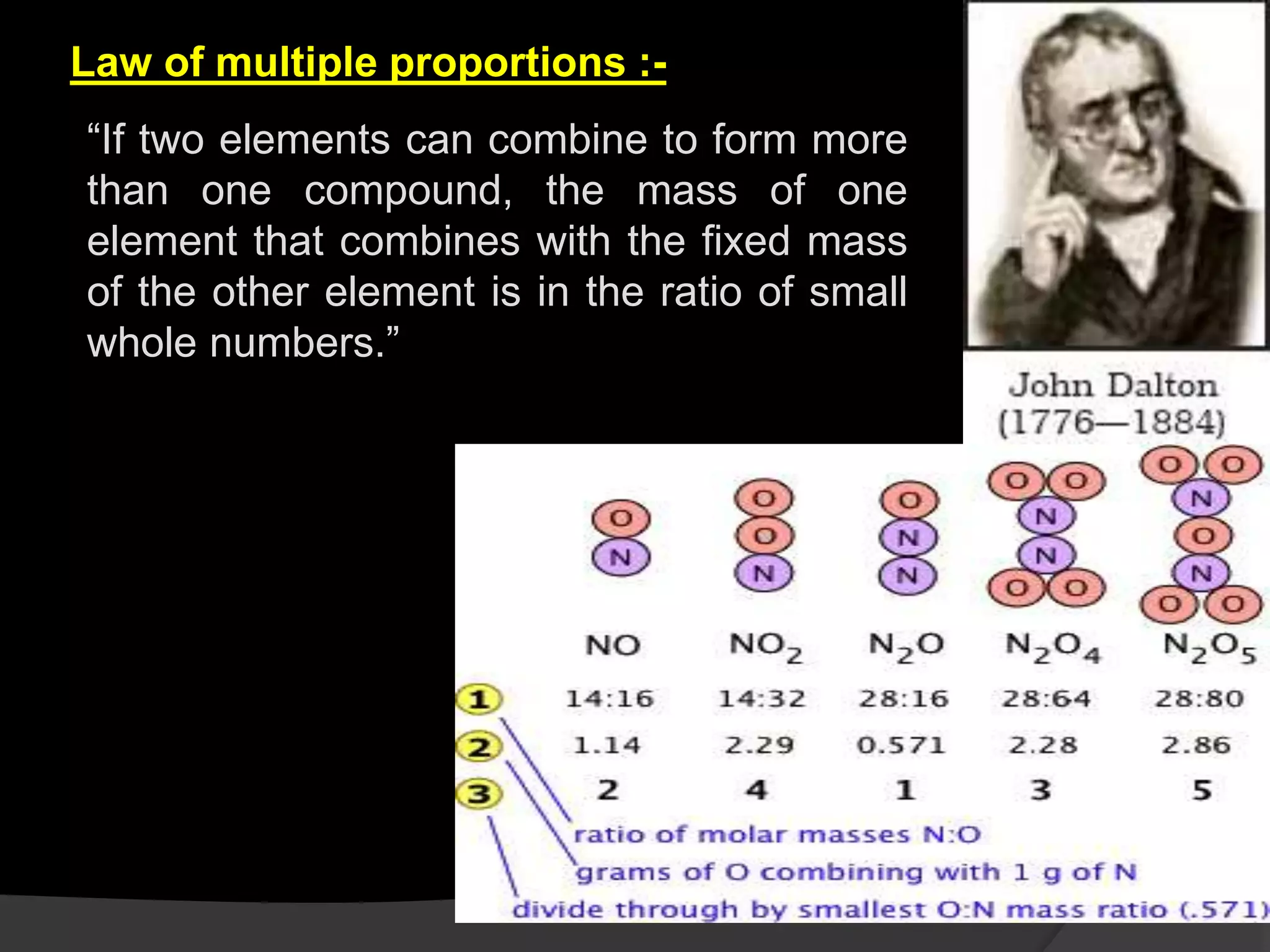
Law of multiple proportions :-
“If two elements can combine to form more
than one compound, the mass of one
element that combines with the fixed mass
of the other element is in the ratio of small
whole numbers.”
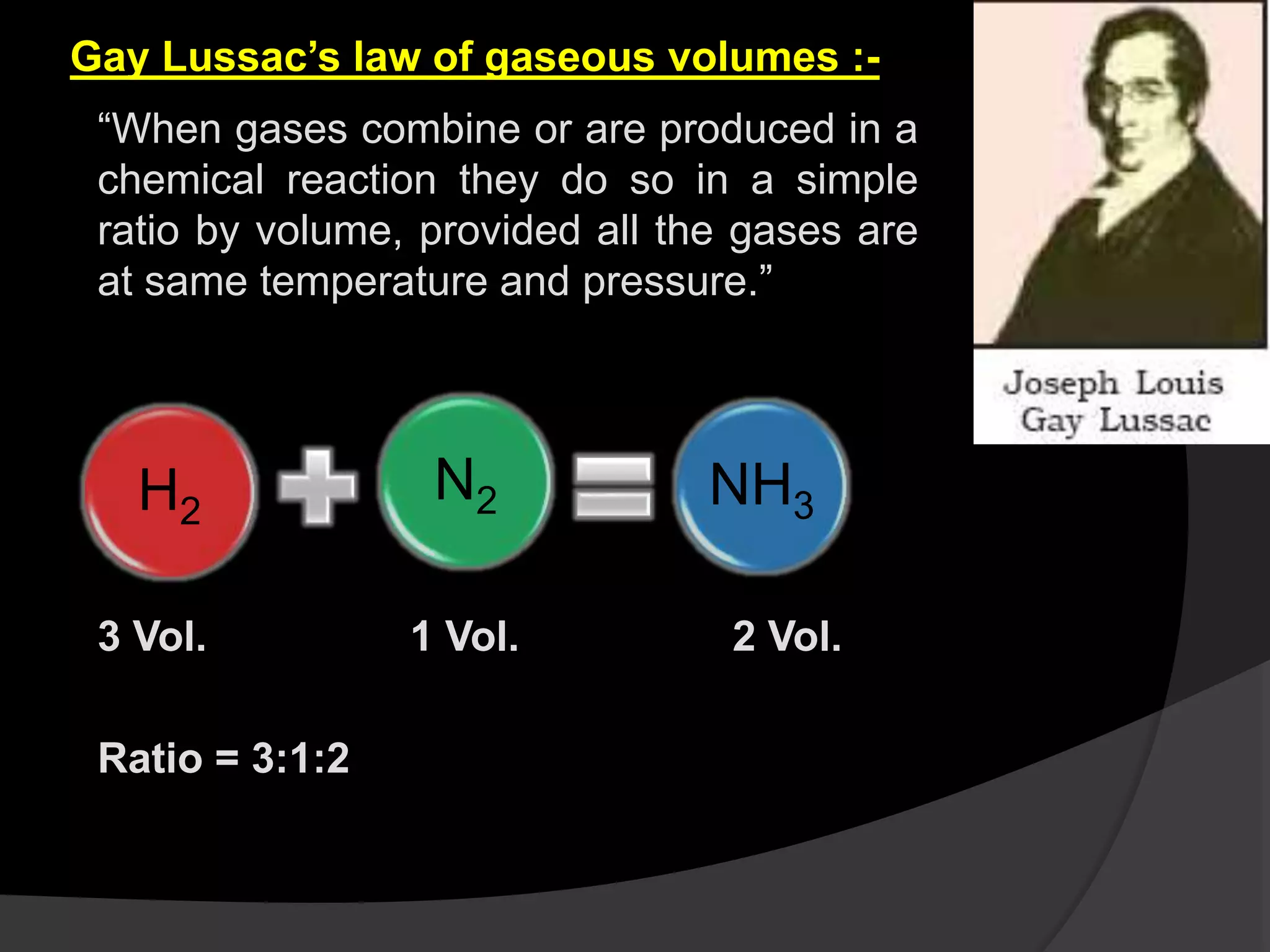
Gay Lussac’s law of gaseous volumes :-
“When gases combine or are produced in a
chemical reaction they do so in a simple
ratio by volume, provided all the gases are
at same temperature and pressure.”
3 Vol. 1 Vol. 2 Vol.
Ratio = 3:1:2
H2
N2 NH3
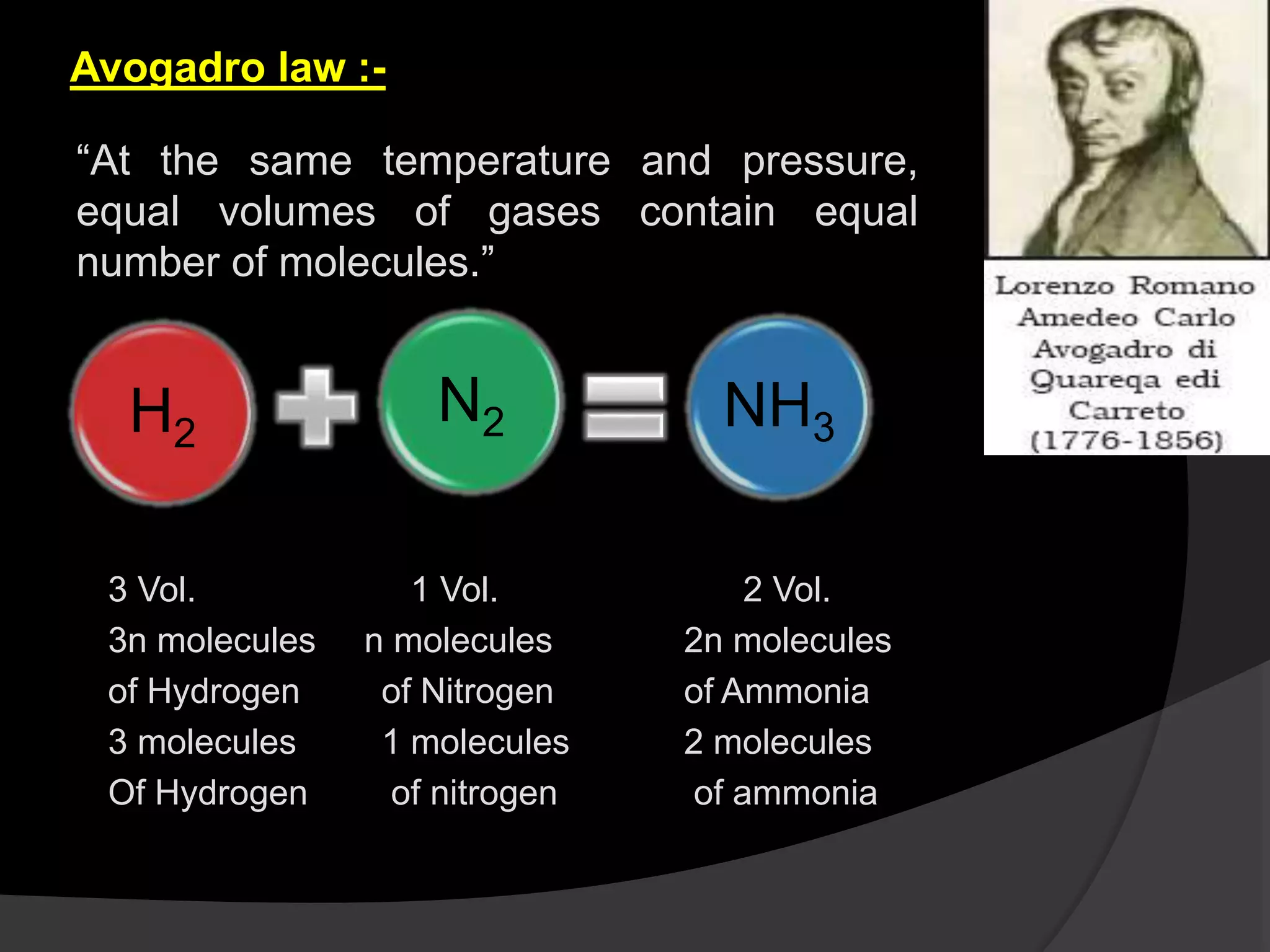
Avogadro law :-
“At the same temperature and pressure,
equal volumes of gases contain equal
number of molecules.”
H2
N2 NH3
3 Vol. 1 Vol. 2 Vol.
3n molecules n molecules 2n molecules
of Hydrogen of Nitrogen of Ammonia
3 molecules 1 molecules 2 molecules
Of Hydrogen of nitrogen of ammonia
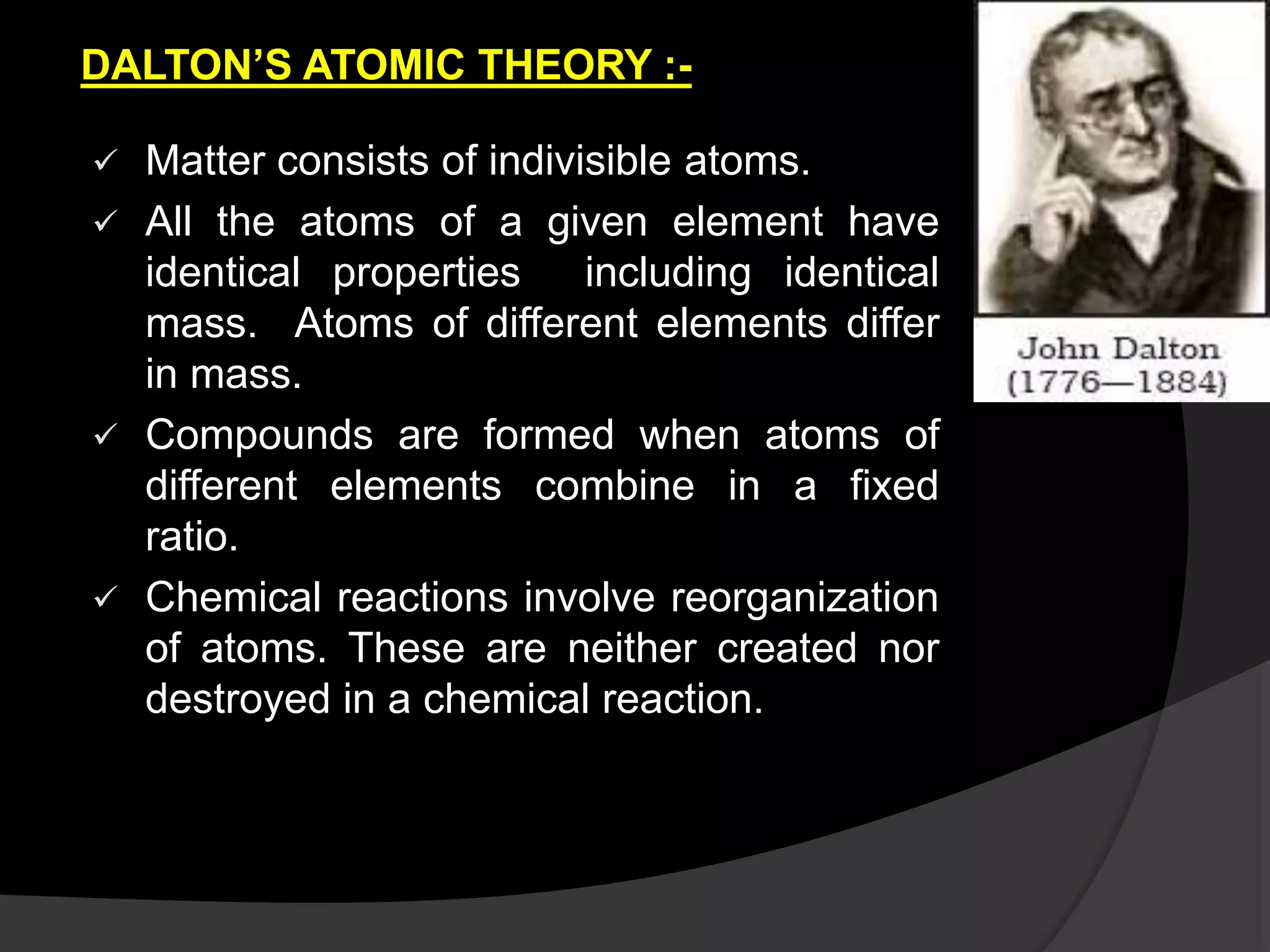
DALTON’S ATOMIC THEORY :-
 Matter consists of indivisible atoms.
 All the atoms of a given element have
identical properties including identical
mass. Atoms of different elements differ
in mass.
 Compounds are formed when atoms of
different elements combine in a fixed
ratio.
 Chemical reactions involve reorganization
of atoms. These are neither created nor
destroyed in a chemical reaction.
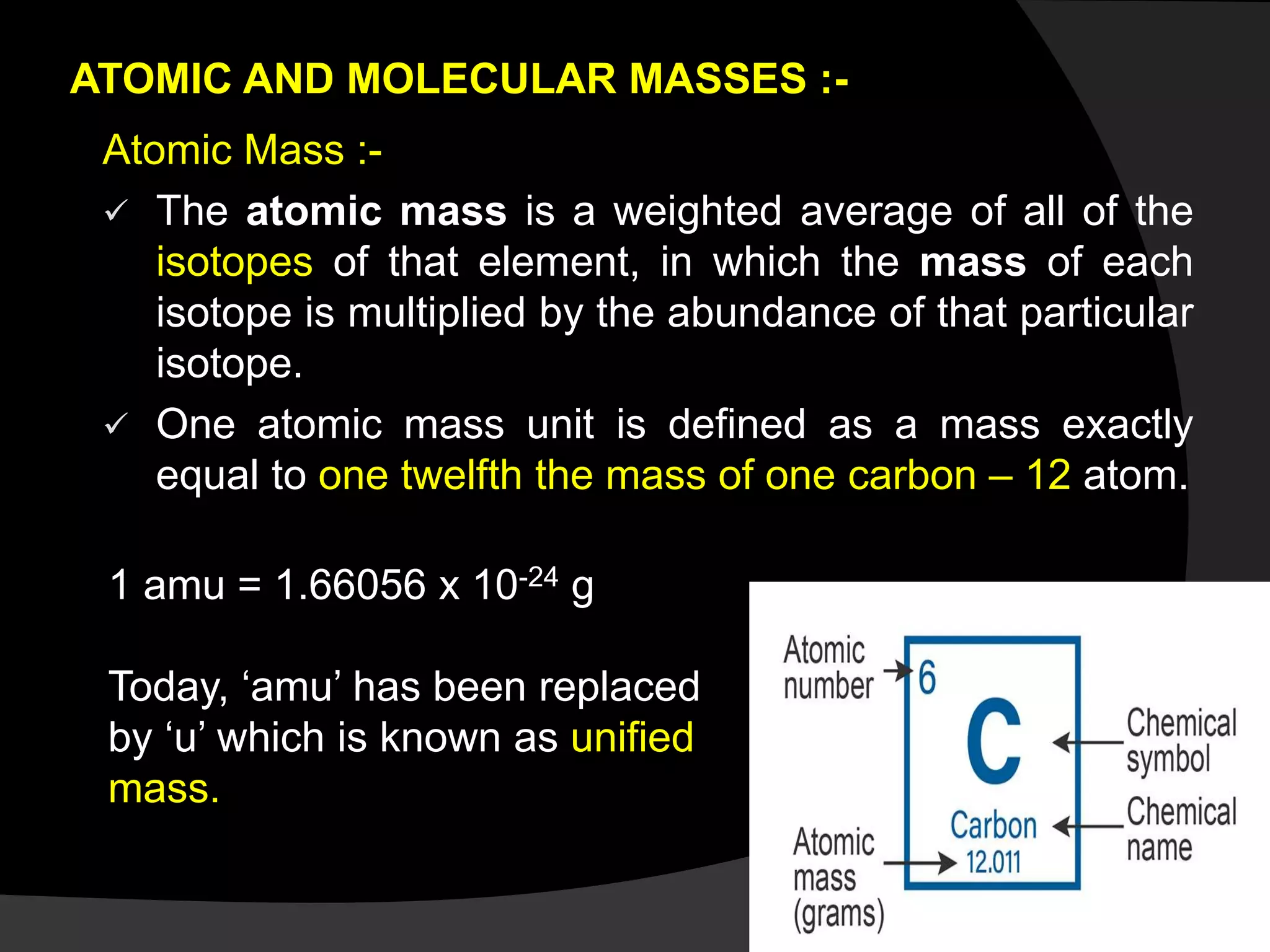
ATOMIC AND MOLECULAR MASSES :-
Atomic Mass :-
 The atomic mass is a weighted average of all of the
isotopes of that element, in which the mass of each
isotope is multiplied by the abundance of that particular
isotope.
 One atomic mass unit is defined as a mass exactly
equal to one twelfth the mass of one carbon – 12 atom.
1 amu = 1.66056 x 10⁻²⁴ g
Today, ‘amu’ has been replaced
by ‘u’ which is known as unified
mass.
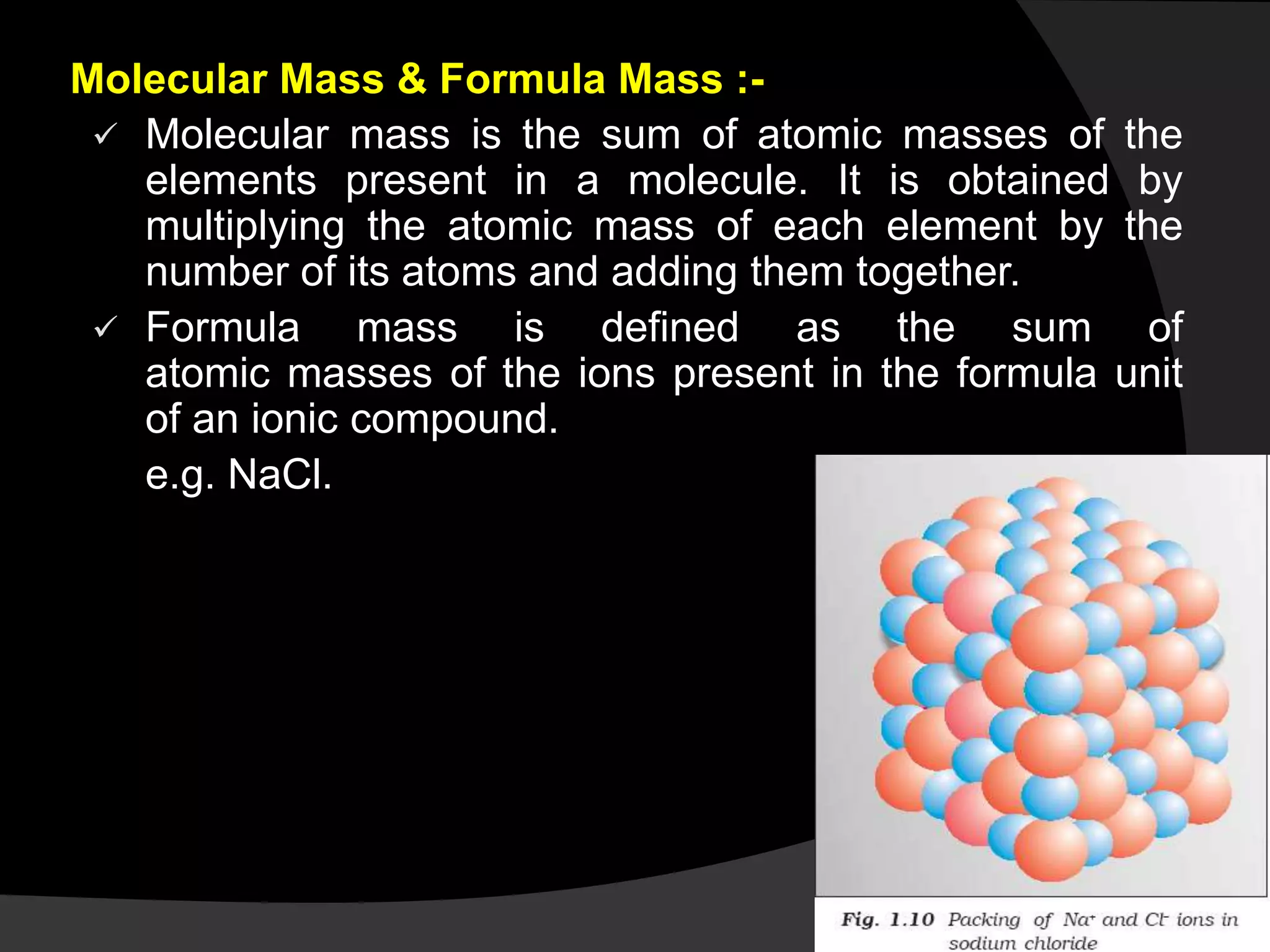
Molecular Mass & Formula Mass :-
 Molecular mass is the sum of atomic masses of the
elements present in a molecule. It is obtained by
multiplying the atomic mass of each element by the
number of its atoms and adding them together.
 Formula mass is defined as the sum of
atomic masses of the ions present in the formula unit
of an ionic compound.
e.g. NaCl.
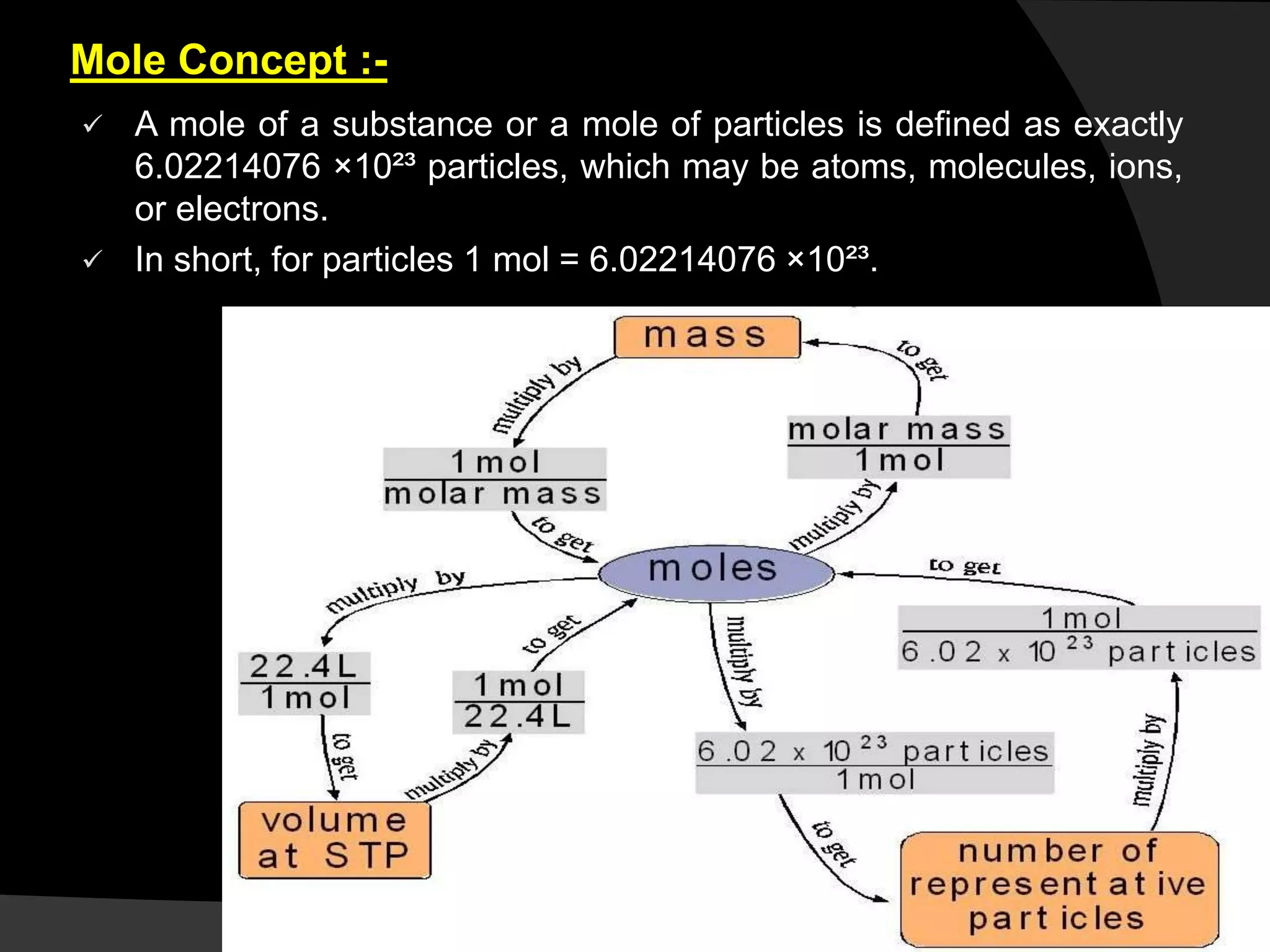
Mole Concept :-
 A mole of a substance or a mole of particles is defined as exactly
6.02214076 ×10²³ particles, which may be atoms, molecules, ions,
or electrons.
 In short, for particles 1 mol = 6.02214076 ×10²³.
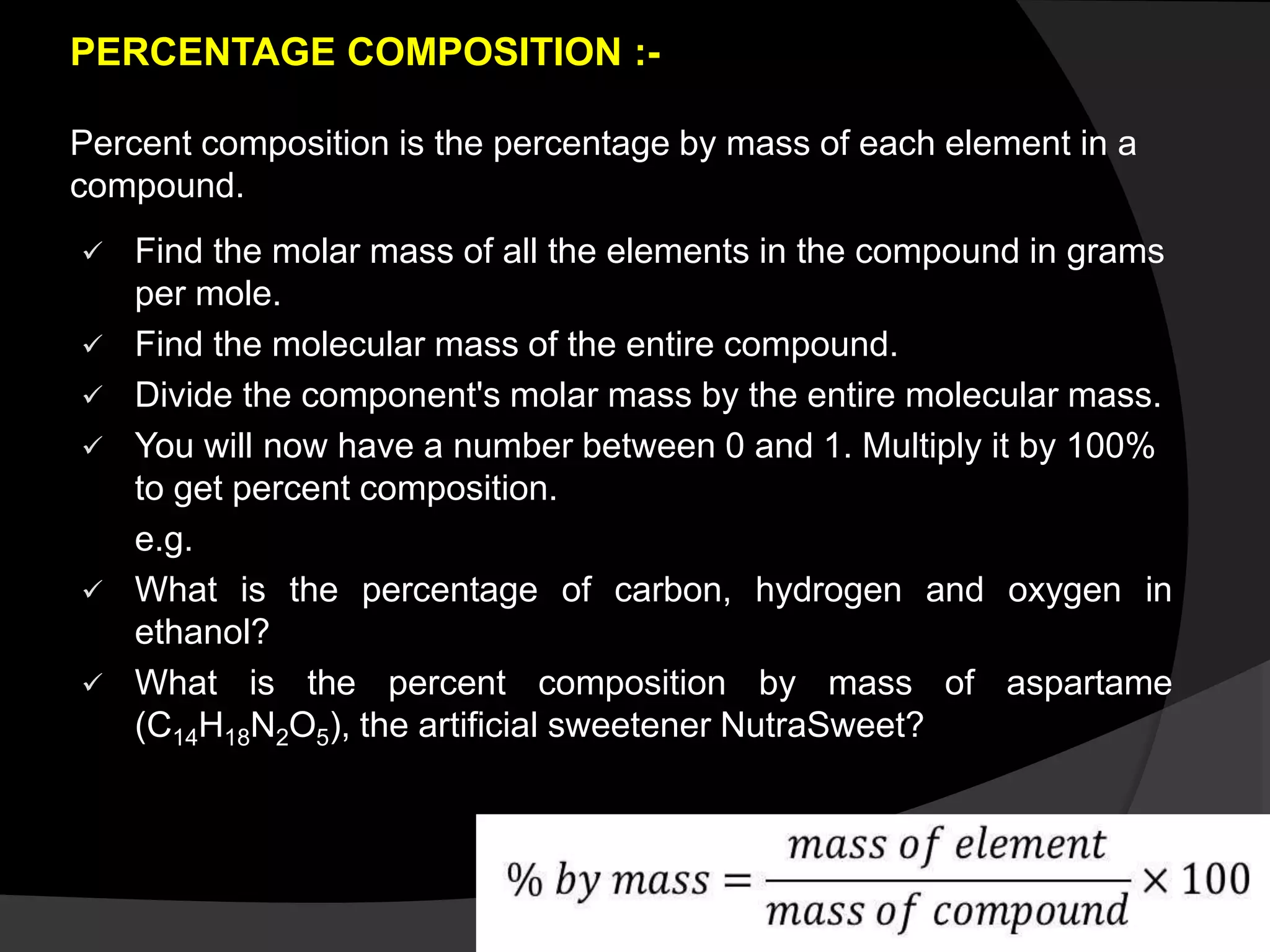
PERCENTAGE COMPOSITION :-
Percent composition is the percentage by mass of each element in a
compound.
 Find the molar mass of all the elements in the compound in grams
per mole.
 Find the molecular mass of the entire compound.
 Divide the component's molar mass by the entire molecular mass.
 You will now have a number between 0 and 1. Multiply it by 100%
to get percent composition.
e.g.
 What is the percentage of carbon, hydrogen and oxygen in
ethanol?
 What is the percent composition by mass of aspartame
(C14H18N2O5), the artificial sweetener NutraSweet?
Empirical Formula for Molecular Formula
 Conversion of mass per cent
to grams.
 Convert into number moles
of each element.
 Divide the mole value
obtained above by the
smallest number to get a
simple ratio.
 Write empirical formula by
mentioning the numbers
after writing the symbols of
respective elements.
 e.g. benzene and acetylene.
An empirical formula represents the simplest whole number ratio of
various atoms present in a compound whereas the molecular formula
shows the exact number of different types of atoms present in a
molecule of a compound.
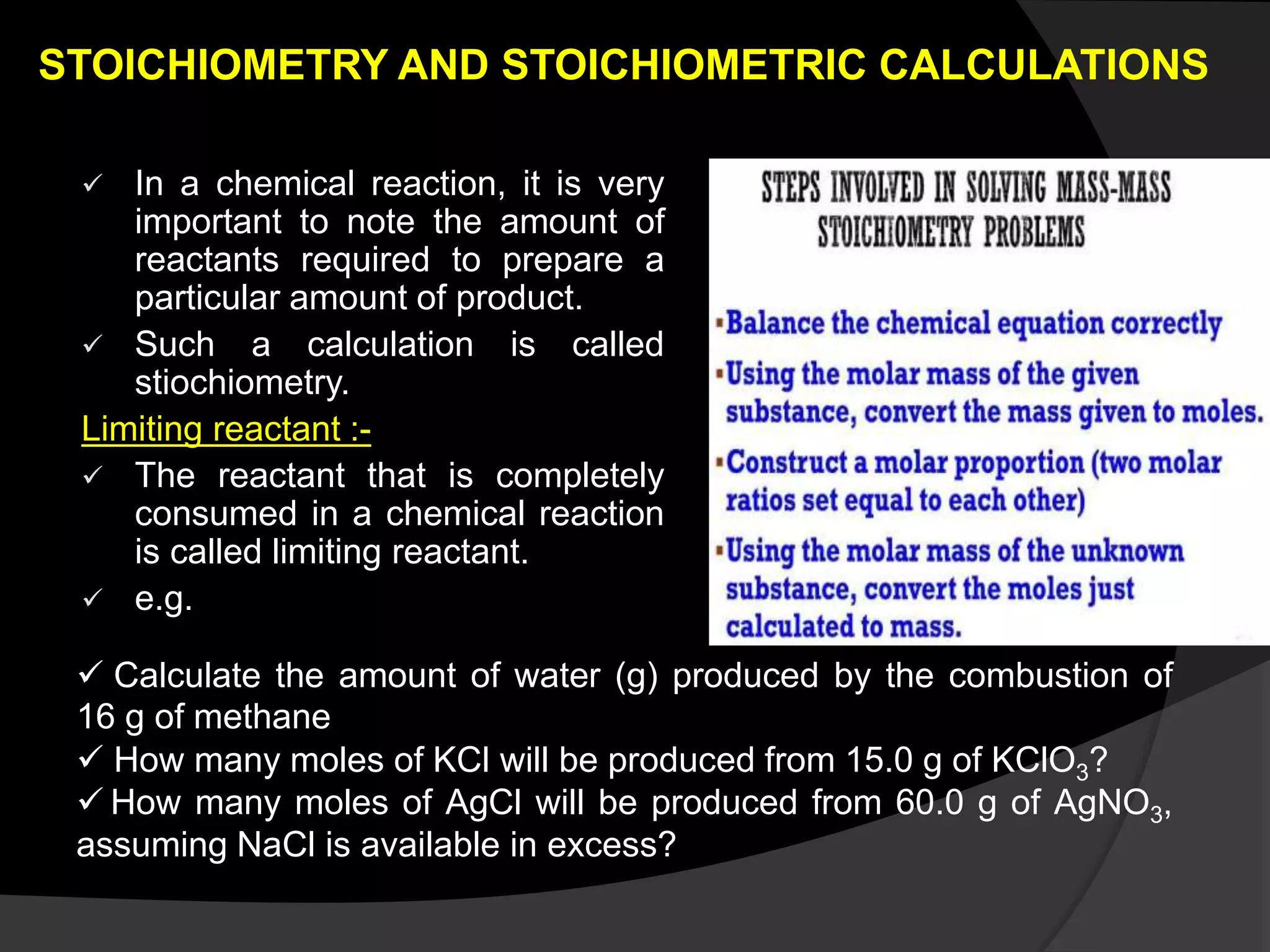
STOICHIOMETRY AND STOICHIOMETRIC CALCULATIONS
 In a chemical reaction, it is very
important to note the amount of
reactants required to prepare a
particular amount of product.
 Such a calculation is called
stiochiometry.
Limiting reactant :-
 The reactant that is completely
consumed in a chemical reaction
is called limiting reactant.
 e.g.
 Calculate the amount of water (g) produced by the combustion of
16 g of methane
 How many moles of KCl will be produced from 15.0 g of KClO3?
 How many moles of AgCl will be produced from 60.0 g of AgNO3​,
assuming NaCl is available in excess?
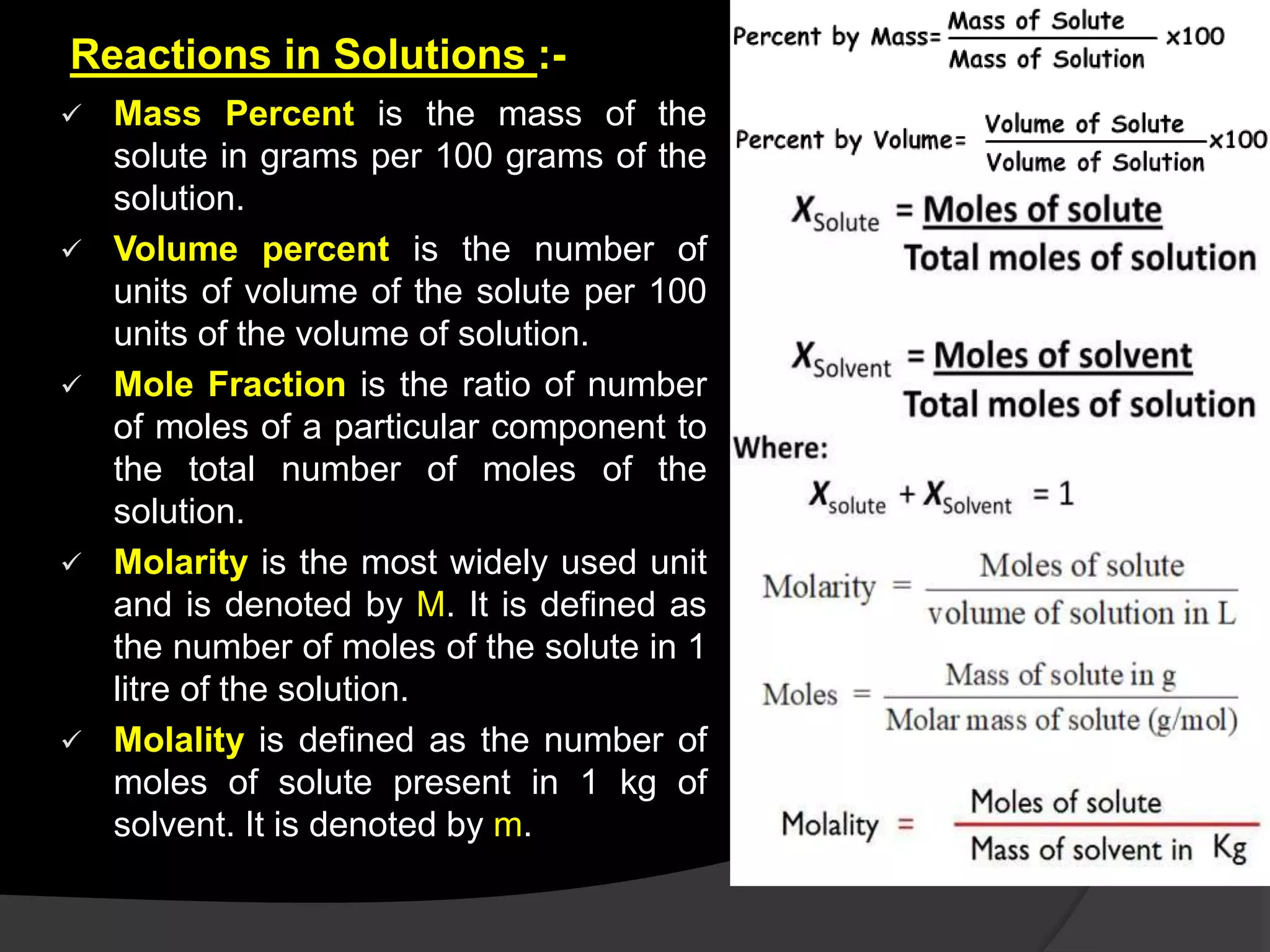
Reactions in Solutions :-
 Mass Percent is the mass of the
solute in grams per 100 grams of the
solution.
 Volume percent is the number of
units of volume of the solute per 100
units of the volume of solution.
 Mole Fraction is the ratio of number
of moles of a particular component to
the total number of moles of the
solution.
 Molarity is the most widely used unit
and is denoted by M. It is defined as
the number of moles of the solute in 1
litre of the solution.
 Molality is defined as the number of
moles of solute present in 1 kg of
solvent. It is denoted by m.
Molarity vs Molality :-
Molarity is temperature dependant, it changes with change in volume.
 Relation between Molarity, Molality and
Mole fraction
e.g.
 How many grams of NaOH are there in
500 mL of a 2 M NaOH solution?
 What is the concentration of a solution
in percentage (w/v) made by dissolving
4.6 g NaCl in water to have 250 mL of
salt solution?
 Calculate the mole fraction, molarity
and molality of 0.26 L of acetic acid
solution. The solution is composed of
14.1 g of acetic acid and 250 g of water.
The molecular mass of acetic acid is
60.
The Dilution Equation
Where,
Ch - 1 some basic concepts of chemistry

Ch - 1 some basic concepts of chemistry

  • 1.
     Role ofchemistry in different fields of life;  Characteristics of three states of matter;  Classify different substances into elements, compounds and mixtures;  Define SI base units and list some commonly used prefixes;  Precision and accuracy;  Scientific notations and significant figures;  Various laws of chemical combination;  Atomic mass, molecular mass and formula mass;  Mole concept;  Calculate the mass per cent of different elements constituting a compound;  Determine empirical formula and molecular formula for a compound;  Stoichiometric calculations; limiting reagent, excess reagent;  Concentration terms like molarity, molality, mole fraction etc.
  • 2.
    Chemistry deals withthe composition, structure and properties of matter.
  • 3.
    Chemistry is aninterdisciplinary subject :-
  • 4.
    Matter :- “Anything whichoccupies space and have mass is called matter.” Three states of matter :-  Solid  Liquid  Gas  Plasma in stars  BEC
  • 5.
  • 6.
  • 7.
    At the macroscopicor bulk level, matter can be classified as mixtures or pure substances. These can be further sub-divided as
  • 8.
    Mixture:- A mixturecontains two or more substances present in it (in any ratio) which are called its components.  A homogeneous mixture, the components completely mix with each other and its composition is uniform throughout.  In heterogeneous mixtures, the composition is not uniform throughout.  Pure substances have fixed composition.  Pure substances can be further classified into elements and compounds.
  • 9.
    Properties of matter:- Physical properties :- are those properties which can be measured or observed without changing the identity or the composition of the substance. E.g. colour, odour, melting point, boiling point, density etc. Chemical properties :- are characteristic reactions of different substances; these include acidity or basicity, combustibility etc. The International System of Units (SI) :- The International System of Units (in French Le Systeme International d‘Unités -abbreviated as SI) was established by the 11th General Conference on Weights and Measures (CGPM from Conference Generale des Poids at Measures). The CGPM is an inter governmental treaty organization created by a diplomatic treaty known as Metre Convention which was signed in Paris in 1875.
  • 10.
    The SI systemhas seven base units
  • 11.
    SI Prefixes:-  Prefixis chosen depending on the quantity to be measured.  Conversion is through. 1. Adding “0s” to the power of 10. e.g. : Distance from Delhi to Agra = 210 km = 210000 m 2. Moving decimal points to the power of 10. e.g. : Distance between dots = 2 cm = 0.02 m. Quantities more than 1 Quantities less than 1
  • 12.
    Accuracy :- Howclosely a measurement match the correct or expected value. Precision :- How closely repeated measurements match each other. Significant figures are meaningful digits which are known with certainty.
  • 13.
    Rules for Identificationof significant figures :-  Non zero digits are significant. e.g. 245, 3 significant figures.  Zeroes in the middle of a number are significant. e.g. 101, 3 significant figures.  Zeroes to the right of a digit after a decimal point are significant. e.g. 0.1200, 4 significant figures.  Zeroes between decimal point and a number are not significant. e.g. 0.00150, 3 significant figures.  Upon addition and subtraction with significant figures, the result cannot have more figures to the right of the decimal point than either of the original numbers.  In multiplication and division with significant numbers, the answer cannot have more significant figures than any of the original numbers. e.g. A person weighing 75.3 kg gains 21% of his weight in a month. What will be his total weight gain?
  • 14.
     Law ofconservation of mass  Law of definite proportion  Law of multiple proportion  Law of combining volumes (Gay Lussac’s Law)  Avogadro's Law LAWS OF CHEMICAL COMBINATIONS
  • 15.
    Law of Conservationof Mass :- “Matter can neither be created nor destroyed”. R1 R2 P1 P2 m1 m2 m3 m4 Total mass of Total mass of Reactants = m1 + m2 products = m3 + m4 According to law of conservation of mass :- Total mass of reactant = Total mass of products Therefore, m1 + m2 = m3 + m4
  • 16.
    Law of definiteproportions :- “A chemical compound always contains exactly the same proportion of elements by weight” 2 g 16 g 18 g By taking ratio 2:16 = 1:8 2H O H2O Copper carbonate % OF COPPER % OF OXYGEN % OF CARBON Natural Sample 51.35 9.74 38.91 Synthetic Sample 51.35 9.74 38.91
  • 17.
    Law of multipleproportions :- “If two elements can combine to form more than one compound, the mass of one element that combines with the fixed mass of the other element is in the ratio of small whole numbers.”
  • 18.
    Gay Lussac’s lawof gaseous volumes :- “When gases combine or are produced in a chemical reaction they do so in a simple ratio by volume, provided all the gases are at same temperature and pressure.” 3 Vol. 1 Vol. 2 Vol. Ratio = 3:1:2 H2 N2 NH3
  • 19.
    Avogadro law :- “Atthe same temperature and pressure, equal volumes of gases contain equal number of molecules.” H2 N2 NH3 3 Vol. 1 Vol. 2 Vol. 3n molecules n molecules 2n molecules of Hydrogen of Nitrogen of Ammonia 3 molecules 1 molecules 2 molecules Of Hydrogen of nitrogen of ammonia
  • 20.
    DALTON’S ATOMIC THEORY:-  Matter consists of indivisible atoms.  All the atoms of a given element have identical properties including identical mass. Atoms of different elements differ in mass.  Compounds are formed when atoms of different elements combine in a fixed ratio.  Chemical reactions involve reorganization of atoms. These are neither created nor destroyed in a chemical reaction.
  • 21.
    ATOMIC AND MOLECULARMASSES :- Atomic Mass :-  The atomic mass is a weighted average of all of the isotopes of that element, in which the mass of each isotope is multiplied by the abundance of that particular isotope.  One atomic mass unit is defined as a mass exactly equal to one twelfth the mass of one carbon – 12 atom. 1 amu = 1.66056 x 10⁻²⁴ g Today, ‘amu’ has been replaced by ‘u’ which is known as unified mass.
  • 22.
    Molecular Mass &Formula Mass :-  Molecular mass is the sum of atomic masses of the elements present in a molecule. It is obtained by multiplying the atomic mass of each element by the number of its atoms and adding them together.  Formula mass is defined as the sum of atomic masses of the ions present in the formula unit of an ionic compound. e.g. NaCl.
  • 23.
    Mole Concept :- A mole of a substance or a mole of particles is defined as exactly 6.02214076 ×10²³ particles, which may be atoms, molecules, ions, or electrons.  In short, for particles 1 mol = 6.02214076 ×10²³.
  • 24.
    PERCENTAGE COMPOSITION :- Percentcomposition is the percentage by mass of each element in a compound.  Find the molar mass of all the elements in the compound in grams per mole.  Find the molecular mass of the entire compound.  Divide the component's molar mass by the entire molecular mass.  You will now have a number between 0 and 1. Multiply it by 100% to get percent composition. e.g.  What is the percentage of carbon, hydrogen and oxygen in ethanol?  What is the percent composition by mass of aspartame (C14H18N2O5), the artificial sweetener NutraSweet?
  • 25.
    Empirical Formula forMolecular Formula  Conversion of mass per cent to grams.  Convert into number moles of each element.  Divide the mole value obtained above by the smallest number to get a simple ratio.  Write empirical formula by mentioning the numbers after writing the symbols of respective elements.  e.g. benzene and acetylene. An empirical formula represents the simplest whole number ratio of various atoms present in a compound whereas the molecular formula shows the exact number of different types of atoms present in a molecule of a compound.
  • 26.
    STOICHIOMETRY AND STOICHIOMETRICCALCULATIONS  In a chemical reaction, it is very important to note the amount of reactants required to prepare a particular amount of product.  Such a calculation is called stiochiometry. Limiting reactant :-  The reactant that is completely consumed in a chemical reaction is called limiting reactant.  e.g.  Calculate the amount of water (g) produced by the combustion of 16 g of methane  How many moles of KCl will be produced from 15.0 g of KClO3?  How many moles of AgCl will be produced from 60.0 g of AgNO3​, assuming NaCl is available in excess?
  • 27.
    Reactions in Solutions:-  Mass Percent is the mass of the solute in grams per 100 grams of the solution.  Volume percent is the number of units of volume of the solute per 100 units of the volume of solution.  Mole Fraction is the ratio of number of moles of a particular component to the total number of moles of the solution.  Molarity is the most widely used unit and is denoted by M. It is defined as the number of moles of the solute in 1 litre of the solution.  Molality is defined as the number of moles of solute present in 1 kg of solvent. It is denoted by m.
  • 28.
    Molarity vs Molality:- Molarity is temperature dependant, it changes with change in volume.  Relation between Molarity, Molality and Mole fraction e.g.  How many grams of NaOH are there in 500 mL of a 2 M NaOH solution?  What is the concentration of a solution in percentage (w/v) made by dissolving 4.6 g NaCl in water to have 250 mL of salt solution?  Calculate the mole fraction, molarity and molality of 0.26 L of acetic acid solution. The solution is composed of 14.1 g of acetic acid and 250 g of water. The molecular mass of acetic acid is 60. The Dilution Equation Where,

Editor's Notes

  • #9 An Element consists of only one type of particle. e.g. an atom or a molecule. A compound has properties different from its constituent elements. e.g. water.
  • #11 Read Table 1.2 in your NCERT.
  • #12 What will be your height in centimeters and nanometers if it is 1.65 in SI unit? Ans. 165 cm and 1.65 x 10⁹ nm.
  • #13 1. In chemistry, the result is valid only if is both accurate and precise. 2. Significant figures are the digits which are known with certainty.
  • #14 e.g. 73.3 g + 2.435 g = 75.735 g or after rounding off = 75.7 g. 75.3 x 21/100 = 15.813 kg after rounding off = 16 kg.
  • #16 This law can be verify by Landolt’s tube experiment between NaCl & AgNO3.
  • #18 H2O and H2O2 Is law of multiple proportios is obeyed by all compounds? Answer is NO, it is not obeyed by non-stoichiometric compounds.
  • #19 H2 and Cl2 to form HCl
  • #21 Dalton’s theory could explain the laws of chemical combination.
  • #22 The mass of an atom is expressed in terms of atomic mass units.
  • #23 The mass of one mole of substance in grams is called its molar mass.
  • #24 Find out the number of molecules in 20 litres of Hydrogen at STP. Ans. 0.89 moles i.e. 089 x 6.022 x 1023 = 5.37 x 10²³ molecules.
  • #25 Molecular formula of ethanol is : C2H5OH Molar mass of ethanol is : (2x12.01 + 6x1.008 + 16.00) g = 46.068 g Mass per cent of carbon = (24.02g / 46.068g) ×100 = 52.14% Mass per cent of hydrogen = (6.048g / 46.068g)×100 = 13.13% Mass per cent of oxygen = (16.00 g / 46.068g)×100 = 34.73%. Aspartame - C: 57.14%, H: 6.12%, N: 9.52%, O: 27.21%.
  • #26 What is the empirical formula of each of the following compounds? a. Talc by mass composition contains 19.2% Mg, 29.6% Si, 42.2% O and 9.0% H.  Mg3Si4O10H34 b. Saccharin has by mass composition 45.89% C, 2.75% H, 7.65% N, 26.20% O and 17.50% S.   C7H5NO3S c. Salicylic Acid, used in aspirin, contains 60.87% C, 4.38% H, and 34.75% O by mass composition.  C7H6O3 d. L-Dopa, a drug used for the treatment of Parkinson's disease, is 54.82% C, 5.62% H, 7.10% N, and 32.46% O by mass composition.  C9H11NO4 Determine the empirical formula of the following compounds that underwent combustion analysis. a. Toluene is composed of C and H and yields 5.86 mg of CO2 and 1.37 mg of H2O after combustion.  C7H8 b. 0.1005 g of menthol, which is composed of C, H, and O, yields 0.2829 g CO2 and 0.1159 g H2O after combustion.  C10H20O What is the molecular formula of benzoyl peroxide (the empirical formula is C7H5O2) if the molecular mass is 242 g/mol?  C14H10O4 What are the empirical and molecular formulas of the following compounds? a. Ibuprofen by mass composition is 75.69% C, 8.80% H and 15.51% O and the molecular mass is approximately 206 g/mol.  C13H18O2 b. Caffeine contains by mass composition 49.5% C, 5.15% H, 28.9% N and 16.5 % O and the molecular mass is about 195 g/mol.  C4H5N2O, C8H10N4O2
  • #27 The word ‘stoichiometry’ is derived from two Greek words – stoicheion (meaning element) and metron (meaning measure). Stoichiometry deals with the calculation of masses (sometimes volumes also) of the reactants and the products involved in a chemical reaction. Ans. 36 g water. 0.12 moles of KCl. 0.353 moles of AgCl.
  • #29 Ans. 40 g 1.84 % 0.235 mole in 0.26 L i.e. 0.904 Molar = Molarity and 0.94 Molal, mole fraction of acetic acid = 0.016.