
This project has received funding from the European Union’s Horizon 2020
research and innovation programme under grant agreement No 869993.
Number of ideal
plates:
McCabe-Thiele
method
McCabe-Thiele method
• The number of plates required for
a distillation column can be solved
with simulation programs.
• The McCabe-Thiele method is a
graphical method providing
insight into the effect of various
design specifications on the size
of the column.
• The method has been developed
by two chemical engineering
graduate students, W. L. McCabe
and E. W. Thiele, in 1925.
McCabe-Thiele Method demonstration for water-
methanol separation by WolframAlpha program.
(Hendren, N. & Baumann R. 2016. CC BY-NC-SA)
McCabe-Thiele method
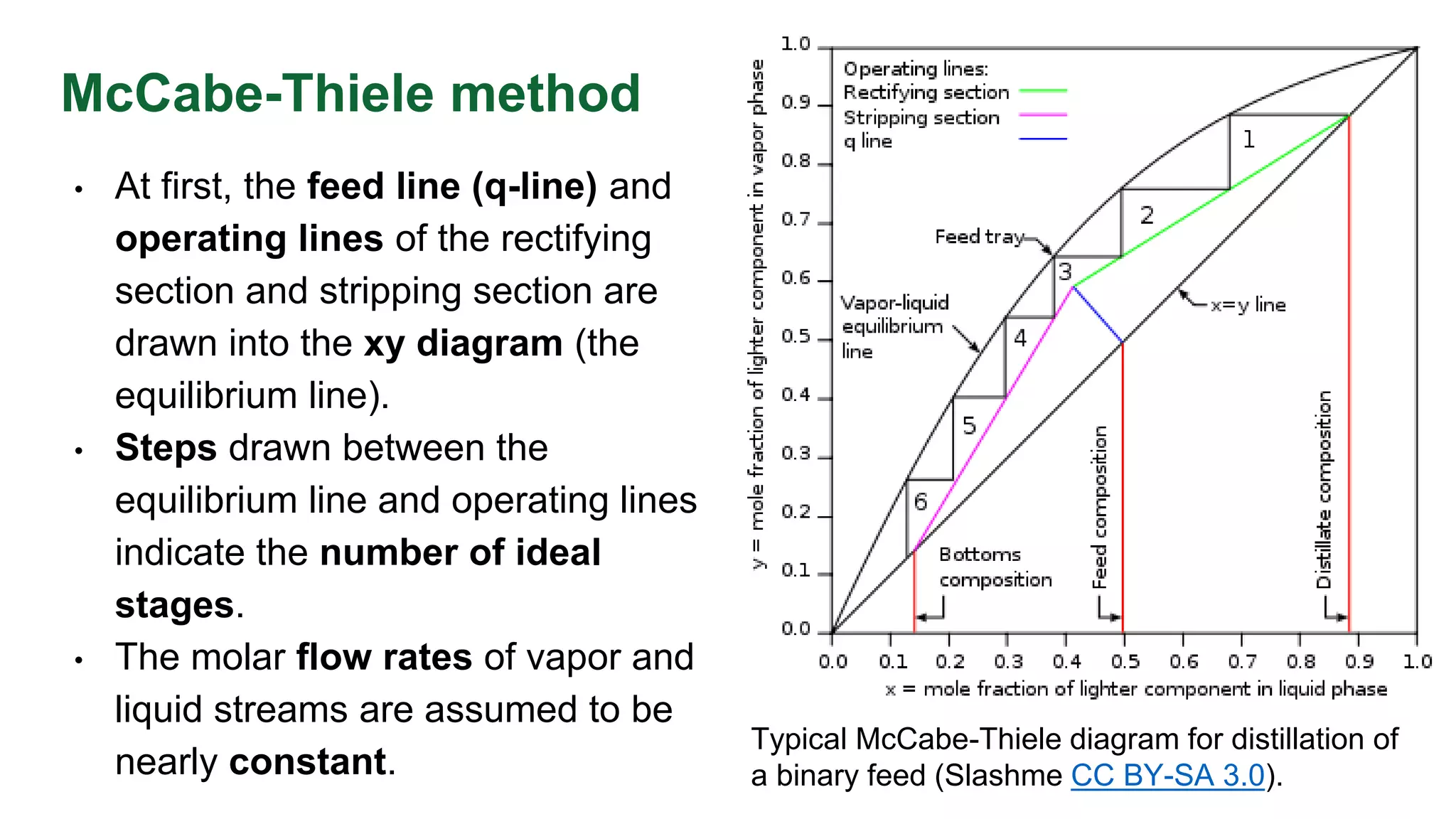
• At first, the feed line (q-line) and
operating lines of the rectifying
section and stripping section are
drawn into the xy diagram (the
equilibrium line).
• Steps drawn between the
equilibrium line and operating lines
indicate the number of ideal
stages.
• The molar flow rates of vapor and
liquid streams are assumed to be
nearly constant.
Typical McCabe-Thiele diagram for distillation of
a binary feed (Slashme CC BY-SA 3.0).
Instructions
1. Get a VLE diagram (xy diagram).
2. Draw the x=y line.
3. Mark the values of xB, xF and xD
into the x=y line.
4. Determine and draw the upper
operating line (rectifying section).
5. Determine and draw the feed line.
6. Determine and draw the lower
operating line (stripping section).
7. Draw and count the steps.
8. Use plate efficiency to calculate
the number of required plates.
Typical McCabe-Thiele diagram for distillation of
a binary feed (Slashme CC BY-SA 3.0).
Feed enthalpy
• The feed enthalpy has a major effect on how the liquid and vapor rates change
at the feed tray of the column.
Sub-cooled liquid Saturated liquid Partially vaporized Saturated vapor Superheated vapor
Feed is below its
bubble point. 
Reduction in the
vapor rate
Feed is at its bubble
point.  The liquid
rate increases.
Vapor rate does not
change.
Feed is partially
vaporized.  Both
liquid and vapor
rates increase.
Feed is at its dew
point.  The vapor
rate increases.
Liquid rate does not
change.
Feed is above its
dew point.  Both
liquid and vapor
rates increase.
Feed line (q-line)
• For the equation of the feed line, we need the feed enthalpy condition
parameter q. It represents the fraction of liquid in the feed.
• The feed line is a vertical line if the feed is saturated liquid (q = 1).
• The feed line is a horizontal line if the feed is saturated vapor (q = 0).
• For other situations, the feed line is plotted by calculating convenient points.
• The operating lines intercept on the feed line.
Sub-cooled
liquid
Saturated
liquid
Partially
vaporized
Saturated
vapor
Superheated
vapor
HF < HL
q > 1
Slope > 1
HF = HL
q = 1
Vertical line
HV > HF > HL
0 < q < 1
Slope < 0
HF = HV
q = 0
Horizontal line
HF > HV
q < 0
0 < slope < 1
𝑦 = −
𝑞
1 − 𝑞
𝑥 +
𝑥𝐹
1 − 𝑞
𝑞 =
𝐻𝑉 − 𝐻𝐹
𝐻𝑉 − 𝐻𝐿
HF = molar enthalpy of feed HL = molar enthalpy of liquid HV = molar enthalpy of vapor
Upper operating line
Operating line for the rectifying section:
𝑦𝑛+1 =
𝐿𝑛
𝑉𝑛+1
𝑥𝑛 +
𝐷𝑥𝐷
𝑉𝑛+1
• If we assume equimolal flow, we can substitute
𝐿𝑛 = 𝐿𝑅 and 𝑉𝑛+1 = 𝑉𝑅
𝑦𝑛+1 =
𝐿𝑅
𝑉𝑅
𝑥𝑛 +
𝐷𝑥𝐷
𝑉𝑅
• It is convenient to express the operating line in
terms of reflux ratio 𝑅𝐷 =
𝐿𝑅
𝐷
𝑦𝑛+1 =
𝑅𝐷
𝑅𝐷 + 1
𝑥𝑛 +
𝑥𝐷
𝑅𝐷 + 1
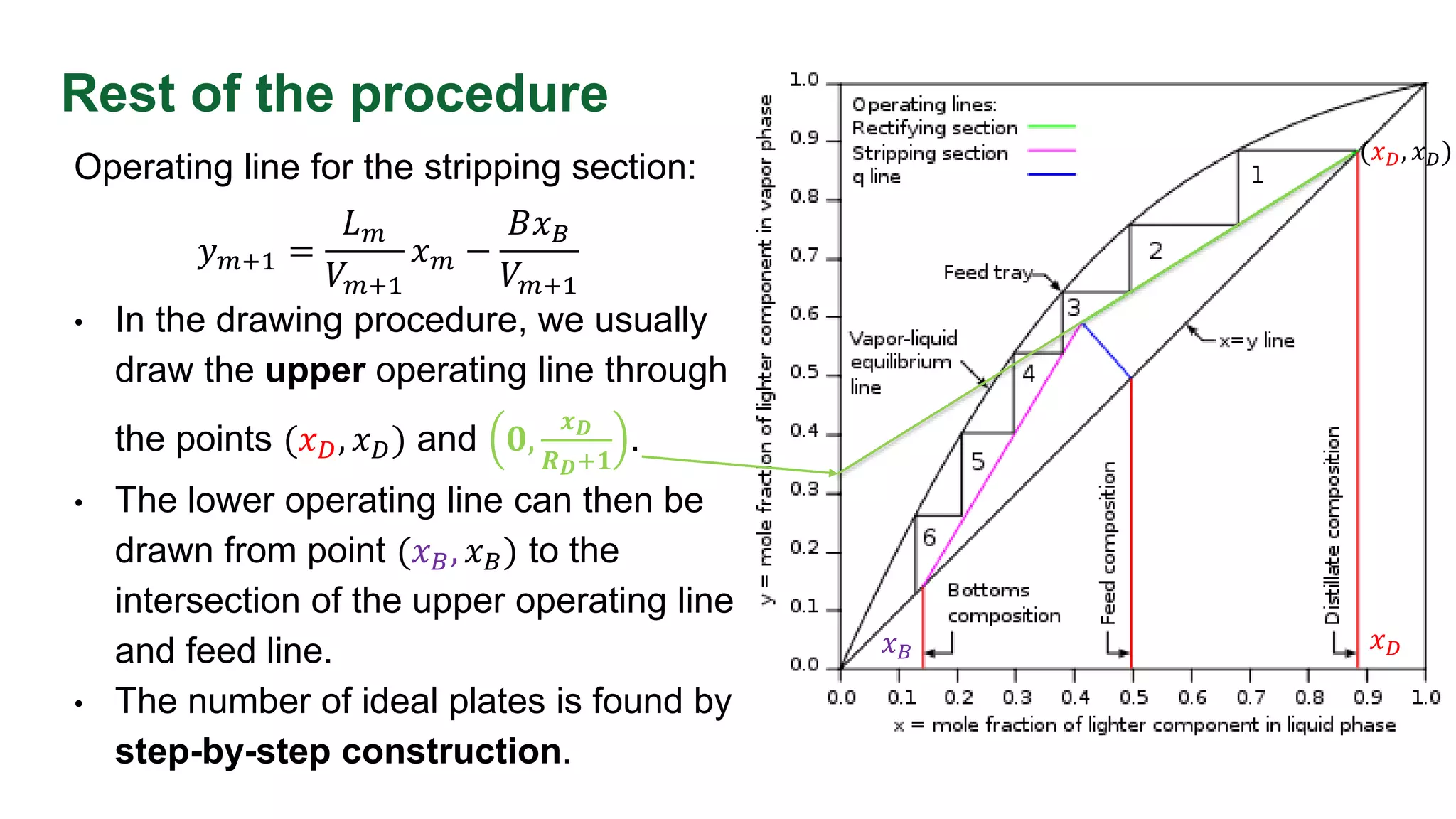
Rest of the procedure
Operating line for the stripping section:
𝑦𝑚+1 =
𝐿𝑚
𝑉𝑚+1
𝑥𝑚 −
𝐵𝑥𝐵
𝑉𝑚+1
• In the drawing procedure, we usually
draw the upper operating line through
the points (𝑥𝐷, 𝑥𝐷) and 𝟎,
𝒙𝑫
𝑹𝑫+𝟏
.
• The lower operating line can then be
drawn from point (𝑥𝐵, 𝑥𝐵) to the
intersection of the upper operating line
and feed line.
• The number of ideal plates is found by
step-by-step construction.
𝑥𝐷
𝑥𝐵
(𝑥𝐷, 𝑥𝐷)
Reboiler and condenser
• Most columns have partial reboilers.
• Vapor leaving the reboiler is in equilibrium
with the bottom liquid product.
• So, the partial reboiler is an equilibrium stage
and the column requires one ideal tray less.
• Most columns have a total condenser. It
means that the entire vapor leaving the
column is condensed and then separated
into distillate product and reflux.
• If a partial condenser is used instead, the
column requires one ideal tray less.
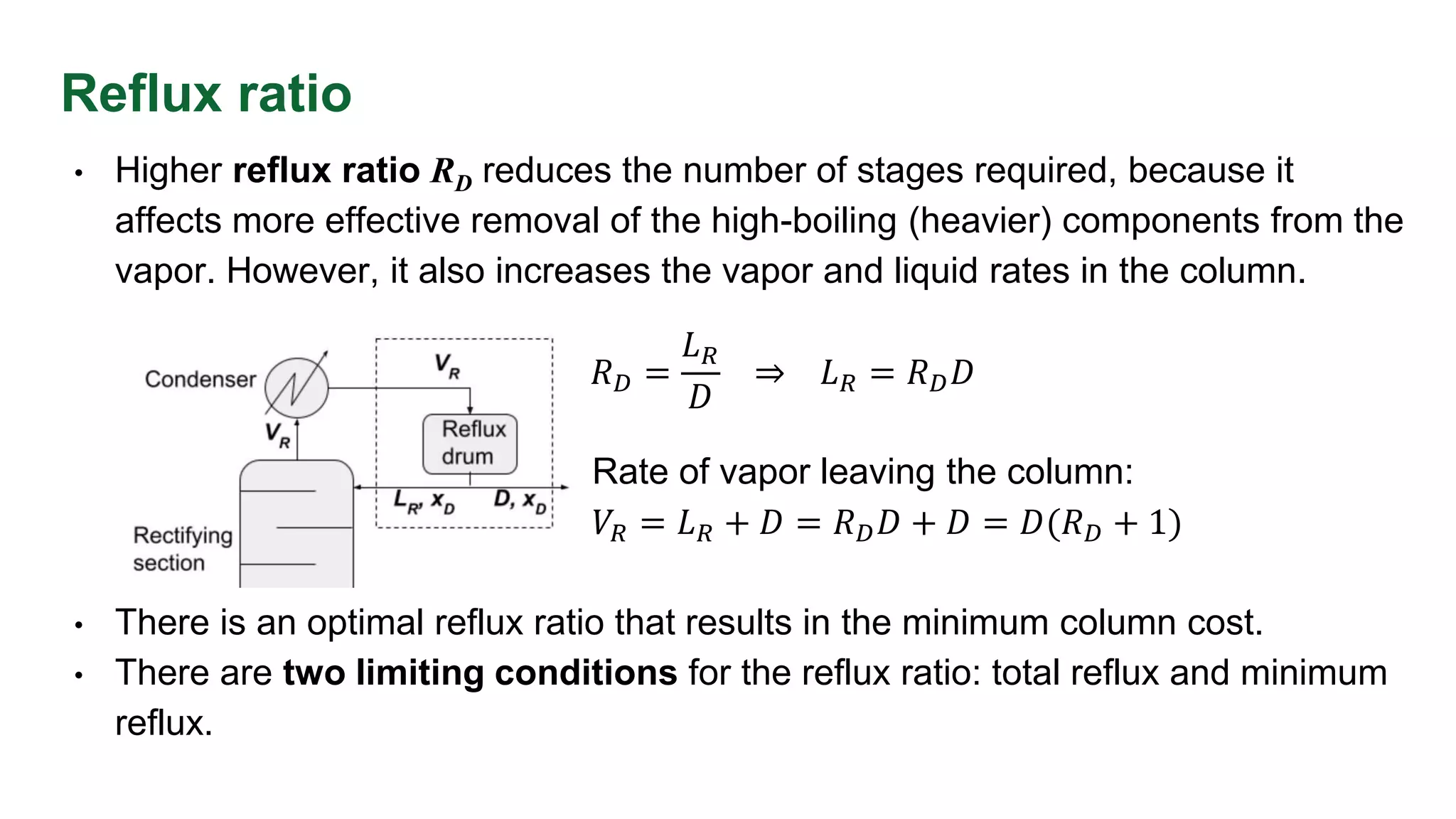
Reflux ratio
• Higher reflux ratio RD reduces the number of stages required, because it
affects more effective removal of the high-boiling (heavier) components from the
vapor. However, it also increases the vapor and liquid rates in the column.
•
Rate of vapor leaving the column:
• 𝑉𝑅 = 𝐿𝑅 + 𝐷 = 𝑅𝐷𝐷 + 𝐷 = 𝐷(𝑅𝐷 + 1)
• There is an optimal reflux ratio that results in the minimum column cost.
• There are two limiting conditions for the reflux ratio: total reflux and minimum
reflux.
𝑅𝐷 =
𝐿𝑅
𝐷
⇒ 𝐿𝑅 = 𝑅𝐷𝐷
Total reflux and minimum reflux ratio
• Total reflux means that all the vapor leaving the column is condensed and
returned to the column. The rates of distillate and bottom product would be
zero so the column cannot be designed for this condition.
• However, it gives the minimum number of stages required.
• When the reflux ratio becomes
smaller, the number of stages
increases. At the minimum reflux
ratio RDmin, the number of stages
becomes infinite.
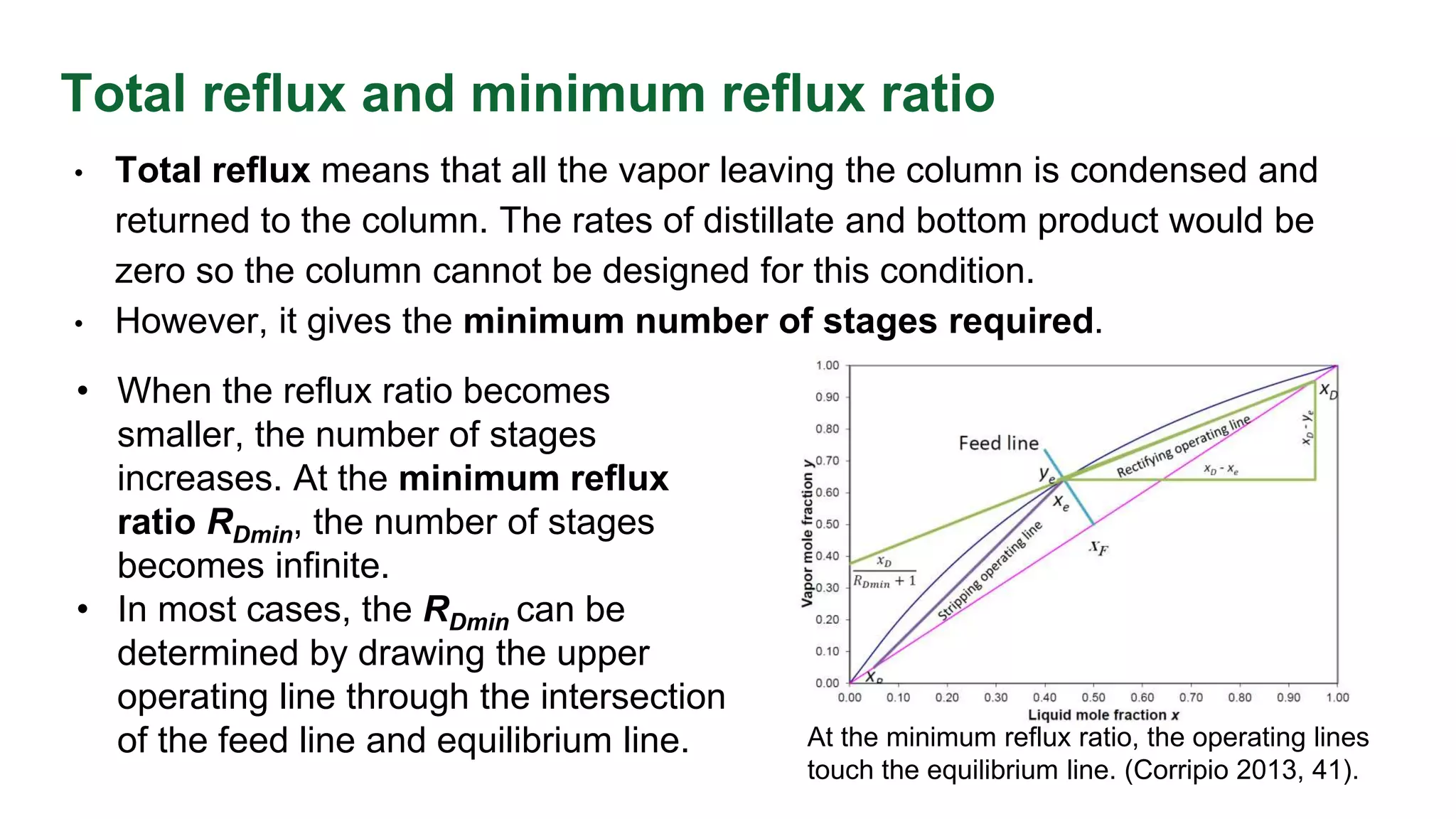
• In most cases, the RDmin can be
determined by drawing the upper
operating line through the intersection
of the feed line and equilibrium line. At the minimum reflux ratio, the operating lines
touch the equilibrium line. (Corripio 2013, 41).
Minimum reflux ratio and optimum reflux ratio
• The y intercept of the upper
operating line is
𝑥𝐷
𝑅𝐷𝑚𝑖𝑛+1
and the
slope is
𝑅𝐷𝑚𝑖𝑛
𝑅𝐷𝑚𝑖𝑛+1
=
𝑥𝐷−𝑦𝑒
𝑥𝐷−𝑥𝑒
.
• Solve 𝑅𝐷𝑚𝑖𝑛 =
𝑥𝐷−𝑦𝑒
𝑦𝑒−𝑥𝑒
• The optimum reflux ratio is a
value between the total reflux
and minimum reflux ratio. This
is the point of most economical
operation.
• Watch the videos with examples
about McCabe-Thiele method.
The minimum reflux ratio can be determined from the
upper operating line intersecting the intercept of the
feed line and equilibrium line (Corripio 2013, 41).
This project has received funding from the European Union’s Horizon 2020
research and innovation programme under grant agreement No 869993.
References
Corripio, A. B. 2013. Binary Distillation Design. pp. 16-44.
Dutta, B. K. 2007. Principles of mass transfer and separation processes. New Delhi: Prentice-Hall,
pp. 359-379.
McCabe, W. L., Smith, J. C. & Harriott,, P. 2005. Unit Operations of Chemical Engineering. 7 th
Edition. New York: McGraw-Hill, pp. 670-693.
Videos:
• Deriving McCabe-Thiele method: https://youtu.be/9gZeftUNejk (13:50)
• An exam task about McCabe Thiele method: https://youtu.be/7f9LIk9qt48 (10:57)
• An exercise with McCabe-Thiele’s method: https://youtu.be/5NA9qd_OJ1k (16:16)
• A detailed example: https://youtu.be/rnTL-wMhsWk (9:14)

2.2 McCabe-Thiele method

  • 1.
    This project hasreceived funding from the European Union’s Horizon 2020 research and innovation programme under grant agreement No 869993. Number of ideal plates: McCabe-Thiele method
  • 2.
    McCabe-Thiele method • Thenumber of plates required for a distillation column can be solved with simulation programs. • The McCabe-Thiele method is a graphical method providing insight into the effect of various design specifications on the size of the column. • The method has been developed by two chemical engineering graduate students, W. L. McCabe and E. W. Thiele, in 1925. McCabe-Thiele Method demonstration for water- methanol separation by WolframAlpha program. (Hendren, N. & Baumann R. 2016. CC BY-NC-SA)
  • 3.
    McCabe-Thiele method • Atfirst, the feed line (q-line) and operating lines of the rectifying section and stripping section are drawn into the xy diagram (the equilibrium line). • Steps drawn between the equilibrium line and operating lines indicate the number of ideal stages. • The molar flow rates of vapor and liquid streams are assumed to be nearly constant. Typical McCabe-Thiele diagram for distillation of a binary feed (Slashme CC BY-SA 3.0).
  • 4.
    Instructions 1. Get aVLE diagram (xy diagram). 2. Draw the x=y line. 3. Mark the values of xB, xF and xD into the x=y line. 4. Determine and draw the upper operating line (rectifying section). 5. Determine and draw the feed line. 6. Determine and draw the lower operating line (stripping section). 7. Draw and count the steps. 8. Use plate efficiency to calculate the number of required plates. Typical McCabe-Thiele diagram for distillation of a binary feed (Slashme CC BY-SA 3.0).
  • 5.
    Feed enthalpy • Thefeed enthalpy has a major effect on how the liquid and vapor rates change at the feed tray of the column. Sub-cooled liquid Saturated liquid Partially vaporized Saturated vapor Superheated vapor Feed is below its bubble point.  Reduction in the vapor rate Feed is at its bubble point.  The liquid rate increases. Vapor rate does not change. Feed is partially vaporized.  Both liquid and vapor rates increase. Feed is at its dew point.  The vapor rate increases. Liquid rate does not change. Feed is above its dew point.  Both liquid and vapor rates increase.
  • 6.
    Feed line (q-line) •For the equation of the feed line, we need the feed enthalpy condition parameter q. It represents the fraction of liquid in the feed. • The feed line is a vertical line if the feed is saturated liquid (q = 1). • The feed line is a horizontal line if the feed is saturated vapor (q = 0). • For other situations, the feed line is plotted by calculating convenient points. • The operating lines intercept on the feed line. Sub-cooled liquid Saturated liquid Partially vaporized Saturated vapor Superheated vapor HF < HL q > 1 Slope > 1 HF = HL q = 1 Vertical line HV > HF > HL 0 < q < 1 Slope < 0 HF = HV q = 0 Horizontal line HF > HV q < 0 0 < slope < 1 𝑦 = − 𝑞 1 − 𝑞 𝑥 + 𝑥𝐹 1 − 𝑞 𝑞 = 𝐻𝑉 − 𝐻𝐹 𝐻𝑉 − 𝐻𝐿 HF = molar enthalpy of feed HL = molar enthalpy of liquid HV = molar enthalpy of vapor
  • 7.
    Upper operating line Operatingline for the rectifying section: 𝑦𝑛+1 = 𝐿𝑛 𝑉𝑛+1 𝑥𝑛 + 𝐷𝑥𝐷 𝑉𝑛+1 • If we assume equimolal flow, we can substitute 𝐿𝑛 = 𝐿𝑅 and 𝑉𝑛+1 = 𝑉𝑅 𝑦𝑛+1 = 𝐿𝑅 𝑉𝑅 𝑥𝑛 + 𝐷𝑥𝐷 𝑉𝑅 • It is convenient to express the operating line in terms of reflux ratio 𝑅𝐷 = 𝐿𝑅 𝐷 𝑦𝑛+1 = 𝑅𝐷 𝑅𝐷 + 1 𝑥𝑛 + 𝑥𝐷 𝑅𝐷 + 1
  • 8.
    Rest of theprocedure Operating line for the stripping section: 𝑦𝑚+1 = 𝐿𝑚 𝑉𝑚+1 𝑥𝑚 − 𝐵𝑥𝐵 𝑉𝑚+1 • In the drawing procedure, we usually draw the upper operating line through the points (𝑥𝐷, 𝑥𝐷) and 𝟎, 𝒙𝑫 𝑹𝑫+𝟏 . • The lower operating line can then be drawn from point (𝑥𝐵, 𝑥𝐵) to the intersection of the upper operating line and feed line. • The number of ideal plates is found by step-by-step construction. 𝑥𝐷 𝑥𝐵 (𝑥𝐷, 𝑥𝐷)
  • 9.
    Reboiler and condenser •Most columns have partial reboilers. • Vapor leaving the reboiler is in equilibrium with the bottom liquid product. • So, the partial reboiler is an equilibrium stage and the column requires one ideal tray less. • Most columns have a total condenser. It means that the entire vapor leaving the column is condensed and then separated into distillate product and reflux. • If a partial condenser is used instead, the column requires one ideal tray less.
  • 10.
    Reflux ratio • Higherreflux ratio RD reduces the number of stages required, because it affects more effective removal of the high-boiling (heavier) components from the vapor. However, it also increases the vapor and liquid rates in the column. • Rate of vapor leaving the column: • 𝑉𝑅 = 𝐿𝑅 + 𝐷 = 𝑅𝐷𝐷 + 𝐷 = 𝐷(𝑅𝐷 + 1) • There is an optimal reflux ratio that results in the minimum column cost. • There are two limiting conditions for the reflux ratio: total reflux and minimum reflux. 𝑅𝐷 = 𝐿𝑅 𝐷 ⇒ 𝐿𝑅 = 𝑅𝐷𝐷
  • 11.
    Total reflux andminimum reflux ratio • Total reflux means that all the vapor leaving the column is condensed and returned to the column. The rates of distillate and bottom product would be zero so the column cannot be designed for this condition. • However, it gives the minimum number of stages required. • When the reflux ratio becomes smaller, the number of stages increases. At the minimum reflux ratio RDmin, the number of stages becomes infinite. • In most cases, the RDmin can be determined by drawing the upper operating line through the intersection of the feed line and equilibrium line. At the minimum reflux ratio, the operating lines touch the equilibrium line. (Corripio 2013, 41).
  • 12.
    Minimum reflux ratioand optimum reflux ratio • The y intercept of the upper operating line is 𝑥𝐷 𝑅𝐷𝑚𝑖𝑛+1 and the slope is 𝑅𝐷𝑚𝑖𝑛 𝑅𝐷𝑚𝑖𝑛+1 = 𝑥𝐷−𝑦𝑒 𝑥𝐷−𝑥𝑒 . • Solve 𝑅𝐷𝑚𝑖𝑛 = 𝑥𝐷−𝑦𝑒 𝑦𝑒−𝑥𝑒 • The optimum reflux ratio is a value between the total reflux and minimum reflux ratio. This is the point of most economical operation. • Watch the videos with examples about McCabe-Thiele method. The minimum reflux ratio can be determined from the upper operating line intersecting the intercept of the feed line and equilibrium line (Corripio 2013, 41).
  • 13.
    This project hasreceived funding from the European Union’s Horizon 2020 research and innovation programme under grant agreement No 869993. References Corripio, A. B. 2013. Binary Distillation Design. pp. 16-44. Dutta, B. K. 2007. Principles of mass transfer and separation processes. New Delhi: Prentice-Hall, pp. 359-379. McCabe, W. L., Smith, J. C. & Harriott,, P. 2005. Unit Operations of Chemical Engineering. 7 th Edition. New York: McGraw-Hill, pp. 670-693. Videos: • Deriving McCabe-Thiele method: https://youtu.be/9gZeftUNejk (13:50) • An exam task about McCabe Thiele method: https://youtu.be/7f9LIk9qt48 (10:57) • An exercise with McCabe-Thiele’s method: https://youtu.be/5NA9qd_OJ1k (16:16) • A detailed example: https://youtu.be/rnTL-wMhsWk (9:14)