This project has received funding from the European Union’s Horizon 2020
research and innovation programme under grant agreement No 869993.
Instructions
for the
Mass transfer
section
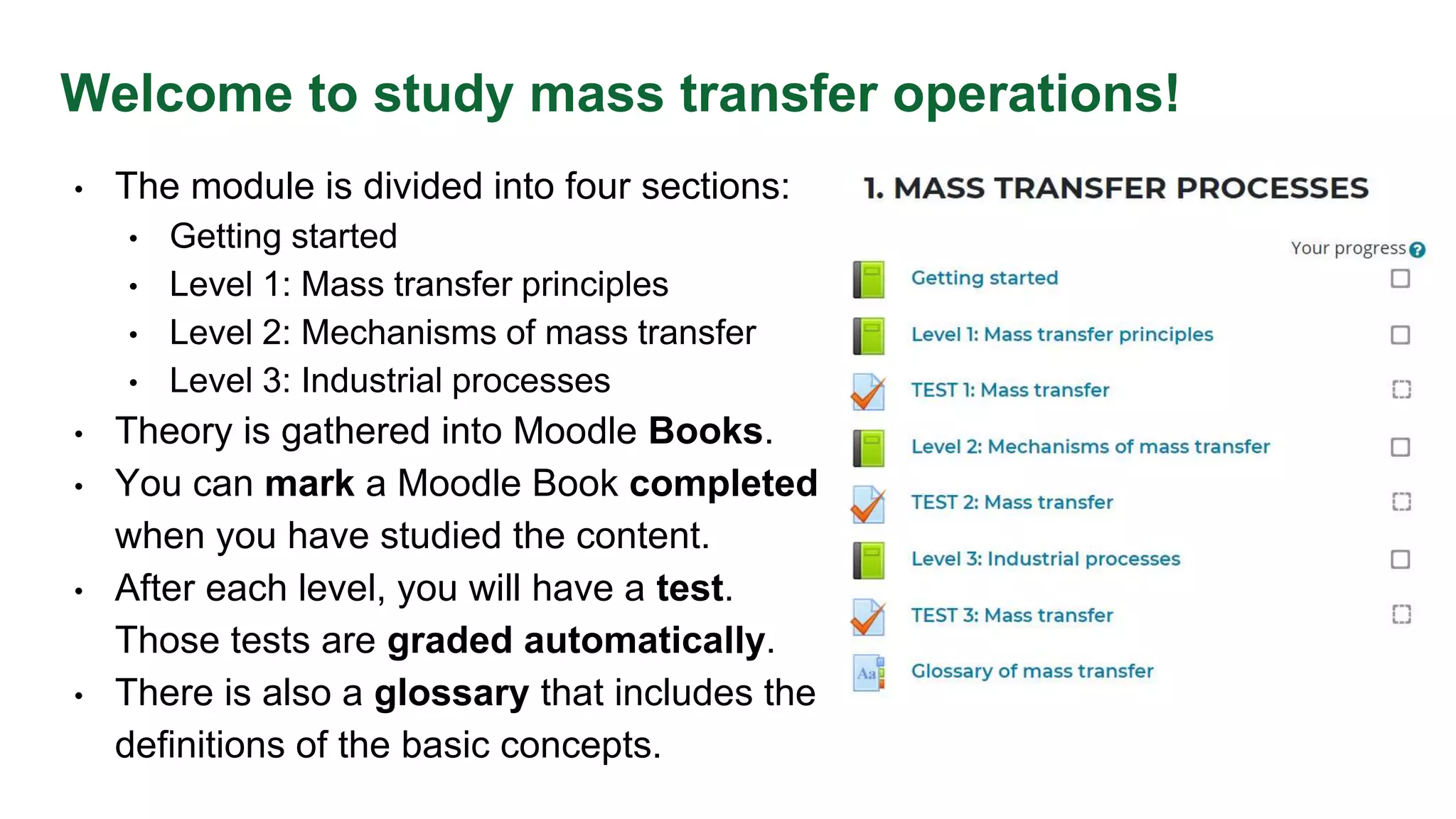
Welcome to study mass transfer operations!
• The module is divided into four sections:
• Getting started
• Level 1: Mass transfer principles
• Level 2: Mechanisms of mass transfer
• Level 3: Industrial processes
• Theory is gathered into Moodle Books.
• You can mark a Moodle Book completed
when you have studied the content.
• After each level, you will have a test.
Those tests are graded automatically.
• There is also a glossary that includes the
definitions of the basic concepts.
Moodle Books
• Each Moodle Book has their own table
of contents. You can use it to navigate
or you may use the navigation bars
above and below the content.
• Each chapter has the same structure:
• Learning objectives
• Study the basics
• Watch the video
• Practice
• Bonus material
• Exercises will help you to deepen your
learning and get prepared for the test.
This project has received funding from the European Union’s Horizon 2020
research and innovation programme under grant agreement No 869993.
Tips for studying
• It is recommended to proceed in order, from
Getting started to levels 1-3. You can follow your
studies by marking studied sections completed.
• In the Getting started section, we shortly run
through the grounding needed in the next levels.
• The keywords are highlighted in the Learning
objectives. By clicking the word, you can see the
definition of it.
• You can use the full screen mode in slideshows,
videos and exercises for better viewing.
• You may deepen your learning by the bonus
material added at the end of each chapter.
Monitoring your progress
• After each level, you will have a test.
• The tests are graded automatically on scale 0-100.
You need to get 50 or more to pass the test.
• You may try the test several times.
• From the Completion progress block on the front
page, you can follow your progress in the tests.
• When you have passed all three tests of one
module, you will earn a badge of that module.
• You can collect points by studying the content in
Moodle books and by passing the tests and this way
increase your Level of expertise.
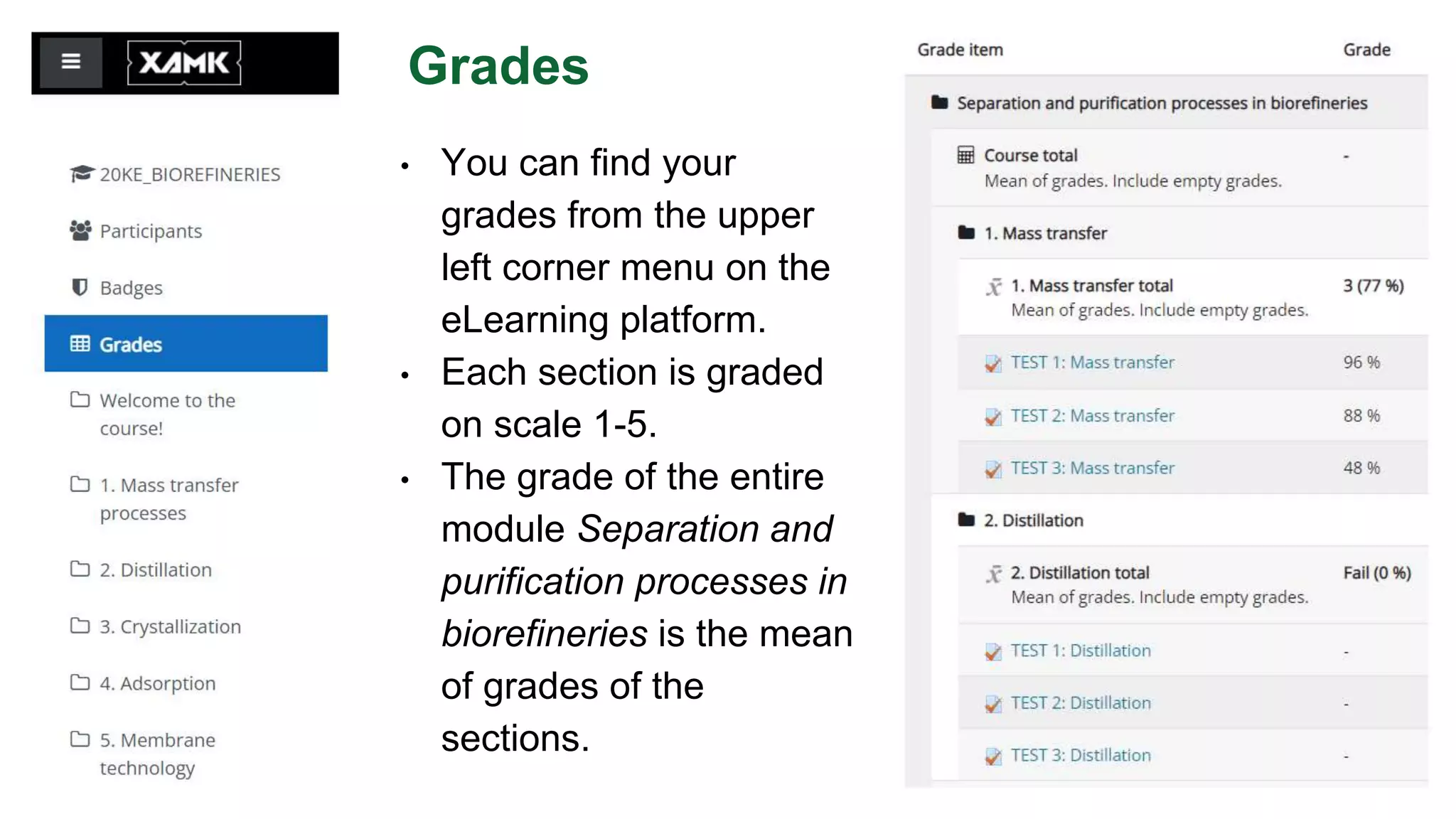
Grades
• You can find your
grades from the upper
left corner menu on the
eLearning platform.
• Each section is graded
on scale 1-5.
• The grade of the entire
module Separation and
purification processes in
biorefineries is the mean
of grades of the
sections.
This project has received funding from the European Union’s Horizon 2020
research and innovation programme under grant agreement No 869993.
Enjoy your journey into
the world of mass transfer!
This material is produced as a part of
IMPRESS project (Integration of efficient
downstreaM PRocessEs for Sugars and
Sugar Alcohols).
The project has received funding from
the European Union’s Horizon 2020
research and innovation programme
under grant agreement No 869993.
Learn more about the IMPRESS project:
https://www.spire2030.eu/impress

0.1 Instructions

  • 1.
    This project hasreceived funding from the European Union’s Horizon 2020 research and innovation programme under grant agreement No 869993. Instructions for the Mass transfer section
  • 2.
    Welcome to studymass transfer operations! • The module is divided into four sections: • Getting started • Level 1: Mass transfer principles • Level 2: Mechanisms of mass transfer • Level 3: Industrial processes • Theory is gathered into Moodle Books. • You can mark a Moodle Book completed when you have studied the content. • After each level, you will have a test. Those tests are graded automatically. • There is also a glossary that includes the definitions of the basic concepts.
  • 3.
    Moodle Books • EachMoodle Book has their own table of contents. You can use it to navigate or you may use the navigation bars above and below the content. • Each chapter has the same structure: • Learning objectives • Study the basics • Watch the video • Practice • Bonus material • Exercises will help you to deepen your learning and get prepared for the test.
  • 4.
    This project hasreceived funding from the European Union’s Horizon 2020 research and innovation programme under grant agreement No 869993. Tips for studying • It is recommended to proceed in order, from Getting started to levels 1-3. You can follow your studies by marking studied sections completed. • In the Getting started section, we shortly run through the grounding needed in the next levels. • The keywords are highlighted in the Learning objectives. By clicking the word, you can see the definition of it. • You can use the full screen mode in slideshows, videos and exercises for better viewing. • You may deepen your learning by the bonus material added at the end of each chapter.
  • 5.
    Monitoring your progress •After each level, you will have a test. • The tests are graded automatically on scale 0-100. You need to get 50 or more to pass the test. • You may try the test several times. • From the Completion progress block on the front page, you can follow your progress in the tests. • When you have passed all three tests of one module, you will earn a badge of that module. • You can collect points by studying the content in Moodle books and by passing the tests and this way increase your Level of expertise.
  • 6.
    Grades • You canfind your grades from the upper left corner menu on the eLearning platform. • Each section is graded on scale 1-5. • The grade of the entire module Separation and purification processes in biorefineries is the mean of grades of the sections.
  • 7.
    This project hasreceived funding from the European Union’s Horizon 2020 research and innovation programme under grant agreement No 869993. Enjoy your journey into the world of mass transfer! This material is produced as a part of IMPRESS project (Integration of efficient downstreaM PRocessEs for Sugars and Sugar Alcohols). The project has received funding from the European Union’s Horizon 2020 research and innovation programme under grant agreement No 869993. Learn more about the IMPRESS project: https://www.spire2030.eu/impress