Electricity
AS level Physics
Contents:
• Static electricity
• Electric fields
• Electric charges
• Electric current
• Potential Difference
• Resistance
• Kirchhoff's Laws & Combination of
resistances
• Resistance and resistivity
Static electricity
• You walk across the rug, reach for the
doorknob and..........ZAP!!!
• ?????????
• Everything in the world consists of tiny
particles called "atoms." Atoms contain
even tinier particles called "protons,"
"neutrons" and "electrons."
Static electricity
• Sometimes, however, the outer layer of
an atom gets rubbed off. This creates
atoms with a slightly more positive charge.
• The item which rubs off the outer layer of
the atom steals" some of the extra
electrons, making it slightly negative.
Static electricity
• As you walk over carpet in socks, your feet
rub electrons off the carpet, leaving you
with a slightly negative static charge.
When you reach for a doorknob, you get
a shock as electrons jump from you to the
knob, which conducts electricity.
Different methods for charging
an object
• Charging by conduction
• Charging by induction
• Charging by friction
Electric field
• It is the region around a charged particle
or object within which a force would be
exerted on a test charge.
• Every charged object will experience the
effect electric field.
Electric field
texthttp://www.learnerstv.com/animation/animation.php?ani=86&cat=physics
Electric charge
• Charge is the fundamental quantity of
electricity. (Electricity is all about charge.)
• No one can tell you what charge is. They
can only tell you how charges interact.
Electric charges
• Electric charge (often just called charge) comes
in two and only two types.
• positive (+) and
• negative (−)
• The term neutral does not refer to a third type of
charge, but to the presence in a region of
positive and negative charges in equal amount.
• The sum of identical positive and negative
quantities is zero (0). This is what it means to be
electrically neutral.
Charges
• Elementary Charge
• 1.60 × 10⁻¹⁹ coulombs
• the magnitude of the charge on an
electron or proton
• Charge is quantized in multiples of the
elementary charge
Electric current
• Electric current is defined as the rate at
which charge flows through a surface (the
cross section of a wire, for example).
• It is a scalar quantity.
• The direction of electric current is always
taken as from positive to negative.
• Current is the flow of charged particles.
Potential differences
• Potential difference between two points in
a circuit is the work done in moving unit
charge (i.e. one coulomb) from one point
to the other
• Unit of potential difference is volt.
Resistance and Resistivity
• What is resistance
• I-V characteristics & Ohm’s Law
• Superconductivity
• Resistance and temperature
• Resistivity
Resistance
• Resistance is the measure of opposition to
electric current.
• This resistance serves to limit the amount
of current through the circuit with a given
amount of voltage supplied by the battery,
as compared with the “short circuit” where
we had nothing but a wire joining one end
of the voltage source (battery) to the other.
More about resistances
• For an electron, the journey from terminal to
terminal is not a direct route. Rather, it is a
zigzag path that results from countless
collisions with fixed atoms within the
conducting material. The electrons encounter
resistance - a hindrance to their movement.
While the electric potential difference
established between the two
terminals encourages the movement of
charge, it is resistance that discourages their
movement.
I-V Characteristics
• When the potential difference across(p.d)
the conductor is varies, the current
through the conductor will also vary.
• These two quantities are found to be
linearly related to a metallic conductor.
• A graph plotted between these two
quantities is called the I-V characteristics.
Ohm’s law
• For a metallic conductor at normal
temperatures, the current flowing through
the conductor is directly proportional to the
potential difference across the terminals.
• This relationship is given as OHM’S LAW.
• V = I R
• Where V is the p.d and I is the current.
• R the constant of proportionality is the
resistance of the conductor.
More on I- V characteristics
• I-V characteristic curves are generally
used as a tool to determine and
understand the basic parameters of a
component or device and which can also
be used to mathematically model its
behaviour within an electrical circuit.
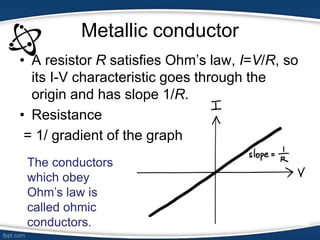
Metallic conductor
• A resistor R satisfies Ohm’s law, I=V/R, so
its I-V characteristic goes through the
origin and has slope 1/R.
• Resistance
= 1/ gradient of the graph
The conductors
which obey
Ohm’s law is
called ohmic
conductors.
Resistance and temperature.
• A conductor which disobeys Ohm’s law is
said to be a non- ohmic conductor.
• Metal filament of a lamp is an example for
that.
• The filament has a very high resistance
and so when current flows through the
circuit the filament heats up and start to
glow.
I-V characteristic for a non-
ohmic resistor
Similar to the case of an ohmic
resistor, the line passes through the
origin
When the current and voltages are
small, the graph is roughly a straight
line.
When the voltages are high it start to
curve showing the resistance value
high.
Graph in detail
Temperature dependence of the
resistance
• When the voltage is more the resistance is
more in case of a filament lamp.
• It can be interpreted as the resistance
variation for the filament is due to the
increase in temperature.
Thermistors
• The name thermistor is a shortening of the
words thermally sensitive resistor.
• Thermistors are the temperature
dependant resistors.
• Their resistance value changes rapidly
with the temperature.
• They are mainly the oxides of manganese
and nickel.
Thermistor circuit symbol
This thermistor circuit symbol is
widely used within circuit diagrams.
Types of thermistors
• Negative temperature coefficient (NTC
thermistor) This type of thermistor has the
property where the resistance decreases with
increasing temperature.
• Positive temperature coefficient (PTC
thermistor) This type has the property where
the resistance increases with increasing
temperature.
Uses Of Thermistors
• Thermistors can be used in a wide variety of
applications. They provide a simple, reliable and
inexpensive method of sensing temperatures. As
such they may be found in a wide variety of
devices from fire alarms to thermostats.
Use of a negative temperature
coefficient thermistor in industry.
• Another thermistor application is as temperature
compensation devices. Most resistors have a
positive temperature co-efficient, their resistance
increasing with increasing temperature. In
applications where stability is required, a
thermistor with a negative temperature co-
efficient can be incorporated.
Diodes
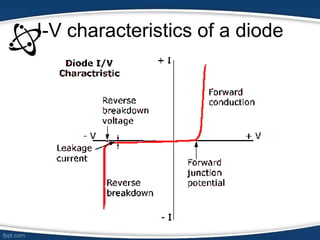
• Semi conductor diode is another non-
ohmic resistor.
• A semi conductor diode allows current flow
only when it is forward biased.
I-V characteristics of a diode
Diodes
• Forward junction potential (threshold
potential) is the voltage applied to a
forward biased junction so that the diode
start conducting (resistance decreases).
• It has a value 0.7 V for silicon diodes and
0.3 V for germanium diodes.
• Breakdown voltage is the reverse voltage
which a diode cannot withstand and it start
conducting beyond that.
Resistance of a pure and an
impure metal.
• Resistance also depends on the material of the
conductor.
If you pass electricity through a wire made of a
pure metal it will have less resistance than a
wire which is made up out of a metal alloy. This
is because the atoms in a pure metal are all
equal in size and the gaps between the atoms
are also equal and so a current can pass easily
through the gaps, whereas in an metal alloy the
atoms are of different sizes and so the atoms
are at unequal intervals making it
more difficult for a current to pass through the
Metals and alloys
Pure metal has an orderly arrangement while
alloys or impure metals have a disorderly
arrangement because of the different sized atoms.
Resistivity
• If the dimensions of a conductor(length
and area of cross section of a conductor)
do not change, it’s resistance will not
change.
• If two conductors of exactly the same
dimensions have a different resistance,
indicates that resistance depends on one
more factor other than length and area of
cross section.
What is resisitivity
• Electrical resistivity (also known
as resistivity, specific electrical
resistance, or volumeresistivity) is an
intrinsic property that quantifies how
strongly a given material opposes the flow
of electric current.
• S. I unit is Ω -m
Resistance of a conductor
depends on
• Length l
• Cross-sectional area A
• The material the wire is made from
• The temperature of the wire
It can be written as ….
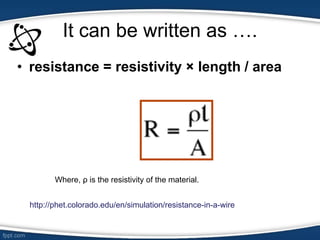
• resistance = resistivity × length / area
Where, ρ is the resistivity of the material.
http://phet.colorado.edu/en/simulation/resistance-in-a-wire
Graphical representation of resistivity of different materials
Graphics to illustrate how
resistance varies with l, A and rho.
Resistivity of some materials
• CONDUCTORS
• Aluminium 2.7 x 10⁻⁸
• Copper 1.7 x 10⁻⁸
• Iron 10.5 x 10⁻⁸
• Mercury 96 x 10-8
• voltage cables.)
INSULATORS
•P.V.C. 5.4 x 10¹⁵
•Glass 1014
•Quartz 1012
•P.T.F.E 1012
(P.T.F.E.= polytetrafluoroethylene used to insulate high voltage
cables.)
Resistivity and temperature
• For metals, resistivity increases as
temperature increases.
• For semiconductors and many insulators,
resistivity decreases with temperature.
With increase in temperature for a metal the collision frequency increases
which results in increase in resistance.
CIRCUITS
• The invention of the battery -- which could
produce a continuous flow of current --
made possible the development of the first
electric circuits. Alessandro Volta invented
the first battery, the voltaic pile, in 1800.
The very first circuits used a battery and
electrodes immersed in a container
of water. The flow of current through the
water produced hydrogen and oxygen.
Voltaic pile
• Constructed of alternating discs of zinc
and copper, with pieces of cardboard
soaked in brine between the metals, the
voltaic pile produced electrical current.
The metallic conducting arc was used to
carry the electricity over a greater
distance. Alessandro Volta's voltaic pile
was the first battery that produced a
reliable, steady current of electricity.
Voltaic pile
EMF – electromotive force
• The electromotive force (e) or e.m.f. is
the energy provided by a cell or battery
per coulomb of charge passing through it,
it is measured in volts (V). It is equal to
the potential difference across the
terminals of the cell when no current is
flowing.
Internal resistance
• When electricity flows round a circuit the
internal resistance of the cell itself resists
the flow of current and so thermal
(heat) energy is wasted in the cell itself.
Internal resistance
• e = electromotive force in volts, V
• I = current in amperes, A
• R = resistance of the load in the circuit in
ohms, W
• r = internal resistance of the cell in
ohms, W
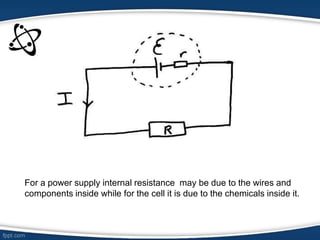
For a power supply internal resistance may be due to the wires and
components inside while for the cell it is due to the chemicals inside it.
If we plot a graph of terminal potential difference (V) against the current in
the circuit (I) we get a straight line with a negative gradient.
A graph of terminal p.d. against current
Internal resistance and emf from
the plot.
• We can them rearrange the e.m.f.
equation from above to match the general
experession for a straight line, y = mx +c.
• V= - Ir+ε
• The slope from the plot gives –r(the
internal resistance of the cell).
• The Y- intercept gives the e.m.f of he cell.
Due to internal resistance
• When the charges flows through external
resistance and internal resistance of the
power supply, some energy is lost as heat.
• The heating effect of cell when we use the
cell to supply power for an electrical
component is because some energy is
used by the charges to do work against
the internal resistance.
Effects of internal resistance
• A battery with low internal resistance
delivers high current on demand. High
resistance causes the battery to heat up
and the voltage to drop. The equipment
cuts off, leaving energy behind.
Low resistance, delivers high
current on demand; battery
stays cool.
High resistance, current is
restricted, voltage drops on
load; battery heats up.
Internal resistance of cell
• http://phet.colorado.edu/en/simulation/lega
cy/circuit-construction-kit-ac-virtual-lab
• Download circuit construction kit and make
a circuit containing a cell, a switch and
resistor .
• Connect an ammeter and voltmeter in the
circuit.
• Right click the cell and change it’s internal
resistance of the cell.
Internal resistance of the cell…
• With switch open measure the voltage
across the cell. It gives the emf of the cell.
• Close the circuit and measure the voltage
using the voltmeter. It gives the terminal
voltage of the cell.
• Vary the resistance value by right clicking
the resistance and repeat the experiment.
Potential dividers.
• A potential divider is a simple circuit that
uses resisters(or thermistors / LDR’s) to
supply a variable potential difference.
• They can be used as audio volume
controls, to control the temperature in a
freezer or monitor changes in light in a
room.
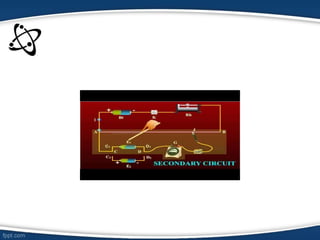
• Two resistors divide up the voltage supplied to
them from a cell. The p.d. that the two resistors
get depends on their resistance values.
• Vin = p.d. supplied by the cell
• Vout = p.d. across the resistor of interest
• R1 = resistance of resistor of interest R1
• R2= resistance of resistor R2
Electricity as level

Electricity as level

  • 1.
  • 2.
    Contents: • Static electricity •Electric fields • Electric charges • Electric current • Potential Difference • Resistance • Kirchhoff's Laws & Combination of resistances • Resistance and resistivity
  • 3.
    Static electricity • Youwalk across the rug, reach for the doorknob and..........ZAP!!! • ????????? • Everything in the world consists of tiny particles called "atoms." Atoms contain even tinier particles called "protons," "neutrons" and "electrons."
  • 4.
    Static electricity • Sometimes,however, the outer layer of an atom gets rubbed off. This creates atoms with a slightly more positive charge. • The item which rubs off the outer layer of the atom steals" some of the extra electrons, making it slightly negative.
  • 5.
    Static electricity • Asyou walk over carpet in socks, your feet rub electrons off the carpet, leaving you with a slightly negative static charge. When you reach for a doorknob, you get a shock as electrons jump from you to the knob, which conducts electricity.
  • 6.
    Different methods forcharging an object • Charging by conduction • Charging by induction • Charging by friction
  • 9.
    Electric field • Itis the region around a charged particle or object within which a force would be exerted on a test charge. • Every charged object will experience the effect electric field.
  • 10.
  • 11.
    Electric charge • Chargeis the fundamental quantity of electricity. (Electricity is all about charge.) • No one can tell you what charge is. They can only tell you how charges interact.
  • 12.
    Electric charges • Electriccharge (often just called charge) comes in two and only two types. • positive (+) and • negative (−) • The term neutral does not refer to a third type of charge, but to the presence in a region of positive and negative charges in equal amount. • The sum of identical positive and negative quantities is zero (0). This is what it means to be electrically neutral.
  • 13.
    Charges • Elementary Charge •1.60 × 10⁻¹⁹ coulombs • the magnitude of the charge on an electron or proton • Charge is quantized in multiples of the elementary charge
  • 14.
    Electric current • Electriccurrent is defined as the rate at which charge flows through a surface (the cross section of a wire, for example). • It is a scalar quantity. • The direction of electric current is always taken as from positive to negative. • Current is the flow of charged particles.
  • 16.
    Potential differences • Potentialdifference between two points in a circuit is the work done in moving unit charge (i.e. one coulomb) from one point to the other • Unit of potential difference is volt.
  • 17.
    Resistance and Resistivity •What is resistance • I-V characteristics & Ohm’s Law • Superconductivity • Resistance and temperature • Resistivity
  • 18.
    Resistance • Resistance isthe measure of opposition to electric current. • This resistance serves to limit the amount of current through the circuit with a given amount of voltage supplied by the battery, as compared with the “short circuit” where we had nothing but a wire joining one end of the voltage source (battery) to the other.
  • 19.
    More about resistances •For an electron, the journey from terminal to terminal is not a direct route. Rather, it is a zigzag path that results from countless collisions with fixed atoms within the conducting material. The electrons encounter resistance - a hindrance to their movement. While the electric potential difference established between the two terminals encourages the movement of charge, it is resistance that discourages their movement.
  • 20.
    I-V Characteristics • Whenthe potential difference across(p.d) the conductor is varies, the current through the conductor will also vary. • These two quantities are found to be linearly related to a metallic conductor. • A graph plotted between these two quantities is called the I-V characteristics.
  • 21.
    Ohm’s law • Fora metallic conductor at normal temperatures, the current flowing through the conductor is directly proportional to the potential difference across the terminals. • This relationship is given as OHM’S LAW. • V = I R • Where V is the p.d and I is the current. • R the constant of proportionality is the resistance of the conductor.
  • 22.
    More on I-V characteristics • I-V characteristic curves are generally used as a tool to determine and understand the basic parameters of a component or device and which can also be used to mathematically model its behaviour within an electrical circuit.
  • 23.
    Metallic conductor • Aresistor R satisfies Ohm’s law, I=V/R, so its I-V characteristic goes through the origin and has slope 1/R. • Resistance = 1/ gradient of the graph The conductors which obey Ohm’s law is called ohmic conductors.
  • 24.
    Resistance and temperature. •A conductor which disobeys Ohm’s law is said to be a non- ohmic conductor. • Metal filament of a lamp is an example for that. • The filament has a very high resistance and so when current flows through the circuit the filament heats up and start to glow.
  • 25.
    I-V characteristic fora non- ohmic resistor
  • 26.
    Similar to thecase of an ohmic resistor, the line passes through the origin When the current and voltages are small, the graph is roughly a straight line. When the voltages are high it start to curve showing the resistance value high. Graph in detail
  • 27.
    Temperature dependence ofthe resistance • When the voltage is more the resistance is more in case of a filament lamp. • It can be interpreted as the resistance variation for the filament is due to the increase in temperature.
  • 29.
    Thermistors • The namethermistor is a shortening of the words thermally sensitive resistor. • Thermistors are the temperature dependant resistors. • Their resistance value changes rapidly with the temperature. • They are mainly the oxides of manganese and nickel.
  • 30.
    Thermistor circuit symbol Thisthermistor circuit symbol is widely used within circuit diagrams.
  • 31.
    Types of thermistors •Negative temperature coefficient (NTC thermistor) This type of thermistor has the property where the resistance decreases with increasing temperature. • Positive temperature coefficient (PTC thermistor) This type has the property where the resistance increases with increasing temperature.
  • 33.
    Uses Of Thermistors •Thermistors can be used in a wide variety of applications. They provide a simple, reliable and inexpensive method of sensing temperatures. As such they may be found in a wide variety of devices from fire alarms to thermostats.
  • 34.
    Use of anegative temperature coefficient thermistor in industry. • Another thermistor application is as temperature compensation devices. Most resistors have a positive temperature co-efficient, their resistance increasing with increasing temperature. In applications where stability is required, a thermistor with a negative temperature co- efficient can be incorporated.
  • 35.
    Diodes • Semi conductordiode is another non- ohmic resistor. • A semi conductor diode allows current flow only when it is forward biased.
  • 36.
  • 37.
    Diodes • Forward junctionpotential (threshold potential) is the voltage applied to a forward biased junction so that the diode start conducting (resistance decreases). • It has a value 0.7 V for silicon diodes and 0.3 V for germanium diodes. • Breakdown voltage is the reverse voltage which a diode cannot withstand and it start conducting beyond that.
  • 38.
    Resistance of apure and an impure metal. • Resistance also depends on the material of the conductor. If you pass electricity through a wire made of a pure metal it will have less resistance than a wire which is made up out of a metal alloy. This is because the atoms in a pure metal are all equal in size and the gaps between the atoms are also equal and so a current can pass easily through the gaps, whereas in an metal alloy the atoms are of different sizes and so the atoms are at unequal intervals making it more difficult for a current to pass through the
  • 39.
    Metals and alloys Puremetal has an orderly arrangement while alloys or impure metals have a disorderly arrangement because of the different sized atoms.
  • 40.
    Resistivity • If thedimensions of a conductor(length and area of cross section of a conductor) do not change, it’s resistance will not change. • If two conductors of exactly the same dimensions have a different resistance, indicates that resistance depends on one more factor other than length and area of cross section.
  • 41.
    What is resisitivity •Electrical resistivity (also known as resistivity, specific electrical resistance, or volumeresistivity) is an intrinsic property that quantifies how strongly a given material opposes the flow of electric current. • S. I unit is Ω -m
  • 42.
    Resistance of aconductor depends on • Length l • Cross-sectional area A • The material the wire is made from • The temperature of the wire
  • 43.
    It can bewritten as …. • resistance = resistivity × length / area Where, ρ is the resistivity of the material. http://phet.colorado.edu/en/simulation/resistance-in-a-wire
  • 44.
    Graphical representation ofresistivity of different materials
  • 45.
    Graphics to illustratehow resistance varies with l, A and rho.
  • 46.
    Resistivity of somematerials • CONDUCTORS • Aluminium 2.7 x 10⁻⁸ • Copper 1.7 x 10⁻⁸ • Iron 10.5 x 10⁻⁸ • Mercury 96 x 10-8 • voltage cables.) INSULATORS •P.V.C. 5.4 x 10¹⁵ •Glass 1014 •Quartz 1012 •P.T.F.E 1012 (P.T.F.E.= polytetrafluoroethylene used to insulate high voltage cables.)
  • 47.
    Resistivity and temperature •For metals, resistivity increases as temperature increases. • For semiconductors and many insulators, resistivity decreases with temperature. With increase in temperature for a metal the collision frequency increases which results in increase in resistance.
  • 48.
    CIRCUITS • The inventionof the battery -- which could produce a continuous flow of current -- made possible the development of the first electric circuits. Alessandro Volta invented the first battery, the voltaic pile, in 1800. The very first circuits used a battery and electrodes immersed in a container of water. The flow of current through the water produced hydrogen and oxygen.
  • 49.
    Voltaic pile • Constructedof alternating discs of zinc and copper, with pieces of cardboard soaked in brine between the metals, the voltaic pile produced electrical current. The metallic conducting arc was used to carry the electricity over a greater distance. Alessandro Volta's voltaic pile was the first battery that produced a reliable, steady current of electricity.
  • 50.
  • 51.
    EMF – electromotiveforce • The electromotive force (e) or e.m.f. is the energy provided by a cell or battery per coulomb of charge passing through it, it is measured in volts (V). It is equal to the potential difference across the terminals of the cell when no current is flowing.
  • 52.
    Internal resistance • Whenelectricity flows round a circuit the internal resistance of the cell itself resists the flow of current and so thermal (heat) energy is wasted in the cell itself.
  • 53.
    Internal resistance • e= electromotive force in volts, V • I = current in amperes, A • R = resistance of the load in the circuit in ohms, W • r = internal resistance of the cell in ohms, W
  • 54.
    For a powersupply internal resistance may be due to the wires and components inside while for the cell it is due to the chemicals inside it.
  • 55.
    If we plota graph of terminal potential difference (V) against the current in the circuit (I) we get a straight line with a negative gradient. A graph of terminal p.d. against current
  • 56.
    Internal resistance andemf from the plot. • We can them rearrange the e.m.f. equation from above to match the general experession for a straight line, y = mx +c. • V= - Ir+ε • The slope from the plot gives –r(the internal resistance of the cell). • The Y- intercept gives the e.m.f of he cell.
  • 57.
    Due to internalresistance • When the charges flows through external resistance and internal resistance of the power supply, some energy is lost as heat. • The heating effect of cell when we use the cell to supply power for an electrical component is because some energy is used by the charges to do work against the internal resistance.
  • 58.
    Effects of internalresistance • A battery with low internal resistance delivers high current on demand. High resistance causes the battery to heat up and the voltage to drop. The equipment cuts off, leaving energy behind.
  • 59.
    Low resistance, delivershigh current on demand; battery stays cool. High resistance, current is restricted, voltage drops on load; battery heats up.
  • 60.
    Internal resistance ofcell • http://phet.colorado.edu/en/simulation/lega cy/circuit-construction-kit-ac-virtual-lab • Download circuit construction kit and make a circuit containing a cell, a switch and resistor . • Connect an ammeter and voltmeter in the circuit. • Right click the cell and change it’s internal resistance of the cell.
  • 61.
    Internal resistance ofthe cell… • With switch open measure the voltage across the cell. It gives the emf of the cell. • Close the circuit and measure the voltage using the voltmeter. It gives the terminal voltage of the cell. • Vary the resistance value by right clicking the resistance and repeat the experiment.
  • 62.
    Potential dividers. • Apotential divider is a simple circuit that uses resisters(or thermistors / LDR’s) to supply a variable potential difference. • They can be used as audio volume controls, to control the temperature in a freezer or monitor changes in light in a room.
  • 64.
    • Two resistorsdivide up the voltage supplied to them from a cell. The p.d. that the two resistors get depends on their resistance values. • Vin = p.d. supplied by the cell • Vout = p.d. across the resistor of interest • R1 = resistance of resistor of interest R1 • R2= resistance of resistor R2

Editor's Notes

  • #8 https://www.youtube.com/watch?v=0twtmCrV1oI
  • #9 http://phet.colorado.edu/en/simulation/balloons-and-static-electricity https://www.youtube.com/watch?v=kwXn3fI5WCU
  • #42 https://en.wikipedia.org/wiki/Electrical_resistivity_and_conductivity https://en.wikipedia.org/wiki/Electrical_resistivity_and_conductivity https://en.wikipedia.org/wiki/Electrical_resistivity_and_conductivity https://en.wikipedia.org/wiki/Electrical_resistivity_and_conductivity https://en.wikipedia.org/wiki/Electrical_resistivity_and_conductivity
  • #44 http://resources.schoolscience.co.uk/CDA/16plus/copelech2pg1.html
  • #45 http://resources.schoolscience.co.uk/CDA/16plus/copelech2pg1.html
  • #46 http://resources.schoolscience.co.uk/CDA/16plus/copelech2pg1.html
  • #47 http://www.learnabout-electronics.org/Resistors/resistors_04.php
  • #51  Photograph courtesy of the National Library of Medicine.  Photograph courtesy of the National Library of Medicine
  • #56 http://physicsnet.co.uk/a-level-physics-as-a2/current-electricity/electromotive-force-and-internal-resistance/
  • #60 http://batteryuniversity.com/learn/article/rising_internal_resistance
  • #65 http://physicsnet.co.uk/a-level-physics-as-a2/current-electricity/potential-divider
  • #66 https://www.youtube.com/watch?v=a4OGT5W4Wc8