Law of conservation of mass:-
“Law of conservation of
mass states that matter
can neither be created
nor be destroyed in a
chemical reaction.”
Law of definite proportions
• “In given
compound always
contains exactly
the same
proportion of
elements by
weight.”
Law of multiple proportions
• “if two elements can combine
to form more than one
compound, the masses of
one element that combine
with a fixed mass of the other
element, are in the ratio of
small whole numbers.”
Gay lussac’s law of gaseous
volumes
• “when gases combine or
are produced in a
chemical reaction they do
so in a simple ratio by
volume provided all gases
are at same temperature
and pressure.”
Avogadro's law
• “Equal volumes of gases
contain equal number of
molecules at standard
temperature and
pressure.”
Daltons atomic theory
• According to Dalton's atomic theory,
1)Matter consists of indivisible atoms.
2)All the atoms of a given element have
identical properties including identical mass.
Atoms of different elements differ in mass.
3)Compounds are formed when atoms of
different elements combine in a fixed ratio.
4)Chemical reactions involve reorganisation of
atoms. These are neither created nor
destroyed in a chemical reaction.
Atomic and molecular masses
• One atomic mass unit
is defined as a mass
exactly equal to one-
twelfth the mass of one
carbon - 12 atom and 1
amu = 1.66056×10⁻²⁴
g .
• Today, ‘amu’ has been
replaced by ‘u’ which
is known as unified
mass.
Molecular mass and formula
mass
• Molecular mass is the sum
of atomic masses of the
elements present in a
molecule. It is obtained by
multiplying the atomic
mass of each element by
the number of its atoms
and adding them together.
• Formula unit mass is the
empirical formula of the
compound.
Mole concept
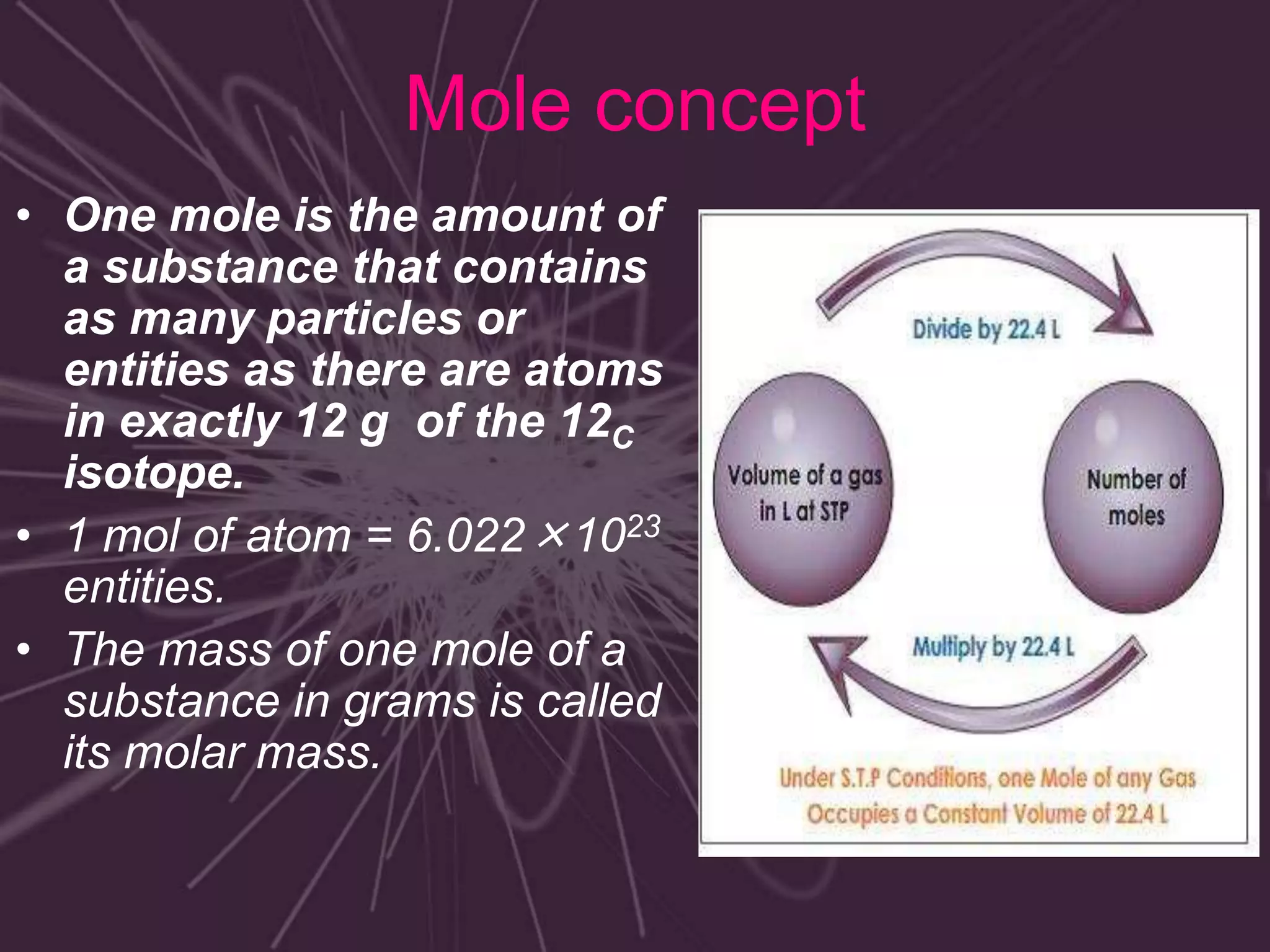
• One mole is the amount of
a substance that contains
as many particles or
entities as there are atoms
in exactly 12 g of the 12C
isotope.
• 1 mol of atom = 6.022×10²³
entities.
• The mass of one mole of a
substance in grams is called
its molar mass.
Limiting reagent
• When any reaction is carried out if
the reactants are not present in
the amounts as required by a
balanced chemical reaction.
• In such situations, one reactant is
in excess over the other. The
reactant which is present in the
lesser amount gets consumed
after sometime and after that no
further reaction takes place
whatever be the amount of the
other reactant present.
• Hence, the reactant which gets
consumed, limits the amount of
product formed and is,
therefore, called the limiting
reagent.
Concentrations in solutions
• The concentration of
a solution is
expressed in 4
different ways.
1)Mass percent
2)Mole fraction
3)Molarity
4)molality
Mass percentage
• Mass % of a compound
is given by the formula
• Mass percentage is
used by only binary
solutions
• It is used for calculation
of very small quantities
Mole fraction
• It is defined as the ratio of number of
moles of a particular component to the
total number of moles of the solution. If a
substance ‘A’ dissolves in substance ‘B’
and their number of moles are nA and nB
respectively; then the mole fractions of A
and B are given as XA and XB
• Mole fraction is a dimensionless
quantity
Molarity
• It is the most widely used
unit and is denoted by M. It
is defined as the number of
moles of the solute in 1 litre
of the solution. Therefore
• molarity of a solution
depends upon temperature
because volume of a
solution is temperature
dependent.
Molality
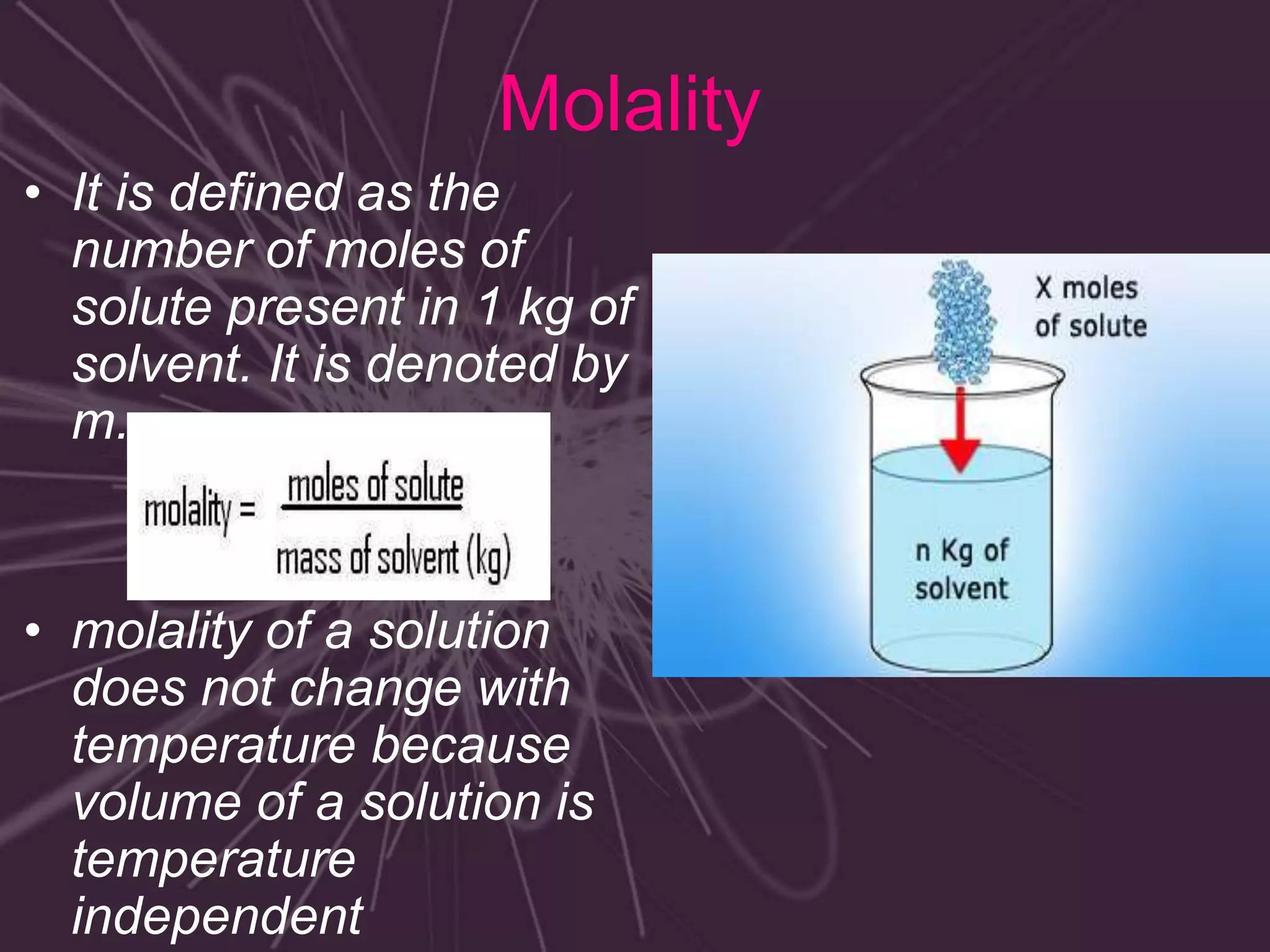
• It is defined as the
number of moles of
solute present in 1 kg of
solvent. It is denoted by
m.
• molality of a solution
does not change with
temperature because
volume of a solution is
temperature
independent
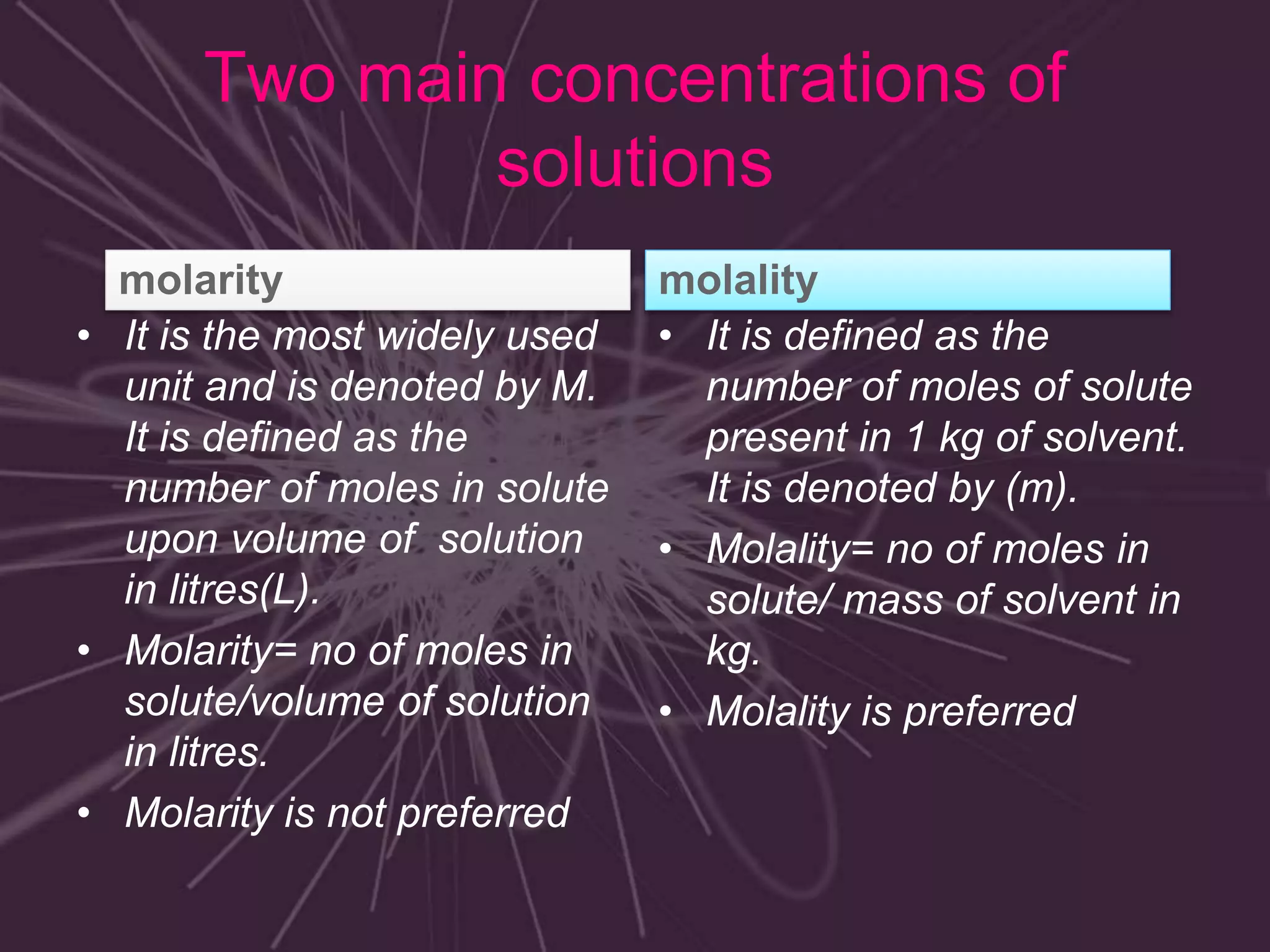
Two main concentrations of
solutions
molarity
• It is the most widely used
unit and is denoted by M.
It is defined as the
number of moles in solute
upon volume of solution
in litres(L).
• Molarity= no of moles in
solute/volume of solution
in litres.
• Molarity is not preferred
molality
• It is defined as the
number of moles of solute
present in 1 kg of solvent.
It is denoted by (m).
• Molality= no of moles in
solute/ mass of solvent in
kg.
• Molality is preferred
Concepts in molarity
• In some cases to find the mass of a
certain compound volume of a compound ,
mass of the second compound and
volume of the second compound will be
given in that case we apply the formula :-
• Another very important formula used in molarity
is finding molarity using density.
The formula is
M =
Example question:
Commercially available sulphuric acid contains
93% by mass and has has a density of 1.84
g/cm3 . Calculate the molarity of the solution and
the volume of concentrated acid required to
prepare 2.5mL of 0.50 M of H2SO4.
% x d x10
mass
Some basic concepts of chemistry.

Some basic concepts of chemistry.

  • 2.
    Law of conservationof mass:- “Law of conservation of mass states that matter can neither be created nor be destroyed in a chemical reaction.”
  • 3.
    Law of definiteproportions • “In given compound always contains exactly the same proportion of elements by weight.”
  • 4.
    Law of multipleproportions • “if two elements can combine to form more than one compound, the masses of one element that combine with a fixed mass of the other element, are in the ratio of small whole numbers.”
  • 5.
    Gay lussac’s lawof gaseous volumes • “when gases combine or are produced in a chemical reaction they do so in a simple ratio by volume provided all gases are at same temperature and pressure.”
  • 6.
    Avogadro's law • “Equalvolumes of gases contain equal number of molecules at standard temperature and pressure.”
  • 7.
    Daltons atomic theory •According to Dalton's atomic theory, 1)Matter consists of indivisible atoms. 2)All the atoms of a given element have identical properties including identical mass. Atoms of different elements differ in mass. 3)Compounds are formed when atoms of different elements combine in a fixed ratio. 4)Chemical reactions involve reorganisation of atoms. These are neither created nor destroyed in a chemical reaction.
  • 8.
    Atomic and molecularmasses • One atomic mass unit is defined as a mass exactly equal to one- twelfth the mass of one carbon - 12 atom and 1 amu = 1.66056×10⁻²⁴ g . • Today, ‘amu’ has been replaced by ‘u’ which is known as unified mass.
  • 9.
    Molecular mass andformula mass • Molecular mass is the sum of atomic masses of the elements present in a molecule. It is obtained by multiplying the atomic mass of each element by the number of its atoms and adding them together. • Formula unit mass is the empirical formula of the compound.
  • 10.
    Mole concept • Onemole is the amount of a substance that contains as many particles or entities as there are atoms in exactly 12 g of the 12C isotope. • 1 mol of atom = 6.022×10²³ entities. • The mass of one mole of a substance in grams is called its molar mass.
  • 11.
    Limiting reagent • Whenany reaction is carried out if the reactants are not present in the amounts as required by a balanced chemical reaction. • In such situations, one reactant is in excess over the other. The reactant which is present in the lesser amount gets consumed after sometime and after that no further reaction takes place whatever be the amount of the other reactant present. • Hence, the reactant which gets consumed, limits the amount of product formed and is, therefore, called the limiting reagent.
  • 12.
    Concentrations in solutions •The concentration of a solution is expressed in 4 different ways. 1)Mass percent 2)Mole fraction 3)Molarity 4)molality
  • 13.
    Mass percentage • Mass% of a compound is given by the formula • Mass percentage is used by only binary solutions • It is used for calculation of very small quantities
  • 14.
    Mole fraction • Itis defined as the ratio of number of moles of a particular component to the total number of moles of the solution. If a substance ‘A’ dissolves in substance ‘B’ and their number of moles are nA and nB respectively; then the mole fractions of A and B are given as XA and XB • Mole fraction is a dimensionless quantity
  • 15.
    Molarity • It isthe most widely used unit and is denoted by M. It is defined as the number of moles of the solute in 1 litre of the solution. Therefore • molarity of a solution depends upon temperature because volume of a solution is temperature dependent.
  • 16.
    Molality • It isdefined as the number of moles of solute present in 1 kg of solvent. It is denoted by m. • molality of a solution does not change with temperature because volume of a solution is temperature independent
  • 17.
    Two main concentrationsof solutions molarity • It is the most widely used unit and is denoted by M. It is defined as the number of moles in solute upon volume of solution in litres(L). • Molarity= no of moles in solute/volume of solution in litres. • Molarity is not preferred molality • It is defined as the number of moles of solute present in 1 kg of solvent. It is denoted by (m). • Molality= no of moles in solute/ mass of solvent in kg. • Molality is preferred
  • 18.
    Concepts in molarity •In some cases to find the mass of a certain compound volume of a compound , mass of the second compound and volume of the second compound will be given in that case we apply the formula :-
  • 19.
    • Another veryimportant formula used in molarity is finding molarity using density. The formula is M = Example question: Commercially available sulphuric acid contains 93% by mass and has has a density of 1.84 g/cm3 . Calculate the molarity of the solution and the volume of concentrated acid required to prepare 2.5mL of 0.50 M of H2SO4. % x d x10 mass