Class XI Chapter 'Some Basic concepts of Chemistry' : unit conversions, laws of chemical combination, mole concept, empirical formula, Stoichiometry, Concentration terms
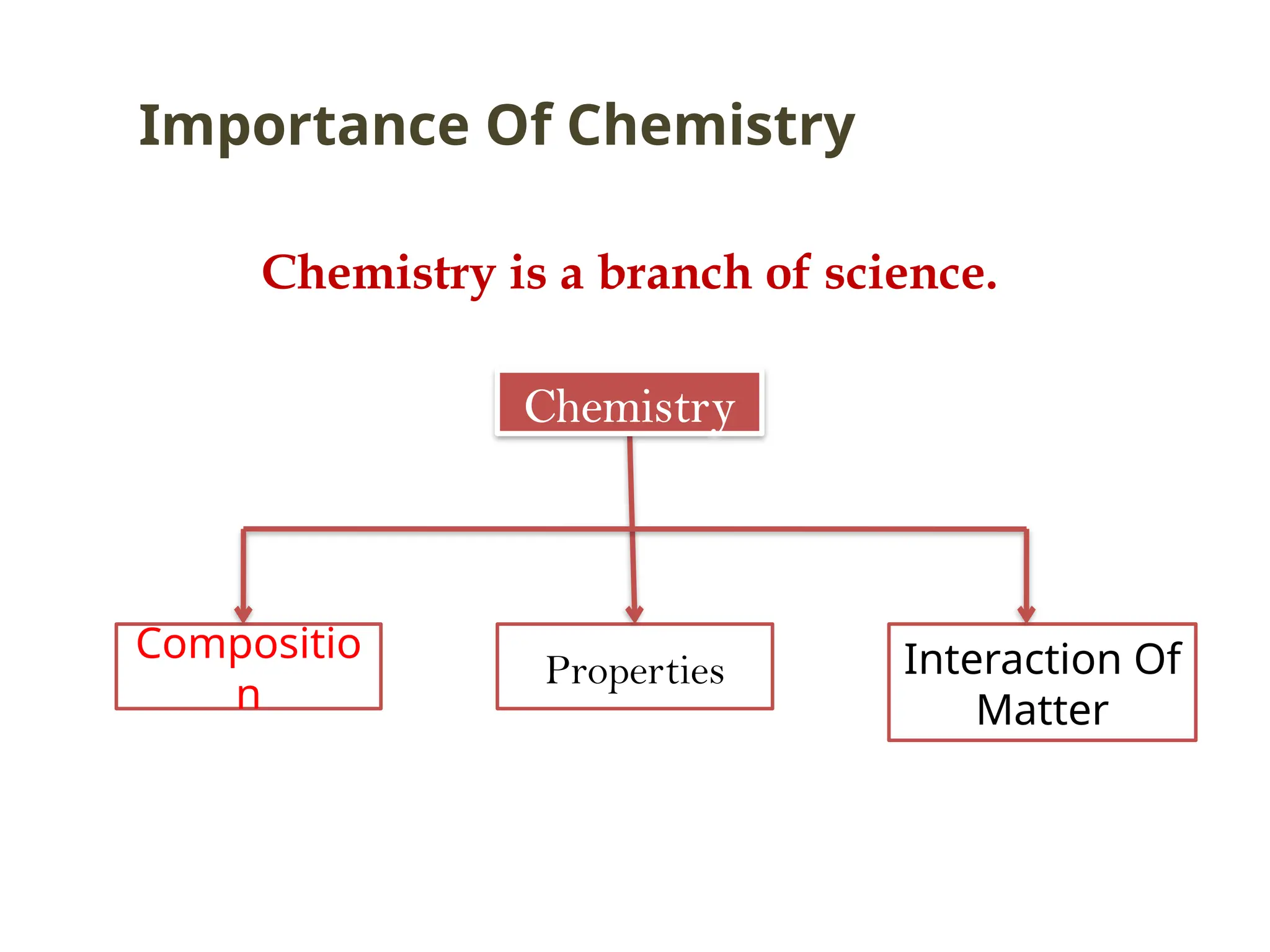
Chemistry is abranch of science.
Compositio
n
Properties Interaction Of
Matter
Chemistry
Importance Of Chemistry
2.
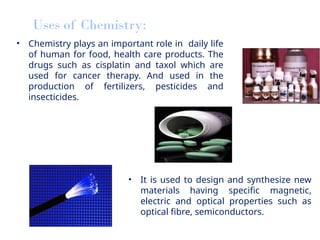
• Chemistry playsan important role in daily life
of human for food, health care products. The
drugs such as cisplatin and taxol which are
used for cancer therapy. And used in the
production of fertilizers, pesticides and
insecticides.
Uses of Chemistry:
• It is used to design and synthesize new
materials having specific magnetic,
electric and optical properties such as
optical fibre, semiconductors.
3.
Synthesis of newmaterials having specific magnetic,
electric and optical properties has lead to the
production of superconducting ceramics, conducting
polymers, optical fibres and large scale
miniaturization of solid state devices .
Safer alternatives to environmentally hazardous
refrigerants like CFCs (chlorofluorocarbons),
responsible for ozone depletion in the stratosphere,
have been successfully synthesised.
Importance Of Chemistry
4.
NATURE OF MATTER
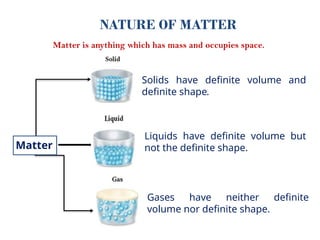
Matteris anything which has mass and occupies space.
Solids have definite volume and
definite shape.
Liquids have definite volume but
not the definite shape.
Gases have neither definite
volume nor definite shape.
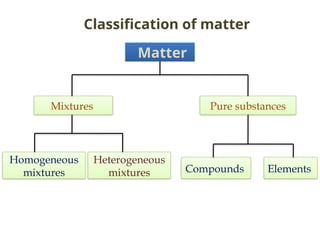
Matter
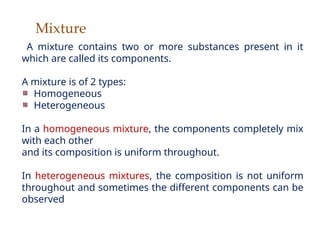
A mixture containstwo or more substances present in it
which are called its components.
A mixture is of 2 types:
Homogeneous
Heterogeneous
In a homogeneous mixture, the components completely mix
with each other
and its composition is uniform throughout.
In heterogeneous mixtures, the composition is not uniform
throughout and sometimes the different components can be
observed
Mixture
7.
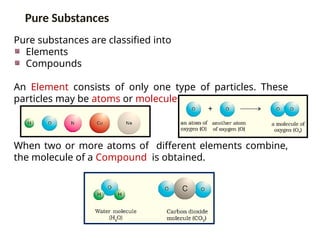
Pure substances areclassified into
Elements
Compounds
An Element consists of only one type of particles. These
particles may be atoms or molecules.
When two or more atoms of different elements combine,
the molecule of a Compound is obtained.
Pure Substances
8.
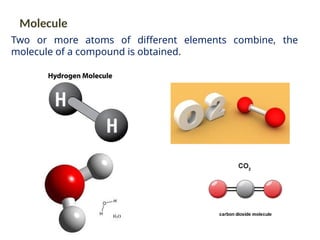
Two or moreatoms of different elements combine, the
molecule of a compound is obtained.
Molecule
9.
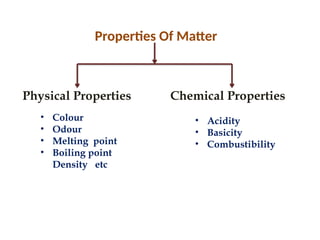
Physical Properties ChemicalProperties
• Colour
• Odour
• Melting point
• Boiling point
Density etc
• Acidity
• Basicity
• Combustibility
Properties Of Matter
10.
MEASUREMENT OF MATTER
Thetwo different systems of measurement are
• the English System
• the Metric System
The metric system is more convenient and it is based on
the decimal system.
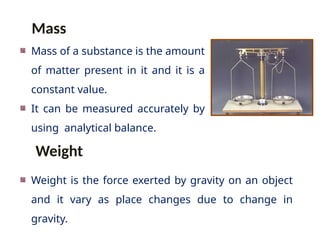
Mass of asubstance is the amount
of matter present in it and it is a
constant value.
It can be measured accurately by
using analytical balance.
Weight is the force exerted by gravity on an object
and it vary as place changes due to change in
gravity.
Mass
Weight
13.
Volume
S.I unit ofvolume is m3
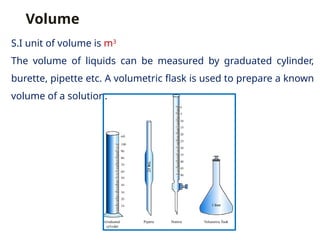
The volume of liquids can be measured by graduated cylinder,
burette, pipette etc. A volumetric flask is used to prepare a known
volume of a solution.
14.
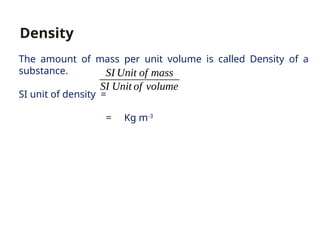
The amount ofmass per unit volume is called Density of a
substance.
SI unit of density =
= Kg m-3
SI Unit of mass
SI Unit of volume
Density
15.
The relation betweenkelvin scale and celsius scale is:
degree celsius(°C)
degree fahrenheit (°F)
kelvin(K)
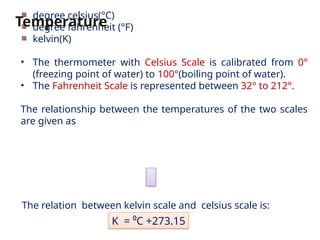
• The thermometer with Celsius Scale is calibrated from 0°
(freezing point of water) to 100°(boiling point of water).
• The Fahrenheit Scale is represented between 32° to 212°.
The relationship between the temperatures of the two scales
are given as
Temperature
K = ⁰C +273.15
16.
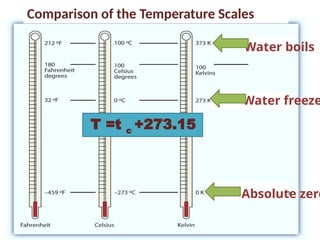
Comparison of theTemperature Scales
Absolute zero
Water freeze
Water boils
T =t c
+273.15
17.
LAWS OF CHEMICALCOMBINATIONS
The combination of elements to form compounds is governed
by the following five basic laws. They are:
Law of Conservation of Mass
Law of Definite Proportions
Law of Multiple Proportions
Gay Lussac’s Law of Gaseous Volumes
Avogadro Law
18.
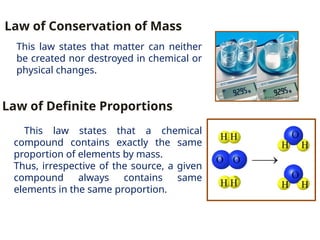
This law statesthat matter can neither
be created nor destroyed in chemical or
physical changes.
This law states that a chemical
compound contains exactly the same
proportion of elements by mass.
Thus, irrespective of the source, a given
compound always contains same
elements in the same proportion.
Law of Conservation of Mass
Law of Definite Proportions
19.
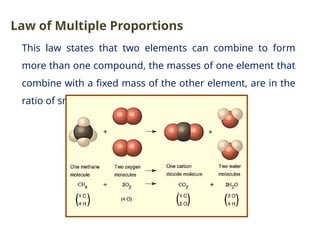
This law statesthat two elements can combine to form
more than one compound, the masses of one element that
combine with a fixed mass of the other element, are in the
ratio of small whole numbers.
Law of Multiple Proportions
20.
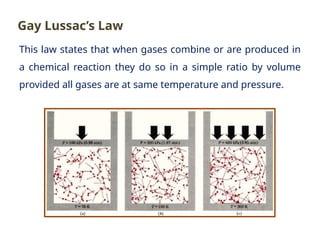
This law statesthat when gases combine or are produced in
a chemical reaction they do so in a simple ratio by volume
provided all gases are at same temperature and pressure.
Gay Lussac’s Law
21.
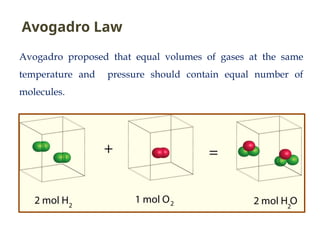
Avogadro proposed thatequal volumes of gases at the same
temperature and pressure should contain equal number of
molecules.
Avogadro Law
22.
Dalton proposed thefollowing :
Matter consists of indivisible atoms.
All the atoms of a given element have identical
properties including identical mass. Atoms of different
elements differ in mass.
Compounds are formed when atoms of different
elements combine in a fixed ratio.
Chemical reactions involve reorganization of atoms.
These are neither created nor destroyed in a chemical
reaction.
DALTON’S ATOMIC THEORY
23.
The massof an atom or atomic mass is actually very small
because atoms are extremely small.
The present system of atomic masses is based on Carbon -
12 as the standard. Carbon - 12 is one of the isotopes of
carbon and has mass of exactly 12 atomic mass unit (amu) .
Atomic mass unit is defined as a mass exactly equal to one
twelfth the mass of one carbon - 12 atom.
1 amu = 1.66056X 10⁻²⁴
g
Mass of an atom of hydrogen = 1.6736X 10⁻²⁴
g
Mass of hydrogen atom (amu) =
= 1.0078 amu
= 1.008 amu
Atomic and Molecular Masses
Atomic Mass
24.
Molecular mass isthe sum of atomic masses of the
elements present in a molecule. This is obtained by
multiplying the atomic mass of each element by the
number of its atoms and then add them together.
Molecular mass of methane = one carbon atom + four hydrogen atoms
(CH4) = (12.011 u) + 4(1.008 u) = 16.043 u
(H2O) = 2(1.008 u) + 16.00 u =18.02 u
Molecular Mass
25.
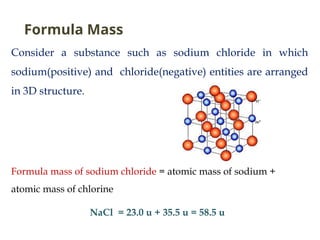
Consider a substancesuch as sodium chloride in which
sodium(positive) and chloride(negative) entities are arranged
in 3D structure.
Formula mass of sodium chloride = atomic mass of sodium +
atomic mass of chlorine
NaCl = 23.0 u + 35.5 u = 58.5 u
Formula Mass
26.
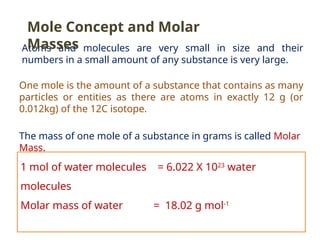
Atoms and moleculesare very small in size and their
numbers in a small amount of any substance is very large.
One mole is the amount of a substance that contains as many
particles or entities as there are atoms in exactly 12 g (or
0.012kg) of the 12C isotope.
The mass of one mole of a substance in grams is called Molar
Mass.
1 mol of water molecules = 6.022 X 10²³
water
molecules
Molar mass of water = 18.02 g mol-1
Mole Concept and Molar
Masses
27.
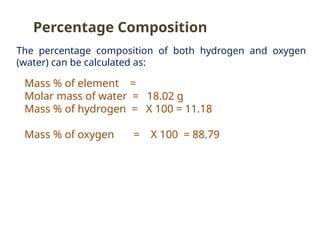
The percentage compositionof both hydrogen and oxygen
(water) can be calculated as:
Mass % of element =
Molar mass of water = 18.02 g
Mass % of hydrogen = X 100 = 11.18
Mass % of oxygen = X 100 = 88.79
Percentage Composition
28.
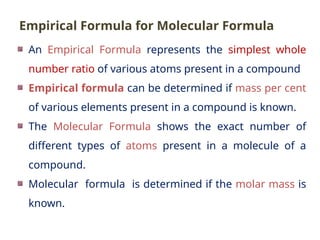
An Empirical Formularepresents the simplest whole
number ratio of various atoms present in a compound
Empirical formula can be determined if mass per cent
of various elements present in a compound is known.
The Molecular Formula shows the exact number of
different types of atoms present in a molecule of a
compound.
Molecular formula is determined if the molar mass is
known.
Empirical Formula for Molecular Formula
29.
Stoichiometry and StoichiometricCalculations
• Stoichiometry deals with the calculation of masses (or
volumes) of the reactants and the products involved in a
chemical reaction.
• ‘Stoichiometry’ is derived from two Greek words stoicheion
means element and metron means measure.
30.
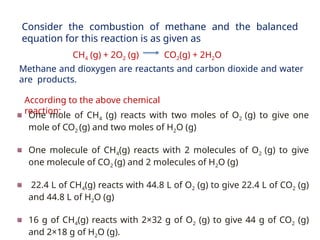
One mole ofCH4 (g) reacts with two moles of O2 (g) to give one
mole of CO2 (g) and two moles of H2O (g)
One molecule of CH4(g) reacts with 2 molecules of O2 (g) to give
one molecule of CO2 (g) and 2 molecules of H2O (g)
22.4 L of CH4(g) reacts with 44.8 L of O2 (g) to give 22.4 L of CO2 (g)
and 44.8 L of H2O (g)
16 g of CH4(g) reacts with 2×32 g of O2 (g) to give 44 g of CO2 (g)
and 2×18 g of H2O (g).
Consider the combustion of methane and the balanced
equation for this reaction is as given as
Methane and dioxygen are reactants and carbon dioxide and water
are products.
CH4 (g) + 2O2 (g) CO2(g) + 2H2O
According to the above chemical
reaction:
31.
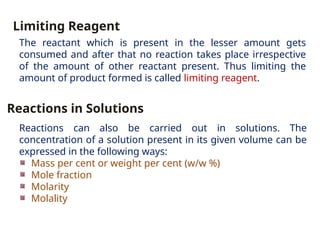
The reactant whichis present in the lesser amount gets
consumed and after that no reaction takes place irrespective
of the amount of other reactant present. Thus limiting the
amount of product formed is called limiting reagent.
Reactions can also be carried out in solutions. The
concentration of a solution present in its given volume can be
expressed in the following ways:
Mass per cent or weight per cent (w/w %)
Mole fraction
Molarity
Molality
Limiting Reagent
Reactions in Solutions
32.
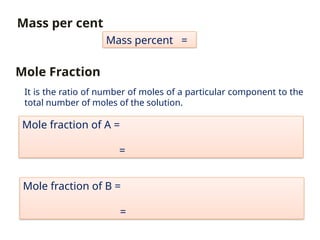
Mass percent =
Molefraction of A =
=
Mole fraction of B =
=
Mass per cent
Mole Fraction
It is the ratio of number of moles of a particular component to the
total number of moles of the solution.
33.
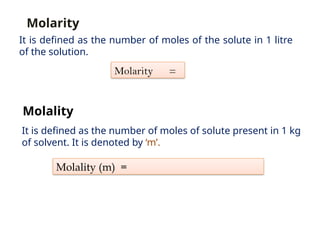
Molarity =
Molality (m)=
Molarity
Molality
It is defined as the number of moles of solute present in 1 kg
of solvent. It is denoted by ‘m’.
It is defined as the number of moles of the solute in 1 litre
of the solution.