This project has received funding from the European Union’s Horizon 2020
research and innovation programme under grant agreement No 869993.
Economics and
finance
Engineering economics
• Engineering economics is the subset
of economic techniques to the
evaluation of engineering alternatives.
• It integrates economic theory with
engineering practice, mathematics
and statistics.
• For each problem, there are usually
many possible alternatives.
• “Do nothing” is one alternative that
need to be considered.
• Non-economic factors are also
important.
Key concepts
• Costs and revenue for each alternative for an
analysis period are the basis of the evaluation.
• Analysis period can be a fixed numbers of years
or estimated life of the project.
• Salvage value is the estimated value of the
investment at the end of its useful life.
• Depreciation is an accounting method of allocating
the cost of an investment over its useful life.
• Present value is the current value of a future sum
of money. An amount of money today is worth
more than the same amount in the future.
Simple interest and compound interest
• Interest is the money paid for the use of money.
• The interest rate is typically expressed as an
annual percentage rate.
• Simple interest is computed on the original
principal. It is mostly used in car loans or short
term personal loans. Simple interest is based
on original principal.
• Compound interest is based on the principal
amount and the interest that accumulates on it
in every period. Interest can be compounded
on any given frequency schedule, from
continuous to daily to annually.
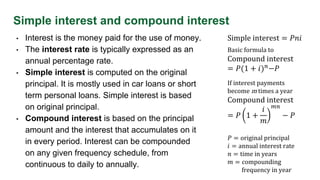
Simple interest = 𝑃𝑛𝑖
Basic formula to
Compound interest
= 𝑃(1 + 𝑖)𝑛−𝑃
𝑃 = original principal
𝑖 = annual interest rate
𝑛 = time in years
𝑚 = compounding
frequency in year
If interest payments
become m times a year
Compound interest
= 𝑃 1 +
𝑖
𝑚
𝑚𝑛
− 𝑃
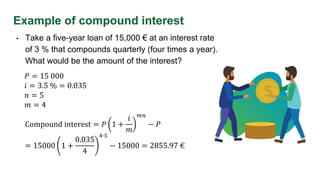
Example of compound interest
• Take a five-year loan of 15,000 € at an interest rate
of 3 % that compounds quarterly (four times a year).
What would be the amount of the interest?
𝑃 = 15 000
𝑖 = 3.5 % = 0.035
𝑛 = 5
𝑚 = 4
Compound interest = 𝑃 1 +
𝑖
𝑚
𝑚𝑛
− 𝑃
= 15000 1 +
0.035
4
4∙5
− 15000 = 2855.97 €
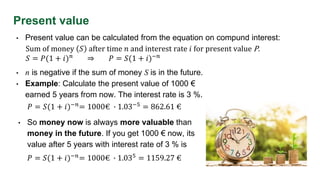
Present value
• Present value can be calculated from the equation on compund interest:
Sum of money 𝑆 after time 𝑛 and interest rate 𝑖 for present value P.
𝑆 = 𝑃(1 + 𝑖)𝑛 ⇒ 𝑃 = 𝑆(1 + 𝑖)−𝑛
• n is negative if the sum of money S is in the future.
• Example: Calculate the present value of 1000 €
earned 5 years from now. The interest rate is 3 %.
𝑃 = 𝑆(1 + 𝑖)−𝑛
= 1000€ ∙ 1.03−5
= 862.61 €
• So money now is always more valuable than
money in the future. If you get 1000 € now, its
value after 5 years with interest rate of 3 % is
𝑃 = 𝑆(1 + 𝑖)−𝑛= 1000€ ∙ 1.035 = 1159.27 €
Other factors
• In practice, the calculation of present value is not that straightforward.
• Value of money will change because of inflation and deflation.
• Cost indexes can be used to estimate the effects of inflation and deflation.
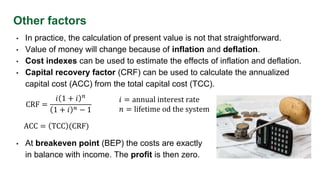
• Capital recovery factor (CRF) can be used to calculate the annualized
capital cost (ACC) from the total capital cost (TCC).
CRF =
𝑖 1 + 𝑖 𝑛
1 + 𝑖 𝑛 − 1
𝑖 = annual interest rate
𝑛 = lifetime od the system
ACC = TCC (CRF)
• At breakeven point (BEP) the costs are exactly
in balance with income. The profit is then zero.
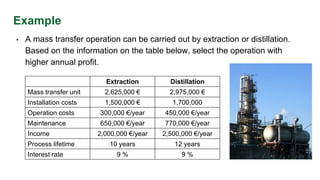
Example
• A mass transfer operation can be carried out by extraction or distillation.
Based on the information on the table below, select the operation with
higher annual profit.
Extraction Distillation
Mass transfer unit 2,625,000 € 2,975,000 €
Installation costs 1,500,000 € 1,700,000
Operation costs 300,000 €/year 450,000 €/year
Maintenance 650,000 €/year 770,000 €/year
Income 2,000,000 €/year 2,500,000 €/year
Process lifetime 10 years 12 years
Interest rate 9 % 9 %
Example: Solution
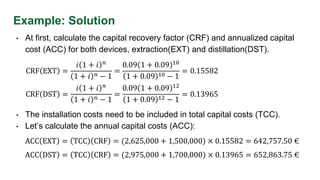
• At first, calculate the capital recovery factor (CRF) and annualized capital
cost (ACC) for both devices, extraction(EXT) and distillation(DST).
CRF EXT =
𝑖 1 + 𝑖 𝑛
1 + 𝑖 𝑛 − 1
=
0.09 1 + 0.09 10
1 + 0.09 10 − 1
= 0.15582
ACC EXT = TCC CRF = (2,625,000 + 1,500,000) × 0.15582 = 642,757.50 €
• The installation costs need to be included in total capital costs (TCC).
• Let’s calculate the annual capital costs (ACC):
CRF DST =
𝑖 1 + 𝑖 𝑛
1 + 𝑖 𝑛 − 1
=
0.09 1 + 0.09 12
1 + 0.09 12 − 1
= 0.13965
ACC DST = TCC CRF = (2,975,000 + 1,700,000) × 0.13965 = 652,863.75 €
Example: Solution
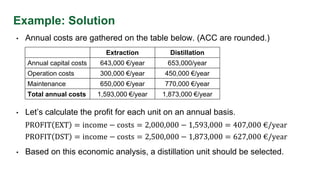
• Annual costs are gathered on the table below. (ACC are rounded.)
• Let’s calculate the profit for each unit on an annual basis.
Extraction Distillation
Annual capital costs 643,000 €/year 653,000/year
Operation costs 300,000 €/year 450,000 €/year
Maintenance 650,000 €/year 770,000 €/year
Total annual costs 1,593,000 €/year 1,873,000 €/year
PROFIT EXT = income − costs = 2,000,000 − 1,593,000 = 407,000 €/year
PROFIT DST = income − costs = 2,500,000 − 1,873,000 = 627,000 €/year
• Based on this economic analysis, a distillation unit should be selected.
Basics of accounting
• Financial accounting is the process of
recording financial transactions in a
business. There are also other classes of
accounting, e.g. management accounting.
• It is essential for engineers to understand
the basics of the subject so they can be
involved in the business related decisions.
• Balance sheet is a summary of the
financial balances of an organization.
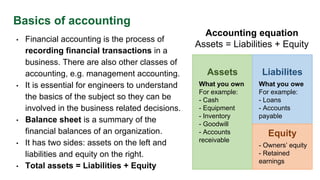
• It has two sides: assets on the left and
liabilities and equity on the right.
• Total assets = Liabilities + Equity
Accounting equation
Assets = Liabilities + Equity
Assets
Equity
Liabilites
What you own
For example:
- Cash
- Equipment
- Inventory
- Goodwill
- Accounts
receivable
What you owe
For example:
- Loans
- Accounts
payable
- Owners’ equity
- Retained
earnings
Financial statements
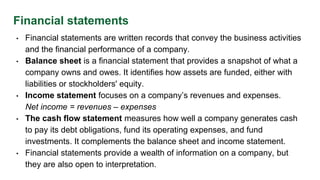
• Financial statements are written records that convey the business activities
and the financial performance of a company.
• Balance sheet is a financial statement that provides a snapshot of what a
company owns and owes. It identifies how assets are funded, either with
liabilities or stockholders' equity.
• Income statement focuses on a company’s revenues and expenses.
Net income = revenues – expenses
• The cash flow statement measures how well a company generates cash
to pay its debt obligations, fund its operating expenses, and fund
investments. It complements the balance sheet and income statement.
• Financial statements provide a wealth of information on a company, but
they are also open to interpretation.
This project has received funding from the European Union’s Horizon 2020
research and innovation programme under grant agreement No 869993.
References
Engineerin Economics [Online]. Wikipedia. Available at:
https://en.wikipedia.org/wiki/Engineering_economics (Accessed: 18 March 2021).
Investopedia Dictionary [Online]. Available at: https://www.investopedia.com/financial-term-
dictionary-4769738 (Accessed: 17 March 2021).
Theodore, L. & Ricci, F. 2010. Mass Transfer Operations for the Practicing Engineer. John Wiley &
Sons, Inc, pp. 489-511.
Videos:
• Introduction to financial statements: https://youtu.be/4sGEtZcLdx8 (12:29)
• Net present value: https://youtu.be/N-lN5xORIwc (5:25)
• Straight line method of depreciation: https://youtu.be/iruD9KTNnNc (6:51)

Engineering economics and finance

  • 1.
    This project hasreceived funding from the European Union’s Horizon 2020 research and innovation programme under grant agreement No 869993. Economics and finance
  • 2.
    Engineering economics • Engineeringeconomics is the subset of economic techniques to the evaluation of engineering alternatives. • It integrates economic theory with engineering practice, mathematics and statistics. • For each problem, there are usually many possible alternatives. • “Do nothing” is one alternative that need to be considered. • Non-economic factors are also important.
  • 3.
    Key concepts • Costsand revenue for each alternative for an analysis period are the basis of the evaluation. • Analysis period can be a fixed numbers of years or estimated life of the project. • Salvage value is the estimated value of the investment at the end of its useful life. • Depreciation is an accounting method of allocating the cost of an investment over its useful life. • Present value is the current value of a future sum of money. An amount of money today is worth more than the same amount in the future.
  • 4.
    Simple interest andcompound interest • Interest is the money paid for the use of money. • The interest rate is typically expressed as an annual percentage rate. • Simple interest is computed on the original principal. It is mostly used in car loans or short term personal loans. Simple interest is based on original principal. • Compound interest is based on the principal amount and the interest that accumulates on it in every period. Interest can be compounded on any given frequency schedule, from continuous to daily to annually. Simple interest = 𝑃𝑛𝑖 Basic formula to Compound interest = 𝑃(1 + 𝑖)𝑛−𝑃 𝑃 = original principal 𝑖 = annual interest rate 𝑛 = time in years 𝑚 = compounding frequency in year If interest payments become m times a year Compound interest = 𝑃 1 + 𝑖 𝑚 𝑚𝑛 − 𝑃
  • 5.
    Example of compoundinterest • Take a five-year loan of 15,000 € at an interest rate of 3 % that compounds quarterly (four times a year). What would be the amount of the interest? 𝑃 = 15 000 𝑖 = 3.5 % = 0.035 𝑛 = 5 𝑚 = 4 Compound interest = 𝑃 1 + 𝑖 𝑚 𝑚𝑛 − 𝑃 = 15000 1 + 0.035 4 4∙5 − 15000 = 2855.97 €
  • 6.
    Present value • Presentvalue can be calculated from the equation on compund interest: Sum of money 𝑆 after time 𝑛 and interest rate 𝑖 for present value P. 𝑆 = 𝑃(1 + 𝑖)𝑛 ⇒ 𝑃 = 𝑆(1 + 𝑖)−𝑛 • n is negative if the sum of money S is in the future. • Example: Calculate the present value of 1000 € earned 5 years from now. The interest rate is 3 %. 𝑃 = 𝑆(1 + 𝑖)−𝑛 = 1000€ ∙ 1.03−5 = 862.61 € • So money now is always more valuable than money in the future. If you get 1000 € now, its value after 5 years with interest rate of 3 % is 𝑃 = 𝑆(1 + 𝑖)−𝑛= 1000€ ∙ 1.035 = 1159.27 €
  • 7.
    Other factors • Inpractice, the calculation of present value is not that straightforward. • Value of money will change because of inflation and deflation. • Cost indexes can be used to estimate the effects of inflation and deflation. • Capital recovery factor (CRF) can be used to calculate the annualized capital cost (ACC) from the total capital cost (TCC). CRF = 𝑖 1 + 𝑖 𝑛 1 + 𝑖 𝑛 − 1 𝑖 = annual interest rate 𝑛 = lifetime od the system ACC = TCC (CRF) • At breakeven point (BEP) the costs are exactly in balance with income. The profit is then zero.
  • 8.
    Example • A masstransfer operation can be carried out by extraction or distillation. Based on the information on the table below, select the operation with higher annual profit. Extraction Distillation Mass transfer unit 2,625,000 € 2,975,000 € Installation costs 1,500,000 € 1,700,000 Operation costs 300,000 €/year 450,000 €/year Maintenance 650,000 €/year 770,000 €/year Income 2,000,000 €/year 2,500,000 €/year Process lifetime 10 years 12 years Interest rate 9 % 9 %
  • 9.
    Example: Solution • Atfirst, calculate the capital recovery factor (CRF) and annualized capital cost (ACC) for both devices, extraction(EXT) and distillation(DST). CRF EXT = 𝑖 1 + 𝑖 𝑛 1 + 𝑖 𝑛 − 1 = 0.09 1 + 0.09 10 1 + 0.09 10 − 1 = 0.15582 ACC EXT = TCC CRF = (2,625,000 + 1,500,000) × 0.15582 = 642,757.50 € • The installation costs need to be included in total capital costs (TCC). • Let’s calculate the annual capital costs (ACC): CRF DST = 𝑖 1 + 𝑖 𝑛 1 + 𝑖 𝑛 − 1 = 0.09 1 + 0.09 12 1 + 0.09 12 − 1 = 0.13965 ACC DST = TCC CRF = (2,975,000 + 1,700,000) × 0.13965 = 652,863.75 €
  • 10.
    Example: Solution • Annualcosts are gathered on the table below. (ACC are rounded.) • Let’s calculate the profit for each unit on an annual basis. Extraction Distillation Annual capital costs 643,000 €/year 653,000/year Operation costs 300,000 €/year 450,000 €/year Maintenance 650,000 €/year 770,000 €/year Total annual costs 1,593,000 €/year 1,873,000 €/year PROFIT EXT = income − costs = 2,000,000 − 1,593,000 = 407,000 €/year PROFIT DST = income − costs = 2,500,000 − 1,873,000 = 627,000 €/year • Based on this economic analysis, a distillation unit should be selected.
  • 11.
    Basics of accounting •Financial accounting is the process of recording financial transactions in a business. There are also other classes of accounting, e.g. management accounting. • It is essential for engineers to understand the basics of the subject so they can be involved in the business related decisions. • Balance sheet is a summary of the financial balances of an organization. • It has two sides: assets on the left and liabilities and equity on the right. • Total assets = Liabilities + Equity Accounting equation Assets = Liabilities + Equity Assets Equity Liabilites What you own For example: - Cash - Equipment - Inventory - Goodwill - Accounts receivable What you owe For example: - Loans - Accounts payable - Owners’ equity - Retained earnings
  • 12.
    Financial statements • Financialstatements are written records that convey the business activities and the financial performance of a company. • Balance sheet is a financial statement that provides a snapshot of what a company owns and owes. It identifies how assets are funded, either with liabilities or stockholders' equity. • Income statement focuses on a company’s revenues and expenses. Net income = revenues – expenses • The cash flow statement measures how well a company generates cash to pay its debt obligations, fund its operating expenses, and fund investments. It complements the balance sheet and income statement. • Financial statements provide a wealth of information on a company, but they are also open to interpretation.
  • 13.
    This project hasreceived funding from the European Union’s Horizon 2020 research and innovation programme under grant agreement No 869993. References Engineerin Economics [Online]. Wikipedia. Available at: https://en.wikipedia.org/wiki/Engineering_economics (Accessed: 18 March 2021). Investopedia Dictionary [Online]. Available at: https://www.investopedia.com/financial-term- dictionary-4769738 (Accessed: 17 March 2021). Theodore, L. & Ricci, F. 2010. Mass Transfer Operations for the Practicing Engineer. John Wiley & Sons, Inc, pp. 489-511. Videos: • Introduction to financial statements: https://youtu.be/4sGEtZcLdx8 (12:29) • Net present value: https://youtu.be/N-lN5xORIwc (5:25) • Straight line method of depreciation: https://youtu.be/iruD9KTNnNc (6:51)