Welcome
to
My Presentation
OSMOTIC PRESSURE
CourseTitle: Physical
Chemistry II
Course Code: ACCE 260
Applied Chemistry & Chemical
Engineering
SHAIKH ASHRAFUL ALAM
Dept. of Applied Chemistry & Chemical Engineering
BSMRSTU,Gopalgang,Bangladesh
Osmosis
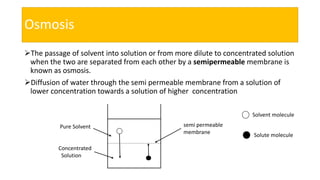
The passage of solvent into solution or from more dilute to concentrated solution
when the two are separated from each other by a semipermeable membrane is
known as osmosis.
Diffusion of water through the semi permeable membrane from a solution of
lower concentration towards a solution of higher concentration
Pure Solvent
Concentrated
Solution
semi permeable
membrane
Solvent molecule
Solute molecule
Osmotic Pressure
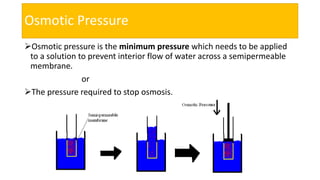
Osmotic pressure is the minimum pressure which needs to be applied
to a solution to prevent interior flow of water across a semipermeable
membrane.
or
The pressure required to stop osmosis.
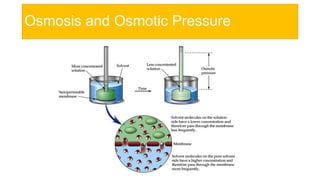
Osmosis and Osmotic Pressure
Determination of Osmotic Pressure
Pfeffer’s Method
Berkely and Harthey’s Method
A Modern Osmometer.
Important term of osmosis & Osmotic
pressure
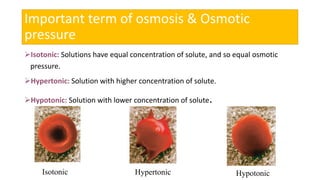
Isotonic: Solutions have equal concentration of solute, and so equal osmotic
pressure.
Hypertonic: Solution with higher concentration of solute.
Hypotonic: Solution with lower concentration of solute.
Isotonic Hypertonic Hypotonic
Law of osmotic pressure
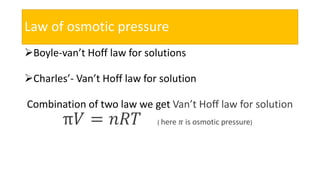
Boyle-van’t Hoff law for solutions
Charles’- Van’t Hoff law for solution
Combination of two law we get Van’t Hoff law for solution
π𝑉 = 𝑛𝑅𝑇 ( here 𝜋 is osmotic pressure)
Calculating osmotic pressure
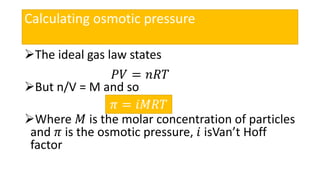
The ideal gas law states
But n/V = M and so
Where 𝑀 is the molar concentration of particles
and 𝜋 is the osmotic pressure, 𝑖 isVan’t Hoff
factor
𝑃𝑉 = 𝑛𝑅𝑇
𝜋 = 𝑖𝑀𝑅𝑇
Relation between osmatic pressure and
other colligative properties
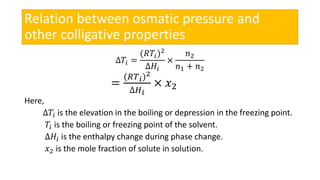
∆𝑇𝑖 =
(𝑅𝑇𝑖)2
∆𝐻𝑖
×
𝑛2
𝑛1 + 𝑛2
=
(𝑅𝑇 𝑖)2
∆𝐻 𝑖
× 𝑥2
Here,
∆𝑇𝑖 is the elevation in the boiling or depression in the freezing point.
𝑇𝑖 is the boiling or freezing point of the solvent.
∆𝐻𝑖 is the enthalpy change during phase change.
𝑥2 is the mole fraction of solute in solution.
Osmotic Pressure – Applications:
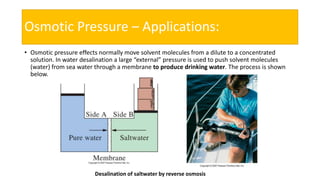
• Osmotic pressure effects normally move solvent molecules from a dilute to a concentrated
solution. In water desalination a large “external” pressure is used to push solvent molecules
(water) from sea water through a membrane to produce drinking water. The process is shown
below.
Desalination of saltwater by reverse osmosis
Importance of Osmosis and Osmotic Pressure
Oncotic pressure of blood plasma
Formation of tissue fluid
Regulation of cell volume

Osmotic pressure

  • 1.
  • 2.
    OSMOTIC PRESSURE CourseTitle: Physical ChemistryII Course Code: ACCE 260 Applied Chemistry & Chemical Engineering
  • 3.
    SHAIKH ASHRAFUL ALAM Dept.of Applied Chemistry & Chemical Engineering BSMRSTU,Gopalgang,Bangladesh
  • 4.
    Osmosis The passage ofsolvent into solution or from more dilute to concentrated solution when the two are separated from each other by a semipermeable membrane is known as osmosis. Diffusion of water through the semi permeable membrane from a solution of lower concentration towards a solution of higher concentration Pure Solvent Concentrated Solution semi permeable membrane Solvent molecule Solute molecule
  • 5.
    Osmotic Pressure Osmotic pressureis the minimum pressure which needs to be applied to a solution to prevent interior flow of water across a semipermeable membrane. or The pressure required to stop osmosis.
  • 6.
  • 7.
    Determination of OsmoticPressure Pfeffer’s Method Berkely and Harthey’s Method A Modern Osmometer.
  • 8.
    Important term ofosmosis & Osmotic pressure Isotonic: Solutions have equal concentration of solute, and so equal osmotic pressure. Hypertonic: Solution with higher concentration of solute. Hypotonic: Solution with lower concentration of solute. Isotonic Hypertonic Hypotonic
  • 9.
    Law of osmoticpressure Boyle-van’t Hoff law for solutions Charles’- Van’t Hoff law for solution Combination of two law we get Van’t Hoff law for solution π𝑉 = 𝑛𝑅𝑇 ( here 𝜋 is osmotic pressure)
  • 10.
    Calculating osmotic pressure Theideal gas law states But n/V = M and so Where 𝑀 is the molar concentration of particles and 𝜋 is the osmotic pressure, 𝑖 isVan’t Hoff factor 𝑃𝑉 = 𝑛𝑅𝑇 𝜋 = 𝑖𝑀𝑅𝑇
  • 11.
    Relation between osmaticpressure and other colligative properties ∆𝑇𝑖 = (𝑅𝑇𝑖)2 ∆𝐻𝑖 × 𝑛2 𝑛1 + 𝑛2 = (𝑅𝑇 𝑖)2 ∆𝐻 𝑖 × 𝑥2 Here, ∆𝑇𝑖 is the elevation in the boiling or depression in the freezing point. 𝑇𝑖 is the boiling or freezing point of the solvent. ∆𝐻𝑖 is the enthalpy change during phase change. 𝑥2 is the mole fraction of solute in solution.
  • 12.
    Osmotic Pressure –Applications: • Osmotic pressure effects normally move solvent molecules from a dilute to a concentrated solution. In water desalination a large “external” pressure is used to push solvent molecules (water) from sea water through a membrane to produce drinking water. The process is shown below. Desalination of saltwater by reverse osmosis
  • 13.
    Importance of Osmosisand Osmotic Pressure Oncotic pressure of blood plasma Formation of tissue fluid Regulation of cell volume

Editor's Notes

  • #5 A semi-permeable membrane discriminates on the basis of molecular type Solvent molecules pass through Large molecules or ions are blocked
  • #14 Oncotic or colloid osmotic pressure is a form of osmotic pressure exerted by proteins.