
Pharmaceutical Operations
Presentation
On
Fractional Distillation
Amity University, NOIDA
Amity Institute of Pharmacy
BY: UNNATI GARG
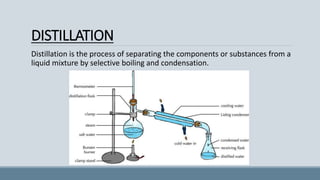
DISTILLATION
Distillation is the process of separating the components or substances from a
liquid mixture by selective boiling and condensation.
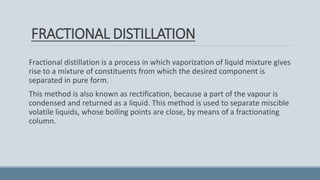
FRACTIONAL DISTILLATION
Fractional distillation is a process in which vaporization of liquid mixture gives
rise to a mixture of constituents from which the desired component is
separated in pure form.
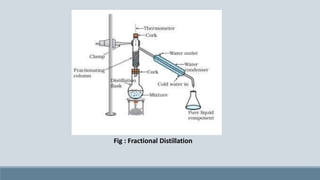
This method is also known as rectification, because a part of the vapour is
condensed and returned as a liquid. This method is used to separate miscible
volatile liquids, whose boiling points are close, by means of a fractionating
column.
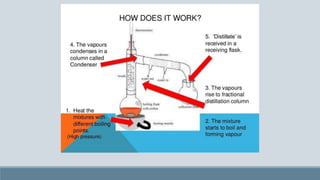
Fig : Fractional Distillation
PRINCIPLE
From the operational point of view, fractional distillation is a mass transfer process
involving counter-current diffusion of the components at each equilibrium stage.
When a liquid mixture is distilled, the partial condensation of the vapour is allowed to
occur in a fractionating column. In the column, ascending vapour from the still is
allowed to come in contact with the condensing vapour returning to the still. This
results in enrichment of the vapour with the more volatile component. By condensing
the vapour and reheating the liquid repeatedly, equilibrium between liquid and vapour
is set up at each stage, which ultimately results in the separation of a more volatile
component
APPLICATIONS
Fractional Distillation is used for :
• Separation of miscible liquids such as acetone and water, chloroform and
benzene.
• Preparation of alcohol which is one of the most important pharmaceutical
substance.
• Separation of non-volatile substance from volatile substance, for eg. Preparation
of distilled water for injection.
• Purification of many organic compounds, such as ethers, amide, etc.
FRACTIONAL vs SIMPLE DISTILLATION
• In Simple distillation, vapour is directly passed through the condenser whereas in
fractional distillation the vapour must pass through a fractionating column in which
partial condensation of vapour is allowed to occur.
• In simple distillation, condensate is collected directly into the receiver, while in
fractional distillation, condensation takes place in the fractionating column, so that
a part of the condensing vapour returns to the still.
ADVANTAGES
• It is extremely easy to use.
• Readily purifies complex mixtures.
• Separates liquids with smaller boiling point separation.
DISADVANTAGES
• It cannot be used to separate miscible liquids, which form azeotropic mixtures.
• Consumes more energy.
• The setup is costly and complicated.
• Takes longer time for liquids to distill.
• Pharmaceutical Engineering: Unit Operations II, CVS Subramanayam, Edition
2015, Volume 2, Ch-7, Distillation, Pg 220-221
• https://www.slideshare.net/abukiya/simple-and-fractional-distillation
REFERENCES
Fractional Distillation

Fractional Distillation

  • 1.
    Pharmaceutical Operations Presentation On Fractional Distillation AmityUniversity, NOIDA Amity Institute of Pharmacy BY: UNNATI GARG
  • 2.
    DISTILLATION Distillation is theprocess of separating the components or substances from a liquid mixture by selective boiling and condensation.
  • 3.
    FRACTIONAL DISTILLATION Fractional distillationis a process in which vaporization of liquid mixture gives rise to a mixture of constituents from which the desired component is separated in pure form. This method is also known as rectification, because a part of the vapour is condensed and returned as a liquid. This method is used to separate miscible volatile liquids, whose boiling points are close, by means of a fractionating column.
  • 4.
    Fig : FractionalDistillation
  • 5.
    PRINCIPLE From the operationalpoint of view, fractional distillation is a mass transfer process involving counter-current diffusion of the components at each equilibrium stage. When a liquid mixture is distilled, the partial condensation of the vapour is allowed to occur in a fractionating column. In the column, ascending vapour from the still is allowed to come in contact with the condensing vapour returning to the still. This results in enrichment of the vapour with the more volatile component. By condensing the vapour and reheating the liquid repeatedly, equilibrium between liquid and vapour is set up at each stage, which ultimately results in the separation of a more volatile component
  • 7.
    APPLICATIONS Fractional Distillation isused for : • Separation of miscible liquids such as acetone and water, chloroform and benzene. • Preparation of alcohol which is one of the most important pharmaceutical substance. • Separation of non-volatile substance from volatile substance, for eg. Preparation of distilled water for injection. • Purification of many organic compounds, such as ethers, amide, etc.
  • 8.
    FRACTIONAL vs SIMPLEDISTILLATION • In Simple distillation, vapour is directly passed through the condenser whereas in fractional distillation the vapour must pass through a fractionating column in which partial condensation of vapour is allowed to occur. • In simple distillation, condensate is collected directly into the receiver, while in fractional distillation, condensation takes place in the fractionating column, so that a part of the condensing vapour returns to the still.
  • 9.
    ADVANTAGES • It isextremely easy to use. • Readily purifies complex mixtures. • Separates liquids with smaller boiling point separation.
  • 10.
    DISADVANTAGES • It cannotbe used to separate miscible liquids, which form azeotropic mixtures. • Consumes more energy. • The setup is costly and complicated. • Takes longer time for liquids to distill.
  • 11.
    • Pharmaceutical Engineering:Unit Operations II, CVS Subramanayam, Edition 2015, Volume 2, Ch-7, Distillation, Pg 220-221 • https://www.slideshare.net/abukiya/simple-and-fractional-distillation REFERENCES