Enthalpy Changes
Chapter 6
Part 1
YouTube: Chemistry bright minds
https://www.youtube.com/channel/UCzXxV4xER9NIWt316gfeO1w
Visit us on
Blog: http://chemistrybrightminds.blogspot.com
Facebook: https://www.facebook.com/BrightMinds
1
Exothermic and endothermic reactions:
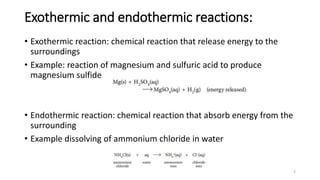
• Exothermic reaction: chemical reaction that release energy to the
surroundings
• Example: reaction of magnesium and sulfuric acid to produce
magnesium sulfide
• Endothermic reaction: chemical reaction that absorb energy from the
surrounding
• Example dissolving of ammonium chloride in water
2
Enthalpy change:
Enthalpy change is the energy exchange between a chemical reaction and
its surroundings at constant pressure.
Enthalpy (H): total energy associated with the materials that react
3
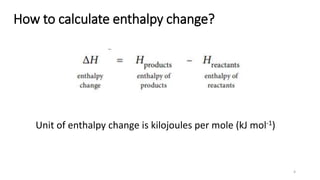
How to calculate enthalpy change?
4
Unit of enthalpy change is kilojoules per mole (kJ mol-1)
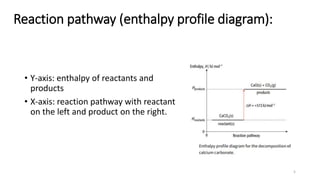
Reaction pathway (enthalpy profile diagram):
• Y-axis: enthalpy of reactants and
products
• X-axis: reaction pathway with reactant
on the left and product on the right.
5
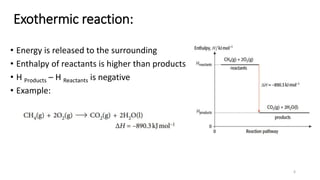
Exothermic reaction:
• Energy is released to the surrounding
• Enthalpy of reactants is higher than products
• H Products – H Reactants is negative
• Example:
6
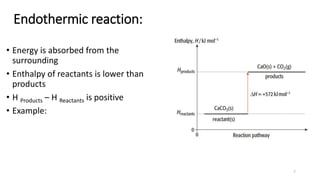
Endothermic reaction:
• Energy is absorbed from the
surrounding
• Enthalpy of reactants is lower than
products
• H Products – H Reactants is positive
• Example:
7
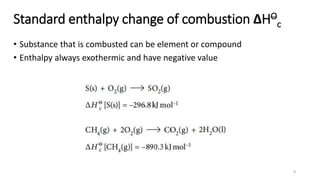
Standard enthalpy change of combustion ΔHO
c
• Substance that is combusted can be element or compound
• Enthalpy always exothermic and have negative value
8
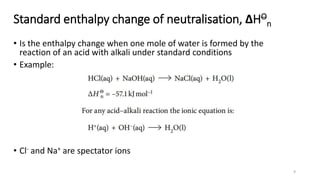
Standard enthalpy change of neutralisation, ΔHO
n
• Is the enthalpy change when one mole of water is formed by the
reaction of an acid with alkali under standard conditions
• Example:
• Cl- and Na+ are spectator ions
9
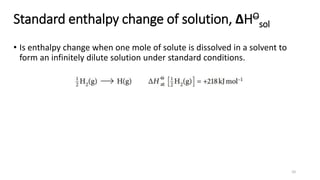
Standard enthalpy change of solution, ΔHO
sol
• Is enthalpy change when one mole of solute is dissolved in a solvent to
form an infinitely dilute solution under standard conditions.
10
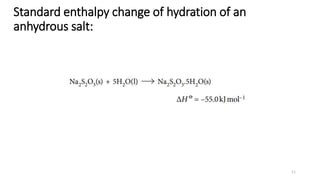
Standard enthalpy change of hydration of an
anhydrous salt:
11
End of Video
12

Enthalpy change

  • 1.
    Enthalpy Changes Chapter 6 Part1 YouTube: Chemistry bright minds https://www.youtube.com/channel/UCzXxV4xER9NIWt316gfeO1w Visit us on Blog: http://chemistrybrightminds.blogspot.com Facebook: https://www.facebook.com/BrightMinds 1
  • 2.
    Exothermic and endothermicreactions: • Exothermic reaction: chemical reaction that release energy to the surroundings • Example: reaction of magnesium and sulfuric acid to produce magnesium sulfide • Endothermic reaction: chemical reaction that absorb energy from the surrounding • Example dissolving of ammonium chloride in water 2
  • 3.
    Enthalpy change: Enthalpy changeis the energy exchange between a chemical reaction and its surroundings at constant pressure. Enthalpy (H): total energy associated with the materials that react 3
  • 4.
    How to calculateenthalpy change? 4 Unit of enthalpy change is kilojoules per mole (kJ mol-1)
  • 5.
    Reaction pathway (enthalpyprofile diagram): • Y-axis: enthalpy of reactants and products • X-axis: reaction pathway with reactant on the left and product on the right. 5
  • 6.
    Exothermic reaction: • Energyis released to the surrounding • Enthalpy of reactants is higher than products • H Products – H Reactants is negative • Example: 6
  • 7.
    Endothermic reaction: • Energyis absorbed from the surrounding • Enthalpy of reactants is lower than products • H Products – H Reactants is positive • Example: 7
  • 8.
    Standard enthalpy changeof combustion ΔHO c • Substance that is combusted can be element or compound • Enthalpy always exothermic and have negative value 8
  • 9.
    Standard enthalpy changeof neutralisation, ΔHO n • Is the enthalpy change when one mole of water is formed by the reaction of an acid with alkali under standard conditions • Example: • Cl- and Na+ are spectator ions 9
  • 10.
    Standard enthalpy changeof solution, ΔHO sol • Is enthalpy change when one mole of solute is dissolved in a solvent to form an infinitely dilute solution under standard conditions. 10
  • 11.
    Standard enthalpy changeof hydration of an anhydrous salt: 11
  • 12.