This project has received funding from the European Union’s Horizon 2020
research and innovation programme under grant agreement No 869993.
Enthalpy
balances in
distillation
What is enthalpy?
• Enthalpy is a technical term to
describe the energy content of a
material.
• Symbol for enthalpy is H or ΔH.
• In molar enthalpy, the unit is kJ/mol.
• The enthalpy data can be found
from databanks of thermodynamic
properties of substances.
• In distillation, enthalpy data is often
presented in an enthalpy-
concentration diagram.
Enthalpy-concentration diagram for ethanol-
water mixture at 1 atm.
(WolframAlpha Demonstration by Binous, Al-
Baghli & Higgins, 2012 CC BY-NC-SA)
Enthalpy in distillation
• In McCabe-Thiele method, we usually
assume constant molal overflow and
the operating lines will then be linear.
• If we don’t make this assumption,
enthalpy balances would be required
in order to perform design calculations.
• The actual variations in the liquid and
vapor streams depend on the enthalpies
of the liquid and vapor mixtures.
• Basic calculations can be made by
enthalpy balance equations.
Enthalpy balance equations
• Total enthalpy balance:
𝐹𝐻𝐹 + 𝑞𝑟 = 𝐷𝐻𝐷 + 𝐵𝐻𝐵 + 𝑞𝑐
• HF = Feed enthalpy
• HD = Enthalpy of the distillate
• HB = Enthalpy of the bottom product
• qr = Heat supplied at the reboiler
• qc = Heat removed from the condenser
• When the feed is liquid at the boiling
point, HF is between HD and HB and the
terms FHF and DHD + BHB nearly
cancel.
 qr ≈ qc
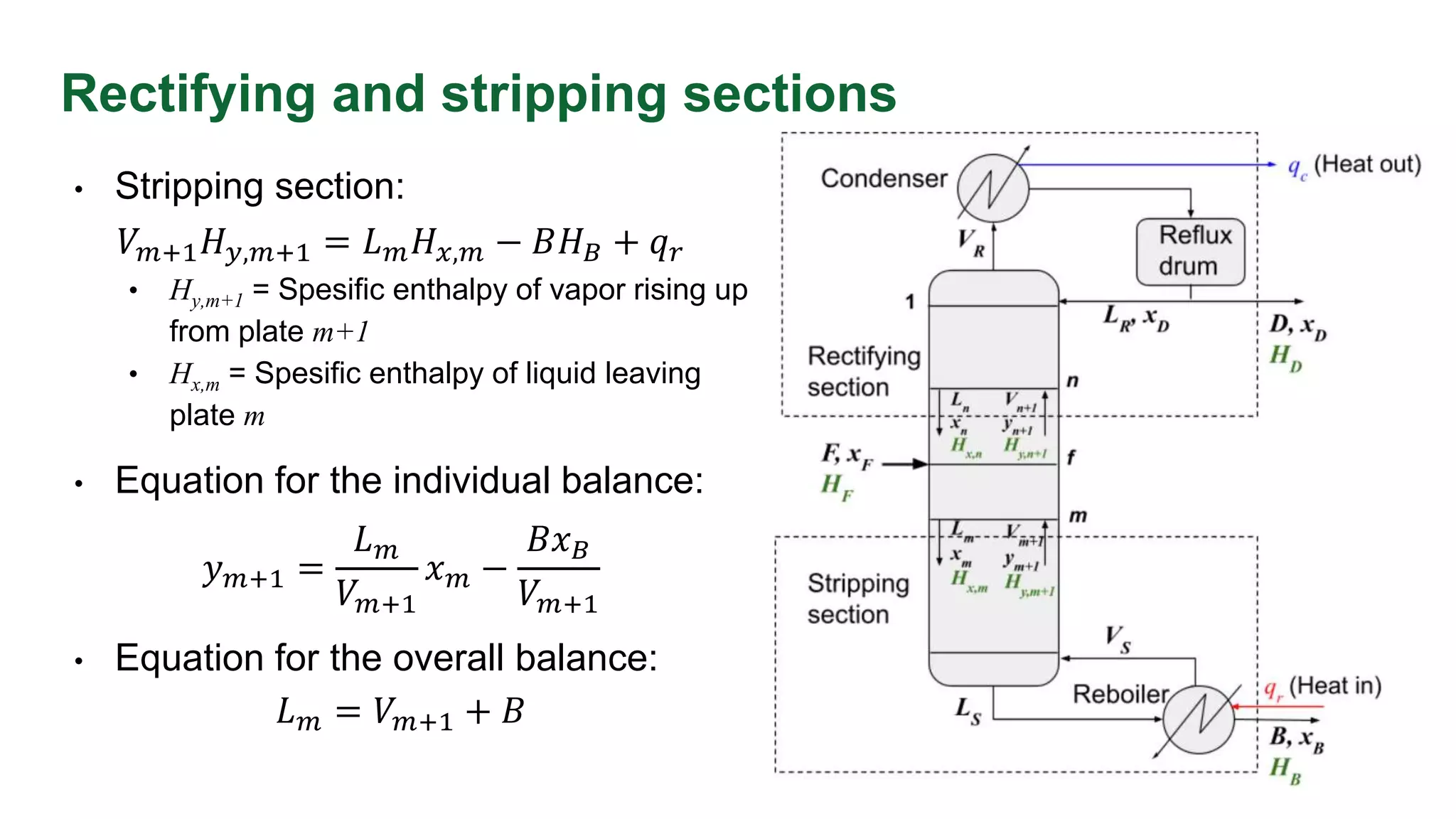
Rectifying and stripping sections
• Rectifying section:
𝑉𝑛+1𝐻𝑦,𝑛+1 = 𝐿𝑛𝐻𝑥,𝑛 + 𝐷𝐻𝐷 + 𝑞𝑐
• Hy,n+1 = Spesific enthalpy of vapor rising up
from plate n+1
• Hx,n = Spesific enthalpy of liquid leaving plate n
• An alternate form:
𝑉𝑛+1𝐻𝑦,𝑛+1 = 𝐿𝑛𝐻𝑥,𝑛 + 𝑉𝑅𝐻𝑦,𝑅 − 𝑅𝐻𝐷
Using relation 𝑞𝑐 = 𝑉𝑅𝐻𝑦,𝑅 − 𝑅𝐻𝐷 − 𝐷𝐻𝐷
Note: R=LR
• Overall and individual balances:
𝑉𝑛+1 = 𝐿𝑛 + 𝐷 𝑦𝑛+1 =
𝐿𝑛
𝑉𝑛+1
𝑥𝑛 +
𝐷𝑥𝐷
𝑉𝑛+1
LR=R
Rectifying and stripping sections
• Stripping section:
𝑉𝑚+1𝐻𝑦,𝑚+1 = 𝐿𝑚𝐻𝑥,𝑚 − 𝐵𝐻𝐵 + 𝑞𝑟
• Hy,m+1 = Spesific enthalpy of vapor rising up
from plate m+1
• Hx,m = Spesific enthalpy of liquid leaving
plate m
• Equation for the individual balance:
𝑦𝑚+1 =
𝐿𝑚
𝑉𝑚+1
𝑥𝑚 −
𝐵𝑥𝐵
𝑉𝑚+1
• Equation for the overall balance:
𝐿𝑚 = 𝑉𝑚+1 + 𝐵
Solving equations
• Solving the equation for rectifying section:
𝑉𝑛+1𝐻𝑦,𝑛+1 = 𝐿𝑛𝐻𝑥,𝑛 + 𝑉𝑅𝐻𝑦,𝑅 − 𝑅𝐻𝐷
• A value of xn is chosen and Hx,n is obtained
from an enthalpy-concentration diagram, or
it is calculated from the average specific
heat and the bubble point.
• A satisfactory value for yn+1 can usually be obtained by using the flow rates LR
and VR in the individual material balance: 𝑦𝑛+1 =
𝐿𝑛
𝑉𝑛+1
𝑥𝑛 +
𝐷𝑥𝐷
𝑉𝑛+1
• Hy,n+1 is evaluated from yn+1 and Ln is replaced by 𝑉𝑛+1 − 𝐷 (from total material
balance 𝑉𝑛+1 = 𝐿𝑛 + 𝐷).
• Vn+1 can now be solved from the equation 𝑉𝑛+1𝐻𝑦,𝑛+1 = 𝐿𝑛𝐻𝑥,𝑛 + 𝑉𝑅𝐻𝑦,𝑅 − 𝑅𝐻𝐷
LR=R
Solving equations
• Solving the equation for stripping section:
𝑉𝑚+1𝐻𝑦,𝑚+1 = 𝐿𝑚𝐻𝑥,𝑚 − 𝐵𝐻𝐵 + 𝑞𝑟
• Following the same approach:
A value of xm is chosen and Hx,m is obtained
from enthalpy data.
• ym+1 is calculated from equation 𝑦𝑚+1 =
𝐿𝑚
𝑉𝑚+1
𝑥𝑚 −
𝐵𝑥𝐵
𝑉𝑚+1
using LS and VS to
approximate Lm and Vm+1 .
• Lm is replaced by 𝑉𝑚+1 + 𝐵 (from total material balance).
• Hy,m+1 is evaluated from ym+1 .
• Vm+1 can now be solved from the equation 𝑉𝑚+1𝐻𝑦,𝑚+1 = 𝐿𝑚𝐻𝑥,𝑚 − 𝐵𝐻𝐵 + 𝑞𝑟
Feed enthalpy condition parameter q
• The feed enthalpy condition parameter q, which is needed when drawing the
feedline (q-line) in McCabe-Thiele method, can be calculated from enthalpies.
• 𝑞 =
𝐻𝑉−𝐻𝐹
𝐻𝑉−𝐻𝐿
• If the feed is saturated liquid, HF = HL and q = 1.
• If the feed is saturated vapor, HF = HV and q = 0.
• For other situations, the feed parameter q can be calculated from enthalpies.
Sub-cooled
liquid
Saturated
liquid
Partially
vaporized
Saturated
vapor
Superheated
vapor
HF < HL
q > 1
HF = HL
q = 1
HV > HF > HL
0 < q < 1
HF = HV
q = 0
HF > HV
q < 0
𝑞 =
𝐻𝑉 − 𝐻𝐹
𝐻𝑉 − 𝐻𝐿
HL = molar enthalpy of liquid
HV = molar enthalpy of vapor HF = molar enthalpy of feed
Enthalpies and values of parameter q with different feed compositions.
Example
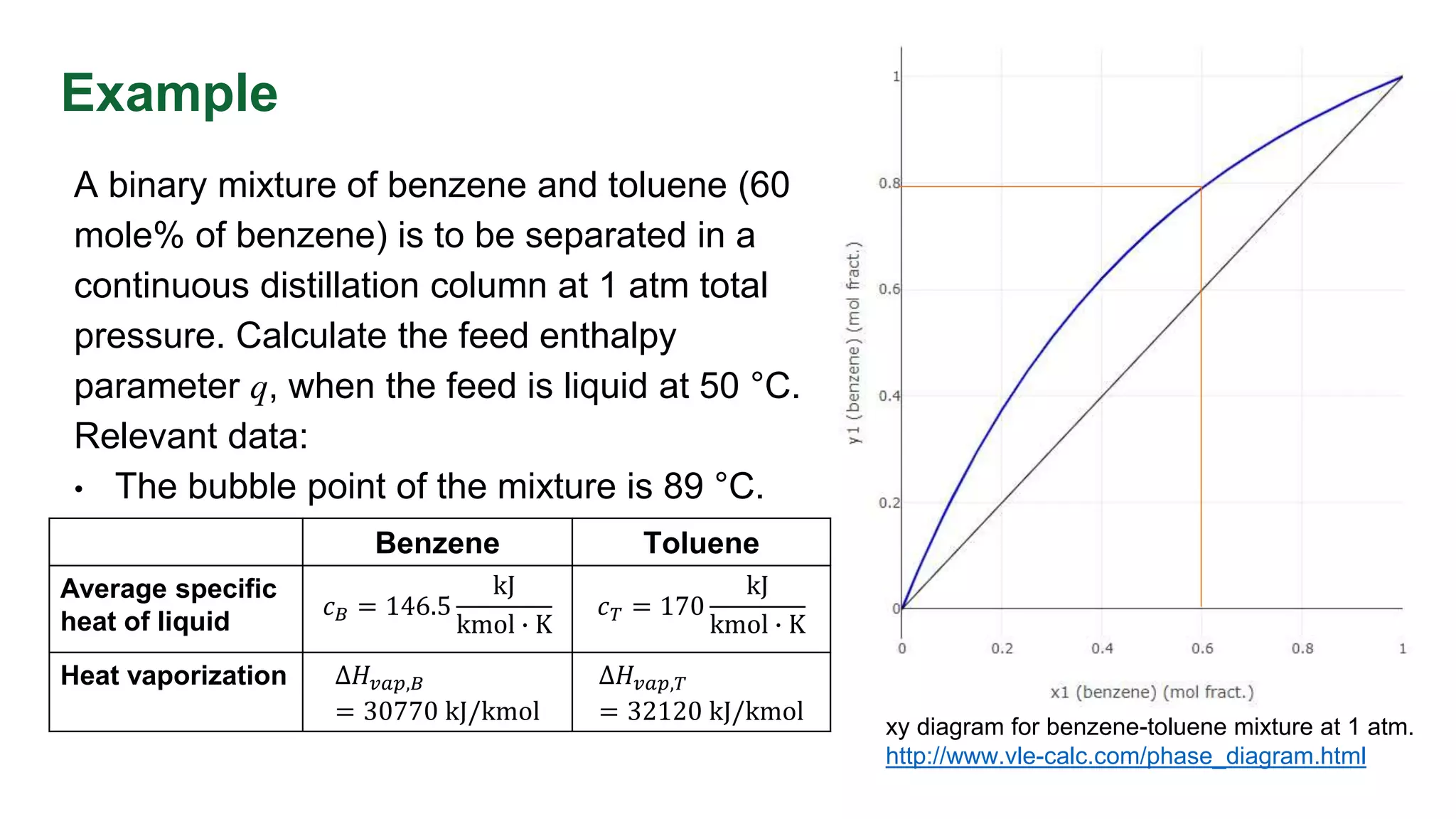
A binary mixture of benzene and toluene (60
mole% of benzene) is to be separated in a
continuous distillation column at 1 atm total
pressure. Calculate the feed enthalpy
parameter q, when the feed is liquid at 50 °C.
Relevant data:
• The bubble point of the mixture is 89 °C.
xy diagram for benzene-toluene mixture at 1 atm.
http://www.vle-calc.com/phase_diagram.html
Benzene Toluene
Average specific
heat of liquid
𝑐𝐵 = 146.5
kJ
kmol ∙ K
𝑐𝑇 = 170
kJ
kmol ∙ K
Heat vaporization Δ𝐻𝑣𝑎𝑝,𝐵
= 30770 kJ/kmol
Δ𝐻𝑣𝑎𝑝,𝑇
= 32120 kJ/kmol
Solution
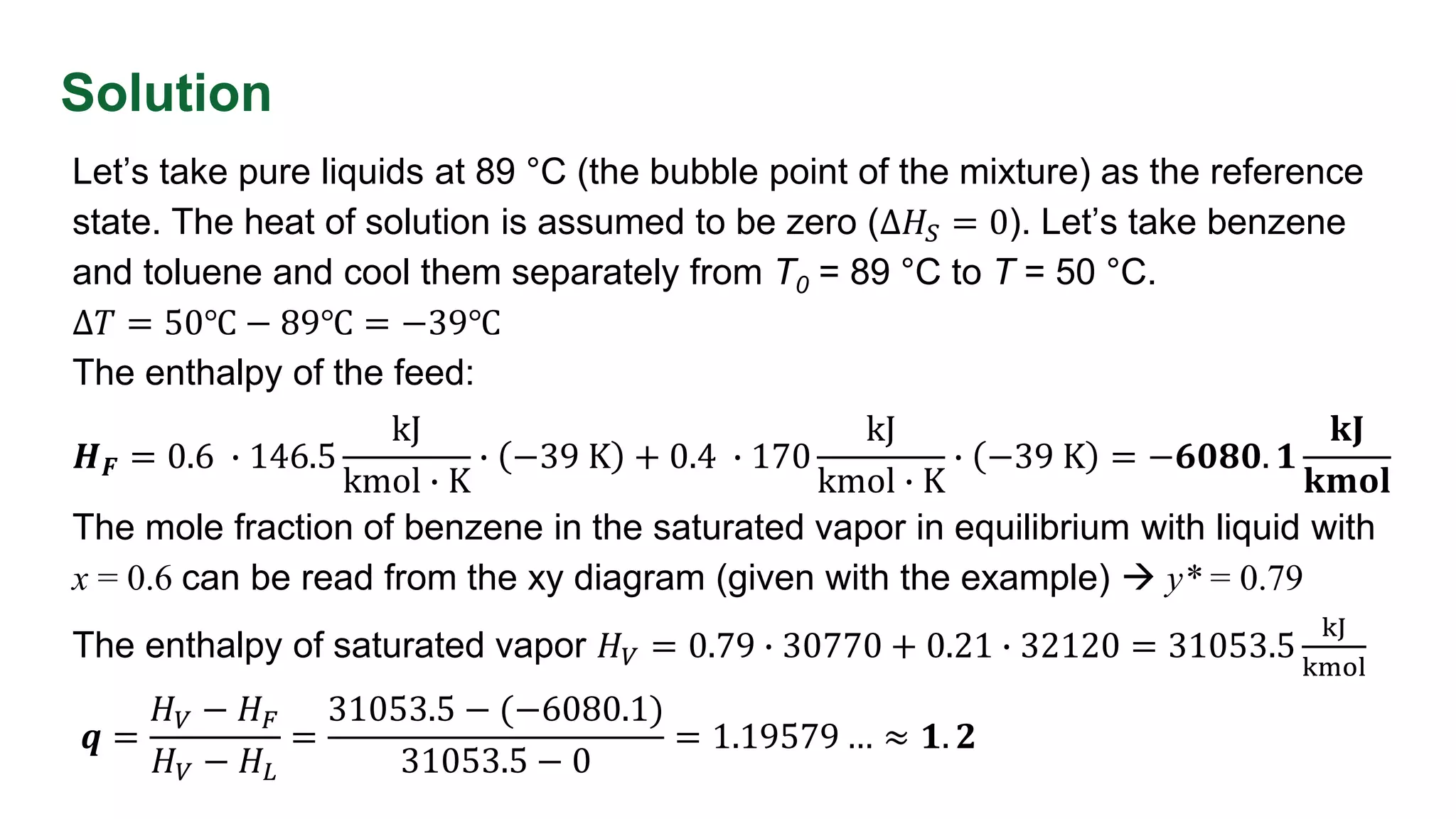
Let’s take pure liquids at 89 °C (the bubble point of the mixture) as the reference
state. The heat of solution is assumed to be zero (Δ𝐻𝑆 = 0). Let’s take benzene
and toluene and cool them separately from T0 = 89 °C to T = 50 °C.
Δ𝑇 = 50℃ − 89℃ = −39℃
The enthalpy of the feed:
𝑯𝑭 = 0.6 ∙ 146.5
kJ
kmol ∙ K
∙ −39 K + 0.4 ∙ 170
kJ
kmol ∙ K
∙ −39 K = −𝟔𝟎𝟖𝟎. 𝟏
𝐤𝐉
𝐤𝐦𝐨𝐥
The mole fraction of benzene in the saturated vapor in equilibrium with liquid with
x = 0.6 can be read from the xy diagram (given with the example)  y* = 0.79
The enthalpy of saturated vapor 𝐻𝑉 = 0.79 ∙ 30770 + 0.21 ∙ 32120 = 31053.5
kJ
kmol
𝒒 =
𝐻𝑉 − 𝐻𝐹
𝐻𝑉 − 𝐻𝐿
=
31053.5 − (−6080.1)
31053.5 − 0
= 1.19579 … ≈ 𝟏. 𝟐
This project has received funding from the European Union’s Horizon 2020
research and innovation programme under grant agreement No 869993.
References
Dutta, B. K. 2007. Principles of mass transfer and separation processes. New Delhi: Prentice-Hall,
pp. 340-343, 367-371.
McCabe, W. L., Smith, J. C. & Harriott,, P. 2005. Unit Operations of Chemical Engineering. 7 th
Edition. New York: McGraw-Hill, pp. 694-701.
Videos:
• Enthalpy Concentration Diagram Example: https://youtu.be/EwlV9RGDcvM (7:56)
• What is Enthalpy? https://youtu.be/SV7U4yAXL5I (11:23)
• Reading an enthalpy-concentration diagram: https://youtu.be/YTlXAMtKWTQ (8:06)

2.3 Enthalpy balances

  • 1.
    This project hasreceived funding from the European Union’s Horizon 2020 research and innovation programme under grant agreement No 869993. Enthalpy balances in distillation
  • 2.
    What is enthalpy? •Enthalpy is a technical term to describe the energy content of a material. • Symbol for enthalpy is H or ΔH. • In molar enthalpy, the unit is kJ/mol. • The enthalpy data can be found from databanks of thermodynamic properties of substances. • In distillation, enthalpy data is often presented in an enthalpy- concentration diagram. Enthalpy-concentration diagram for ethanol- water mixture at 1 atm. (WolframAlpha Demonstration by Binous, Al- Baghli & Higgins, 2012 CC BY-NC-SA)
  • 3.
    Enthalpy in distillation •In McCabe-Thiele method, we usually assume constant molal overflow and the operating lines will then be linear. • If we don’t make this assumption, enthalpy balances would be required in order to perform design calculations. • The actual variations in the liquid and vapor streams depend on the enthalpies of the liquid and vapor mixtures. • Basic calculations can be made by enthalpy balance equations.
  • 4.
    Enthalpy balance equations •Total enthalpy balance: 𝐹𝐻𝐹 + 𝑞𝑟 = 𝐷𝐻𝐷 + 𝐵𝐻𝐵 + 𝑞𝑐 • HF = Feed enthalpy • HD = Enthalpy of the distillate • HB = Enthalpy of the bottom product • qr = Heat supplied at the reboiler • qc = Heat removed from the condenser • When the feed is liquid at the boiling point, HF is between HD and HB and the terms FHF and DHD + BHB nearly cancel.  qr ≈ qc
  • 5.
    Rectifying and strippingsections • Rectifying section: 𝑉𝑛+1𝐻𝑦,𝑛+1 = 𝐿𝑛𝐻𝑥,𝑛 + 𝐷𝐻𝐷 + 𝑞𝑐 • Hy,n+1 = Spesific enthalpy of vapor rising up from plate n+1 • Hx,n = Spesific enthalpy of liquid leaving plate n • An alternate form: 𝑉𝑛+1𝐻𝑦,𝑛+1 = 𝐿𝑛𝐻𝑥,𝑛 + 𝑉𝑅𝐻𝑦,𝑅 − 𝑅𝐻𝐷 Using relation 𝑞𝑐 = 𝑉𝑅𝐻𝑦,𝑅 − 𝑅𝐻𝐷 − 𝐷𝐻𝐷 Note: R=LR • Overall and individual balances: 𝑉𝑛+1 = 𝐿𝑛 + 𝐷 𝑦𝑛+1 = 𝐿𝑛 𝑉𝑛+1 𝑥𝑛 + 𝐷𝑥𝐷 𝑉𝑛+1 LR=R
  • 6.
    Rectifying and strippingsections • Stripping section: 𝑉𝑚+1𝐻𝑦,𝑚+1 = 𝐿𝑚𝐻𝑥,𝑚 − 𝐵𝐻𝐵 + 𝑞𝑟 • Hy,m+1 = Spesific enthalpy of vapor rising up from plate m+1 • Hx,m = Spesific enthalpy of liquid leaving plate m • Equation for the individual balance: 𝑦𝑚+1 = 𝐿𝑚 𝑉𝑚+1 𝑥𝑚 − 𝐵𝑥𝐵 𝑉𝑚+1 • Equation for the overall balance: 𝐿𝑚 = 𝑉𝑚+1 + 𝐵
  • 7.
    Solving equations • Solvingthe equation for rectifying section: 𝑉𝑛+1𝐻𝑦,𝑛+1 = 𝐿𝑛𝐻𝑥,𝑛 + 𝑉𝑅𝐻𝑦,𝑅 − 𝑅𝐻𝐷 • A value of xn is chosen and Hx,n is obtained from an enthalpy-concentration diagram, or it is calculated from the average specific heat and the bubble point. • A satisfactory value for yn+1 can usually be obtained by using the flow rates LR and VR in the individual material balance: 𝑦𝑛+1 = 𝐿𝑛 𝑉𝑛+1 𝑥𝑛 + 𝐷𝑥𝐷 𝑉𝑛+1 • Hy,n+1 is evaluated from yn+1 and Ln is replaced by 𝑉𝑛+1 − 𝐷 (from total material balance 𝑉𝑛+1 = 𝐿𝑛 + 𝐷). • Vn+1 can now be solved from the equation 𝑉𝑛+1𝐻𝑦,𝑛+1 = 𝐿𝑛𝐻𝑥,𝑛 + 𝑉𝑅𝐻𝑦,𝑅 − 𝑅𝐻𝐷 LR=R
  • 8.
    Solving equations • Solvingthe equation for stripping section: 𝑉𝑚+1𝐻𝑦,𝑚+1 = 𝐿𝑚𝐻𝑥,𝑚 − 𝐵𝐻𝐵 + 𝑞𝑟 • Following the same approach: A value of xm is chosen and Hx,m is obtained from enthalpy data. • ym+1 is calculated from equation 𝑦𝑚+1 = 𝐿𝑚 𝑉𝑚+1 𝑥𝑚 − 𝐵𝑥𝐵 𝑉𝑚+1 using LS and VS to approximate Lm and Vm+1 . • Lm is replaced by 𝑉𝑚+1 + 𝐵 (from total material balance). • Hy,m+1 is evaluated from ym+1 . • Vm+1 can now be solved from the equation 𝑉𝑚+1𝐻𝑦,𝑚+1 = 𝐿𝑚𝐻𝑥,𝑚 − 𝐵𝐻𝐵 + 𝑞𝑟
  • 9.
    Feed enthalpy conditionparameter q • The feed enthalpy condition parameter q, which is needed when drawing the feedline (q-line) in McCabe-Thiele method, can be calculated from enthalpies. • 𝑞 = 𝐻𝑉−𝐻𝐹 𝐻𝑉−𝐻𝐿 • If the feed is saturated liquid, HF = HL and q = 1. • If the feed is saturated vapor, HF = HV and q = 0. • For other situations, the feed parameter q can be calculated from enthalpies. Sub-cooled liquid Saturated liquid Partially vaporized Saturated vapor Superheated vapor HF < HL q > 1 HF = HL q = 1 HV > HF > HL 0 < q < 1 HF = HV q = 0 HF > HV q < 0 𝑞 = 𝐻𝑉 − 𝐻𝐹 𝐻𝑉 − 𝐻𝐿 HL = molar enthalpy of liquid HV = molar enthalpy of vapor HF = molar enthalpy of feed Enthalpies and values of parameter q with different feed compositions.
  • 10.
    Example A binary mixtureof benzene and toluene (60 mole% of benzene) is to be separated in a continuous distillation column at 1 atm total pressure. Calculate the feed enthalpy parameter q, when the feed is liquid at 50 °C. Relevant data: • The bubble point of the mixture is 89 °C. xy diagram for benzene-toluene mixture at 1 atm. http://www.vle-calc.com/phase_diagram.html Benzene Toluene Average specific heat of liquid 𝑐𝐵 = 146.5 kJ kmol ∙ K 𝑐𝑇 = 170 kJ kmol ∙ K Heat vaporization Δ𝐻𝑣𝑎𝑝,𝐵 = 30770 kJ/kmol Δ𝐻𝑣𝑎𝑝,𝑇 = 32120 kJ/kmol
  • 11.
    Solution Let’s take pureliquids at 89 °C (the bubble point of the mixture) as the reference state. The heat of solution is assumed to be zero (Δ𝐻𝑆 = 0). Let’s take benzene and toluene and cool them separately from T0 = 89 °C to T = 50 °C. Δ𝑇 = 50℃ − 89℃ = −39℃ The enthalpy of the feed: 𝑯𝑭 = 0.6 ∙ 146.5 kJ kmol ∙ K ∙ −39 K + 0.4 ∙ 170 kJ kmol ∙ K ∙ −39 K = −𝟔𝟎𝟖𝟎. 𝟏 𝐤𝐉 𝐤𝐦𝐨𝐥 The mole fraction of benzene in the saturated vapor in equilibrium with liquid with x = 0.6 can be read from the xy diagram (given with the example)  y* = 0.79 The enthalpy of saturated vapor 𝐻𝑉 = 0.79 ∙ 30770 + 0.21 ∙ 32120 = 31053.5 kJ kmol 𝒒 = 𝐻𝑉 − 𝐻𝐹 𝐻𝑉 − 𝐻𝐿 = 31053.5 − (−6080.1) 31053.5 − 0 = 1.19579 … ≈ 𝟏. 𝟐
  • 12.
    This project hasreceived funding from the European Union’s Horizon 2020 research and innovation programme under grant agreement No 869993. References Dutta, B. K. 2007. Principles of mass transfer and separation processes. New Delhi: Prentice-Hall, pp. 340-343, 367-371. McCabe, W. L., Smith, J. C. & Harriott,, P. 2005. Unit Operations of Chemical Engineering. 7 th Edition. New York: McGraw-Hill, pp. 694-701. Videos: • Enthalpy Concentration Diagram Example: https://youtu.be/EwlV9RGDcvM (7:56) • What is Enthalpy? https://youtu.be/SV7U4yAXL5I (11:23) • Reading an enthalpy-concentration diagram: https://youtu.be/YTlXAMtKWTQ (8:06)