2D Geometric Transformations
Total Slide (51)
1
Geometric transformation means change in
 Place
 orientation
 Size
 Shape.
2
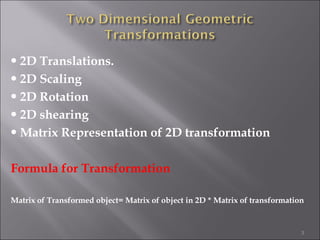
2D Translations.
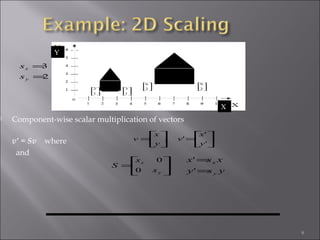
2D Scaling
2D Rotation
2D shearing
Matrix Representation of 2D transformation
Formula for Transformation
Matrix of Transformed object= Matrix of object in 2D * Matrix of transformation
3
4
x y
x
y
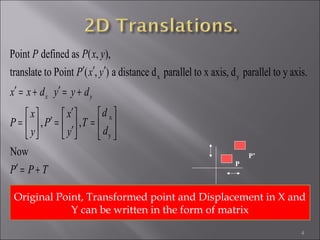
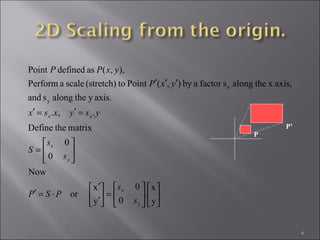
Point defined as ( , ),
translate to Point ( , ) a distance d parallel to x axis, d parallel to y axis.
, ,
Now
x y
P P x y
P x y
x x d y y d
dx x
P P T
dy y
P P T
′ ′ ′
′ ′= + = +
′     
′= = =     ′     
′ = +
P
P’
Original Point, Transformed point and Displacement in X and
Y can be written in the form of matrix
5
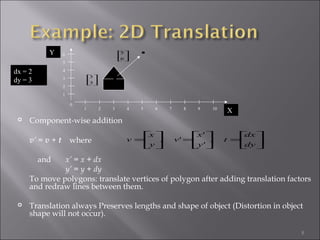
 Component-wise addition
v’ = v + t where
and x’ = x + dx
y’ = y + dy
To move polygons: translate vertices of polygon after adding translation factors
and redraw lines between them.
 Translation always Preserves lengths and shape of object (Distortion in object
shape will not occur).
dx = 2
dy = 3
Y
X
0
1
1
2
2
3 4 5 6 7 8 9 10
3
4
5
6






=





=





=
dy
dx
t
y
x
v
y
x
v ,
'
'
',






3
3






6
5
6












=





′
′
⋅=′






=
=′=′
′′′
y
x
.
0
0
y
x
or
Now
0
0
matrixtheDefine
.,.
axis.ythealongsand
axis,xthealongsfactoraby),(Pointto(stretch)scaleaPerform
),,(asdefinedPoint
y
x
y
x
y
x
yx
s
s
PSP
s
s
S
ysyxsx
yxP
yxPP
P
P’
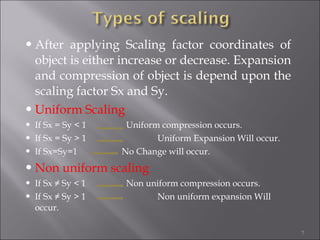
After applying Scaling factor coordinates of
object is either increase or decrease. Expansion
and compression of object is depend upon the
scaling factor Sx and Sy.
Uniform Scaling
 If Sx = Sy < 1 Uniform compression occurs.
 If Sx = Sy > 1 Uniform Expansion Will occur.
 If Sx=Sy=1 No Change will occur.
Non uniform scaling
 If Sx ≠ Sy < 1 Non uniform compression occurs.
 If Sx ≠ Sy > 1 Non uniform expansion Will
occur.
7
 Uniform Scaling
 Non Uniform scaling
8
9
 Component-wise scalar multiplication of vectors
v’ = Sv where
and






=





=
'
'
',
y
x
v
y
x
v






=
y
x
s
s
S
0
0
ysy
xsx
y
x
=
=
'
'
Y
X
0
1
1
2
2
3 4 5 6 7 8 9 10
3
4
5
6
2
3
=
=
y
x
s
s






1
2






1
3 





2
6






2
9
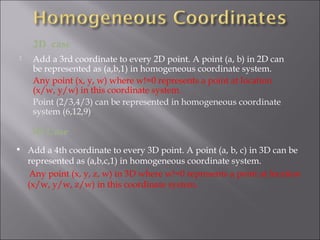
 Add a 3rd coordinate to every 2D point. A point (a, b) in 2D can
be represented as (a,b,1) in homogeneous coordinate system.
Any point (x, y, w) where w!=0 represents a point at location
(x/w, y/w) in this coordinate system.
Point (2/3,4/3) can be represented in homogeneous coordinate
system (6,12,9)
2D case
3D Case
• Add a 4th coordinate to every 3D point. A point (a, b, c) in 3D can be
represented as (a,b,c,1) in homogeneous coordinate system.
Any point (x, y, z, w) in 3D where w!=0 represents a point at location
(x/w, y/w, z/w) in this coordinate system.
11
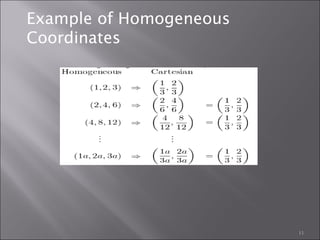
Example of Homogeneous
Coordinates
 Object coordinates are (00,10,11,01) Perform uniform expansion of this
object. Take scaling factor from your side.Draw final Figure also.
12
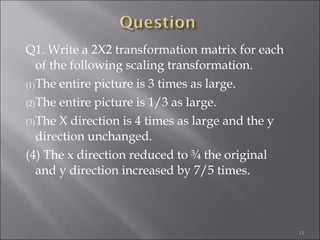
Q1. Write a 2X2 transformation matrix for each
of the following scaling transformation.
(1)The entire picture is 3 times as large.
(2)The entire picture is 1/3 as large.
(3)The X direction is 4 times as large and the y
direction unchanged.
(4) The x direction reduced to ¾ the original
and y direction increased by 7/5 times.
13
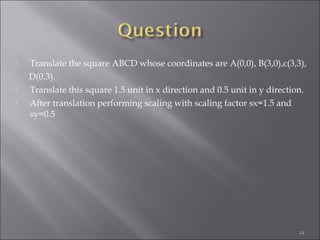
 Translate the square ABCD whose coordinates are A(0,0), B(3,0),c(3,3),
D(0,3).
 Translate this square 1.5 unit in x direction and 0.5 unit in y direction.
 After translation performing scaling with scaling factor sx=1.5 and
sy=0.5
14
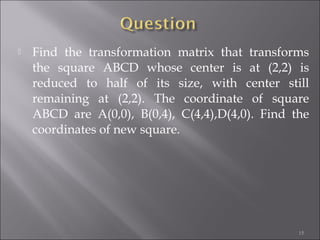
 Find the transformation matrix that transforms
the square ABCD whose center is at (2,2) is
reduced to half of its size, with center still
remaining at (2,2). The coordinate of square
ABCD are A(0,0), B(0,4), C(4,4),D(4,0). Find the
coordinates of new square.
15
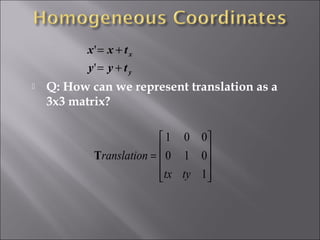
 Q: How can we represent translation as a
3x3 matrix?
y
x
tyy
txx
+=
+=
'
'










=
1
010
001
tytx
ranslationT
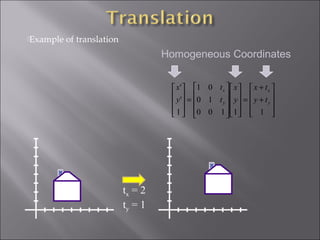
Example of translation










+
+
=




















=










11100
10
01
1
'
'
y
x
y
x
ty
tx
y
x
t
t
y
x
tx = 2
ty = 1
Homogeneous Coordinates
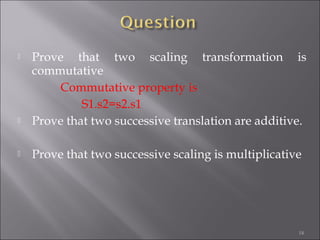
 Prove that two scaling transformation is
commutative
Commutative property is
S1.s2=s2.s1
 Prove that two successive translation are additive.
 Prove that two successive scaling is multiplicative
18
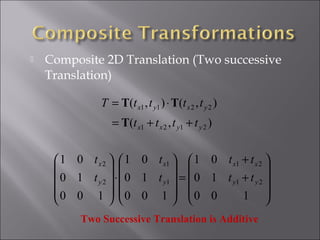
 Composite 2D Translation (Two successive
Translation)
),(
),(),(
2121
2211
yyxx
yxyx
tttt
ttttT
++=
⋅=
T
TT










+
+
=










⋅










100
10
01
100
10
01
100
10
01
21
21
1
1
2
2
yy
xx
y
x
y
x
tt
tt
t
t
t
t
Two Successive Translation is Additive
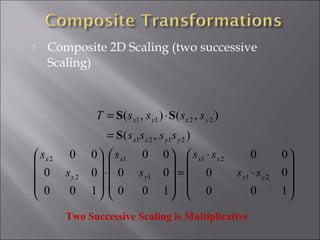
 Composite 2D Scaling (two successive
Scaling)
),(
),(),(
2121
2211
yyxx
yxyx
ssss
ssssT
S
SS
=
⋅=










⋅
⋅
=










⋅










100
00
00
100
00
00
100
00
00
21
21
1
1
2
2
yy
xx
y
x
y
x
ss
ss
s
s
s
s
Two Successive Scaling is Multiplicative
21
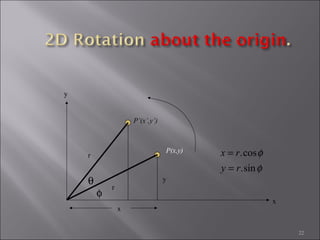
2D Rotation
22
y
x
r
r
P’(x’,y’)
P(x,y)
θ
φ
y
φ
φ
sin.
cos.
ry
rx
=
=
x
23
y
x
r
r
P’(x’,y’)
P(x,y)
θ
φ
y
φ
φ
sin.
cos.
ry
rx
=
=
x
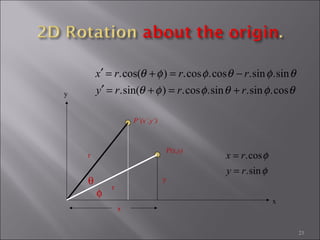
θφθφφθ
θφθφφθ
cos.sin.sin.cos.)sin(.
sin.sin.cos.cos.)cos(.
rrry
rrrx
+=+=′
−=+=′
24
φ
φ
sin.
cos.
ry
rx
=
=
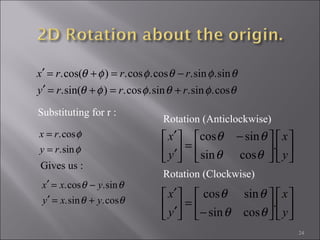
θφθφφθ
θφθφφθ
cos.sin.sin.cos.)sin(.
sin.sin.cos.cos.)cos(.
rrry
rrrx
+=+=′
−=+=′
Substituting for r :
Gives us :
θθ
θθ
cos.sin.
sin.cos.
yxy
yxx
+=′
−=′











 −
=





′
′
y
x
y
x
.
cossin
sincos
θθ
θθ
Rotation (Anticlockwise)












−
=





′
′
y
x
y
x
.
cossin
sincos
θθ
θθ
Rotation (Clockwise)
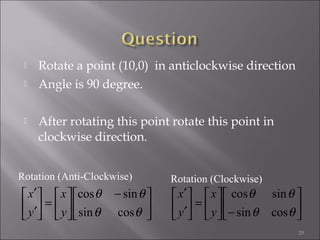
 Rotate a point (10,0) in anticlockwise direction
 Angle is 90 degree.
 After rotating this point rotate this point in
clockwise direction.
25





 −






=





′
′
θθ
θθ
cossin
sincos
y
x
y
x






−





=





′
′
θθ
θθ
cossin
sincos
y
x
y
x
Rotation (Clockwise)Rotation (Anti-Clockwise)
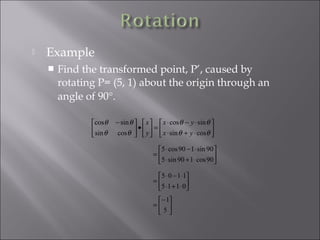
 Example
 Find the transformed point, P’, caused by
rotating P= (5, 1) about the origin through an
angle of 90°.






⋅+⋅
⋅−⋅
=





•




 −
θθ
θθ
θθ
θθ
cossin
sincos
cossin
sincos
yx
yx
y
x






⋅+⋅
⋅−⋅
=
90cos190sin5
90sin190cos5






⋅+⋅
⋅−⋅
=
0115
1105





−
=
5
1
27
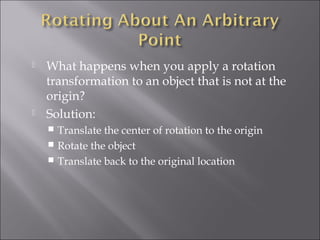
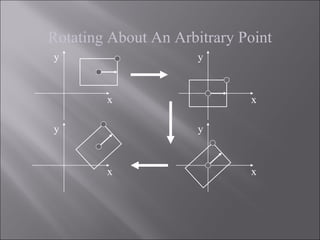
 What happens when you apply a rotation
transformation to an object that is not at the
origin?
 Solution:
 Translate the center of rotation to the origin
 Rotate the object
 Translate back to the original location
 In matrix form, it can be shown as
Here
 TR is Translation Matrix (Translation towards Origin)
 RƟ is Rotation Matrix (Rotation Matrix can be clockwise and
anticlockwise Rotation)
 TR
-1
is Translation matrix (Away from origin)
29
[ ] [ ][ ][ ]
1
R RT T R Tθ
−
=
Rotating About An Arbitrary Point
x
y
x
y
x
y
x
y
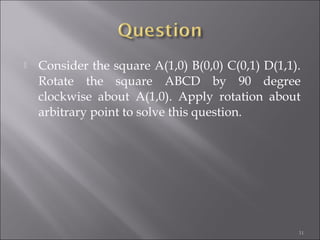
 Consider the square A(1,0) B(0,0) C(0,1) D(1,1).
Rotate the square ABCD by 90 degree
clockwise about A(1,0). Apply rotation about
arbitrary point to solve this question.
31
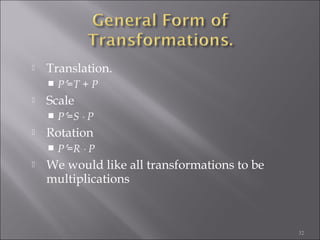
 Translation.
 P′=T + P
 Scale
 P′=S ⋅ P
 Rotation
 P′=R ⋅ P
 We would like all transformations to be
multiplications
32
33
 Translate [1,3] by [7,9]
 Scale [2,3] by 5 in the X direction and 10 in the Y direction

Rotate [2,2] by 90°
(π/2)










=










⋅










1
12
8
1
3
1
100
910
701










=










⋅










1
30
10
1
3
2
100
0100
005









−
=










⋅









 −
=










⋅









 −
1
2
2
1
2
2
100
001
010
1
2
2
100
0)2/cos()2/sin(
0)2/sin()2/cos(
ππ
ππ
34
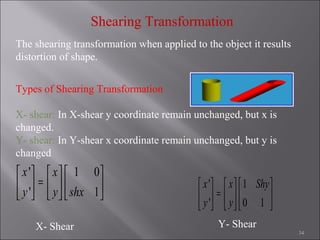
Shearing Transformation
The shearing transformation when applied to the object it results
distortion of shape.
Types of Shearing Transformation
X- shear: In X-shear y coordinate remain unchanged, but x is
changed.
Y- shear: In Y-shear x coordinate remain unchanged, but y is
changed
' 1
' 0 1
x x Shy
y y
     
=     
     
X- Shear Y- Shear
' 1 0
' 1
x x
y y shx
     
=     
     
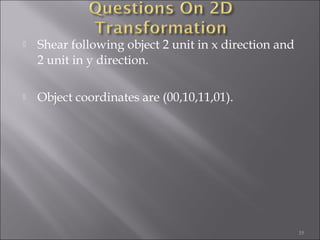
 Shear following object 2 unit in x direction and
2 unit in y direction.
 Object coordinates are (00,10,11,01).
35
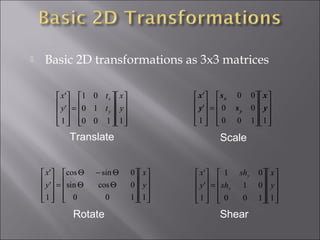
 Basic 2D transformations as 3x3 matrices




















ΘΘ
Θ−Θ
=










1100
0cossin
0sincos
1
'
'
y
x
y
x




















=










1100
10
01
1
'
'
y
x
t
t
y
x
y
x




















=










1100
01
01
1
'
'
y
x
sh
sh
y
x
x
y
Translate
Rotate Shear




















=










1100
00
00
1
'
'
y
x
s
s
y
x
y
x
Scale
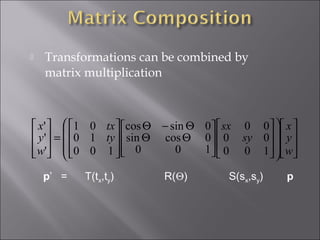
 Transformations can be combined by
matrix multiplication
































ΘΘ
Θ−Θ








=








w
y
x
sy
sx
ty
tx
w
y
x
100
00
00
100
0cossin
0sincos
100
10
01
'
'
'
p’ = T(tx,ty) R(Θ) S(sx,sy) p
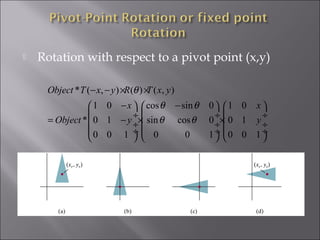
 Rotation with respect to a pivot point (x,y)
* ( , ) ( ) ( , )
1 0 cos sin 0 1 0
* 0 1 sin cos 0 0 1
0 0 1 0 0 1 0 0 1
Object T x y R T x y
x x
Object y y
θ
θ θ
θ θ
− − × ×
− −     
 ÷  ÷  ÷
= − × × ÷  ÷  ÷
 ÷  ÷  ÷
     
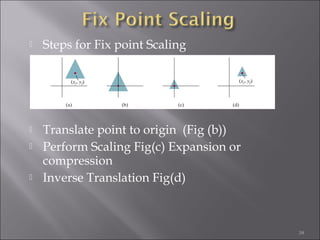
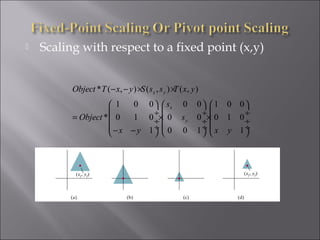
 Steps for Fix point Scaling
 Translate point to origin (Fig (b))
 Perform Scaling Fig(c) Expansion or
compression
 Inverse Translation Fig(d)
39
 Scaling with respect to a fixed point (x,y)
* ( , ) ( , ) ( , )
1 0 0 0 0 1 0 0
* 0 1 0 0 0 0 1 0
1 0 0 1 1
x y
x
y
Object T x y S s s T x y
s
Object s
x y x y
− − × ×
     
 ÷  ÷  ÷
= × × ÷  ÷  ÷
 ÷  ÷  ÷− −     
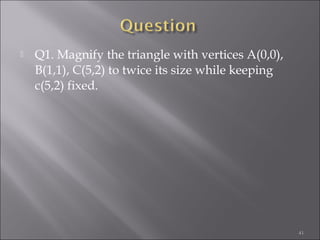
 Q1. Magnify the triangle with vertices A(0,0),
B(1,1), C(5,2) to twice its size while keeping
c(5,2) fixed.
41
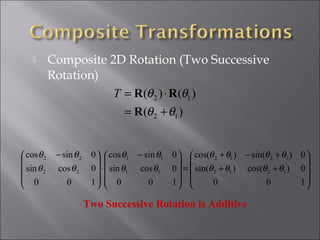
 Composite 2D Rotation (Two Successive
Rotation)
)(
)()(
12
12
θθ
θθ
+=
⋅=
R
RRT










++
+−+
=









 −
⋅









 −
100
0)cos()sin(
0)sin()cos(
100
0cossin
0sincos
100
0cossin
0sincos
1212
1212
11
11
22
22
θθθθ
θθθθ
θθ
θθ
θθ
θθ
Two Successive Rotation is Additive
43
Thanks !!

2 d transformation

  • 1.
  • 2.
    Geometric transformation meanschange in  Place  orientation  Size  Shape. 2
  • 3.
    2D Translations. 2D Scaling 2DRotation 2D shearing Matrix Representation of 2D transformation Formula for Transformation Matrix of Transformed object= Matrix of object in 2D * Matrix of transformation 3
  • 4.
    4 x y x y Point definedas ( , ), translate to Point ( , ) a distance d parallel to x axis, d parallel to y axis. , , Now x y P P x y P x y x x d y y d dx x P P T dy y P P T ′ ′ ′ ′ ′= + = + ′      ′= = =     ′      ′ = + P P’ Original Point, Transformed point and Displacement in X and Y can be written in the form of matrix
  • 5.
    5  Component-wise addition v’= v + t where and x’ = x + dx y’ = y + dy To move polygons: translate vertices of polygon after adding translation factors and redraw lines between them.  Translation always Preserves lengths and shape of object (Distortion in object shape will not occur). dx = 2 dy = 3 Y X 0 1 1 2 2 3 4 5 6 7 8 9 10 3 4 5 6       =      =      = dy dx t y x v y x v , ' ' ',       3 3       6 5
  • 6.
  • 7.
    After applying Scalingfactor coordinates of object is either increase or decrease. Expansion and compression of object is depend upon the scaling factor Sx and Sy. Uniform Scaling  If Sx = Sy < 1 Uniform compression occurs.  If Sx = Sy > 1 Uniform Expansion Will occur.  If Sx=Sy=1 No Change will occur. Non uniform scaling  If Sx ≠ Sy < 1 Non uniform compression occurs.  If Sx ≠ Sy > 1 Non uniform expansion Will occur. 7
  • 8.
     Uniform Scaling Non Uniform scaling 8
  • 9.
    9  Component-wise scalarmultiplication of vectors v’ = Sv where and       =      = ' ' ', y x v y x v       = y x s s S 0 0 ysy xsx y x = = ' ' Y X 0 1 1 2 2 3 4 5 6 7 8 9 10 3 4 5 6 2 3 = = y x s s       1 2       1 3       2 6       2 9
  • 10.
     Add a3rd coordinate to every 2D point. A point (a, b) in 2D can be represented as (a,b,1) in homogeneous coordinate system. Any point (x, y, w) where w!=0 represents a point at location (x/w, y/w) in this coordinate system. Point (2/3,4/3) can be represented in homogeneous coordinate system (6,12,9) 2D case 3D Case • Add a 4th coordinate to every 3D point. A point (a, b, c) in 3D can be represented as (a,b,c,1) in homogeneous coordinate system. Any point (x, y, z, w) in 3D where w!=0 represents a point at location (x/w, y/w, z/w) in this coordinate system.
  • 11.
  • 12.
     Object coordinatesare (00,10,11,01) Perform uniform expansion of this object. Take scaling factor from your side.Draw final Figure also. 12
  • 13.
    Q1. Write a2X2 transformation matrix for each of the following scaling transformation. (1)The entire picture is 3 times as large. (2)The entire picture is 1/3 as large. (3)The X direction is 4 times as large and the y direction unchanged. (4) The x direction reduced to ¾ the original and y direction increased by 7/5 times. 13
  • 14.
     Translate thesquare ABCD whose coordinates are A(0,0), B(3,0),c(3,3), D(0,3).  Translate this square 1.5 unit in x direction and 0.5 unit in y direction.  After translation performing scaling with scaling factor sx=1.5 and sy=0.5 14
  • 15.
     Find thetransformation matrix that transforms the square ABCD whose center is at (2,2) is reduced to half of its size, with center still remaining at (2,2). The coordinate of square ABCD are A(0,0), B(0,4), C(4,4),D(4,0). Find the coordinates of new square. 15
  • 16.
     Q: Howcan we represent translation as a 3x3 matrix? y x tyy txx += += ' '           = 1 010 001 tytx ranslationT
  • 17.
  • 18.
     Prove thattwo scaling transformation is commutative Commutative property is S1.s2=s2.s1  Prove that two successive translation are additive.  Prove that two successive scaling is multiplicative 18
  • 19.
     Composite 2DTranslation (Two successive Translation) ),( ),(),( 2121 2211 yyxx yxyx tttt ttttT ++= ⋅= T TT           + + =           ⋅           100 10 01 100 10 01 100 10 01 21 21 1 1 2 2 yy xx y x y x tt tt t t t t Two Successive Translation is Additive
  • 20.
     Composite 2DScaling (two successive Scaling) ),( ),(),( 2121 2211 yyxx yxyx ssss ssssT S SS = ⋅=           ⋅ ⋅ =           ⋅           100 00 00 100 00 00 100 00 00 21 21 1 1 2 2 yy xx y x y x ss ss s s s s Two Successive Scaling is Multiplicative
  • 21.
  • 22.
  • 23.
  • 24.
    24 φ φ sin. cos. ry rx = = θφθφφθ θφθφφθ cos.sin.sin.cos.)sin(. sin.sin.cos.cos.)cos(. rrry rrrx +=+=′ −=+=′ Substituting for r: Gives us : θθ θθ cos.sin. sin.cos. yxy yxx +=′ −=′             − =      ′ ′ y x y x . cossin sincos θθ θθ Rotation (Anticlockwise)             − =      ′ ′ y x y x . cossin sincos θθ θθ Rotation (Clockwise)
  • 25.
     Rotate apoint (10,0) in anticlockwise direction  Angle is 90 degree.  After rotating this point rotate this point in clockwise direction. 25       −       =      ′ ′ θθ θθ cossin sincos y x y x       −      =      ′ ′ θθ θθ cossin sincos y x y x Rotation (Clockwise)Rotation (Anti-Clockwise)
  • 26.
     Example  Findthe transformed point, P’, caused by rotating P= (5, 1) about the origin through an angle of 90°.       ⋅+⋅ ⋅−⋅ =      •      − θθ θθ θθ θθ cossin sincos cossin sincos yx yx y x       ⋅+⋅ ⋅−⋅ = 90cos190sin5 90sin190cos5       ⋅+⋅ ⋅−⋅ = 0115 1105      − = 5 1
  • 27.
  • 28.
     What happenswhen you apply a rotation transformation to an object that is not at the origin?  Solution:  Translate the center of rotation to the origin  Rotate the object  Translate back to the original location
  • 29.
     In matrixform, it can be shown as Here  TR is Translation Matrix (Translation towards Origin)  RƟ is Rotation Matrix (Rotation Matrix can be clockwise and anticlockwise Rotation)  TR -1 is Translation matrix (Away from origin) 29 [ ] [ ][ ][ ] 1 R RT T R Tθ − =
  • 30.
    Rotating About AnArbitrary Point x y x y x y x y
  • 31.
     Consider thesquare A(1,0) B(0,0) C(0,1) D(1,1). Rotate the square ABCD by 90 degree clockwise about A(1,0). Apply rotation about arbitrary point to solve this question. 31
  • 32.
     Translation.  P′=T+ P  Scale  P′=S ⋅ P  Rotation  P′=R ⋅ P  We would like all transformations to be multiplications 32
  • 33.
    33  Translate [1,3]by [7,9]  Scale [2,3] by 5 in the X direction and 10 in the Y direction  Rotate [2,2] by 90° (π/2)           =           ⋅           1 12 8 1 3 1 100 910 701           =           ⋅           1 30 10 1 3 2 100 0100 005          − =           ⋅           − =           ⋅           − 1 2 2 1 2 2 100 001 010 1 2 2 100 0)2/cos()2/sin( 0)2/sin()2/cos( ππ ππ
  • 34.
    34 Shearing Transformation The shearingtransformation when applied to the object it results distortion of shape. Types of Shearing Transformation X- shear: In X-shear y coordinate remain unchanged, but x is changed. Y- shear: In Y-shear x coordinate remain unchanged, but y is changed ' 1 ' 0 1 x x Shy y y       =            X- Shear Y- Shear ' 1 0 ' 1 x x y y shx       =           
  • 35.
     Shear followingobject 2 unit in x direction and 2 unit in y direction.  Object coordinates are (00,10,11,01). 35
  • 36.
     Basic 2Dtransformations as 3x3 matrices                     ΘΘ Θ−Θ =           1100 0cossin 0sincos 1 ' ' y x y x                     =           1100 10 01 1 ' ' y x t t y x y x                     =           1100 01 01 1 ' ' y x sh sh y x x y Translate Rotate Shear                     =           1100 00 00 1 ' ' y x s s y x y x Scale
  • 37.
     Transformations canbe combined by matrix multiplication                                 ΘΘ Θ−Θ         =         w y x sy sx ty tx w y x 100 00 00 100 0cossin 0sincos 100 10 01 ' ' ' p’ = T(tx,ty) R(Θ) S(sx,sy) p
  • 38.
     Rotation withrespect to a pivot point (x,y) * ( , ) ( ) ( , ) 1 0 cos sin 0 1 0 * 0 1 sin cos 0 0 1 0 0 1 0 0 1 0 0 1 Object T x y R T x y x x Object y y θ θ θ θ θ − − × × − −       ÷  ÷  ÷ = − × × ÷  ÷  ÷  ÷  ÷  ÷      
  • 39.
     Steps forFix point Scaling  Translate point to origin (Fig (b))  Perform Scaling Fig(c) Expansion or compression  Inverse Translation Fig(d) 39
  • 40.
     Scaling withrespect to a fixed point (x,y) * ( , ) ( , ) ( , ) 1 0 0 0 0 1 0 0 * 0 1 0 0 0 0 1 0 1 0 0 1 1 x y x y Object T x y S s s T x y s Object s x y x y − − × ×        ÷  ÷  ÷ = × × ÷  ÷  ÷  ÷  ÷  ÷− −     
  • 41.
     Q1. Magnifythe triangle with vertices A(0,0), B(1,1), C(5,2) to twice its size while keeping c(5,2) fixed. 41
  • 42.
     Composite 2DRotation (Two Successive Rotation) )( )()( 12 12 θθ θθ += ⋅= R RRT           ++ +−+ =           − ⋅           − 100 0)cos()sin( 0)sin()cos( 100 0cossin 0sincos 100 0cossin 0sincos 1212 1212 11 11 22 22 θθθθ θθθθ θθ θθ θθ θθ Two Successive Rotation is Additive
  • 43.