2D TRANSFORMATIONS
2D Transformations
• What is transformations?
– The geometrical changes of an object from a
current state to modified state.
• Why the transformations is needed?
– To manipulate the initially created object and to
display the modified object without having to
redraw it.
• 2 ways
– Object Transformation
• Alter the coordinates descriptions an object
• Translation, rotation, scaling etc.
• Coordinate system unchanged
– Coordinate transformation
• Produce a different coordinate system
2D Transformations
Matrix Math
• Why do we use matrix?
– More convenient organization of data.
– More efficient processing
– Enable the combination of various
concatenations
Translation
• A translation moves all points
in an object along the same
straight-line path to new
positions[ Linear
Displacement].
• The path is represented by a
vector, called the translation or
shift vector.
• We can write the components:
X’ = X + tx
Y’ = Y+ ty
• or in matrix form:
P' = P + T
tx
ty
x’
y’
x
y
tx
ty
= +
(2, 2)
= 6
=4
?
Rotation
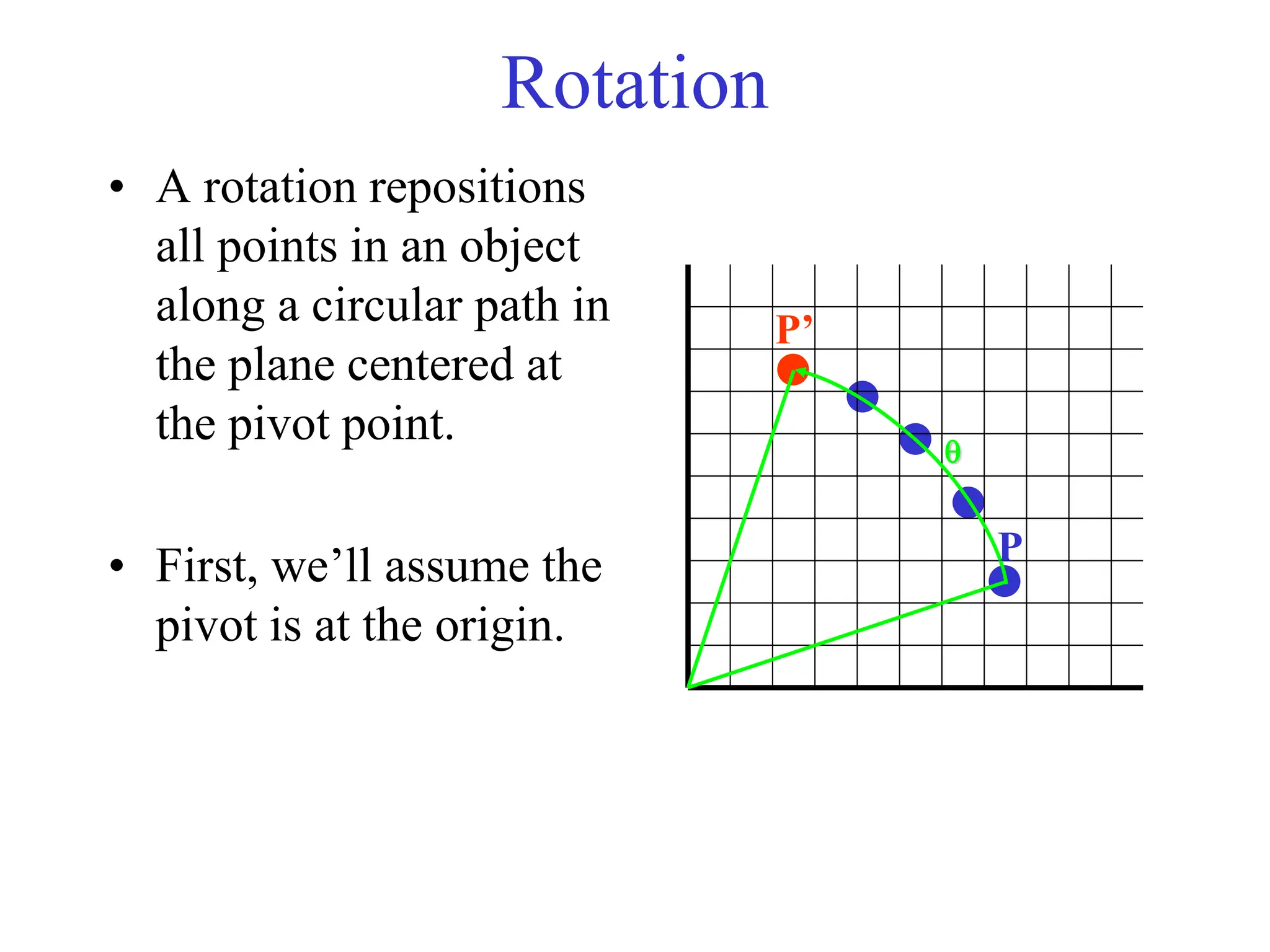
• A rotation repositions
all points in an object
along a circular path in
the plane centered at
the pivot point.
• First, we’ll assume the
pivot is at the origin.

P
P’
Rotation
• Review Trigonometry
=> cos  = x/r , sin = y/r
• x = r. cos , y = r.sin 


P(x,y)
x
y
r
x’
y’

P’(x’, y’)
r
=> cos (+ ) = x’/r
•x’ = r. cos (+ )
•x’ = r.coscos -r.sinsin
•x’ = x.cos  – y.sin 
=>sin (+ ) = y’/r
y’ = r. sin (+ )
•y’ = r.cossin + r.sincos
•y’ = x.sin  + y.cos 
Identity of Trigonometry
Rotation
• We can write the components:
p'x = px cos  – py sin 
p'y = px sin  + py cos 
• or in matrix form:
P' = R • P
•  can be clockwise (-ve) or
counterclockwise (+ve as our
example).
• Rotation matrix

P(x,y)

x
y
r
x’
y’

P’(x’, y’)





 





cos
sin
sin
cos
R
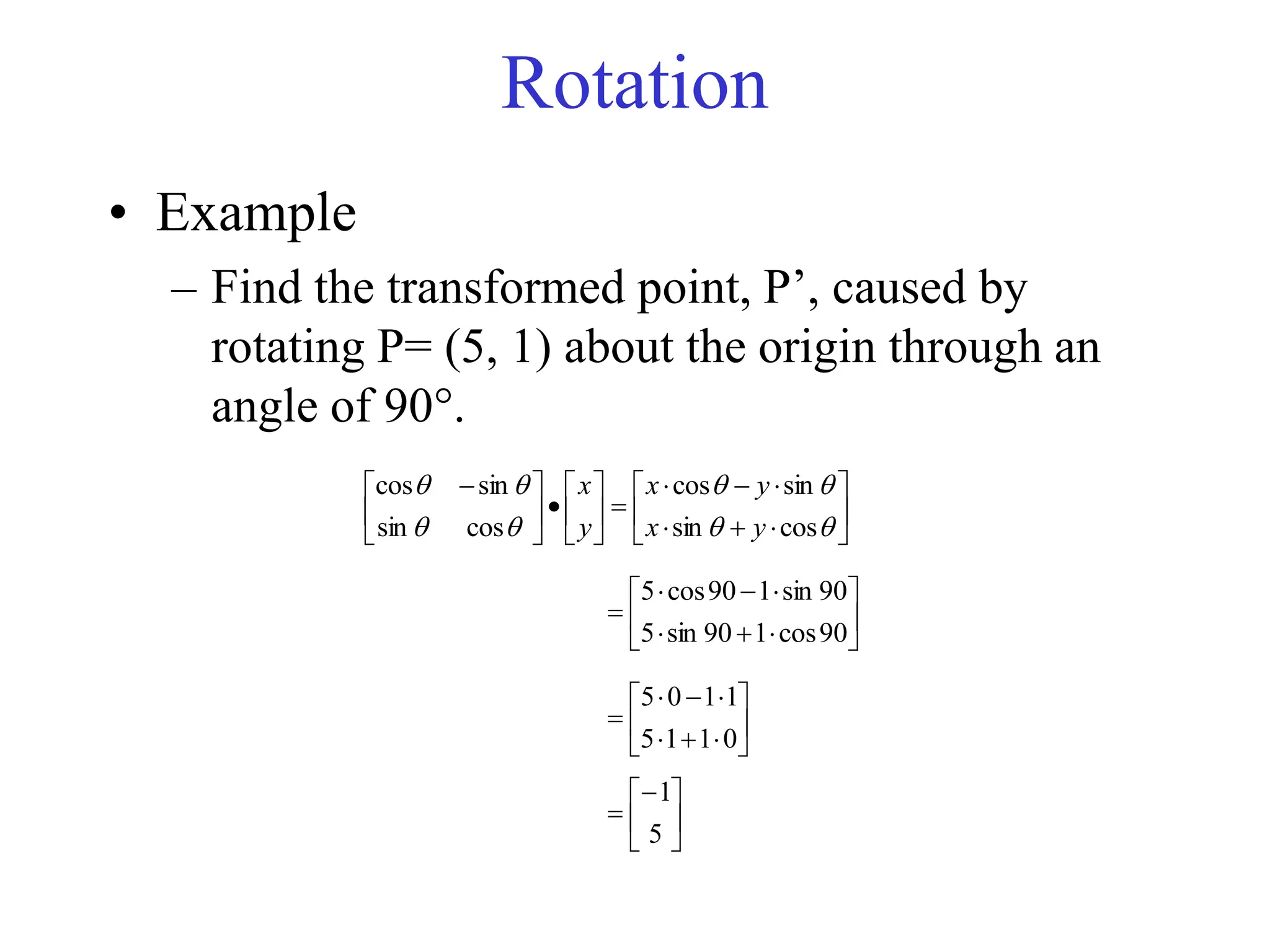
• Example
– Find the transformed point, P’, caused by
rotating P= (5, 1) about the origin through an
angle of 90.
Rotation

























 








cos
sin
sin
cos
cos
sin
sin
cos
y
x
y
x
y
x













90
cos
1
90
sin
5
90
sin
1
90
cos
5













0
1
1
5
1
1
0
5







5
1
Scaling
• Scaling changes the size of an
object and involves two scale
factors, Sx and Sy for the x-
and y- coordinates
respectively.
• Scales are about the origin.
• We can write the components:
p'x = sx • px
p'y = sy • py
or in matrix form:
P' = S • P
Scale matrix as:







y
x
s
s
S
0
0
P
P’
Scaling
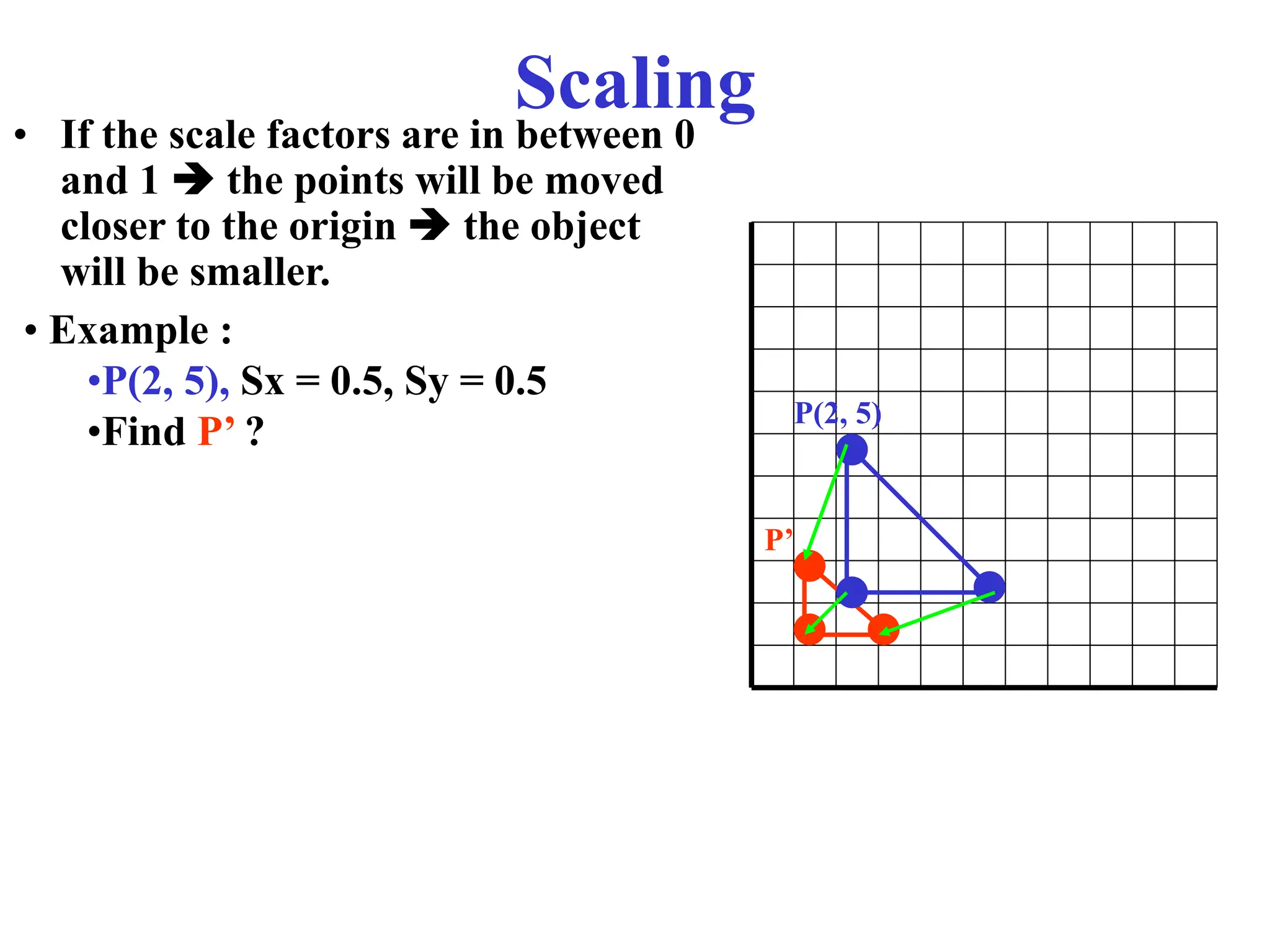
• If the scale factors are in between 0
and 1  the points will be moved
closer to the origin  the object
will be smaller.
P(2, 5)
P’
• Example :
•P(2, 5), Sx = 0.5, Sy = 0.5
•Find P’ ?
Scaling
• If the scale factors are in between 0
and 1  the points will be moved
closer to the origin  the object
will be smaller.
P(2, 5)
P’
• Example :
•P(2, 5), Sx = 0.5, Sy = 0.5
•Find P’ ?
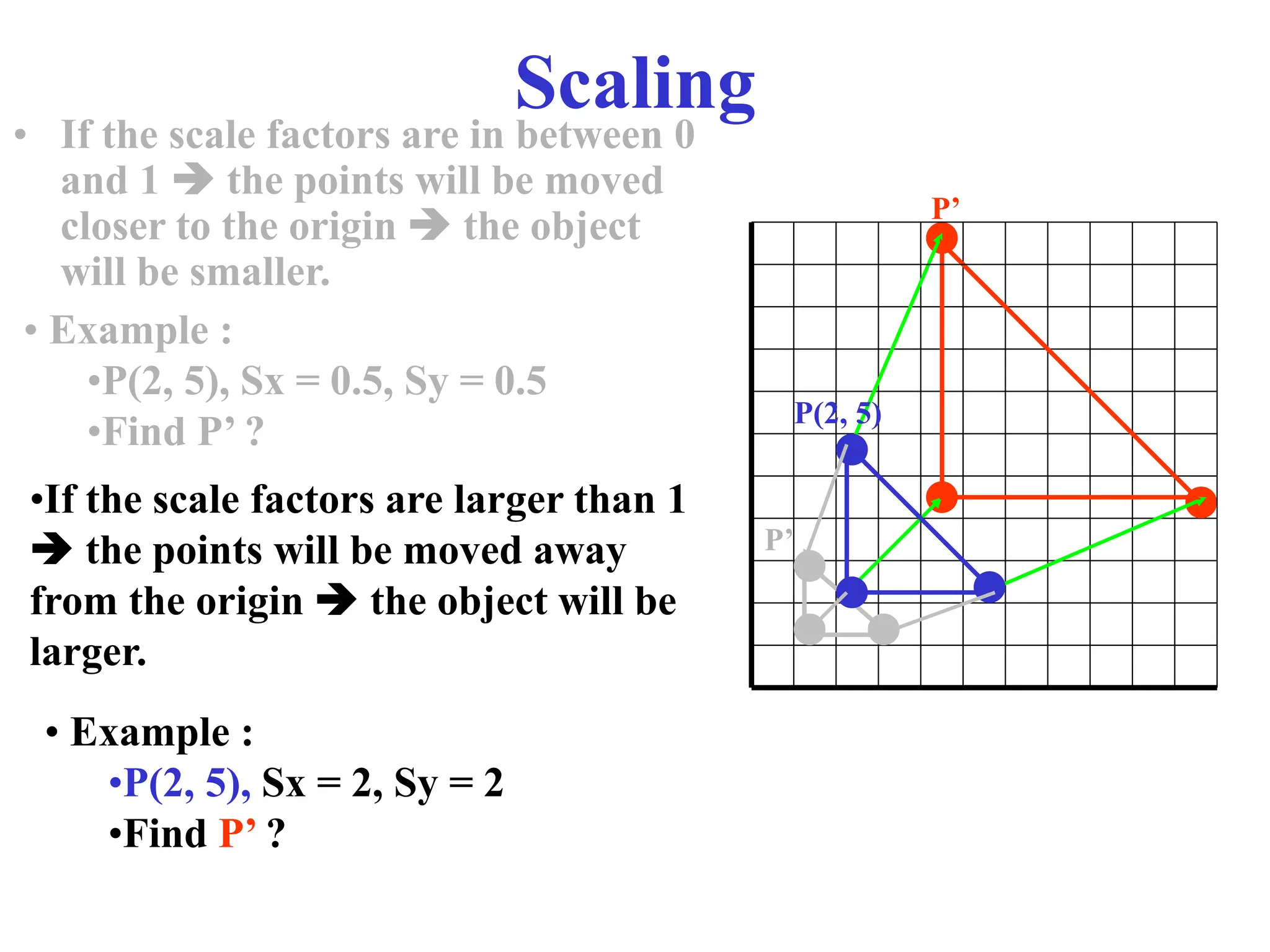
•If the scale factors are larger than 1
 the points will be moved away
from the origin  the object will be
larger.
P’
• Example :
•P(2, 5), Sx = 2, Sy = 2
•Find P’ ?
Scaling
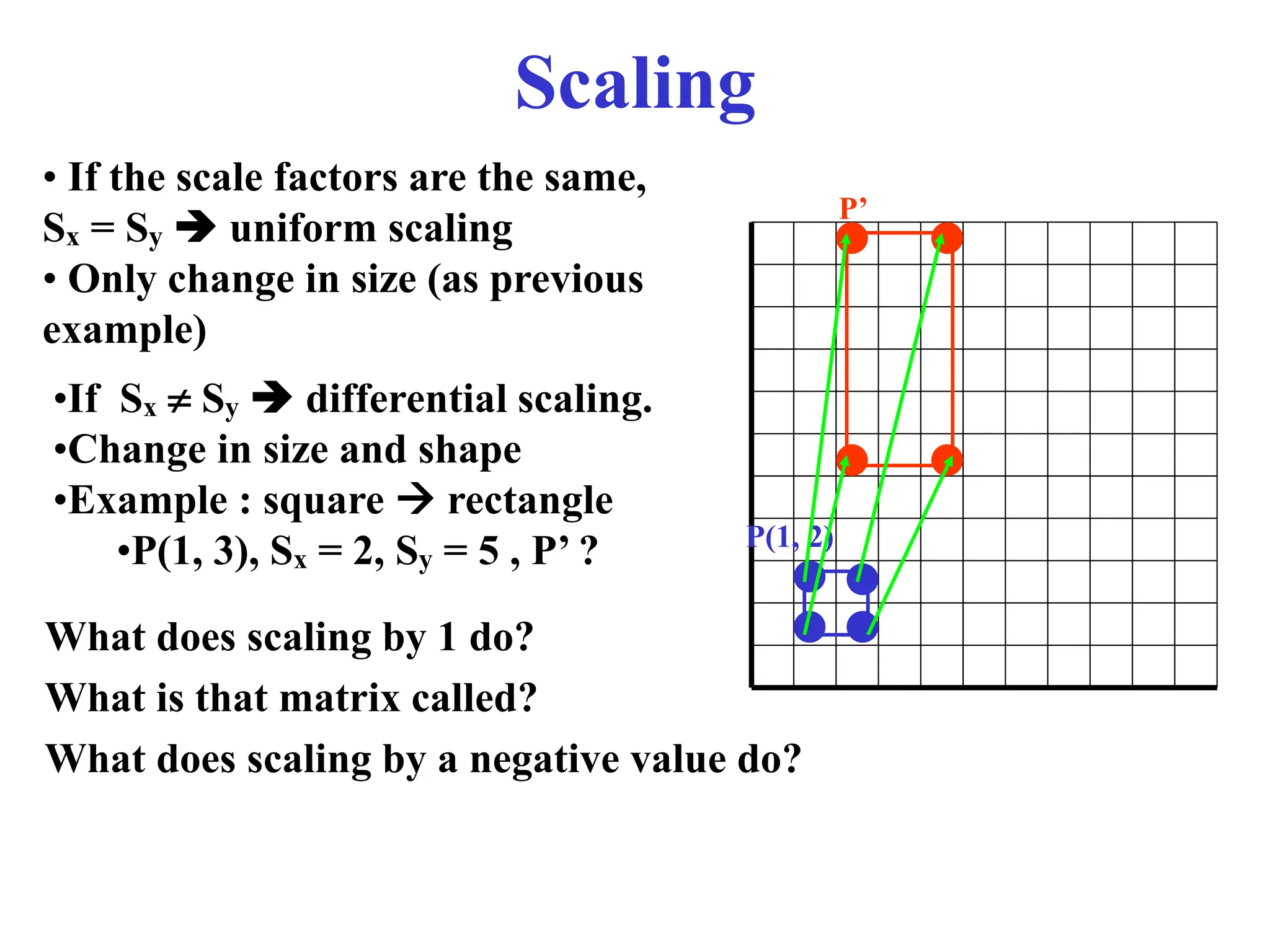
• If the scale factors are the same,
Sx = Sy  uniform scaling
• Only change in size (as previous
example)
P(1, 2)
P’
•If Sx  Sy  differential scaling.
•Change in size and shape
•Example : square  rectangle
•P(1, 3), Sx = 2, Sy = 5 , P’ ?
What does scaling by 1 do?
What is that matrix called?
What does scaling by a negative value do?
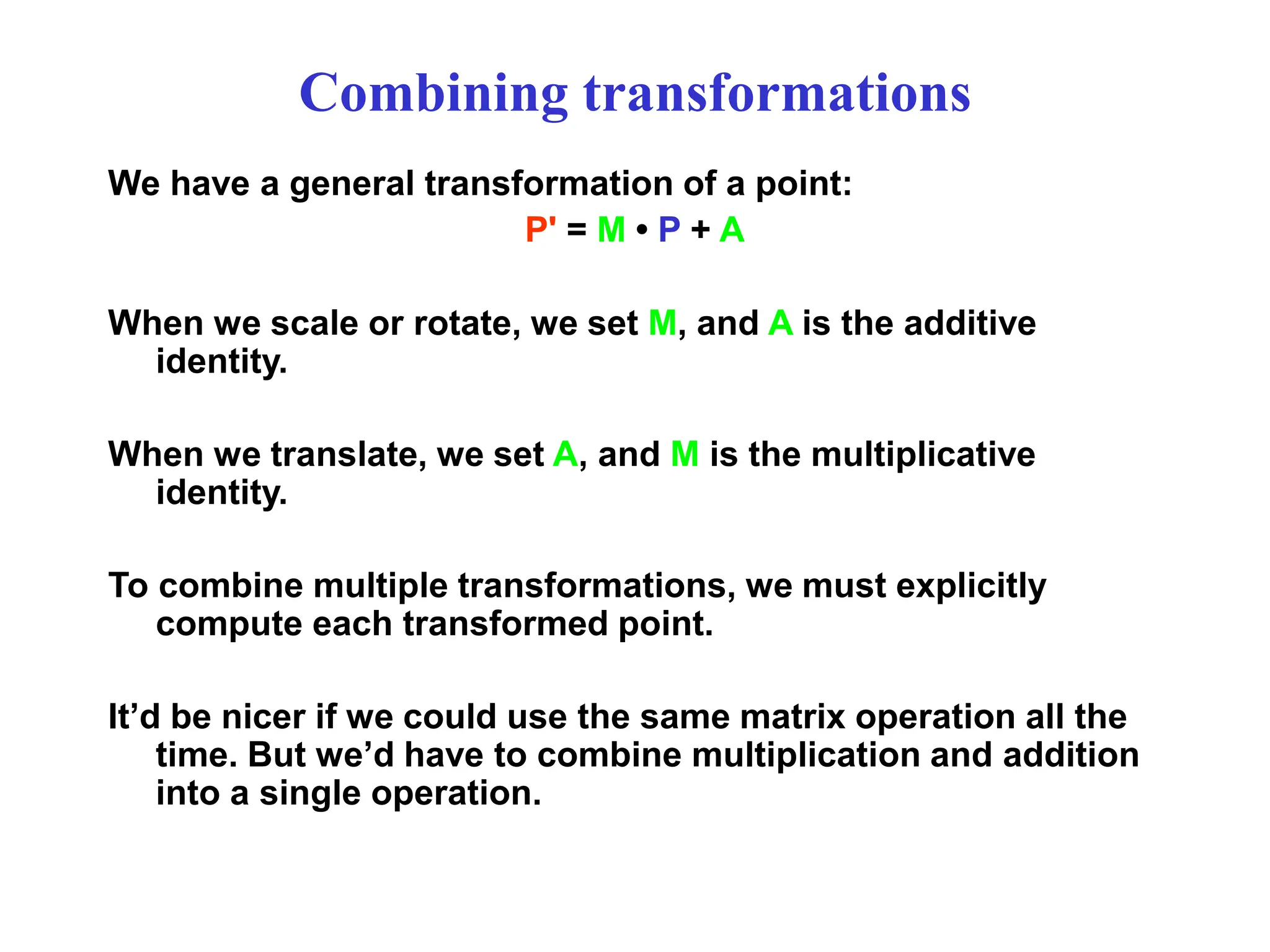
Combining transformations
We have a general transformation of a point:
P' = M • P + A
When we scale or rotate, we set M, and A is the additive
identity.
When we translate, we set A, and M is the multiplicative
identity.
To combine multiple transformations, we must explicitly
compute each transformed point.
It’d be nicer if we could use the same matrix operation all the
time. But we’d have to combine multiplication and addition
into a single operation.
Homogenous Coordinates
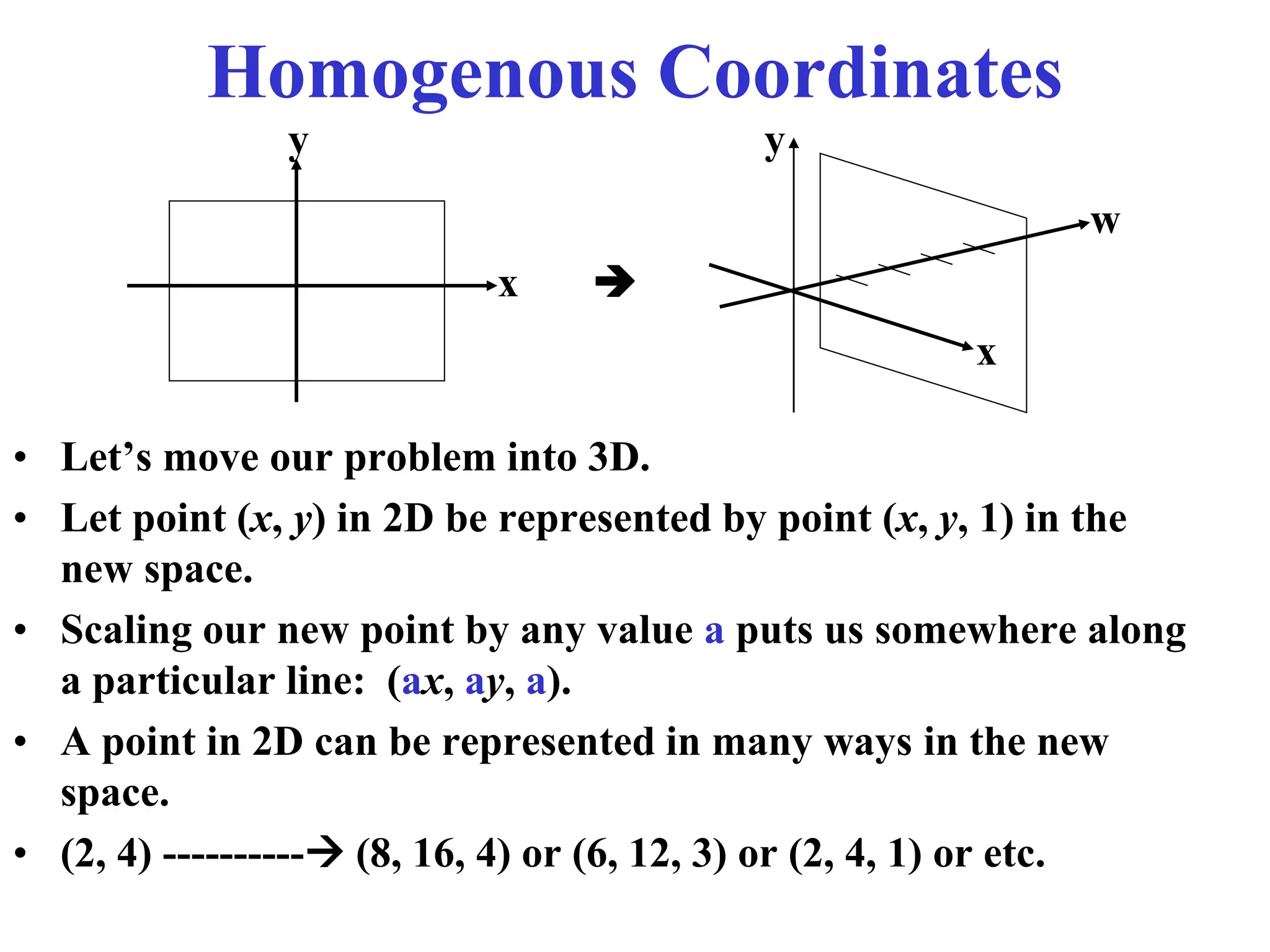
• Let’s move our problem into 3D.
• Let point (x, y) in 2D be represented by point (x, y, 1) in the
new space.
• Scaling our new point by any value a puts us somewhere along
a particular line: (ax, ay, a).
• A point in 2D can be represented in many ways in the new
space.
• (2, 4) ---------- (8, 16, 4) or (6, 12, 3) or (2, 4, 1) or etc.
y y
x
x
w

Homogenous Coordinates
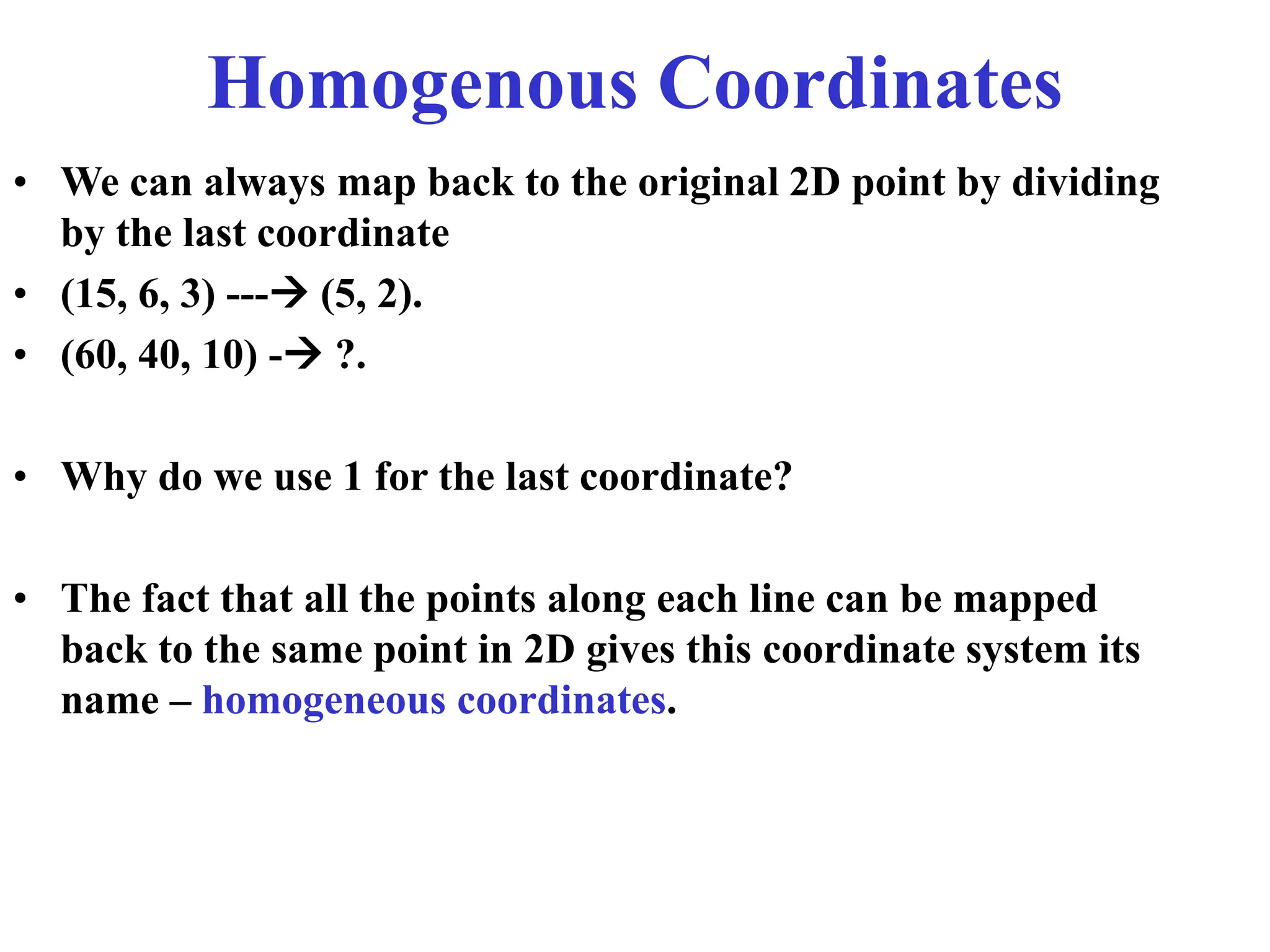
• We can always map back to the original 2D point by dividing
by the last coordinate
• (15, 6, 3) --- (5, 2).
• (60, 40, 10) - ?.
• Why do we use 1 for the last coordinate?
• The fact that all the points along each line can be mapped
back to the same point in 2D gives this coordinate system its
name – homogeneous coordinates.
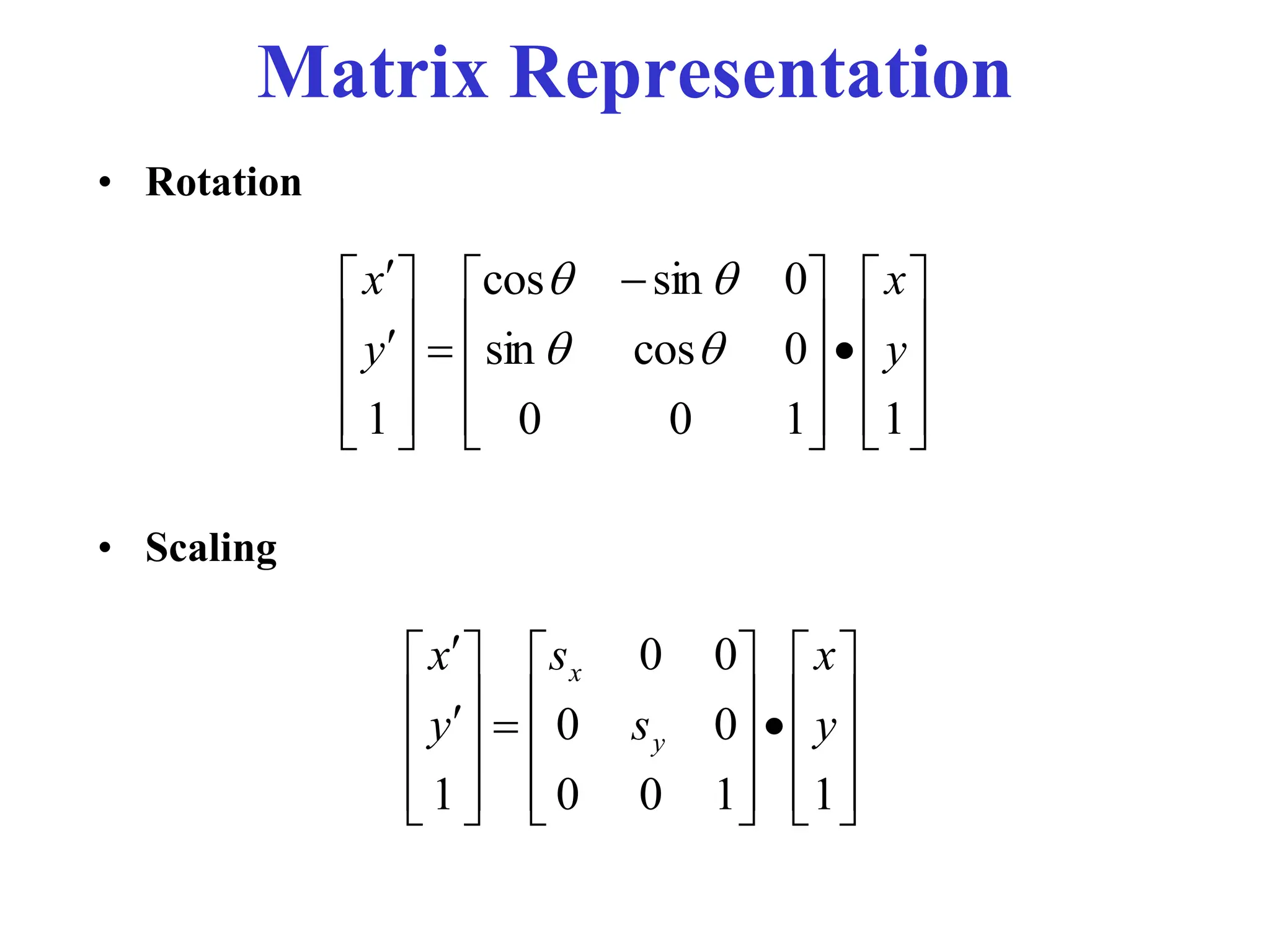
Matrix Representation
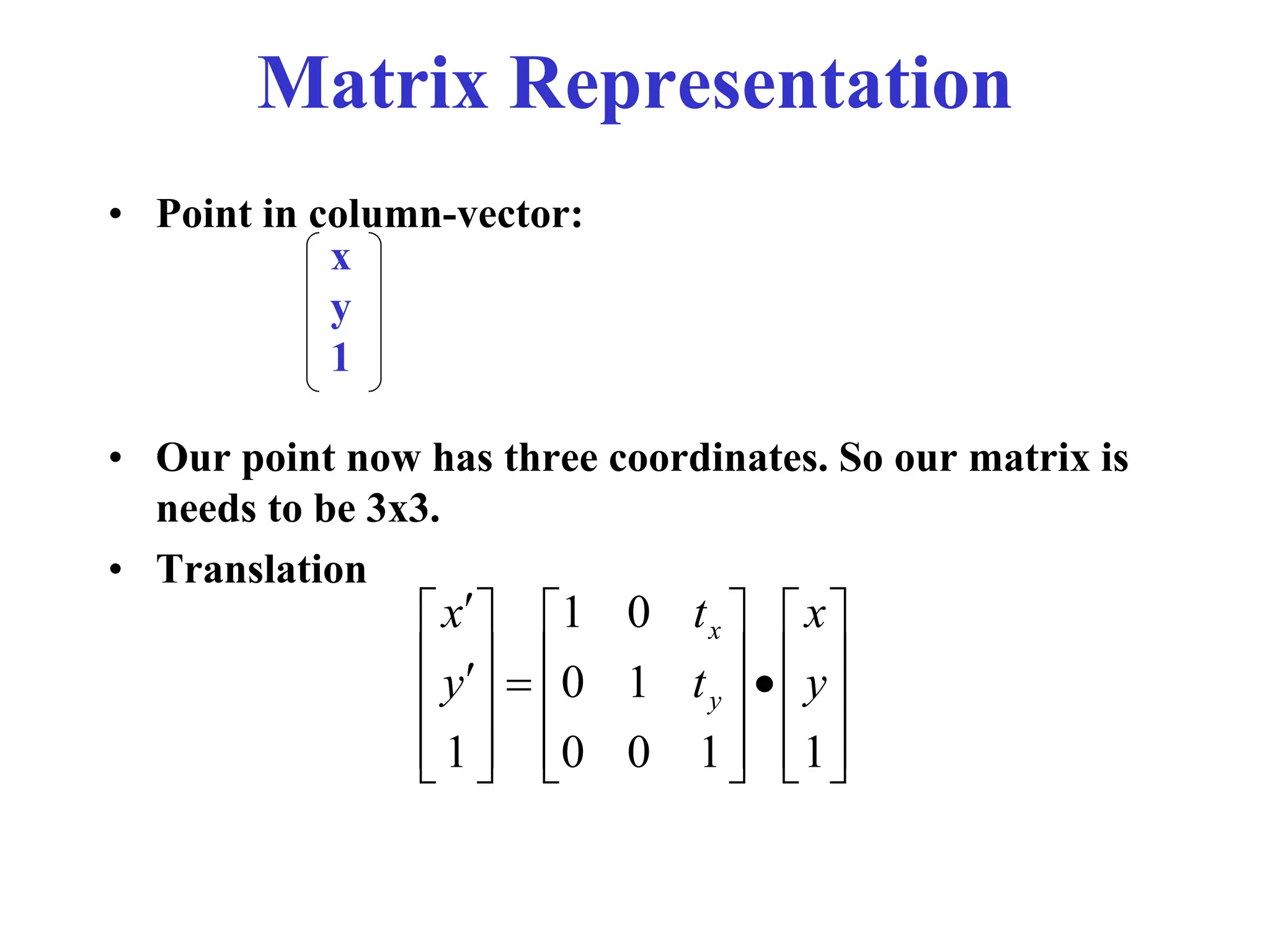
• Point in column-vector:
• Our point now has three coordinates. So our matrix is
needs to be 3x3.
• Translation
x
y
1


































1
1
0
0
1
0
0
1
1
y
x
t
t
y
x
y
x
• Rotation
• Scaling
Matrix Representation




















 













1
1
0
0
0
cos
sin
0
sin
cos
1
y
x
y
x






































1
1
0
0
0
0
0
0
1
y
x
s
s
y
x
y
x
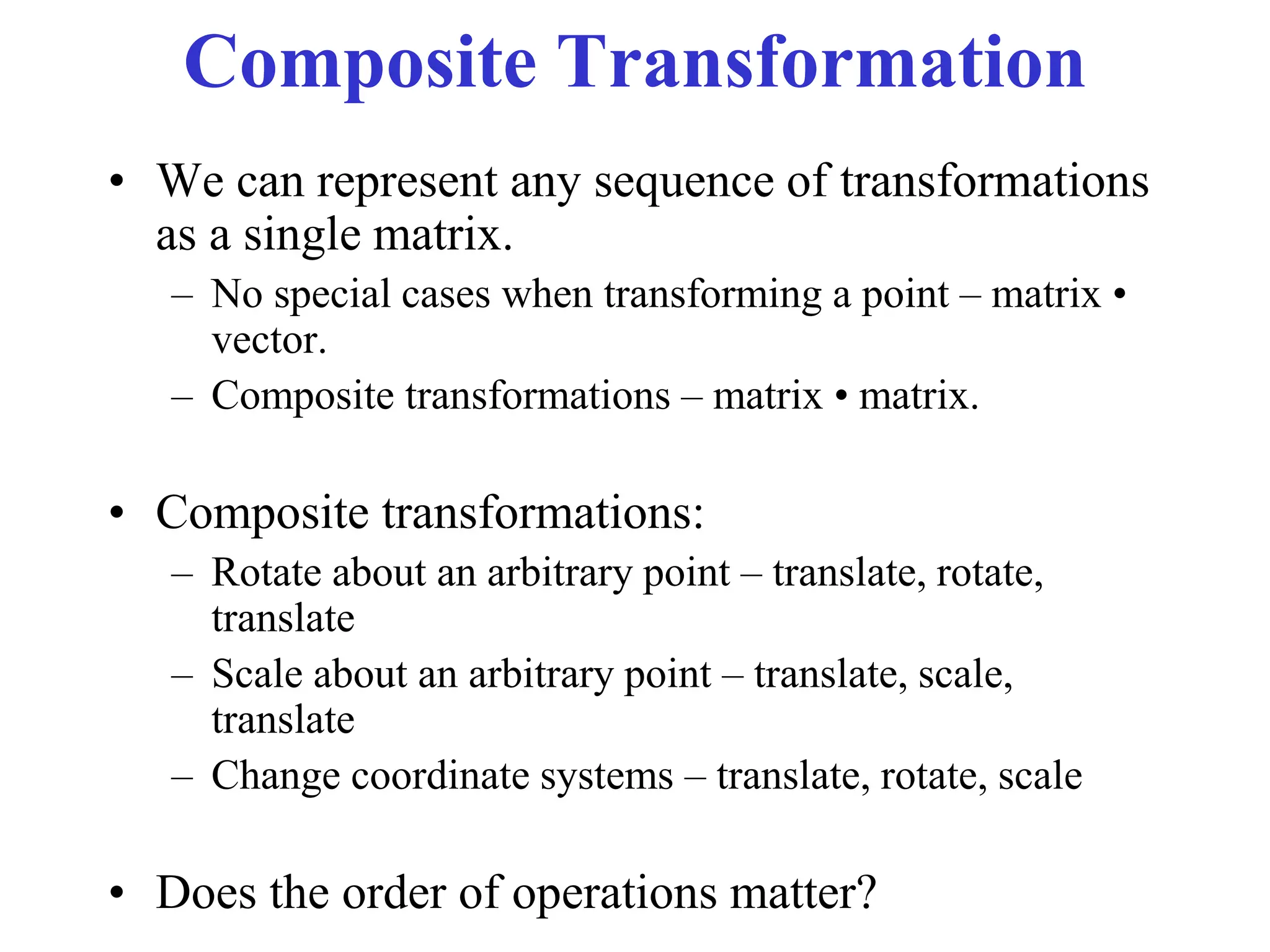
Composite Transformation
• We can represent any sequence of transformations
as a single matrix.
– No special cases when transforming a point – matrix •
vector.
– Composite transformations – matrix • matrix.
• Composite transformations:
– Rotate about an arbitrary point – translate, rotate,
translate
– Scale about an arbitrary point – translate, scale,
translate
– Change coordinate systems – translate, rotate, scale
• Does the order of operations matter?
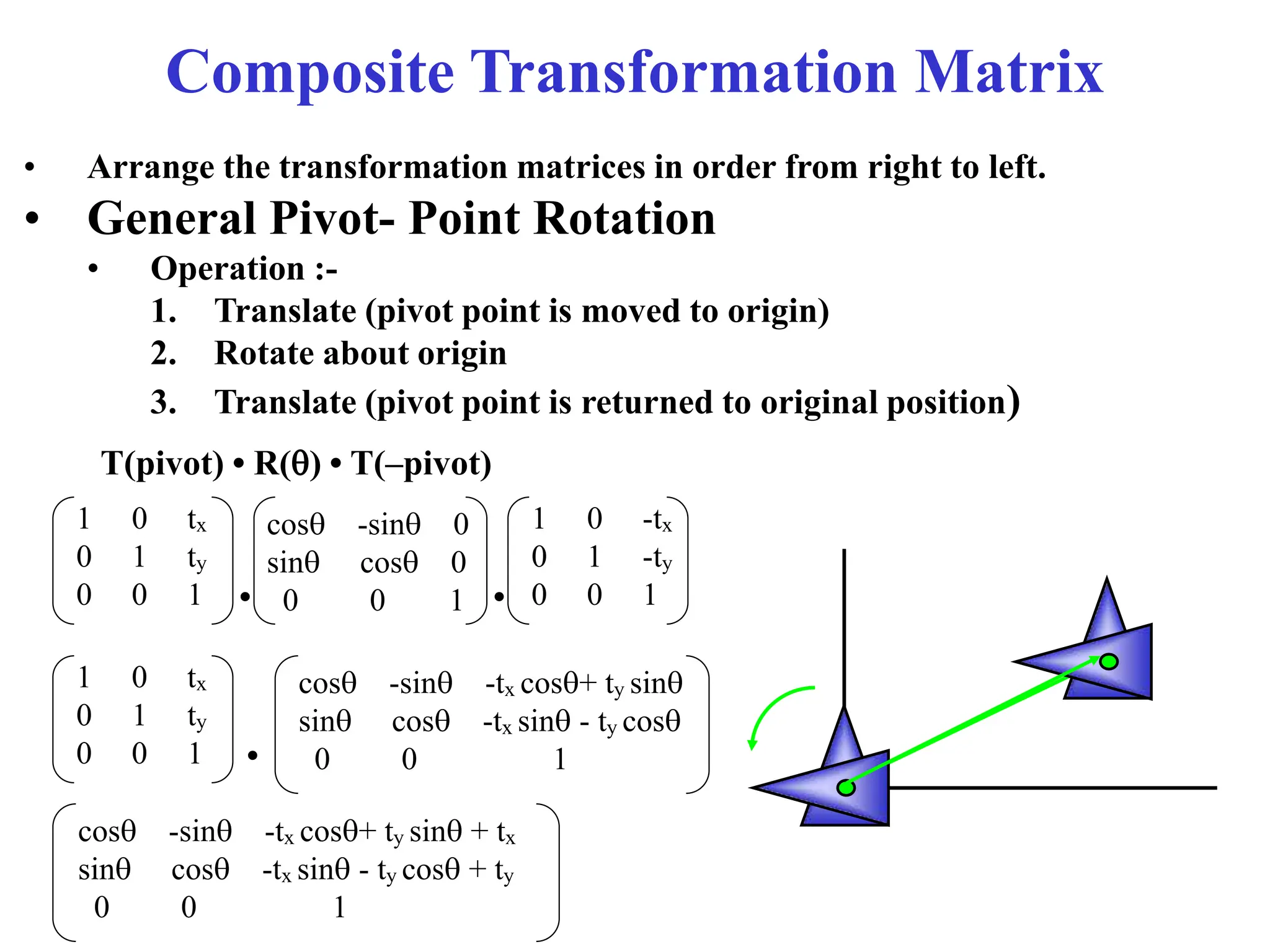
Composite Transformation Matrix
• Arrange the transformation matrices in order from right to left.
• General Pivot- Point Rotation
• Operation :-
1. Translate (pivot point is moved to origin)
2. Rotate about origin
3. Translate (pivot point is returned to original position)
T(pivot) • R() • T(–pivot)
1 0 -tx
0 1 -ty
0 0 1
cos -sin 0
sin cos 0
0 0 1
1 0 tx
0 1 ty
0 0 1 . .
cos -sin -tx cos+ ty sin + tx
sin cos -tx sin - ty cos + ty
0 0 1
cos -sin -tx cos+ ty sin
sin cos -tx sin - ty cos
0 0 1
1 0 tx
0 1 ty
0 0 1 .
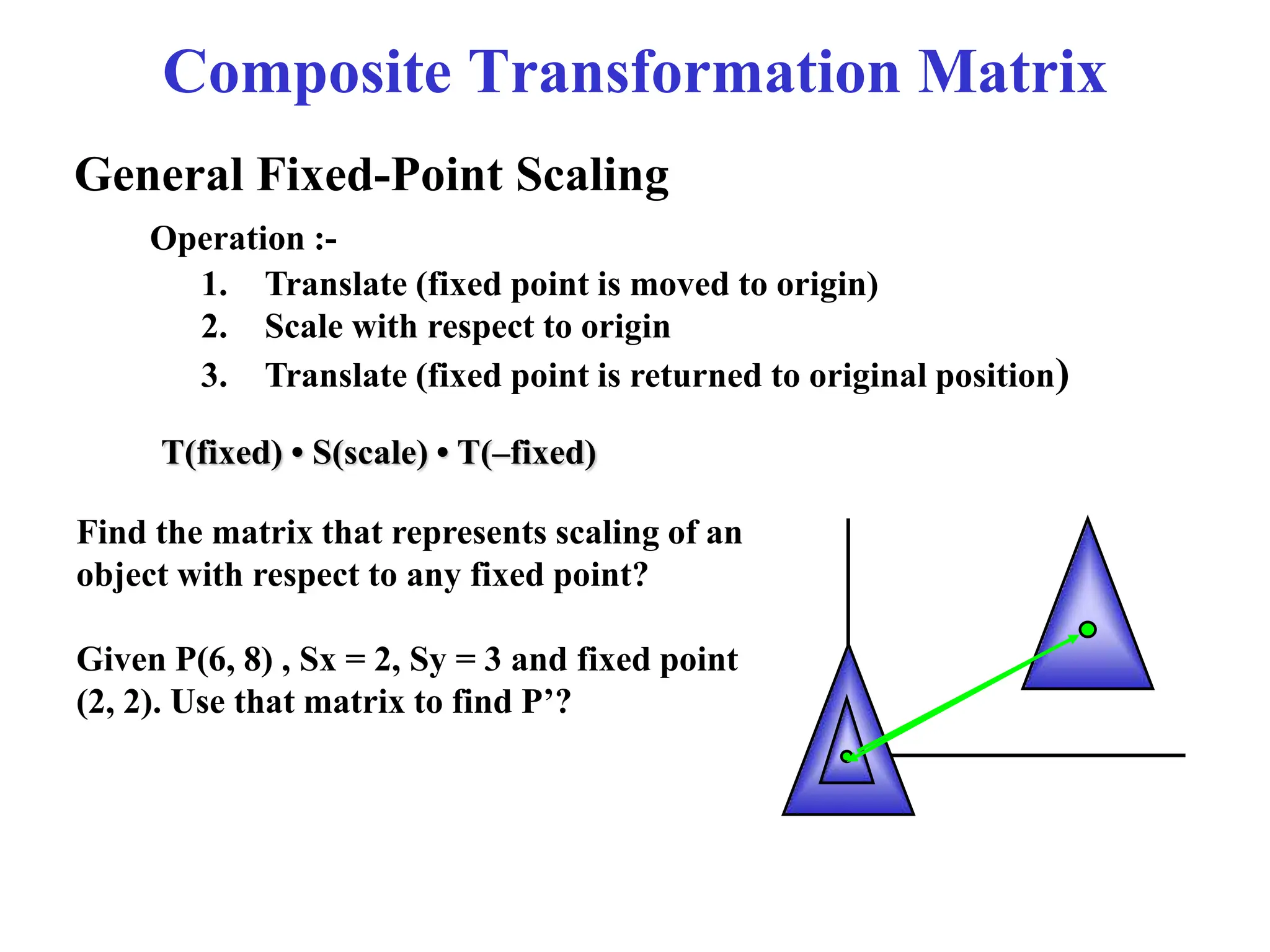
Composite Transformation Matrix
General Fixed-Point Scaling
Operation :-
1. Translate (fixed point is moved to origin)
2. Scale with respect to origin
3. Translate (fixed point is returned to original position)
T(fixed) • S(scale) • T(–fixed)
Find the matrix that represents scaling of an
object with respect to any fixed point?
Given P(6, 8) , Sx = 2, Sy = 3 and fixed point
(2, 2). Use that matrix to find P’?

“Transformations are the operations applied to geometrical description of an object to change its position, orientation, or size are called geometric transformations”.

  • 1.
  • 2.
    2D Transformations • Whatis transformations? – The geometrical changes of an object from a current state to modified state. • Why the transformations is needed? – To manipulate the initially created object and to display the modified object without having to redraw it.
  • 3.
    • 2 ways –Object Transformation • Alter the coordinates descriptions an object • Translation, rotation, scaling etc. • Coordinate system unchanged – Coordinate transformation • Produce a different coordinate system 2D Transformations
  • 4.
    Matrix Math • Whydo we use matrix? – More convenient organization of data. – More efficient processing – Enable the combination of various concatenations
  • 5.
    Translation • A translationmoves all points in an object along the same straight-line path to new positions[ Linear Displacement]. • The path is represented by a vector, called the translation or shift vector. • We can write the components: X’ = X + tx Y’ = Y+ ty • or in matrix form: P' = P + T tx ty x’ y’ x y tx ty = + (2, 2) = 6 =4 ?
  • 6.
    Rotation • A rotationrepositions all points in an object along a circular path in the plane centered at the pivot point. • First, we’ll assume the pivot is at the origin.  P P’
  • 7.
    Rotation • Review Trigonometry =>cos  = x/r , sin = y/r • x = r. cos , y = r.sin    P(x,y) x y r x’ y’  P’(x’, y’) r => cos (+ ) = x’/r •x’ = r. cos (+ ) •x’ = r.coscos -r.sinsin •x’ = x.cos  – y.sin  =>sin (+ ) = y’/r y’ = r. sin (+ ) •y’ = r.cossin + r.sincos •y’ = x.sin  + y.cos  Identity of Trigonometry
  • 8.
    Rotation • We canwrite the components: p'x = px cos  – py sin  p'y = px sin  + py cos  • or in matrix form: P' = R • P •  can be clockwise (-ve) or counterclockwise (+ve as our example). • Rotation matrix  P(x,y)  x y r x’ y’  P’(x’, y’)             cos sin sin cos R
  • 9.
    • Example – Findthe transformed point, P’, caused by rotating P= (5, 1) about the origin through an angle of 90. Rotation                                    cos sin sin cos cos sin sin cos y x y x y x              90 cos 1 90 sin 5 90 sin 1 90 cos 5              0 1 1 5 1 1 0 5        5 1
  • 10.
    Scaling • Scaling changesthe size of an object and involves two scale factors, Sx and Sy for the x- and y- coordinates respectively. • Scales are about the origin. • We can write the components: p'x = sx • px p'y = sy • py or in matrix form: P' = S • P Scale matrix as:        y x s s S 0 0 P P’
  • 11.
    Scaling • If thescale factors are in between 0 and 1  the points will be moved closer to the origin  the object will be smaller. P(2, 5) P’ • Example : •P(2, 5), Sx = 0.5, Sy = 0.5 •Find P’ ?
  • 12.
    Scaling • If thescale factors are in between 0 and 1  the points will be moved closer to the origin  the object will be smaller. P(2, 5) P’ • Example : •P(2, 5), Sx = 0.5, Sy = 0.5 •Find P’ ? •If the scale factors are larger than 1  the points will be moved away from the origin  the object will be larger. P’ • Example : •P(2, 5), Sx = 2, Sy = 2 •Find P’ ?
  • 13.
    Scaling • If thescale factors are the same, Sx = Sy  uniform scaling • Only change in size (as previous example) P(1, 2) P’ •If Sx  Sy  differential scaling. •Change in size and shape •Example : square  rectangle •P(1, 3), Sx = 2, Sy = 5 , P’ ? What does scaling by 1 do? What is that matrix called? What does scaling by a negative value do?
  • 14.
    Combining transformations We havea general transformation of a point: P' = M • P + A When we scale or rotate, we set M, and A is the additive identity. When we translate, we set A, and M is the multiplicative identity. To combine multiple transformations, we must explicitly compute each transformed point. It’d be nicer if we could use the same matrix operation all the time. But we’d have to combine multiplication and addition into a single operation.
  • 15.
    Homogenous Coordinates • Let’smove our problem into 3D. • Let point (x, y) in 2D be represented by point (x, y, 1) in the new space. • Scaling our new point by any value a puts us somewhere along a particular line: (ax, ay, a). • A point in 2D can be represented in many ways in the new space. • (2, 4) ---------- (8, 16, 4) or (6, 12, 3) or (2, 4, 1) or etc. y y x x w 
  • 16.
    Homogenous Coordinates • Wecan always map back to the original 2D point by dividing by the last coordinate • (15, 6, 3) --- (5, 2). • (60, 40, 10) - ?. • Why do we use 1 for the last coordinate? • The fact that all the points along each line can be mapped back to the same point in 2D gives this coordinate system its name – homogeneous coordinates.
  • 17.
    Matrix Representation • Pointin column-vector: • Our point now has three coordinates. So our matrix is needs to be 3x3. • Translation x y 1                                   1 1 0 0 1 0 0 1 1 y x t t y x y x
  • 18.
    • Rotation • Scaling MatrixRepresentation                                    1 1 0 0 0 cos sin 0 sin cos 1 y x y x                                       1 1 0 0 0 0 0 0 1 y x s s y x y x
  • 19.
    Composite Transformation • Wecan represent any sequence of transformations as a single matrix. – No special cases when transforming a point – matrix • vector. – Composite transformations – matrix • matrix. • Composite transformations: – Rotate about an arbitrary point – translate, rotate, translate – Scale about an arbitrary point – translate, scale, translate – Change coordinate systems – translate, rotate, scale • Does the order of operations matter?
  • 20.
    Composite Transformation Matrix •Arrange the transformation matrices in order from right to left. • General Pivot- Point Rotation • Operation :- 1. Translate (pivot point is moved to origin) 2. Rotate about origin 3. Translate (pivot point is returned to original position) T(pivot) • R() • T(–pivot) 1 0 -tx 0 1 -ty 0 0 1 cos -sin 0 sin cos 0 0 0 1 1 0 tx 0 1 ty 0 0 1 . . cos -sin -tx cos+ ty sin + tx sin cos -tx sin - ty cos + ty 0 0 1 cos -sin -tx cos+ ty sin sin cos -tx sin - ty cos 0 0 1 1 0 tx 0 1 ty 0 0 1 .
  • 21.
    Composite Transformation Matrix GeneralFixed-Point Scaling Operation :- 1. Translate (fixed point is moved to origin) 2. Scale with respect to origin 3. Translate (fixed point is returned to original position) T(fixed) • S(scale) • T(–fixed) Find the matrix that represents scaling of an object with respect to any fixed point? Given P(6, 8) , Sx = 2, Sy = 3 and fixed point (2, 2). Use that matrix to find P’?