TOPIC –
ReflectionTransformation
And
CompositeTransformation
Reflection transformation
• Definition –
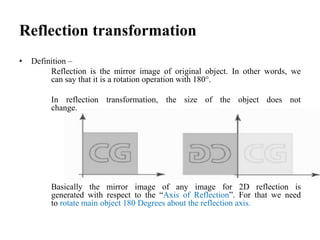
Reflection is the mirror image of original object. In other words, we
can say that it is a rotation operation with 180°.
In reflection transformation, the size of the object does not
change.
Basically the mirror image of any image for 2D reflection is
generated with respect to the “Axis of Reflection”. For that we need
to rotate main object 180 Degrees about the reflection axis.
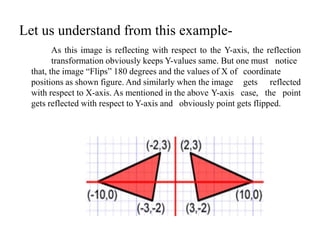
Let us understand from this example-
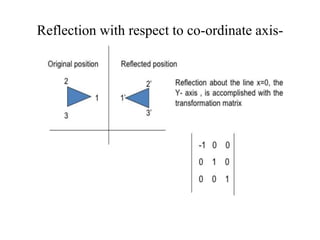
As this image is reflecting with respect to the Y-axis, the reflection
transformation obviously keeps Y-values same. But one must notice
that, the image “Flips” 180 degrees and the values of X of coordinate
positions as shown figure. And similarly when the image gets reflected
with respect to X-axis. As mentioned in the above Y-axis case, the point
gets reflected with respect to Y-axis and obviously point gets flipped.
Types of reflection-
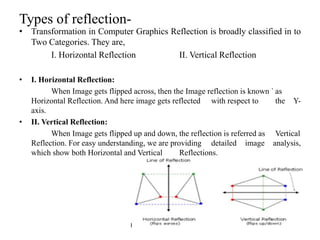
• Transformation in Computer Graphics Reflection is broadly classified in to
Two Categories. They are,
I. Horizontal Reflection II. Vertical Reflection
• I. Horizontal Reflection:
When Image gets flipped across, then the Image reflection is known ` as
Horizontal Reflection. And here image gets reflected with respect to the Y-
axis.
• II. Vertical Reflection:
When Image gets flipped up and down, the reflection is referred as Vertical
Reflection. For easy understanding, we are providing detailed image analysis,
which show both Horizontal and Vertical Reflections.
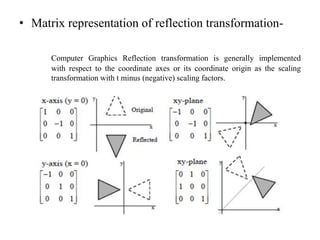
• Matrix representation of reflection transformation-
Computer Graphics Reflection transformation is generally implemented
with respect to the coordinate axes or its coordinate origin as the scaling
transformation with t minus (negative) scaling factors.
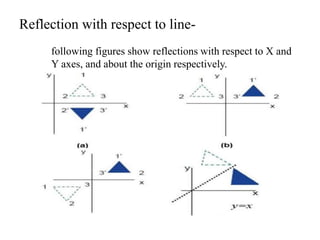
Reflection with respect to line-
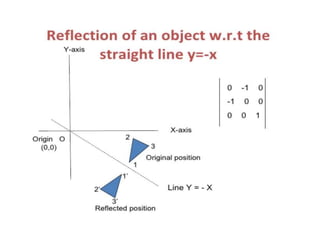
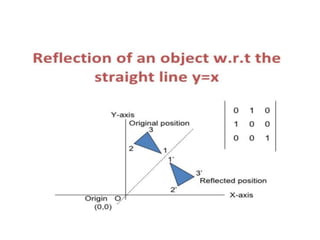
following figures show reflections with respect to X and
Y axes, and about the origin respectively.
Composite Transformation
A composite transformation (or composition of
transformations) is two or more transformations performed one after
the other. Sometimes, a composition of transformations is equivalent
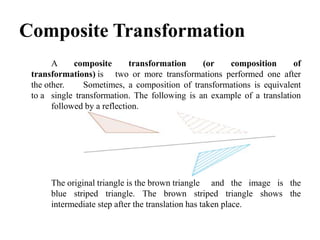
to a single transformation. The following is an example of a translation
followed by a reflection.
The original triangle is the brown triangle and the image is the
blue striped triangle. The brown striped triangle shows the
intermediate step after the translation has taken place.
Let us understand composite transformation with
this example-
• Example-
– Reflection through an arbitrary line.
we have already discussed reflection through the line x=0, y=0 and
y=x. All these lines passes through origin. But when reflection is to be
performed about a line that neither passes through the origin nor
parallel to the co-ordinate axis can be solved using the following steps-
Step 1- Translate the line and the object so that the line passes
through origin.
Step 2- Rotate the line and the object about the origin until the line is
coincident with one of the coordinate axis about which we are
familiar to perform reflection.
Step 3- Reflect the object through the co-ordinate axis.
Step 4- Apply the inverse rotation about the origin to shift the line
at translated position.
Step 5- Apply inverse translation to send back the object
(i.e., line) to its original position matrix rotation.
T = [TR ] * [Ro ] * [Rref] * [Ro
-1 ] * [Tr-1]
Where
TR - Translation matrix
Ro - Matrix for rotation by angle O
Rref – Reflection about any axis
R0
-1 - Inverse rotation
Tr
-1 - Inverse Translation
Reflection with respect to co-ordinate axis-
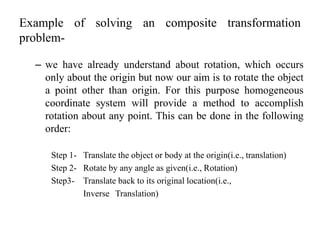
Example of solving an composite transformation
problem-
– we have already understand about rotation, which occurs
only about the origin but now our aim is to rotate the object
a point other than origin. For this purpose homogeneous
coordinate system will provide a method to accomplish
rotation about any point. This can be done in the following
order:
Step 1- Translate the object or body at the origin(i.e., translation)
Step 2- Rotate by any angle as given(i.e., Rotation)
Step3- Translate back to its original location(i.e.,
Inverse Translation)
• In matrix form, it can be shown as
[T] = [TR][RO][TR]-1
Where T
R = Translation matrix
R
O = Rotation matrix by an
angle 0
T
R
-1 = Inverse Translation
matrix

Reflection transformation

  • 1.
  • 2.
    Reflection transformation • Definition– Reflection is the mirror image of original object. In other words, we can say that it is a rotation operation with 180°. In reflection transformation, the size of the object does not change. Basically the mirror image of any image for 2D reflection is generated with respect to the “Axis of Reflection”. For that we need to rotate main object 180 Degrees about the reflection axis.
  • 3.
    Let us understandfrom this example- As this image is reflecting with respect to the Y-axis, the reflection transformation obviously keeps Y-values same. But one must notice that, the image “Flips” 180 degrees and the values of X of coordinate positions as shown figure. And similarly when the image gets reflected with respect to X-axis. As mentioned in the above Y-axis case, the point gets reflected with respect to Y-axis and obviously point gets flipped.
  • 4.
    Types of reflection- •Transformation in Computer Graphics Reflection is broadly classified in to Two Categories. They are, I. Horizontal Reflection II. Vertical Reflection • I. Horizontal Reflection: When Image gets flipped across, then the Image reflection is known ` as Horizontal Reflection. And here image gets reflected with respect to the Y- axis. • II. Vertical Reflection: When Image gets flipped up and down, the reflection is referred as Vertical Reflection. For easy understanding, we are providing detailed image analysis, which show both Horizontal and Vertical Reflections.
  • 5.
    • Matrix representationof reflection transformation- Computer Graphics Reflection transformation is generally implemented with respect to the coordinate axes or its coordinate origin as the scaling transformation with t minus (negative) scaling factors.
  • 6.
    Reflection with respectto line- following figures show reflections with respect to X and Y axes, and about the origin respectively.
  • 7.
    Composite Transformation A compositetransformation (or composition of transformations) is two or more transformations performed one after the other. Sometimes, a composition of transformations is equivalent to a single transformation. The following is an example of a translation followed by a reflection. The original triangle is the brown triangle and the image is the blue striped triangle. The brown striped triangle shows the intermediate step after the translation has taken place.
  • 8.
    Let us understandcomposite transformation with this example- • Example- – Reflection through an arbitrary line. we have already discussed reflection through the line x=0, y=0 and y=x. All these lines passes through origin. But when reflection is to be performed about a line that neither passes through the origin nor parallel to the co-ordinate axis can be solved using the following steps- Step 1- Translate the line and the object so that the line passes through origin. Step 2- Rotate the line and the object about the origin until the line is coincident with one of the coordinate axis about which we are familiar to perform reflection. Step 3- Reflect the object through the co-ordinate axis.
  • 9.
    Step 4- Applythe inverse rotation about the origin to shift the line at translated position. Step 5- Apply inverse translation to send back the object (i.e., line) to its original position matrix rotation. T = [TR ] * [Ro ] * [Rref] * [Ro -1 ] * [Tr-1] Where TR - Translation matrix Ro - Matrix for rotation by angle O Rref – Reflection about any axis R0 -1 - Inverse rotation Tr -1 - Inverse Translation
  • 10.
    Reflection with respectto co-ordinate axis-
  • 13.
    Example of solvingan composite transformation problem- – we have already understand about rotation, which occurs only about the origin but now our aim is to rotate the object a point other than origin. For this purpose homogeneous coordinate system will provide a method to accomplish rotation about any point. This can be done in the following order: Step 1- Translate the object or body at the origin(i.e., translation) Step 2- Rotate by any angle as given(i.e., Rotation) Step3- Translate back to its original location(i.e., Inverse Translation)
  • 14.
    • In matrixform, it can be shown as [T] = [TR][RO][TR]-1 Where T R = Translation matrix R O = Rotation matrix by an angle 0 T R -1 = Inverse Translation matrix