COMMONLY DONE LIVER FUNCTION
TESTS (LFT), JAUNDICE
Dr Ifat Ara Begum
Assistant Professor
Dept Of Biochemistry
Dhaka Medical College,
Dhaka
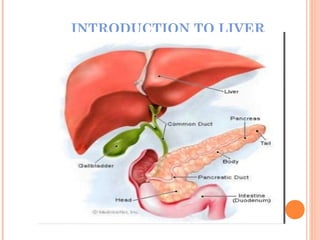
INTRODUCTION TO LIVER
CONTD
Vital organ of the digestive system
Weight of human liver: 1.44 – 1.66 kg
Lies to the right of stomach and & overlies
the gall bladder (in right hypochondrium &
most of the epigastrium)
Divided into 2 lobes (right and left) if
viewed from parietal surface. If viewed on
visceral surface, it is divided into 4 lobes
with the addition of caudate & quadrate
lobes.
CONTD
Two major types of cells:
 Parenchymal cells (hepatocytes): 80%
of liver volume.
 Non-parenchymal cells: constitute
40% of total number of liver cells but
only 6.5% of its volume.
[Sinusoidal hepatic endothelial cells,
kupffer cells & hepatic stellate cells are
some of the non-parenchymal cells]
CONTD
Is connected to 2 large blood vessels:
hepatic artery & portal vein.
 Hepatic artery carries blood from
aorta.
 Portal vein carries blood containing
digested nutrients from the entire
gastrointestinal tract and also the spleen
& pancreas.
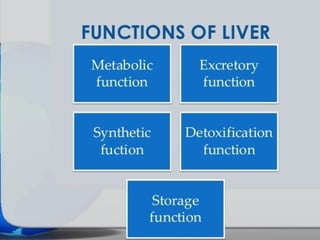
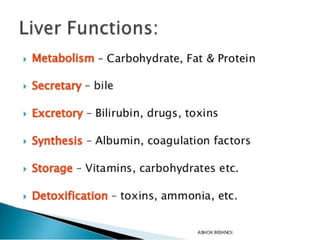
FUNCTIONS OF LIVER
The various functions of liver are
carried out by the liver cells or
hepatocytes. It is thought to be
responsible for up to 500 separate
functions, usually in combination with
other systems and organs.
1. METABOLIC FUNCTION
Liver actively participates in
carbohydrate, protein , lipid, mineral &
vitamin metabolism.
 Carbohydrate Metabolism: Glycolysis,
TCA cycle, Glycogen metabolism,
Gluconeogenesis, HMP shunt
CONTD
 Lipid Metabolism: Cholesterol
metabolism, PL synthesis,
Lipogenesis , Synthesis of TAG,
Lipolysis, FA oxidation, LP
metabolism , Ketogenesis
 Protein Metabolism: Plasma protein
synthesis, Transamination,
Deamination, Urea cycle, Uric acid
synthesis
2. EXCRETORY FUNCTION
Bile pigments, bile salts, drugs,
steroids (cholesterol), heavy metals
etc are excreted in bile into
intestine.
[Secretory function of liver
includes secretion of bile into the
intestine]
3. SYNTHETIC FUNCTION
Synthesis of plasma proteins (except
immunoglobulin), LPs, clotting factors as
well as protein C, protein S & antithrombin
In 1st
trimester fetus, the main site of RBC
production
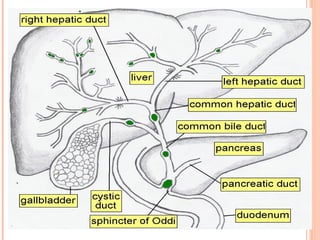
Produces and secretes bile (some of the bile
directly drains in to the duodenum & some
is stored in the gall bladder.
CONTD
Major site of thrombopoietin
production ( a glycoprotein
hormone regulating platelet
production by bone marrow)
Produces IGF-1 (PP protein
hormone having role in children
growth & continues to have
anabolic effects in adults)
4.
DETOXIFICATION/BIOTRANSFORMA
TION FUNCTION
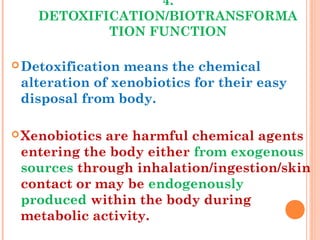
Detoxification means the chemical
alteration of xenobiotics for their easy
disposal from body.
Xenobiotics are harmful chemical agents
entering the body either from exogenous
sources through inhalation/ingestion/skin
contact or may be endogenously
produced within the body during
metabolic activity.
CONTD
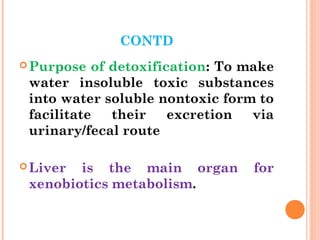
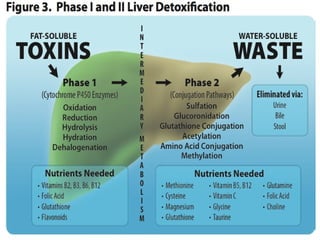
Purpose of detoxification: To make
water insoluble toxic substances
into water soluble nontoxic form to
facilitate their excretion via
urinary/fecal route
Liver is the main organ for
xenobiotics metabolism.
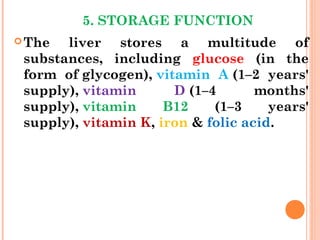
5. STORAGE FUNCTION
The liver stores a multitude of
substances, including glucose (in the
form of glycogen), vitamin A (1–2 years'
supply), vitamin D (1–4 months'
supply), vitamin B12 (1–3 years'
supply), vitamin K, iron & folic acid.
6. OTHER FUNCTIONS
 The liver is responsible for
immunological effects—
the mononuclear phagocyte
system (MPS) of the liver contains many
immunologically active cells, acting as a
'sieve' for antigens carried to it via
the portal system.
 The liver produces albumin, the
major osmolar component of blood
serum.
CONTD
 The liver synthesizes angiotensinogen,
a hormone that is responsible for
raising the blood pressure when
activated by renin.
 The liver also functions as a blood
reservoir, being an expandable organ.
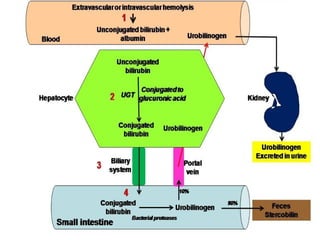
BILIRUBIN
METABOLISM
INTRODUCTION
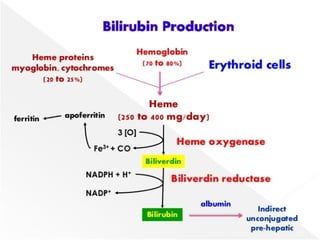
 The catabolic end product of heme.
 80% of this is derived from Hb & 20%
from other heme containing substances
(Myoglobin, Cytochromes, Peroxidase &
Catalase).
 35 mg bilirubin from 1 gm of Hb
Total bilirubin production: 250 - 300
mg/D
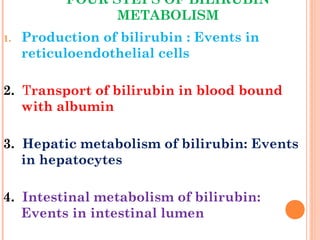
FOUR STEPS OF BILIRUBIN
METABOLISM
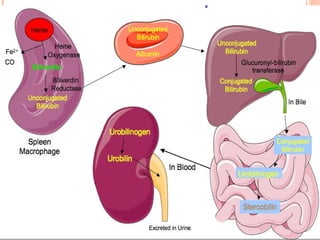
1. Production of bilirubin : Events in
reticuloendothelial cells
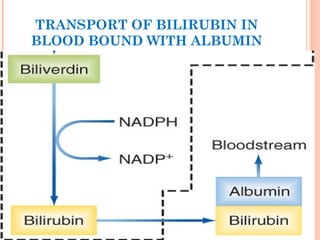
2. Transport of bilirubin in blood bound
with albumin
3. Hepatic metabolism of bilirubin: Events
in hepatocytes
4. Intestinal metabolism of bilirubin:
Events in intestinal lumen
TRANSPORT OF BILIRUBIN IN
BLOOD BOUND WITH ALBUMIN
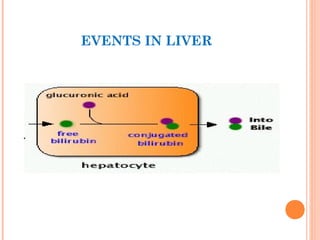
EVENTS IN LIVER
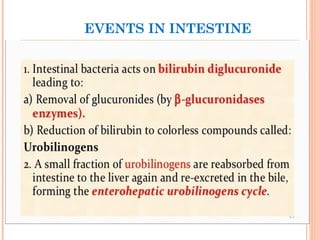
EVENTS IN INTESTINE
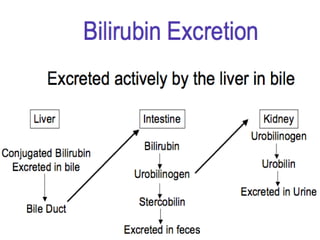
ENTERO-HEPATIC CIRCULATION
OF UROBILINOGEN
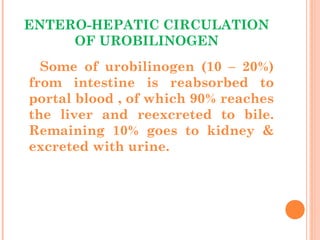
Some of urobilinogen (10 – 20%)
from intestine is reabsorbed to
portal blood , of which 90% reaches
the liver and reexcreted to bile.
Remaining 10% goes to kidney &
excreted with urine.
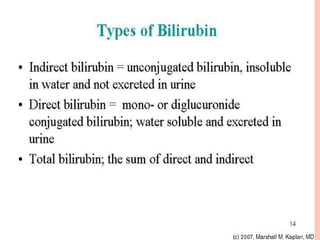
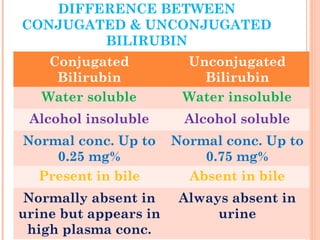
DIFFERENCE BETWEEN
CONJUGATED & UNCONJUGATED
BILIRUBIN
Conjugated
Bilirubin
Unconjugated
Bilirubin
Water soluble Water insoluble
Alcohol insoluble Alcohol soluble
Normal conc. Up to
0.25 mg%
Normal conc. Up to
0.75 mg%
Present in bile Absent in bile
Normally absent in
urine but appears in
high plasma conc.
Always absent in
urine
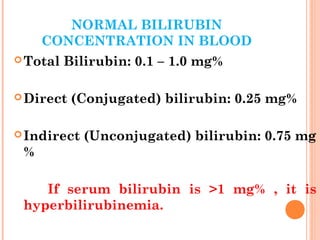
NORMAL BILIRUBIN
CONCENTRATION IN BLOOD
Total Bilirubin: 0.1 – 1.0 mg%
Direct (Conjugated) bilirubin: 0.25 mg%
Indirect (Unconjugated) bilirubin: 0.75 mg
%
If serum bilirubin is >1 mg% , it is
hyperbilirubinemia.
Liver function tests
( LFTs )
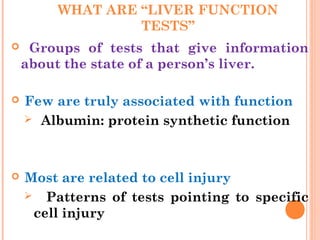
WHAT ARE “LIVER FUNCTION
TESTS”
 Groups of tests that give information
about the state of a person’s liver.
 Few are truly associated with function
 Albumin: protein synthetic function
 Most are related to cell injury
 Patterns of tests pointing to specific
cell injury
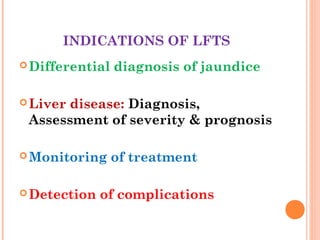
INDICATIONS OF LFTS
Differential diagnosis of jaundice
Liver disease: Diagnosis,
Assessment of severity & prognosis
Monitoring of treatment
Detection of complications
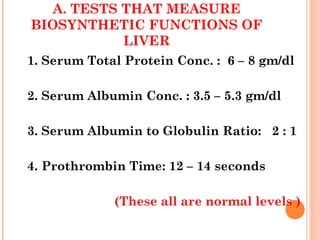
A. TESTS THAT MEASURE
BIOSYNTHETIC FUNCTIONS OF
LIVER
1. Serum Total Protein Conc. : 6 – 8 gm/dl
2. Serum Albumin Conc. : 3.5 – 5.3 gm/dl
3. Serum Albumin to Globulin Ratio: 2 : 1
4. Prothrombin Time: 12 – 14 seconds
(These all are normal levels )
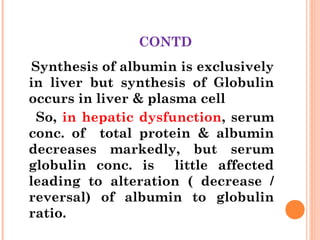
CONTD
Synthesis of albumin is exclusively
in liver but synthesis of Globulin
occurs in liver & plasma cell
So, in hepatic dysfunction, serum
conc. of total protein & albumin
decreases markedly, but serum
globulin conc. is little affected
leading to alteration ( decrease /
reversal) of albumin to globulin
ratio.
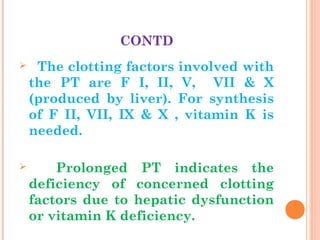
CONTD
 The clotting factors involved with
the PT are F I, II, V, VII & X
(produced by liver). For synthesis
of F II, VII, IX & X , vitamin K is
needed.
 Prolonged PT indicates the
deficiency of concerned clotting
factors due to hepatic dysfunction
or vitamin K deficiency.
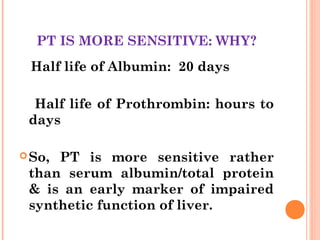
PT IS MORE SENSITIVE: WHY?
Half life of Albumin: 20 days
Half life of Prothrombin: hours to
days
So, PT is more sensitive rather
than serum albumin/total protein
& is an early marker of impaired
synthetic function of liver.
B. TESTS BASED EXCRETORY
FUNCTIONS OF LIVER
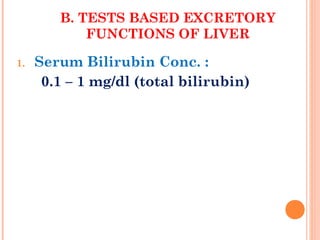
1. Serum Bilirubin Conc. :
0.1 – 1 mg/dl (total bilirubin)
C. TESTS FOR DETECTION OF
HEPATOCELLULAR DAMAGE
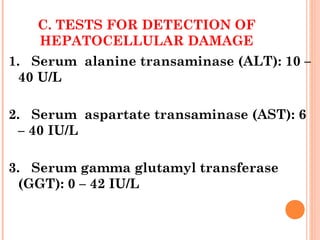
1. Serum alanine transaminase (ALT): 10 –
40 U/L
2. Serum aspartate transaminase (AST): 6
– 40 IU/L
3. Serum gamma glutamyl transferase
(GGT): 0 – 42 IU/L
CONTD
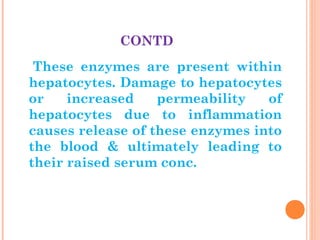
These enzymes are present within
hepatocytes. Damage to hepatocytes
or increased permeability of
hepatocytes due to inflammation
causes release of these enzymes into
the blood & ultimately leading to
their raised serum conc.
D. TESTS FOR CHOLESTASIS/
BILLIARY TRACT OBSTRUCTION
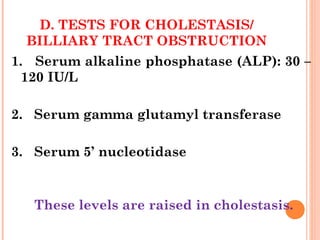
1. Serum alkaline phosphatase (ALP): 30 –
120 IU/L
2. Serum gamma glutamyl transferase
3. Serum 5’ nucleotidase
These levels are raised in cholestasis.
CONTD
ALP is the most important
indicator of cholestasis. Normally
it is present in canalicular &
sinusoidal membranes of
hepatocytes. Following cholestasis,
stagnated bile acid induces ALP
synthesis by hepatocytes & billiary
tract epi. cells leading to increased
plasma ALP
E. TESTS FOR METABOLIC
FUNCTIONS OF LIVER
 Galactose tolerance test
 Serum glucose level
 Serum LDH
F. OTHER LFTS
Immunology: Blood tests may be
done to
detect:
a. Viruses and antibodies to
viruses: Various viral infections
can cause hepatitis
(inflammation of the liver) - for
example, hepatitis A
virus, hepatitis B virus, etc.
CONTD
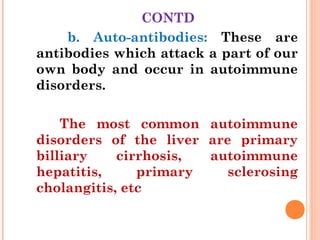
b. Auto-antibodies: These are
antibodies which attack a part of our
own body and occur in autoimmune
disorders.
The most common autoimmune
disorders of the liver are primary
billiary cirrhosis, autoimmune
hepatitis, primary sclerosing
cholangitis, etc
CONTD
Other types of protein in the blood
can point to specific liver diseases
- for example:
 Ceruloplasmin is reduced
in Wilson's disease.
 Lack of α1-antitrypsin is an
uncommon cause of cirrhosis.
 A high level of ferritin is a
marker of haemochromatosis.
CONTD
Other tests such as liver biopsy,
ultrasound scan, other types of
scan, etc may be needed to clarify
the cause of a liver disorder,
and/or to monitor its progress.
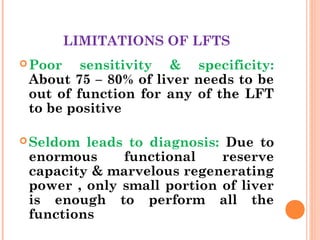
LIMITATIONS OF LFTS
Poor sensitivity & specificity:
About 75 – 80% of liver needs to be
out of function for any of the LFT
to be positive
Seldom leads to diagnosis: Due to
enormous functional reserve
capacity & marvelous regenerating
power , only small portion of liver
is enough to perform all the
functions
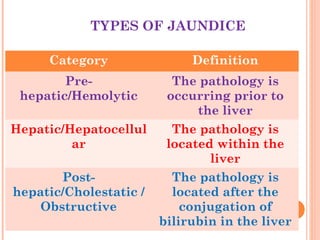
TYPES OF JAUNDICE
Category Definition
Pre-
hepatic/Hemolytic
The pathology is
occurring prior to
the liver
Hepatic/Hepatocellul
ar
The pathology is
located within the
liver
Post-
hepatic/Cholestatic /
Obstructive
The pathology is
located after the
conjugation of
bilirubin in the liver
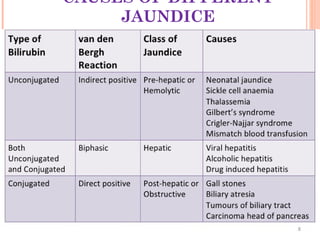
CAUSES OF DIFFERENT
JAUNDICE
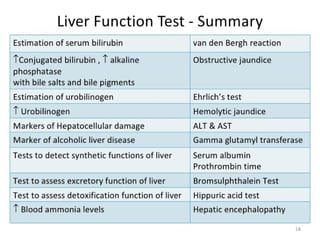
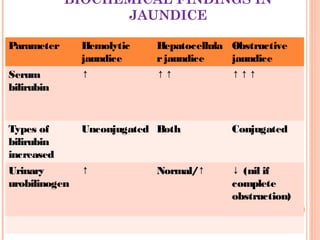
BIOCHEMICAL FINDINGS IN
JAUNDICE
Parameter Hemolytic
jaundice
Hepatocellula
rjaundice
Obstructive
jaundice
Serum
bilirubin
↑ ↑↑ ↑↑↑
Types of
bilirubin
increased
Unconjugated Both Conjugated
Urinary
urobilinogen
↑ Normal/↑ ↓ (nil if
complete
obstruction)
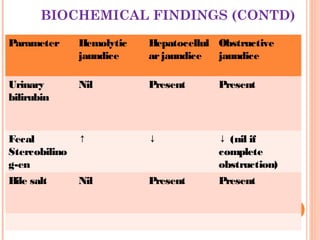
BIOCHEMICAL FINDINGS (CONTD)
Parameter Hemolytic
jaundice
Hepatocellul
arjaundice
Obstructive
jaundice
Urinary
bilirubin
Nil Present Present
Fecal
Stercobilino
g-en
↑ ↓ ↓ (nil if
complete
obstruction)
Bile salt Nil Present Present
BIOCHEMICAL FINDINGS (CONTD)
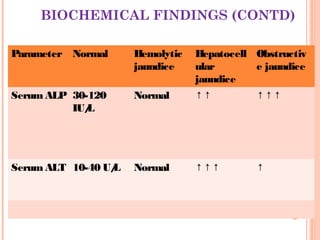
Parameter Normal Hemolytic
jaundice
Hepatocell
ular
jaundice
Obstructiv
e jaundice
Serum ALP 30-120
IU/L
Normal ↑↑ ↑↑↑
Serum ALT 10-40 U/L Normal ↑↑↑ ↑
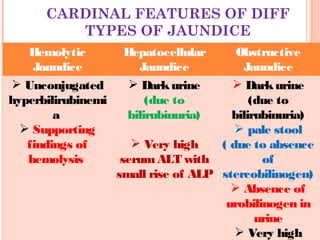
CARDINAL FEATURES OF DIFF
TYPES OF JAUNDICE
Hemolytic
Jaundice
Hepatocellular
Jaundice
Obstructive
Jaundice
 Unconjugated
hyperbilirubinemi
a
 Supporting
findings of
hemolysis
 Darkurine
(due to
bilirubinuria)
 Very high
serumALT with
small rise of ALP
 Darkurine
(due to
bilirubinuria)
 pale stool
( due to absence
of
stercobilinogen)
 Absence of
urobilinogen in
urine
 Very high
CONTD
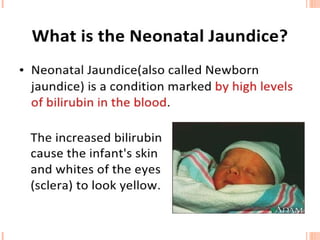
Breakdown of red blood cells
(which release bilirubin into the
blood) and immaturity of the
newborn's liver (which cannot
effectively metabolize bilirubin
and prepare it for excretion into
urine)
Normal neonatal jaundice appears
between the 2nd and 5th days of
life and clears with time
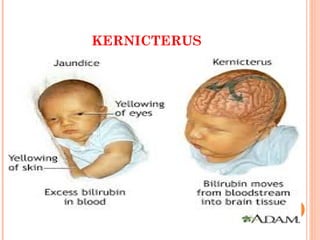
KERNICTERUS
Commonly done liver function tests

Commonly done liver function tests

  • 1.
    COMMONLY DONE LIVERFUNCTION TESTS (LFT), JAUNDICE Dr Ifat Ara Begum Assistant Professor Dept Of Biochemistry Dhaka Medical College, Dhaka
  • 2.
  • 3.
    CONTD Vital organ ofthe digestive system Weight of human liver: 1.44 – 1.66 kg Lies to the right of stomach and & overlies the gall bladder (in right hypochondrium & most of the epigastrium) Divided into 2 lobes (right and left) if viewed from parietal surface. If viewed on visceral surface, it is divided into 4 lobes with the addition of caudate & quadrate lobes.
  • 4.
    CONTD Two major typesof cells:  Parenchymal cells (hepatocytes): 80% of liver volume.  Non-parenchymal cells: constitute 40% of total number of liver cells but only 6.5% of its volume. [Sinusoidal hepatic endothelial cells, kupffer cells & hepatic stellate cells are some of the non-parenchymal cells]
  • 5.
    CONTD Is connected to2 large blood vessels: hepatic artery & portal vein.  Hepatic artery carries blood from aorta.  Portal vein carries blood containing digested nutrients from the entire gastrointestinal tract and also the spleen & pancreas.
  • 6.
    FUNCTIONS OF LIVER Thevarious functions of liver are carried out by the liver cells or hepatocytes. It is thought to be responsible for up to 500 separate functions, usually in combination with other systems and organs.
  • 8.
    1. METABOLIC FUNCTION Liveractively participates in carbohydrate, protein , lipid, mineral & vitamin metabolism.  Carbohydrate Metabolism: Glycolysis, TCA cycle, Glycogen metabolism, Gluconeogenesis, HMP shunt
  • 9.
    CONTD  Lipid Metabolism:Cholesterol metabolism, PL synthesis, Lipogenesis , Synthesis of TAG, Lipolysis, FA oxidation, LP metabolism , Ketogenesis  Protein Metabolism: Plasma protein synthesis, Transamination, Deamination, Urea cycle, Uric acid synthesis
  • 10.
    2. EXCRETORY FUNCTION Bilepigments, bile salts, drugs, steroids (cholesterol), heavy metals etc are excreted in bile into intestine. [Secretory function of liver includes secretion of bile into the intestine]
  • 12.
    3. SYNTHETIC FUNCTION Synthesisof plasma proteins (except immunoglobulin), LPs, clotting factors as well as protein C, protein S & antithrombin In 1st trimester fetus, the main site of RBC production Produces and secretes bile (some of the bile directly drains in to the duodenum & some is stored in the gall bladder.
  • 13.
    CONTD Major site ofthrombopoietin production ( a glycoprotein hormone regulating platelet production by bone marrow) Produces IGF-1 (PP protein hormone having role in children growth & continues to have anabolic effects in adults)
  • 14.
    4. DETOXIFICATION/BIOTRANSFORMA TION FUNCTION Detoxification meansthe chemical alteration of xenobiotics for their easy disposal from body. Xenobiotics are harmful chemical agents entering the body either from exogenous sources through inhalation/ingestion/skin contact or may be endogenously produced within the body during metabolic activity.
  • 15.
    CONTD Purpose of detoxification:To make water insoluble toxic substances into water soluble nontoxic form to facilitate their excretion via urinary/fecal route Liver is the main organ for xenobiotics metabolism.
  • 17.
    5. STORAGE FUNCTION Theliver stores a multitude of substances, including glucose (in the form of glycogen), vitamin A (1–2 years' supply), vitamin D (1–4 months' supply), vitamin B12 (1–3 years' supply), vitamin K, iron & folic acid.
  • 18.
    6. OTHER FUNCTIONS The liver is responsible for immunological effects— the mononuclear phagocyte system (MPS) of the liver contains many immunologically active cells, acting as a 'sieve' for antigens carried to it via the portal system.  The liver produces albumin, the major osmolar component of blood serum.
  • 19.
    CONTD  The liversynthesizes angiotensinogen, a hormone that is responsible for raising the blood pressure when activated by renin.  The liver also functions as a blood reservoir, being an expandable organ.
  • 21.
  • 22.
    INTRODUCTION  The catabolicend product of heme.  80% of this is derived from Hb & 20% from other heme containing substances (Myoglobin, Cytochromes, Peroxidase & Catalase).  35 mg bilirubin from 1 gm of Hb Total bilirubin production: 250 - 300 mg/D
  • 23.
    FOUR STEPS OFBILIRUBIN METABOLISM 1. Production of bilirubin : Events in reticuloendothelial cells 2. Transport of bilirubin in blood bound with albumin 3. Hepatic metabolism of bilirubin: Events in hepatocytes 4. Intestinal metabolism of bilirubin: Events in intestinal lumen
  • 25.
    TRANSPORT OF BILIRUBININ BLOOD BOUND WITH ALBUMIN
  • 26.
  • 27.
  • 29.
    ENTERO-HEPATIC CIRCULATION OF UROBILINOGEN Someof urobilinogen (10 – 20%) from intestine is reabsorbed to portal blood , of which 90% reaches the liver and reexcreted to bile. Remaining 10% goes to kidney & excreted with urine.
  • 33.
    DIFFERENCE BETWEEN CONJUGATED &UNCONJUGATED BILIRUBIN Conjugated Bilirubin Unconjugated Bilirubin Water soluble Water insoluble Alcohol insoluble Alcohol soluble Normal conc. Up to 0.25 mg% Normal conc. Up to 0.75 mg% Present in bile Absent in bile Normally absent in urine but appears in high plasma conc. Always absent in urine
  • 34.
    NORMAL BILIRUBIN CONCENTRATION INBLOOD Total Bilirubin: 0.1 – 1.0 mg% Direct (Conjugated) bilirubin: 0.25 mg% Indirect (Unconjugated) bilirubin: 0.75 mg % If serum bilirubin is >1 mg% , it is hyperbilirubinemia.
  • 35.
  • 36.
    WHAT ARE “LIVERFUNCTION TESTS”  Groups of tests that give information about the state of a person’s liver.  Few are truly associated with function  Albumin: protein synthetic function  Most are related to cell injury  Patterns of tests pointing to specific cell injury
  • 37.
    INDICATIONS OF LFTS Differentialdiagnosis of jaundice Liver disease: Diagnosis, Assessment of severity & prognosis Monitoring of treatment Detection of complications
  • 38.
    A. TESTS THATMEASURE BIOSYNTHETIC FUNCTIONS OF LIVER 1. Serum Total Protein Conc. : 6 – 8 gm/dl 2. Serum Albumin Conc. : 3.5 – 5.3 gm/dl 3. Serum Albumin to Globulin Ratio: 2 : 1 4. Prothrombin Time: 12 – 14 seconds (These all are normal levels )
  • 39.
    CONTD Synthesis of albuminis exclusively in liver but synthesis of Globulin occurs in liver & plasma cell So, in hepatic dysfunction, serum conc. of total protein & albumin decreases markedly, but serum globulin conc. is little affected leading to alteration ( decrease / reversal) of albumin to globulin ratio.
  • 40.
    CONTD  The clottingfactors involved with the PT are F I, II, V, VII & X (produced by liver). For synthesis of F II, VII, IX & X , vitamin K is needed.  Prolonged PT indicates the deficiency of concerned clotting factors due to hepatic dysfunction or vitamin K deficiency.
  • 41.
    PT IS MORESENSITIVE: WHY? Half life of Albumin: 20 days Half life of Prothrombin: hours to days So, PT is more sensitive rather than serum albumin/total protein & is an early marker of impaired synthetic function of liver.
  • 42.
    B. TESTS BASEDEXCRETORY FUNCTIONS OF LIVER 1. Serum Bilirubin Conc. : 0.1 – 1 mg/dl (total bilirubin)
  • 43.
    C. TESTS FORDETECTION OF HEPATOCELLULAR DAMAGE 1. Serum alanine transaminase (ALT): 10 – 40 U/L 2. Serum aspartate transaminase (AST): 6 – 40 IU/L 3. Serum gamma glutamyl transferase (GGT): 0 – 42 IU/L
  • 44.
    CONTD These enzymes arepresent within hepatocytes. Damage to hepatocytes or increased permeability of hepatocytes due to inflammation causes release of these enzymes into the blood & ultimately leading to their raised serum conc.
  • 45.
    D. TESTS FORCHOLESTASIS/ BILLIARY TRACT OBSTRUCTION 1. Serum alkaline phosphatase (ALP): 30 – 120 IU/L 2. Serum gamma glutamyl transferase 3. Serum 5’ nucleotidase These levels are raised in cholestasis.
  • 46.
    CONTD ALP is themost important indicator of cholestasis. Normally it is present in canalicular & sinusoidal membranes of hepatocytes. Following cholestasis, stagnated bile acid induces ALP synthesis by hepatocytes & billiary tract epi. cells leading to increased plasma ALP
  • 47.
    E. TESTS FORMETABOLIC FUNCTIONS OF LIVER  Galactose tolerance test  Serum glucose level  Serum LDH
  • 48.
    F. OTHER LFTS Immunology:Blood tests may be done to detect: a. Viruses and antibodies to viruses: Various viral infections can cause hepatitis (inflammation of the liver) - for example, hepatitis A virus, hepatitis B virus, etc.
  • 49.
    CONTD b. Auto-antibodies: Theseare antibodies which attack a part of our own body and occur in autoimmune disorders. The most common autoimmune disorders of the liver are primary billiary cirrhosis, autoimmune hepatitis, primary sclerosing cholangitis, etc
  • 50.
    CONTD Other types ofprotein in the blood can point to specific liver diseases - for example:  Ceruloplasmin is reduced in Wilson's disease.  Lack of α1-antitrypsin is an uncommon cause of cirrhosis.  A high level of ferritin is a marker of haemochromatosis.
  • 51.
    CONTD Other tests such asliver biopsy, ultrasound scan, other types of scan, etc may be needed to clarify the cause of a liver disorder, and/or to monitor its progress.
  • 53.
    LIMITATIONS OF LFTS Poorsensitivity & specificity: About 75 – 80% of liver needs to be out of function for any of the LFT to be positive Seldom leads to diagnosis: Due to enormous functional reserve capacity & marvelous regenerating power , only small portion of liver is enough to perform all the functions
  • 56.
    TYPES OF JAUNDICE CategoryDefinition Pre- hepatic/Hemolytic The pathology is occurring prior to the liver Hepatic/Hepatocellul ar The pathology is located within the liver Post- hepatic/Cholestatic / Obstructive The pathology is located after the conjugation of bilirubin in the liver
  • 57.
  • 58.
    BIOCHEMICAL FINDINGS IN JAUNDICE ParameterHemolytic jaundice Hepatocellula rjaundice Obstructive jaundice Serum bilirubin ↑ ↑↑ ↑↑↑ Types of bilirubin increased Unconjugated Both Conjugated Urinary urobilinogen ↑ Normal/↑ ↓ (nil if complete obstruction)
  • 59.
    BIOCHEMICAL FINDINGS (CONTD) ParameterHemolytic jaundice Hepatocellul arjaundice Obstructive jaundice Urinary bilirubin Nil Present Present Fecal Stercobilino g-en ↑ ↓ ↓ (nil if complete obstruction) Bile salt Nil Present Present
  • 60.
    BIOCHEMICAL FINDINGS (CONTD) ParameterNormal Hemolytic jaundice Hepatocell ular jaundice Obstructiv e jaundice Serum ALP 30-120 IU/L Normal ↑↑ ↑↑↑ Serum ALT 10-40 U/L Normal ↑↑↑ ↑
  • 61.
    CARDINAL FEATURES OFDIFF TYPES OF JAUNDICE Hemolytic Jaundice Hepatocellular Jaundice Obstructive Jaundice  Unconjugated hyperbilirubinemi a  Supporting findings of hemolysis  Darkurine (due to bilirubinuria)  Very high serumALT with small rise of ALP  Darkurine (due to bilirubinuria)  pale stool ( due to absence of stercobilinogen)  Absence of urobilinogen in urine  Very high
  • 63.
    CONTD Breakdown of redblood cells (which release bilirubin into the blood) and immaturity of the newborn's liver (which cannot effectively metabolize bilirubin and prepare it for excretion into urine) Normal neonatal jaundice appears between the 2nd and 5th days of life and clears with time
  • 65.