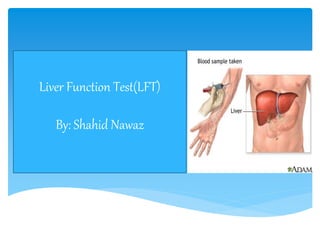
Liver Function Test(LFT)
By: Shahid Nawaz
Functions
 The liver is a reddish brown wedge-
shaped organ with four lobes of unequal
size and shape.
 A human liver normally weighs
1.44–1.66 kg (3.2–3.7 lb).
 It’s important to remember that diagnosis of liver
disease depends on a combination of patient history,
physical examination, laboratory testing, biopsy and
sometimes imaging studies such as ultrasound scans.
What are liver function tests?
 Liver function tests are blood tests used to help
diagnose and monitor liver disease or damage.
 The tests measure the levels of certain enzymes
and proteins in our blood.
 Some of these tests measure how well the liver
is performing its normal functions of producing
protein and clearing bilirubin, a blood waste
product.
Definition
 The Role of the Liver is to keep the Body’s Complex Internal Chemistry
in balance.
 It takes Raw Nutrients From Our Digestive System
 In the form of carbohydrates, protein, amino acids
 Processes them so they can be stored and sent to different parts of
our body in the right form and quantity.
 Liver regulates the level of sugars in our blood and
manufactures bile (which breaks down fats in our stomach).
 It also helps to remove Toxins, Drugs and Hormones from our
Bloodstream.
 This brief explanation does the liver little justice - it actually carries out
over 1,500 complex biochemical functions.
Role of The Liver
 Liver function tests can be used to:
 Screen for liver infections, such as hepatitis
 Monitor the progression of a disease, such as viral or
alcoholic hepatitis, and determine how well a
treatment is working
 Measure the severity of a disease, particularly
scarring of the liver (cirrhosis)
 Monitor possible side effects of medications
Why it's done
 ALT is an enzyme made by cells in the liver.
 The liver is the body’s largest gland. It has
several important functions, including:
 making proteins
 storing vitamins and iron
 removing toxins from the blood
 producing bile, which aids in digestion
Alanine transaminase (ALT)
 ALT Is an enzyme produced in hepatocytes (the major type
of liver cells).
 ALT level in the blood is increased when hepatocytes are
damaged or die - all types of hepatitis (viral, alcoholic, drug
induced etc) cause hepatocyte damage.
 Levels of ALT may equate to the degree of cell damage
but this is not always the case, particularly with hepatitis C.
 An accurate estimate of liver cell damage can only be made
by liver biopsy.
Alanine transaminase (ALT)
 Relatively low concentrations in other tissues so more
specific than AST .
 Levels fluctuate during the day Rise may occur with
the use of certain drugs or during periods of
strenuous exercise.
Alanine Transaminase (ALT)
 The ALT test is usually used to determine
whether someone has liver injury or failure.
symptoms of liver disease, including:
 jaundice, which is yellowing of the eyes or skin
 dark urine
 nausea
 vomiting
 right upper quadrant abdominal pain
Alanine transaminase (ALT)
 Proteins called enzymes help the liver break
down proteins so the body can absorb them
more easily. ALT is one of these enzymes.
 It plays a crucial role in metabolism, the process
that turns food into energy.
 ALT is normally found inside liver cells.
 when the liver is damaged or inflamed, ALT can
be released into your bloodstream. This causes
serum ALT levels to rise.
 Normal Values : 7 to 55 (U/L)
Alanine transaminase (ALT)
 AST is an enzyme found in various parts of the
body.
 The highest concentrations are found in muscle,
heart, and liver.
 A small amount of AST is typically found in the
bloodstream.
 Elevated amounts of this enzyme may signal a
health problem.
Aspartate aminotransferase (AST)
Symptoms
weakness
loss of appetite
nausea or vomiting
swelling in the abdomen
yellow skin or eyes (jaundice)
dark urine
severe skin itching
Aspartate Transaminase (AST)
 AST Is similar to ALT , but less specific for liver disease
because it is also produced in body muscle cells. It
does tend to be higher than ALT in cases of alcohol-
related liver disease.
Aspartate Transaminase (AST)
• Occurs in two Isoenzyme, indistinguishable on standard
AST assays.
• The mitochondrial Isoenzyme is produced in hepatocytes
and reacts to membrane stresses in a similar way to ALT.
• The cytosolic Isoenzyme is present in skeletal muscle, heart
muscle and kidney tissue.
• Caution must be exercised in its use to evaluate
hepatocellular damage.
• Usually rises in conjunction with ALT to indicate
hepatocellular injury: a Hepatitic picture.
Aspartate Transaminase (AST)
 This test may also be ordered for people at high
risk of developing liver problems.
 exposure to viruses that cause hepatitis
 heavy alcohol use
 family history of liver disease
 diabetes
 being overweight
 Normal Values: 8 to 48 U/L
Aspartate Transaminase (AST)
 Alkaline phosphatase is an enzyme found in our
bloodstream.
 ALP helps break down proteins in the body and
exists in different forms, depending on where it
originates.
 It is mostly produced in our liver, but some is also
made in our bones, intestines, and kidneys.
Alkaline phosphatase (ALP).
 ALK Phosphatase Refers to Alkaline Phosphatase, a
family of enzymes produced in the bile ducts,
intestine, kidneys, placenta and bones. These levels
may rise when disease of the bile ducts or bone
disorders occur.
ALK Phosphatase
• A group of Isoenzyme that act to dephosphorylate a
variety of molecules throughout the body.
• Produced in the membranes of cells lining bile ducts and
canaliculi.
• Released in response to the accumulation of bile salts or
cholestasis.
• Non-hepatic production in the kidney, intestine,
leukocytes, placenta and bone.
• Physiological rise in pregnancy or in growing children.
• Pathological rise in Paget’s disease, renal disease and with
bone metastases.
ALK Phosphatase
 Higher levels of ALP may indicate liver damage
or disease, such as a blocked bile duct, or certain
bone diseases.
 Abnormal levels of ALP also indicate
malnutrition, kidney tumors, or a serious
infection.
 The normal range of ALP varies from person to
person and depends on your age, blood type,
gender.
 Normal Values: 45 to 115 U/L
ALK Phosphatase
 Proteins are important building blocks of all cells
and tissues.
 Proteins are necessary for our body’s growth,
development, and health.
 Total Protein contains albumin and globulin.
Albumin proteins keep fluid from leaking out of
your blood vessels.
Globulin proteins play an important role in our
immune system.
Total Protein
Low total protein may indicate:
 bleeding
 liver disorder
 kidney disorder, such as a nephrotic disorder or
glomerulonephritis
 malnutrition
 extensive burns
 inflammatory conditions
 delayed post-surgery recovery
Total Protein
 Elevated total protein may indicate:
 inflammation or infections, such as viral hepatitis
B or C, or HIV
 bone marrow disorders, such as multiple
myeloma disease
 Normal Values
Total Protein: 6.3 to 7.9 g/dL
Total Protein
 Albumin Provides a gauge of nutritional status. Can
be reduced due to liver damage and kidney disease.
Because albumin is made in the liver, levels tend to
drop with cirrhosis.
Albumin
 Globulin Describes the specific level of globulins -
which include antibodies.
 This measure can be raised when liver cells are
damaged due to autoimmune liver damage or to long-
standing liver disease of many types, particularly
when cirrhosis exists.
Globulin
 Bilirubin is a substance produced during the
normal breakdown of red blood cells.
 Bilirubin passes through the liver and is excreted
in stool.
 Elevated levels of bilirubin (jaundice) might
indicate liver damage or disease or certain types
of anemia.
Bilirubin
 In an adult, high bilirubin may be due to
problems with the liver, bile ducts, or
gallbladder. Examples include:
 drug toxicity
 liver diseases like hepatitis
 cirrhosis (scarring of the liver)
 cancer of the gallbladder or pancreas
 Gallstones
 Normal Values : 0.1 to 1.2 mg/dL
Bilirubin
 GGT test measures the amount of the enzyme
GGT in our blood.
 Enzymes are molecules that are necessary for
chemical reactions in our body.
 GGT functions in the body as a transport
molecule, helping to move other molecules
around the body.
 It plays a significant role in helping the liver
metabolize drugs and other toxins.
gamma-Glutamyl transpeptidase (GGT)
 GGT is concentrated in the liver.
 it’s also present in the gallbladder, spleen,
pancreas, and kidneys.
 GGT blood levels are usually high when the liver
is damaged.
gamma-Glutamyl transpeptidase (GGT)
The symptoms of liver problems include:
 decreased appetite
 vomiting or nausea
 lack of energy
 abdominal pain
 jaundice, which is a yellowing of the skin
 unusually dark urine
 light-colored feces
 itchy skin
 Normal Values : 9 to 48 U/L
gamma-Glutamyl transpeptidase (GGT)
Normal Values & Changes
Thank You

Liver function test(lft) 09.05.16

  • 1.
  • 7.
    Functions  The liveris a reddish brown wedge- shaped organ with four lobes of unequal size and shape.  A human liver normally weighs 1.44–1.66 kg (3.2–3.7 lb).
  • 8.
     It’s importantto remember that diagnosis of liver disease depends on a combination of patient history, physical examination, laboratory testing, biopsy and sometimes imaging studies such as ultrasound scans. What are liver function tests?
  • 9.
     Liver functiontests are blood tests used to help diagnose and monitor liver disease or damage.  The tests measure the levels of certain enzymes and proteins in our blood.  Some of these tests measure how well the liver is performing its normal functions of producing protein and clearing bilirubin, a blood waste product. Definition
  • 10.
     The Roleof the Liver is to keep the Body’s Complex Internal Chemistry in balance.  It takes Raw Nutrients From Our Digestive System  In the form of carbohydrates, protein, amino acids  Processes them so they can be stored and sent to different parts of our body in the right form and quantity.  Liver regulates the level of sugars in our blood and manufactures bile (which breaks down fats in our stomach).  It also helps to remove Toxins, Drugs and Hormones from our Bloodstream.  This brief explanation does the liver little justice - it actually carries out over 1,500 complex biochemical functions. Role of The Liver
  • 11.
     Liver functiontests can be used to:  Screen for liver infections, such as hepatitis  Monitor the progression of a disease, such as viral or alcoholic hepatitis, and determine how well a treatment is working  Measure the severity of a disease, particularly scarring of the liver (cirrhosis)  Monitor possible side effects of medications Why it's done
  • 12.
     ALT isan enzyme made by cells in the liver.  The liver is the body’s largest gland. It has several important functions, including:  making proteins  storing vitamins and iron  removing toxins from the blood  producing bile, which aids in digestion Alanine transaminase (ALT)
  • 13.
     ALT Isan enzyme produced in hepatocytes (the major type of liver cells).  ALT level in the blood is increased when hepatocytes are damaged or die - all types of hepatitis (viral, alcoholic, drug induced etc) cause hepatocyte damage.  Levels of ALT may equate to the degree of cell damage but this is not always the case, particularly with hepatitis C.  An accurate estimate of liver cell damage can only be made by liver biopsy. Alanine transaminase (ALT)
  • 14.
     Relatively lowconcentrations in other tissues so more specific than AST .  Levels fluctuate during the day Rise may occur with the use of certain drugs or during periods of strenuous exercise. Alanine Transaminase (ALT)
  • 15.
     The ALTtest is usually used to determine whether someone has liver injury or failure. symptoms of liver disease, including:  jaundice, which is yellowing of the eyes or skin  dark urine  nausea  vomiting  right upper quadrant abdominal pain Alanine transaminase (ALT)
  • 16.
     Proteins calledenzymes help the liver break down proteins so the body can absorb them more easily. ALT is one of these enzymes.  It plays a crucial role in metabolism, the process that turns food into energy.  ALT is normally found inside liver cells.  when the liver is damaged or inflamed, ALT can be released into your bloodstream. This causes serum ALT levels to rise.  Normal Values : 7 to 55 (U/L) Alanine transaminase (ALT)
  • 17.
     AST isan enzyme found in various parts of the body.  The highest concentrations are found in muscle, heart, and liver.  A small amount of AST is typically found in the bloodstream.  Elevated amounts of this enzyme may signal a health problem. Aspartate aminotransferase (AST)
  • 18.
    Symptoms weakness loss of appetite nauseaor vomiting swelling in the abdomen yellow skin or eyes (jaundice) dark urine severe skin itching Aspartate Transaminase (AST)
  • 19.
     AST Issimilar to ALT , but less specific for liver disease because it is also produced in body muscle cells. It does tend to be higher than ALT in cases of alcohol- related liver disease. Aspartate Transaminase (AST)
  • 20.
    • Occurs intwo Isoenzyme, indistinguishable on standard AST assays. • The mitochondrial Isoenzyme is produced in hepatocytes and reacts to membrane stresses in a similar way to ALT. • The cytosolic Isoenzyme is present in skeletal muscle, heart muscle and kidney tissue. • Caution must be exercised in its use to evaluate hepatocellular damage. • Usually rises in conjunction with ALT to indicate hepatocellular injury: a Hepatitic picture. Aspartate Transaminase (AST)
  • 21.
     This testmay also be ordered for people at high risk of developing liver problems.  exposure to viruses that cause hepatitis  heavy alcohol use  family history of liver disease  diabetes  being overweight  Normal Values: 8 to 48 U/L Aspartate Transaminase (AST)
  • 22.
     Alkaline phosphataseis an enzyme found in our bloodstream.  ALP helps break down proteins in the body and exists in different forms, depending on where it originates.  It is mostly produced in our liver, but some is also made in our bones, intestines, and kidneys. Alkaline phosphatase (ALP).
  • 23.
     ALK PhosphataseRefers to Alkaline Phosphatase, a family of enzymes produced in the bile ducts, intestine, kidneys, placenta and bones. These levels may rise when disease of the bile ducts or bone disorders occur. ALK Phosphatase
  • 24.
    • A groupof Isoenzyme that act to dephosphorylate a variety of molecules throughout the body. • Produced in the membranes of cells lining bile ducts and canaliculi. • Released in response to the accumulation of bile salts or cholestasis. • Non-hepatic production in the kidney, intestine, leukocytes, placenta and bone. • Physiological rise in pregnancy or in growing children. • Pathological rise in Paget’s disease, renal disease and with bone metastases. ALK Phosphatase
  • 25.
     Higher levelsof ALP may indicate liver damage or disease, such as a blocked bile duct, or certain bone diseases.  Abnormal levels of ALP also indicate malnutrition, kidney tumors, or a serious infection.  The normal range of ALP varies from person to person and depends on your age, blood type, gender.  Normal Values: 45 to 115 U/L ALK Phosphatase
  • 26.
     Proteins areimportant building blocks of all cells and tissues.  Proteins are necessary for our body’s growth, development, and health.  Total Protein contains albumin and globulin. Albumin proteins keep fluid from leaking out of your blood vessels. Globulin proteins play an important role in our immune system. Total Protein
  • 27.
    Low total proteinmay indicate:  bleeding  liver disorder  kidney disorder, such as a nephrotic disorder or glomerulonephritis  malnutrition  extensive burns  inflammatory conditions  delayed post-surgery recovery Total Protein
  • 28.
     Elevated totalprotein may indicate:  inflammation or infections, such as viral hepatitis B or C, or HIV  bone marrow disorders, such as multiple myeloma disease  Normal Values Total Protein: 6.3 to 7.9 g/dL Total Protein
  • 29.
     Albumin Providesa gauge of nutritional status. Can be reduced due to liver damage and kidney disease. Because albumin is made in the liver, levels tend to drop with cirrhosis. Albumin
  • 30.
     Globulin Describesthe specific level of globulins - which include antibodies.  This measure can be raised when liver cells are damaged due to autoimmune liver damage or to long- standing liver disease of many types, particularly when cirrhosis exists. Globulin
  • 31.
     Bilirubin isa substance produced during the normal breakdown of red blood cells.  Bilirubin passes through the liver and is excreted in stool.  Elevated levels of bilirubin (jaundice) might indicate liver damage or disease or certain types of anemia. Bilirubin
  • 32.
     In anadult, high bilirubin may be due to problems with the liver, bile ducts, or gallbladder. Examples include:  drug toxicity  liver diseases like hepatitis  cirrhosis (scarring of the liver)  cancer of the gallbladder or pancreas  Gallstones  Normal Values : 0.1 to 1.2 mg/dL Bilirubin
  • 33.
     GGT testmeasures the amount of the enzyme GGT in our blood.  Enzymes are molecules that are necessary for chemical reactions in our body.  GGT functions in the body as a transport molecule, helping to move other molecules around the body.  It plays a significant role in helping the liver metabolize drugs and other toxins. gamma-Glutamyl transpeptidase (GGT)
  • 34.
     GGT isconcentrated in the liver.  it’s also present in the gallbladder, spleen, pancreas, and kidneys.  GGT blood levels are usually high when the liver is damaged. gamma-Glutamyl transpeptidase (GGT)
  • 35.
    The symptoms ofliver problems include:  decreased appetite  vomiting or nausea  lack of energy  abdominal pain  jaundice, which is a yellowing of the skin  unusually dark urine  light-colored feces  itchy skin  Normal Values : 9 to 48 U/L gamma-Glutamyl transpeptidase (GGT)
  • 36.
  • 38.