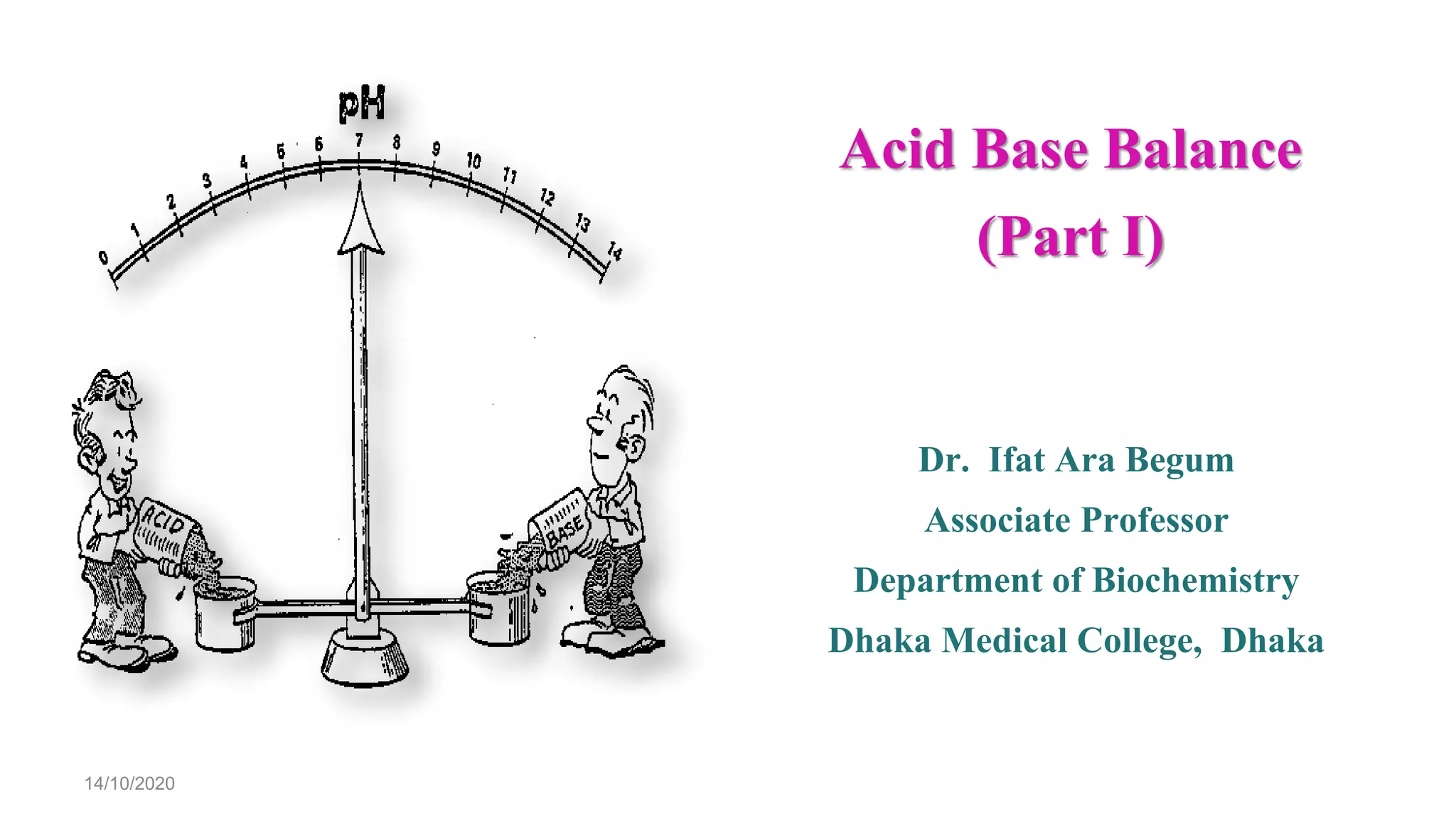
Acid Base Balance
(Part I)
Dr. Ifat Ara Begum
Associate Professor
Department of Biochemistry
Dhaka Medical College, Dhaka
14/10/2020
Learning objectives
 Acid: Definition, types, sources
 Base : Definition, types, sources
 pH : Definition, normal blood pH, maintenance of static blood pH
 Acid base disorders : Types
2
 Proton (H
+
) donor in aqueous
solution
 pH <7
 Produces H+ when dissolved in water
 May be charged particle [NH4
+,
H2PO4
-] or may be without charge
[HCl]
 Types: Strong acid , Weak acid
 Proton (H+) acceptor in aqueous
solution
 pH >7
 Produces OH- when dissolved in water
 May be charged particle [Cl-, HCO3
-]
or may be without charge [NH3]
 Types: Strong base , Weak base
Acid Base
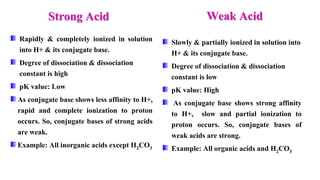
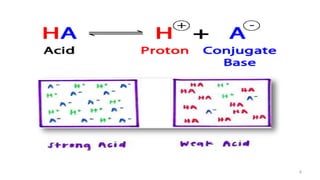
Rapidly & completely ionized in solution
into H+ & its conjugate base.
Degree of dissociation & dissociation
constant is high
pK value: Low
As conjugate base shows less affinity to H+,
rapid and complete ionization to proton
occurs. So, conjugate bases of strong acids
are weak.
Example: All inorganic acids except H2CO3
Slowly & partially ionized in solution into
H+ & its conjugate base.
Degree of dissociation & dissociation
constant is low
pK value: High
As conjugate base shows strong affinity
to H+, slow and partial ionization to
proton occurs. So, conjugate bases of
weak acids are strong.
Example: All organic acids and H2CO3
Strong Acid Weak Acid
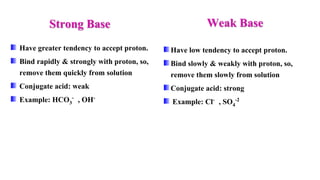
Have greater tendency to accept proton.
Bind rapidly & strongly with proton, so,
remove them quickly from solution
Conjugate acid: weak
Example: HCO3
- , OH-
Have low tendency to accept proton.
Bind slowly & weakly with proton, so,
remove them slowly from solution
Conjugate acid: strong
Example: Cl- , SO4
-2
Strong Base Weak Base
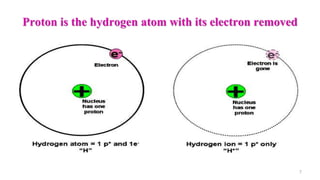
Proton is the hydrogen atom with its electron removed
7
8
9
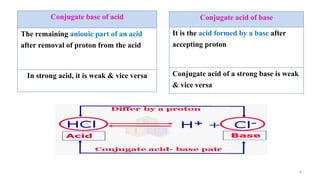
Conjugate base of acid
The remaining anionic part of an acid
after removal of proton from the acid
In strong acid, it is weak & vice versa
Conjugate acid of base
It is the acid formed by a base after
accepting proton
Conjugate acid of a strong base is weak
& vice versa
10
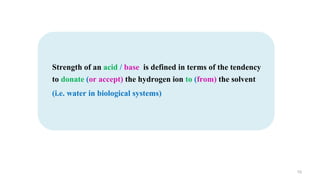
Strength of an acid / base is defined in terms of the tendency
to donate (or accept) the hydrogen ion to (from) the solvent
(i.e. water in biological systems)
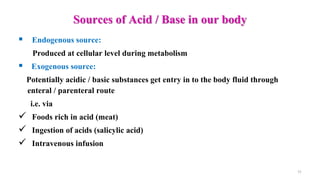
Sources of Acid / Base in our body
 Endogenous source:
Produced at cellular level during metabolism
 Exogenous source:
Potentially acidic / basic substances get entry in to the body fluid through
enteral / parenteral route
i.e. via
 Foods rich in acid (meat)
 Ingestion of acids (salicylic acid)
 Intravenous infusion
11
12
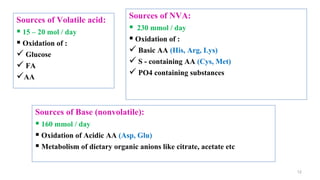
Sources of Volatile acid:
 15 – 20 mol / day
 Oxidation of :
 Glucose
 FA
AA
Sources of NVA:
 230 mmol / day
 Oxidation of :
 Basic AA (His, Arg, Lys)
 S - containing AA (Cys, Met)
 PO4 containing substances
Sources of Base (nonvolatile):
 160 mmol / day
 Oxidation of Acidic AA (Asp, Glu)
 Metabolism of dietary organic anions like citrate, acetate etc
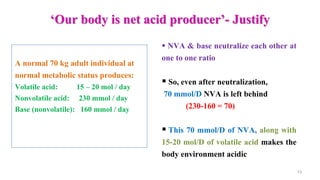
‘Our body is net acid producer’- Justify
13
 NVA & base neutralize each other at
one to one ratio
 So, even after neutralization,
70 mmol/D NVA is left behind
(230-160 = 70)
 This 70 mmol/D of NVA, along with
15-20 mol/D of volatile acid makes the
body environment acidic
A normal 70 kg adult individual at
normal metabolic status produces:
Volatile acid: 15 – 20 mol / day
Nonvolatile acid: 230 mmol / day
Base (nonvolatile): 160 mmol / day
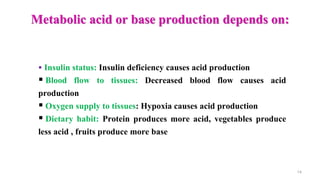
Metabolic acid or base production depends on:
14
 Insulin status: Insulin deficiency causes acid production
 Blood flow to tissues: Decreased blood flow causes acid
production
 Oxygen supply to tissues: Hypoxia causes acid production
 Dietary habit: Protein produces more acid, vegetables produce
less acid , fruits produce more base
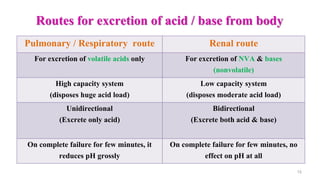
Routes for excretion of acid / base from body
15
Pulmonary / Respiratory route Renal route
For excretion of volatile acids only For excretion of NVA & bases
(nonvolatile)
High capacity system
(disposes huge acid load)
Low capacity system
(disposes moderate acid load)
Unidirectional
(Excrete only acid)
Bidirectional
(Excrete both acid & base)
On complete failure for few minutes, it
reduces pH grossly
On complete failure for few minutes, no
effect on pH at all
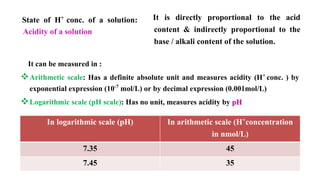
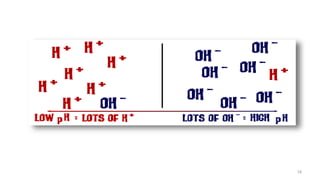
State of H+ conc. of a solution:
Acidity of a solution
It is directly proportional to the acid
content & indirectly proportional to the
base / alkali content of the solution.
It can be measured in :
Arithmetic scale: Has a definite absolute unit and measures acidity (H+ conc. ) by
exponential expression (10-7 mol/L) or by decimal expression (0.001mol/L)
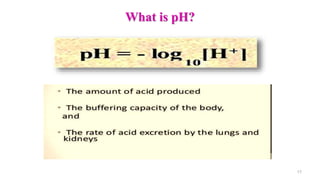
Logarithmic scale (pH scale): Has no unit, measures acidity by pH
In logarithmic scale (pH) In arithmetic scale (H+concentration
in nmol/L)
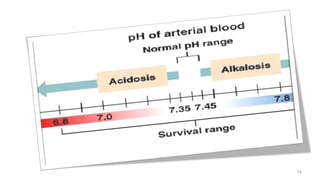
7.35 45
7.45 35
What is pH?
17
18
19
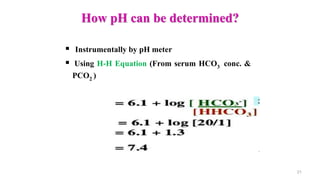
How pH can be determined?
 Instrumentally by pH meter
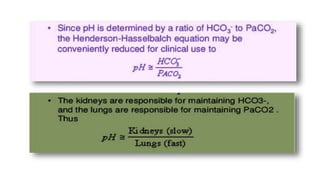
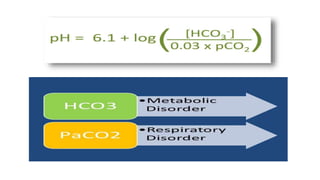
 Using H-H Equation (From serum HCO3 conc. &
PCO2 )
21
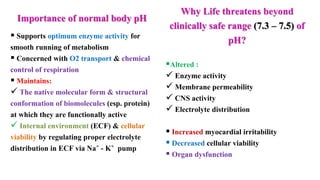
 Supports optimum enzyme activity for
smooth running of metabolism
 Concerned with O2 transport & chemical
control of respiration
 Maintains:
 The native molecular form & structural
conformation of biomolecules (esp. protein)
at which they are functionally active
 Internal environment (ECF) & cellular
viability by regulating proper electrolyte
distribution in ECF via Na+ - K+ pump
Altered :
 Enzyme activity
 Membrane permeability
 CNS activity
 Electrolyte distribution
 Increased myocardial irritability
 Decreased cellular viability
 Organ dysfunction
Importance of normal body pH
Why Life threatens beyond
clinically safe range (7.3 – 7.5) of
pH?
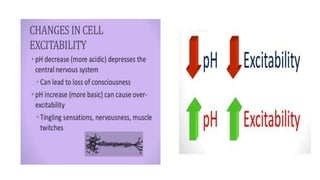
Here are some Important Effects of pH change in body
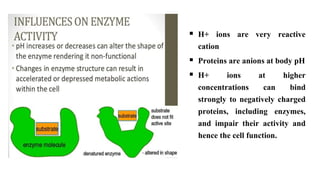
 H+ ions are very reactive
cation
 Proteins are anions at body pH
 H+ ions at higher
concentrations can bind
strongly to negatively charged
proteins, including enzymes,
and impair their activity and
hence the cell function.
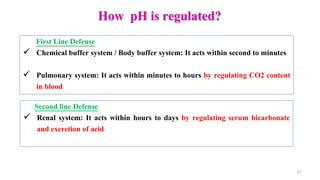
How pH is regulated?
27
First Line Defense
 Chemical buffer system / Body buffer system: It acts within second to minutes
 Pulmonary system: It acts within minutes to hours by regulating CO2 content
in blood
Second line Defense
 Renal system: It acts within hours to days by regulating serum bicarbonate
and excretion of acid
Buffer
A mixture of weak acid & its conjugate base or a mixture of weak acid & its
salt with strong base
that can accept / release H+ in a solution
to resist marked changes in H+ conc. or pH of that solution
despite the addition of moderate amount of acid / base to the solution.
28
Principle of buffer action:
Conversion of strong acid in to weak acid
 Conversion of strong base in to weak base
29
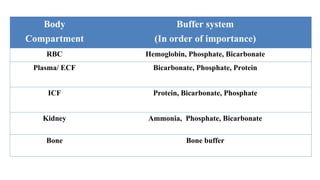
Body
Compartment
Buffer system
(In order of importance)
RBC Hemoglobin, Phosphate, Bicarbonate
Plasma/ ECF Bicarbonate, Phosphate, Protein
ICF Protein, Bicarbonate, Phosphate
Kidney Ammonia, Phosphate, Bicarbonate
Bone Bone buffer
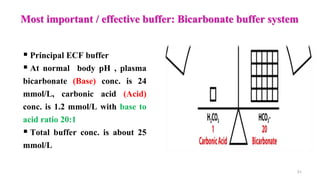
Most important / effective buffer: Bicarbonate buffer system
31
 Principal ECF buffer
 At normal body pH , plasma
bicarbonate (Base) conc. is 24
mmol/L, carbonic acid (Acid)
conc. is 1.2 mmol/L with base to
acid ratio 20:1
 Total buffer conc. is about 25
mmol/L
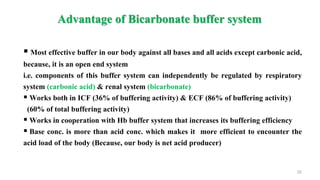
Advantage of Bicarbonate buffer system
32
 Most effective buffer in our body against all bases and all acids except carbonic acid,
because, it is an open end system
i.e. components of this buffer system can independently be regulated by respiratory
system (carbonic acid) & renal system (bicarbonate)
 Works both in ICF (36% of buffering activity) & ECF (86% of buffering activity)
(60% of total buffering activity)
 Works in cooperation with Hb buffer system that increases its buffering efficiency
 Base conc. is more than acid conc. which makes it more efficient to encounter the
acid load of the body (Because, our body is net acid producer)
Disadvantage of Bicarbonate buffer system
33
 Weak buffer because of its low pK value (6.1), which is far
below the normal body pH.
(Protein and Phosphate buffer is stronger)
 Cant buffer carbonic acid , so can not operate in respiratory
acid base disorders
Bone Buffer
 Alkaline calcium phosphate salt of bone
deposited in the form of Hydroxyapatite
Crystal (HAC)
 Action: Delayed, needs hours to days
 Buffering capacity: Very high
 No role in acute acidosis
 In CRF, where chronic acidosis occurs ,
classic body buffers frequently fails to buffer
all the retained acid. So, bone buffer comes in
action at the cost of bone demineralization.
Importance of bone buffer:
 Can prevent the dev. of acidosis in
mild/moderate CRF
 Its activity in CRF leads to
osteoporosis of bone with resultant
hypercalcemia & calciuria
 Hypercalcemia can predispose to
dev. of renal stone (as calcium
oxalate/ phosphate)
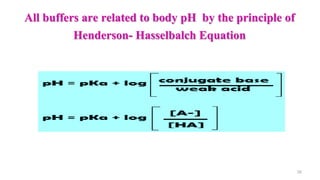
All buffers are related to body pH by the principle of
Henderson- Hasselbalch Equation
35
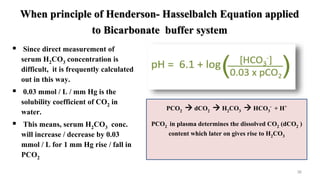
When principle of Henderson- Hasselbalch Equation applied
to Bicarbonate buffer system
36
 Since direct measurement of
serum H2CO3 concentration is
difficult, it is frequently calculated
out in this way.
 0.03 mmol / L / mm Hg is the
solubility coefficient of CO2 in
water.
 This means, serum H2CO3 conc.
will increase / decrease by 0.03
mmol / L for 1 mm Hg rise / fall in
PCO2
PCO2  dCO2  H2CO3  HCO3
- + H+
PCO2 in plasma determines the dissolved CO2 (dCO2 )
content which later on gives rise to H2CO3
38
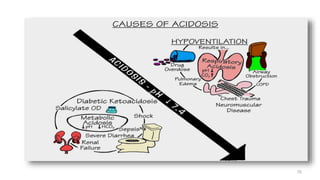
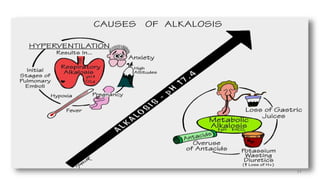
Acid Base Disorders
Types of ABD
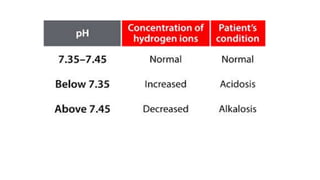
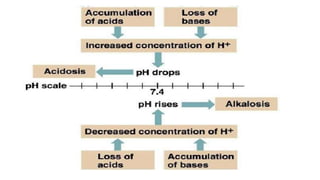
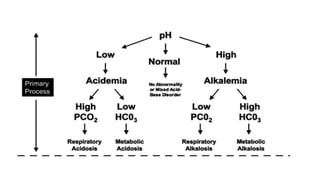
 Acidosis: A condition in which the blood has too much acid (or too little
base), resulting in a decrease in blood pH
 Alkalosis: A condition in which the blood has too much base (or too little
acid), resulting in an increase in blood pH
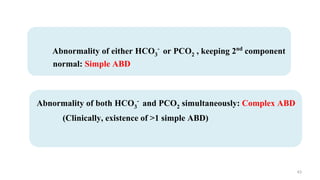
Abnormality of both HCO3
- and PCO2 simultaneously: Complex ABD
(Clinically, existence of >1 simple ABD)
43
Abnormality of either HCO3
- or PCO2 , keeping 2nd component
normal: Simple ABD
44
Acid Base Balance
(Part II)
Dr. Ifat Ara Begum
Associate Professor
Department of Biochemistry
Dhaka Medical College, Dhaka
14/10/2020
Learning objectives
 Acid base disorders : Types (Contd), their compensation & correction
 Anion gap
 Base excess
 Bicarbonate space
46
Types of Simple ABD
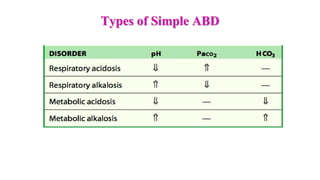
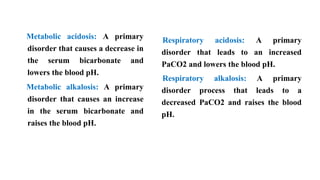
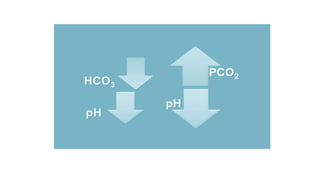
Metabolic acidosis: A primary
disorder that causes a decrease in
the serum bicarbonate and
lowers the blood pH.
Metabolic alkalosis: A primary
disorder that causes an increase
in the serum bicarbonate and
raises the blood pH.
Respiratory acidosis: A primary
disorder that leads to an increased
PaCO2 and lowers the blood pH.
Respiratory alkalosis: A primary
disorder process that leads to a
decreased PaCO2 and raises the blood
pH.
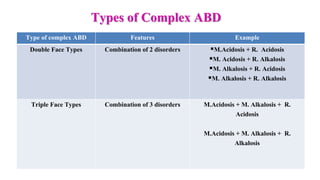
Types of Complex ABD
Type of complex ABD Features Example
Double Face Types Combination of 2 disorders M.Acidosis + R. Acidosis
M. Acidosis + R. Alkalosis
M. Alkalosis + R. Acidosis
M. Alkalosis + R. Alkalosis
Triple Face Types Combination of 3 disorders M.Acidosis + M. Alkalosis + R.
Acidosis
M.Acidosis + M. Alkalosis + R.
Alkalosis
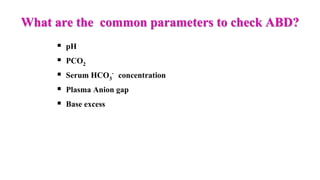
What are the common parameters to check ABD?
 pH
 PCO2
 Serum HCO3
- concentration
 Plasma Anion gap
 Base excess
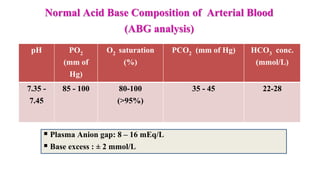
Normal Acid Base Composition of Arterial Blood
(ABG analysis)
pH PO2
(mm of
Hg)
O2 saturation
(%)
PCO2 (mm of Hg) HCO3 conc.
(mmol/L)
7.35 -
7.45
85 - 100 80-100
(>95%)
35 - 45 22-28
 Plasma Anion gap: 8 – 16 mEq/L
 Base excess : ± 2 mmol/L
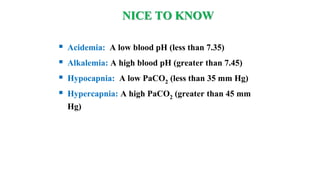
NICE TO KNOW
 Acidemia: A low blood pH (less than 7.35)
 Alkalemia: A high blood pH (greater than 7.45)
 Hypocapnia: A low PaCO2 (less than 35 mm Hg)
 Hypercapnia: A high PaCO2 (greater than 45 mm
Hg)
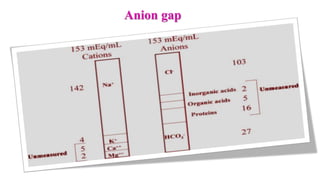
Anion gap
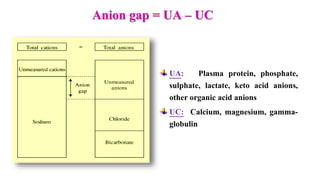
Anion gap = UA – UC
UA: Plasma protein, phosphate,
sulphate, lactate, keto acid anions,
other organic acid anions
UC: Calcium, magnesium, gamma-
globulin
 Normal range: 8 – 16 mEq/L
[K level is ignored since plasma K+
concentration doesn’t vary that
much]
 Importance of AG:
It helps to differentiate the causes
of metabolic acidosis
It helps to determine the nature of
metabolic acidosis (simple /
complex)
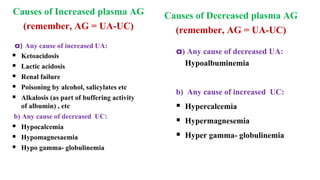
Causes of Increased plasma AG
(remember, AG = UA-UC)
a) Any cause of increased UA:
 Ketoacidosis
 Lactic acidosis
 Renal failure
 Poisoning by alcohol, salicylates etc
 Alkalosis (as part of buffering activity
of albumin) , etc
b) Any cause of decreased UC:
 Hypocalcemia
 Hypomagnesaemia
 Hypo gamma- globulinemia
Causes of Decreased plasma AG
(remember, AG = UA-UC)
a) Any cause of decreased UA:
Hypoalbuminemia
b) Any cause of increased UC:
 Hypercalcemia
 Hypermagnesemia
 Hyper gamma- globulinemia
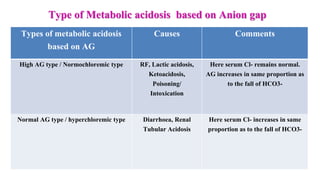
Type of Metabolic acidosis based on Anion gap
Types of metabolic acidosis
based on AG
Causes Comments
High AG type / Normochloremic type RF, Lactic acidosis,
Ketoacidosis,
Poisoning/
Intoxication
Here serum Cl- remains normal.
AG increases in same proportion as
to the fall of HCO3-
Normal AG type / hyperchloremic type Diarrhoea, Renal
Tubular Acidosis
Here serum Cl- increases in same
proportion as to the fall of HCO3-
Base Excess
 Difference between present /actual
bicarbonate concentration of an individual
and the standard bicarbonate concentration
 Base Excess = [HCO3
-] p – [HCO3
-]std
 Positive BE: High plasma HCO3
- conc. which
is found in metabolic alkalosis & respiratory
acidosis
 Negative BE: Low plasma HCO3
- conc. which
is found in metabolic acidosis & respiratory
alkalosis
Standard plasma bicarbonate concentration:
 It is the plasma bicarbonate concentration of an individual of an
individual at:
 Body temperature 37 degree C
 Arterial PCO2 at 40 mm Hg
 Hb conc. normal 14-16 g/dl
 Oxygen saturation of Hb normal >95%
 Symbolized as [HCO3
-]std
 24 mmol / L
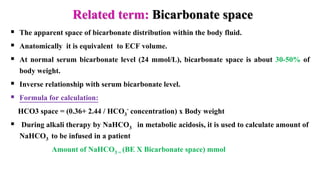
Related term: Bicarbonate space
 The apparent space of bicarbonate distribution within the body fluid.
 Anatomically it is equivalent to ECF volume.
 At normal serum bicarbonate level (24 mmol/L), bicarbonate space is about 30-50% of
body weight.
 Inverse relationship with serum bicarbonate level.
 Formula for calculation:
HCO3 space = (0.36+ 2.44 / HCO3
- concentration) x Body weight
 During alkali therapy by NaHCO3 in metabolic acidosis, it is used to calculate amount of
NaHCO3 to be infused in a patient
Amount of NaHCO3 = (BE X Bicarbonate space) mmol
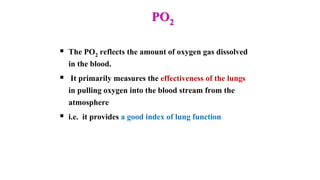
PO2
 The PO2 reflects the amount of oxygen gas dissolved
in the blood.
 It primarily measures the effectiveness of the lungs
in pulling oxygen into the blood stream from the
atmosphere
 i.e. it provides a good index of lung function
Events of ABD According to Time Course
 Primary event / Primary defect
 Buffering by ICF & ECF buffers
 Compensation / Secondary event
 Correction / Repair
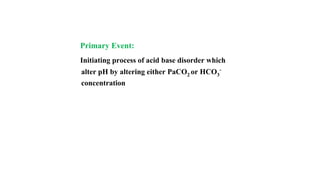
Primary Event:
Initiating process of acid base disorder which
alter pH by altering either PaCO2 or HCO3
-
concentration
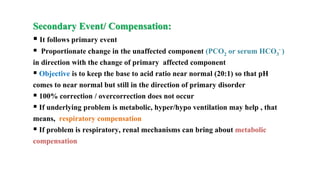
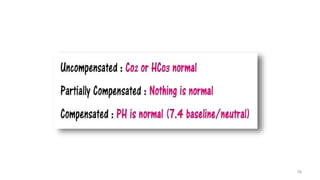
Secondary Event/ Compensation:
 It follows primary event
 Proportionate change in the unaffected component (PCO2 or serum HCO3
- )
in direction with the change of primary affected component
 Objective is to keep the base to acid ratio near normal (20:1) so that pH
comes to near normal but still in the direction of primary disorder
 100% correction / overcorrection does not occur
 If underlying problem is metabolic, hyper/hypo ventilation may help , that
means, respiratory compensation
 If problem is respiratory, renal mechanisms can bring about metabolic
compensation
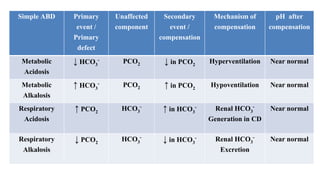
Simple ABD Primary
event /
Primary
defect
Unaffected
component
Secondary
event /
compensation
Mechanism of
compensation
pH after
compensation
Metabolic
Acidosis
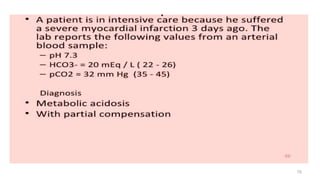
↓ HCO3
- PCO2 ↓ in PCO2 Hyperventilation Near normal
Metabolic
Alkalosis
↑ HCO3
- PCO2 ↑ in PCO2 Hypoventilation Near normal
Respiratory
Acidosis
↑ PCO2 HCO3
-
↑ in HCO3
- Renal HCO3
-
Generation in CD
Near normal
Respiratory
Alkalosis
↓ PCO2 HCO3
-
↓ in HCO3
- Renal HCO3
-
Excretion
Near normal
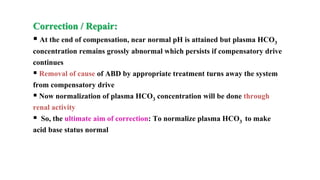
Correction / Repair:
 At the end of compensation, near normal pH is attained but plasma HCO3
concentration remains grossly abnormal which persists if compensatory drive
continues
 Removal of cause of ABD by appropriate treatment turns away the system
from compensatory drive
 Now normalization of plasma HCO3 concentration will be done through
renal activity
 So, the ultimate aim of correction: To normalize plasma HCO3 to make
acid base status normal
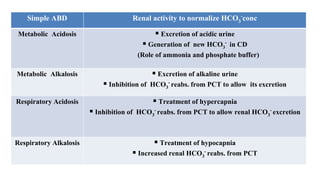
Simple ABD Renal activity to normalize HCO3
-conc
Metabolic Acidosis  Excretion of acidic urine
 Generation of new HCO3
- in CD
(Role of ammonia and phosphate buffer)
Metabolic Alkalosis  Excretion of alkaline urine
 Inhibition of HCO3
- reabs. from PCT to allow its excretion
Respiratory Acidosis  Treatment of hypercapnia
 Inhibition of HCO3
- reabs. from PCT to allow renal HCO3
- excretion
Respiratory Alkalosis  Treatment of hypocapnia
 Increased renal HCO3
- reabs. from PCT
70
71
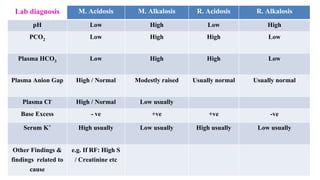
Lab diagnosis M. Acidosis M. Alkalosis R. Acidosis R. Alkalosis
pH Low High Low High
PCO2 Low High High Low
Plasma HCO3 Low High High Low
Plasma Anion Gap High / Normal Modestly raised Usually normal Usually normal
Plasma Cl- High / Normal Low usually
Base Excess - ve +ve +ve -ve
Serum K+ High usually Low usually High usually Low usually
Other Findings &
findings related to
cause
e.g. If RF: High S
/ Creatinine etc
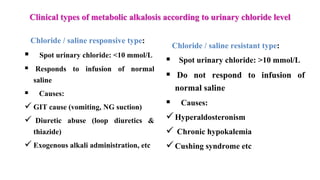
Clinical types of metabolic alkalosis according to urinary chloride level
Chloride / saline responsive type:
 Spot urinary chloride: <10 mmol/L
 Responds to infusion of normal
saline
 Causes:
 GIT cause (vomiting, NG suction)
 Diuretic abuse (loop diuretics &
thiazide)
 Exogenous alkali administration, etc
Chloride / saline resistant type:
 Spot urinary chloride: >10 mmol/L
 Do not respond to infusion of
normal saline
 Causes:
Hyperaldosteronism
 Chronic hypokalemia
Cushing syndrome etc
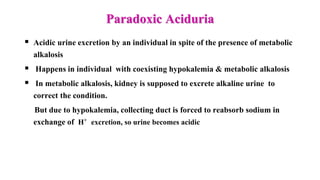
Paradoxic Aciduria
 Acidic urine excretion by an individual in spite of the presence of metabolic
alkalosis
 Happens in individual with coexisting hypokalemia & metabolic alkalosis
 In metabolic alkalosis, kidney is supposed to excrete alkaline urine to
correct the condition.
But due to hypokalemia, collecting duct is forced to reabsorb sodium in
exchange of H+ excretion, so urine becomes acidic
75
76
77

Acid base balance (updated in 2020)

  • 1.
    Acid Base Balance (PartI) Dr. Ifat Ara Begum Associate Professor Department of Biochemistry Dhaka Medical College, Dhaka 14/10/2020
  • 2.
    Learning objectives  Acid:Definition, types, sources  Base : Definition, types, sources  pH : Definition, normal blood pH, maintenance of static blood pH  Acid base disorders : Types 2
  • 3.
     Proton (H + )donor in aqueous solution  pH <7  Produces H+ when dissolved in water  May be charged particle [NH4 +, H2PO4 -] or may be without charge [HCl]  Types: Strong acid , Weak acid  Proton (H+) acceptor in aqueous solution  pH >7  Produces OH- when dissolved in water  May be charged particle [Cl-, HCO3 -] or may be without charge [NH3]  Types: Strong base , Weak base Acid Base
  • 5.
    Rapidly & completelyionized in solution into H+ & its conjugate base. Degree of dissociation & dissociation constant is high pK value: Low As conjugate base shows less affinity to H+, rapid and complete ionization to proton occurs. So, conjugate bases of strong acids are weak. Example: All inorganic acids except H2CO3 Slowly & partially ionized in solution into H+ & its conjugate base. Degree of dissociation & dissociation constant is low pK value: High As conjugate base shows strong affinity to H+, slow and partial ionization to proton occurs. So, conjugate bases of weak acids are strong. Example: All organic acids and H2CO3 Strong Acid Weak Acid
  • 6.
    Have greater tendencyto accept proton. Bind rapidly & strongly with proton, so, remove them quickly from solution Conjugate acid: weak Example: HCO3 - , OH- Have low tendency to accept proton. Bind slowly & weakly with proton, so, remove them slowly from solution Conjugate acid: strong Example: Cl- , SO4 -2 Strong Base Weak Base
  • 7.
    Proton is thehydrogen atom with its electron removed 7
  • 8.
  • 9.
    9 Conjugate base ofacid The remaining anionic part of an acid after removal of proton from the acid In strong acid, it is weak & vice versa Conjugate acid of base It is the acid formed by a base after accepting proton Conjugate acid of a strong base is weak & vice versa
  • 10.
    10 Strength of anacid / base is defined in terms of the tendency to donate (or accept) the hydrogen ion to (from) the solvent (i.e. water in biological systems)
  • 11.
    Sources of Acid/ Base in our body  Endogenous source: Produced at cellular level during metabolism  Exogenous source: Potentially acidic / basic substances get entry in to the body fluid through enteral / parenteral route i.e. via  Foods rich in acid (meat)  Ingestion of acids (salicylic acid)  Intravenous infusion 11
  • 12.
    12 Sources of Volatileacid:  15 – 20 mol / day  Oxidation of :  Glucose  FA AA Sources of NVA:  230 mmol / day  Oxidation of :  Basic AA (His, Arg, Lys)  S - containing AA (Cys, Met)  PO4 containing substances Sources of Base (nonvolatile):  160 mmol / day  Oxidation of Acidic AA (Asp, Glu)  Metabolism of dietary organic anions like citrate, acetate etc
  • 13.
    ‘Our body isnet acid producer’- Justify 13  NVA & base neutralize each other at one to one ratio  So, even after neutralization, 70 mmol/D NVA is left behind (230-160 = 70)  This 70 mmol/D of NVA, along with 15-20 mol/D of volatile acid makes the body environment acidic A normal 70 kg adult individual at normal metabolic status produces: Volatile acid: 15 – 20 mol / day Nonvolatile acid: 230 mmol / day Base (nonvolatile): 160 mmol / day
  • 14.
    Metabolic acid orbase production depends on: 14  Insulin status: Insulin deficiency causes acid production  Blood flow to tissues: Decreased blood flow causes acid production  Oxygen supply to tissues: Hypoxia causes acid production  Dietary habit: Protein produces more acid, vegetables produce less acid , fruits produce more base
  • 15.
    Routes for excretionof acid / base from body 15 Pulmonary / Respiratory route Renal route For excretion of volatile acids only For excretion of NVA & bases (nonvolatile) High capacity system (disposes huge acid load) Low capacity system (disposes moderate acid load) Unidirectional (Excrete only acid) Bidirectional (Excrete both acid & base) On complete failure for few minutes, it reduces pH grossly On complete failure for few minutes, no effect on pH at all
  • 16.
    State of H+conc. of a solution: Acidity of a solution It is directly proportional to the acid content & indirectly proportional to the base / alkali content of the solution. It can be measured in : Arithmetic scale: Has a definite absolute unit and measures acidity (H+ conc. ) by exponential expression (10-7 mol/L) or by decimal expression (0.001mol/L) Logarithmic scale (pH scale): Has no unit, measures acidity by pH In logarithmic scale (pH) In arithmetic scale (H+concentration in nmol/L) 7.35 45 7.45 35
  • 17.
  • 18.
  • 19.
  • 21.
    How pH canbe determined?  Instrumentally by pH meter  Using H-H Equation (From serum HCO3 conc. & PCO2 ) 21
  • 22.
     Supports optimumenzyme activity for smooth running of metabolism  Concerned with O2 transport & chemical control of respiration  Maintains:  The native molecular form & structural conformation of biomolecules (esp. protein) at which they are functionally active  Internal environment (ECF) & cellular viability by regulating proper electrolyte distribution in ECF via Na+ - K+ pump Altered :  Enzyme activity  Membrane permeability  CNS activity  Electrolyte distribution  Increased myocardial irritability  Decreased cellular viability  Organ dysfunction Importance of normal body pH Why Life threatens beyond clinically safe range (7.3 – 7.5) of pH?
  • 23.
    Here are someImportant Effects of pH change in body
  • 25.
     H+ ionsare very reactive cation  Proteins are anions at body pH  H+ ions at higher concentrations can bind strongly to negatively charged proteins, including enzymes, and impair their activity and hence the cell function.
  • 27.
    How pH isregulated? 27 First Line Defense  Chemical buffer system / Body buffer system: It acts within second to minutes  Pulmonary system: It acts within minutes to hours by regulating CO2 content in blood Second line Defense  Renal system: It acts within hours to days by regulating serum bicarbonate and excretion of acid
  • 28.
    Buffer A mixture ofweak acid & its conjugate base or a mixture of weak acid & its salt with strong base that can accept / release H+ in a solution to resist marked changes in H+ conc. or pH of that solution despite the addition of moderate amount of acid / base to the solution. 28 Principle of buffer action: Conversion of strong acid in to weak acid  Conversion of strong base in to weak base
  • 29.
  • 30.
    Body Compartment Buffer system (In orderof importance) RBC Hemoglobin, Phosphate, Bicarbonate Plasma/ ECF Bicarbonate, Phosphate, Protein ICF Protein, Bicarbonate, Phosphate Kidney Ammonia, Phosphate, Bicarbonate Bone Bone buffer
  • 31.
    Most important /effective buffer: Bicarbonate buffer system 31  Principal ECF buffer  At normal body pH , plasma bicarbonate (Base) conc. is 24 mmol/L, carbonic acid (Acid) conc. is 1.2 mmol/L with base to acid ratio 20:1  Total buffer conc. is about 25 mmol/L
  • 32.
    Advantage of Bicarbonatebuffer system 32  Most effective buffer in our body against all bases and all acids except carbonic acid, because, it is an open end system i.e. components of this buffer system can independently be regulated by respiratory system (carbonic acid) & renal system (bicarbonate)  Works both in ICF (36% of buffering activity) & ECF (86% of buffering activity) (60% of total buffering activity)  Works in cooperation with Hb buffer system that increases its buffering efficiency  Base conc. is more than acid conc. which makes it more efficient to encounter the acid load of the body (Because, our body is net acid producer)
  • 33.
    Disadvantage of Bicarbonatebuffer system 33  Weak buffer because of its low pK value (6.1), which is far below the normal body pH. (Protein and Phosphate buffer is stronger)  Cant buffer carbonic acid , so can not operate in respiratory acid base disorders
  • 34.
    Bone Buffer  Alkalinecalcium phosphate salt of bone deposited in the form of Hydroxyapatite Crystal (HAC)  Action: Delayed, needs hours to days  Buffering capacity: Very high  No role in acute acidosis  In CRF, where chronic acidosis occurs , classic body buffers frequently fails to buffer all the retained acid. So, bone buffer comes in action at the cost of bone demineralization. Importance of bone buffer:  Can prevent the dev. of acidosis in mild/moderate CRF  Its activity in CRF leads to osteoporosis of bone with resultant hypercalcemia & calciuria  Hypercalcemia can predispose to dev. of renal stone (as calcium oxalate/ phosphate)
  • 35.
    All buffers arerelated to body pH by the principle of Henderson- Hasselbalch Equation 35
  • 36.
    When principle ofHenderson- Hasselbalch Equation applied to Bicarbonate buffer system 36  Since direct measurement of serum H2CO3 concentration is difficult, it is frequently calculated out in this way.  0.03 mmol / L / mm Hg is the solubility coefficient of CO2 in water.  This means, serum H2CO3 conc. will increase / decrease by 0.03 mmol / L for 1 mm Hg rise / fall in PCO2 PCO2  dCO2  H2CO3  HCO3 - + H+ PCO2 in plasma determines the dissolved CO2 (dCO2 ) content which later on gives rise to H2CO3
  • 38.
  • 40.
    Types of ABD Acidosis: A condition in which the blood has too much acid (or too little base), resulting in a decrease in blood pH  Alkalosis: A condition in which the blood has too much base (or too little acid), resulting in an increase in blood pH
  • 43.
    Abnormality of bothHCO3 - and PCO2 simultaneously: Complex ABD (Clinically, existence of >1 simple ABD) 43 Abnormality of either HCO3 - or PCO2 , keeping 2nd component normal: Simple ABD
  • 44.
  • 45.
    Acid Base Balance (PartII) Dr. Ifat Ara Begum Associate Professor Department of Biochemistry Dhaka Medical College, Dhaka 14/10/2020
  • 46.
    Learning objectives  Acidbase disorders : Types (Contd), their compensation & correction  Anion gap  Base excess  Bicarbonate space 46
  • 48.
  • 49.
    Metabolic acidosis: Aprimary disorder that causes a decrease in the serum bicarbonate and lowers the blood pH. Metabolic alkalosis: A primary disorder that causes an increase in the serum bicarbonate and raises the blood pH. Respiratory acidosis: A primary disorder that leads to an increased PaCO2 and lowers the blood pH. Respiratory alkalosis: A primary disorder process that leads to a decreased PaCO2 and raises the blood pH.
  • 50.
    Types of ComplexABD Type of complex ABD Features Example Double Face Types Combination of 2 disorders M.Acidosis + R. Acidosis M. Acidosis + R. Alkalosis M. Alkalosis + R. Acidosis M. Alkalosis + R. Alkalosis Triple Face Types Combination of 3 disorders M.Acidosis + M. Alkalosis + R. Acidosis M.Acidosis + M. Alkalosis + R. Alkalosis
  • 51.
    What are thecommon parameters to check ABD?  pH  PCO2  Serum HCO3 - concentration  Plasma Anion gap  Base excess
  • 52.
    Normal Acid BaseComposition of Arterial Blood (ABG analysis) pH PO2 (mm of Hg) O2 saturation (%) PCO2 (mm of Hg) HCO3 conc. (mmol/L) 7.35 - 7.45 85 - 100 80-100 (>95%) 35 - 45 22-28  Plasma Anion gap: 8 – 16 mEq/L  Base excess : ± 2 mmol/L
  • 53.
    NICE TO KNOW Acidemia: A low blood pH (less than 7.35)  Alkalemia: A high blood pH (greater than 7.45)  Hypocapnia: A low PaCO2 (less than 35 mm Hg)  Hypercapnia: A high PaCO2 (greater than 45 mm Hg)
  • 54.
  • 55.
    Anion gap =UA – UC UA: Plasma protein, phosphate, sulphate, lactate, keto acid anions, other organic acid anions UC: Calcium, magnesium, gamma- globulin
  • 56.
     Normal range:8 – 16 mEq/L [K level is ignored since plasma K+ concentration doesn’t vary that much]  Importance of AG: It helps to differentiate the causes of metabolic acidosis It helps to determine the nature of metabolic acidosis (simple / complex)
  • 57.
    Causes of Increasedplasma AG (remember, AG = UA-UC) a) Any cause of increased UA:  Ketoacidosis  Lactic acidosis  Renal failure  Poisoning by alcohol, salicylates etc  Alkalosis (as part of buffering activity of albumin) , etc b) Any cause of decreased UC:  Hypocalcemia  Hypomagnesaemia  Hypo gamma- globulinemia Causes of Decreased plasma AG (remember, AG = UA-UC) a) Any cause of decreased UA: Hypoalbuminemia b) Any cause of increased UC:  Hypercalcemia  Hypermagnesemia  Hyper gamma- globulinemia
  • 58.
    Type of Metabolicacidosis based on Anion gap Types of metabolic acidosis based on AG Causes Comments High AG type / Normochloremic type RF, Lactic acidosis, Ketoacidosis, Poisoning/ Intoxication Here serum Cl- remains normal. AG increases in same proportion as to the fall of HCO3- Normal AG type / hyperchloremic type Diarrhoea, Renal Tubular Acidosis Here serum Cl- increases in same proportion as to the fall of HCO3-
  • 59.
    Base Excess  Differencebetween present /actual bicarbonate concentration of an individual and the standard bicarbonate concentration  Base Excess = [HCO3 -] p – [HCO3 -]std  Positive BE: High plasma HCO3 - conc. which is found in metabolic alkalosis & respiratory acidosis  Negative BE: Low plasma HCO3 - conc. which is found in metabolic acidosis & respiratory alkalosis
  • 60.
    Standard plasma bicarbonateconcentration:  It is the plasma bicarbonate concentration of an individual of an individual at:  Body temperature 37 degree C  Arterial PCO2 at 40 mm Hg  Hb conc. normal 14-16 g/dl  Oxygen saturation of Hb normal >95%  Symbolized as [HCO3 -]std  24 mmol / L
  • 61.
    Related term: Bicarbonatespace  The apparent space of bicarbonate distribution within the body fluid.  Anatomically it is equivalent to ECF volume.  At normal serum bicarbonate level (24 mmol/L), bicarbonate space is about 30-50% of body weight.  Inverse relationship with serum bicarbonate level.  Formula for calculation: HCO3 space = (0.36+ 2.44 / HCO3 - concentration) x Body weight  During alkali therapy by NaHCO3 in metabolic acidosis, it is used to calculate amount of NaHCO3 to be infused in a patient Amount of NaHCO3 = (BE X Bicarbonate space) mmol
  • 62.
    PO2  The PO2reflects the amount of oxygen gas dissolved in the blood.  It primarily measures the effectiveness of the lungs in pulling oxygen into the blood stream from the atmosphere  i.e. it provides a good index of lung function
  • 63.
    Events of ABDAccording to Time Course  Primary event / Primary defect  Buffering by ICF & ECF buffers  Compensation / Secondary event  Correction / Repair
  • 64.
    Primary Event: Initiating processof acid base disorder which alter pH by altering either PaCO2 or HCO3 - concentration
  • 65.
    Secondary Event/ Compensation: It follows primary event  Proportionate change in the unaffected component (PCO2 or serum HCO3 - ) in direction with the change of primary affected component  Objective is to keep the base to acid ratio near normal (20:1) so that pH comes to near normal but still in the direction of primary disorder  100% correction / overcorrection does not occur  If underlying problem is metabolic, hyper/hypo ventilation may help , that means, respiratory compensation  If problem is respiratory, renal mechanisms can bring about metabolic compensation
  • 67.
    Simple ABD Primary event/ Primary defect Unaffected component Secondary event / compensation Mechanism of compensation pH after compensation Metabolic Acidosis ↓ HCO3 - PCO2 ↓ in PCO2 Hyperventilation Near normal Metabolic Alkalosis ↑ HCO3 - PCO2 ↑ in PCO2 Hypoventilation Near normal Respiratory Acidosis ↑ PCO2 HCO3 - ↑ in HCO3 - Renal HCO3 - Generation in CD Near normal Respiratory Alkalosis ↓ PCO2 HCO3 - ↓ in HCO3 - Renal HCO3 - Excretion Near normal
  • 68.
    Correction / Repair: At the end of compensation, near normal pH is attained but plasma HCO3 concentration remains grossly abnormal which persists if compensatory drive continues  Removal of cause of ABD by appropriate treatment turns away the system from compensatory drive  Now normalization of plasma HCO3 concentration will be done through renal activity  So, the ultimate aim of correction: To normalize plasma HCO3 to make acid base status normal
  • 69.
    Simple ABD Renalactivity to normalize HCO3 -conc Metabolic Acidosis  Excretion of acidic urine  Generation of new HCO3 - in CD (Role of ammonia and phosphate buffer) Metabolic Alkalosis  Excretion of alkaline urine  Inhibition of HCO3 - reabs. from PCT to allow its excretion Respiratory Acidosis  Treatment of hypercapnia  Inhibition of HCO3 - reabs. from PCT to allow renal HCO3 - excretion Respiratory Alkalosis  Treatment of hypocapnia  Increased renal HCO3 - reabs. from PCT
  • 70.
  • 71.
  • 72.
    Lab diagnosis M.Acidosis M. Alkalosis R. Acidosis R. Alkalosis pH Low High Low High PCO2 Low High High Low Plasma HCO3 Low High High Low Plasma Anion Gap High / Normal Modestly raised Usually normal Usually normal Plasma Cl- High / Normal Low usually Base Excess - ve +ve +ve -ve Serum K+ High usually Low usually High usually Low usually Other Findings & findings related to cause e.g. If RF: High S / Creatinine etc
  • 73.
    Clinical types ofmetabolic alkalosis according to urinary chloride level Chloride / saline responsive type:  Spot urinary chloride: <10 mmol/L  Responds to infusion of normal saline  Causes:  GIT cause (vomiting, NG suction)  Diuretic abuse (loop diuretics & thiazide)  Exogenous alkali administration, etc Chloride / saline resistant type:  Spot urinary chloride: >10 mmol/L  Do not respond to infusion of normal saline  Causes: Hyperaldosteronism  Chronic hypokalemia Cushing syndrome etc
  • 74.
    Paradoxic Aciduria  Acidicurine excretion by an individual in spite of the presence of metabolic alkalosis  Happens in individual with coexisting hypokalemia & metabolic alkalosis  In metabolic alkalosis, kidney is supposed to excrete alkaline urine to correct the condition. But due to hypokalemia, collecting duct is forced to reabsorb sodium in exchange of H+ excretion, so urine becomes acidic
  • 75.
  • 76.
  • 77.