LIVER
FUNCTION
TESTS
LIVER
O Liver is the central organ of our body.
O Liver is a reddish-brown , wedge-
shaped organ with two lobes of unequal size and
shape.
O Average weight for men being 970–1,860g and for
women 600–1,770g.
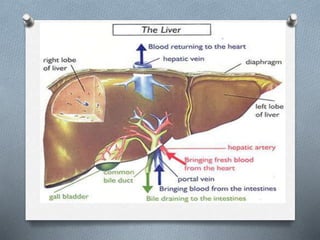
O Located in the right upper quadrant of
the abdominal cavity, it rests just below
the diaphragm, to the right of the stomach and
overlies the gall bladder.
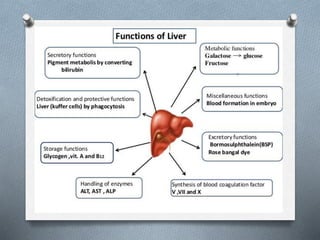
FUNCTIONS OF LIVER
1. Metabolic functions
2. Secretory functions
3. Detoxification and protective functions
4. Storage functions
5. Synthesis of blood coagulation factor
6. Excretory functions
7. Handling of enzymes
8. Other functions
1. Metabolic functions--
• Conversion of absorbed monosaccharide i.e.
galactose and fructose into glucose.
• Cholesterol biosynthesis and its esterification and
excretion
• Conversion of NH3 into urea.
• Biosynthesis of protein.
• Metabolism of vitamin and minerals. Synthesis of
blood coagulation factors.
• Formation of blood in embryo.
2. Secretory functions--
• Liver is responsible bile pigment metabolism
by converting bilirubin , formed from heme
catabolism
3.Detoxification and protective functions--
• Liver (Kupffer cells) can remove foreign bodies
from blood by phagocytosis.
• It can detoxify various drugs converting them
into less toxic substances.
4.Storage functions
• Liver stores glucose in the form of glycogen and
stores some vitamin e.g. vitamin A and B12.
5.Synthesis of blood coagulation factor--
• Preprothrombin convert into prothormbin in the
presence of vitamin k.
6.Excretory functions--
• Bromosulphthaline (BSP)and Rose Bengal dye are
excreted through liver cells.
7.Handling of enzymes--
• Much significance is to liver for handling of enzymes
like
alkaline phosphatase (ALP)and release of aspartate
transaminase(GOT) and alanine transaminase (GPT).
8.Other functions--
• Blood formation in embryo.
DISEASES OF THE LIVER
O Liver is suspected to a number of
diseases
O The disease can be-
• Infectious
• Toxic
• Immune
• Inherited
• Neoplastic
Hepatitis
O It is a viral disease.
O Involves inflammation of the liver
O Leading to impaired hepatocellular function
O Results in marked elevation of all forms of bilirubin
in serum and in urinary bile.
O Significant elevations of aspartate transaminase
(AST) and alanine transaminase (ALT).
O The outcome of viral hepatitis may range from no
symptoms to acute fatal liver pathology ; cirrhosis
or hepatic cancer.
O Serious disease state of liver
O Resulting from chronic inflammation and
subsequent replacement of normal liver tissue
with nonfunctional fibrotic tissue involving the
entire liver.
O Mostly caused by chronic alcohol abuse or
chronic viral hepatitis.
O Symptoms include- anorexia; fatigue; weight loss;
hypertension and finally liver failure.
O Vitamin D deficiency due to malabsorption leading
to osteoporosis.
O Blood disorders and clotting may be impaired.
CIRRHOSIS
O Alcohol is primarily metabolized in liver and
excess of alcohol (>40g/day) intake can cause
liver damage.
O Fatty liver
O Continued intake of excess alcohol leads to
alcoholic hepatitis and finally cirrhosis.
O Alcohol is readily absorbed from the stomach &
small intestine. It cannot be stored and hence
must be metabolized through oxidation- “blank
energy”.
O Also the excess hydrogen converts pyruvate to
lactate which decreases glucose production.
Alcoholic Liver Disease
O Bilirubin levels in the blood are increased as a
result of three conditions depending on the three
phases of bilirubin metabolism-
a) Prehepatic (prehepatic hyperbilirubinemia)
b) Hepatic (Hepatic hyperbilirubinemia)
c) Posthepatic (Posthepatic hyperbilirubinemia).
Hyperbilirubinemia may be due to--
• Increased bilirubin production
• Decreased hepatic uptake
• Decreased hepatic conjugation
• Decreased excretion of bilirubin into bile.
Disorders of bilirubin
metabolism
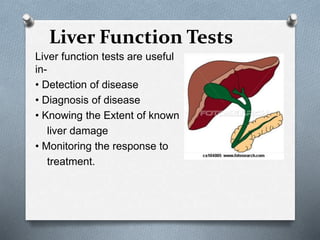
Liver Function Tests
Liver function tests are useful
in-
• Detection of disease
• Diagnosis of disease
• Knowing the Extent of known
liver damage
• Monitoring the response to
treatment.
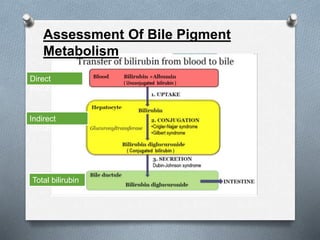
Assessment Of Bile Pigment
Metabolism
Direct
bilirubin
Indirect
bilirubin
Total bilirubin
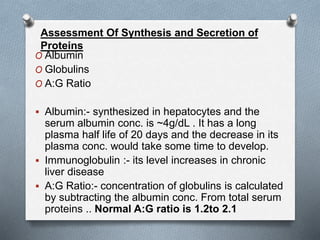
Assessment Of Synthesis and Secretion of
Proteins
O Albumin
O Globulins
O A:G Ratio
 Albumin:- synthesized in hepatocytes and the
serum albumin conc. is ~4g/dL . It has a long
plasma half life of 20 days and the decrease in its
plasma conc. would take some time to develop.
 Immunoglobulin :- its level increases in chronic
liver disease
 A:G Ratio:- concentration of globulins is calculated
by subtracting the albumin conc. From total serum
proteins .. Normal A:G ratio is 1.2to 2.1
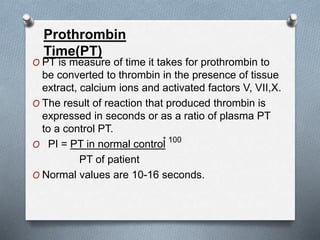
O PT is measure of time it takes for prothrombin to
be converted to thrombin in the presence of tissue
extract, calcium ions and activated factors V, VII,X.
O The result of reaction that produced thrombin is
expressed in seconds or as a ratio of plasma PT
to a control PT.
O PI = PT in normal control
PT of patient
O Normal values are 10-16 seconds.
Prothrombin
Time(PT)
* 100
Glucose tolerance test - not much value in liver
disease
Galactose tolerance test - The normal liver is able
to convert galactose to glucose in patient with
hepatic disease this ability is defective
• It is used primarily to detect liver cell injury.
• It can be performed in presence of jaundice..
Tests based on carbohydrate
metabolism
O Nitrogen part of amino acid is converted to NH3
in liver by transaminase and deamination
(transdeamination)
O Other source of ammonia
1. NH3 formed from nitrigenous material by
bacterial action in gut.
2. In kidney hydrolysis of glutamin by
glutaminase
3. Catabolism of pyrimidin.
Assessment Of Blood
Ammonia
• Normal range 40 – 75 μg /dl
• New born 29 – 70 μg /dl
• Adults – 15 – 45 μg /dl
• Increased level of ammonia can be found
in more advanced case of cirrhosis of
liver.
• Blood level may be over 200 μg per 100ml
in case of cirrhosis or hepatic coma
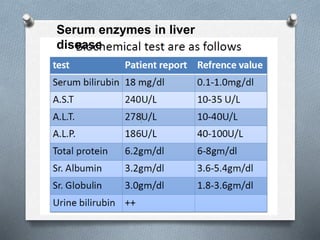
Serum enzymes in liver
disease
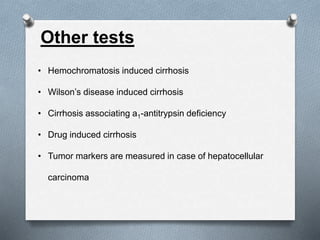
Other tests
• Hemochromatosis induced cirrhosis
• Wilson’s disease induced cirrhosis
• Cirrhosis associating a1-antitrypsin deficiency
• Drug induced cirrhosis
• Tumor markers are measured in case of hepatocellular
carcinoma
Liver function tests

Liver function tests

  • 1.
  • 2.
    LIVER O Liver isthe central organ of our body. O Liver is a reddish-brown , wedge- shaped organ with two lobes of unequal size and shape. O Average weight for men being 970–1,860g and for women 600–1,770g. O Located in the right upper quadrant of the abdominal cavity, it rests just below the diaphragm, to the right of the stomach and overlies the gall bladder.
  • 3.
    FUNCTIONS OF LIVER 1.Metabolic functions 2. Secretory functions 3. Detoxification and protective functions 4. Storage functions 5. Synthesis of blood coagulation factor 6. Excretory functions 7. Handling of enzymes 8. Other functions
  • 4.
    1. Metabolic functions-- •Conversion of absorbed monosaccharide i.e. galactose and fructose into glucose. • Cholesterol biosynthesis and its esterification and excretion • Conversion of NH3 into urea. • Biosynthesis of protein. • Metabolism of vitamin and minerals. Synthesis of blood coagulation factors. • Formation of blood in embryo.
  • 5.
    2. Secretory functions-- •Liver is responsible bile pigment metabolism by converting bilirubin , formed from heme catabolism 3.Detoxification and protective functions-- • Liver (Kupffer cells) can remove foreign bodies from blood by phagocytosis. • It can detoxify various drugs converting them into less toxic substances. 4.Storage functions • Liver stores glucose in the form of glycogen and stores some vitamin e.g. vitamin A and B12.
  • 6.
    5.Synthesis of bloodcoagulation factor-- • Preprothrombin convert into prothormbin in the presence of vitamin k. 6.Excretory functions-- • Bromosulphthaline (BSP)and Rose Bengal dye are excreted through liver cells. 7.Handling of enzymes-- • Much significance is to liver for handling of enzymes like alkaline phosphatase (ALP)and release of aspartate transaminase(GOT) and alanine transaminase (GPT). 8.Other functions-- • Blood formation in embryo.
  • 8.
    DISEASES OF THELIVER O Liver is suspected to a number of diseases O The disease can be- • Infectious • Toxic • Immune • Inherited • Neoplastic
  • 9.
    Hepatitis O It isa viral disease. O Involves inflammation of the liver O Leading to impaired hepatocellular function O Results in marked elevation of all forms of bilirubin in serum and in urinary bile. O Significant elevations of aspartate transaminase (AST) and alanine transaminase (ALT). O The outcome of viral hepatitis may range from no symptoms to acute fatal liver pathology ; cirrhosis or hepatic cancer.
  • 10.
    O Serious diseasestate of liver O Resulting from chronic inflammation and subsequent replacement of normal liver tissue with nonfunctional fibrotic tissue involving the entire liver. O Mostly caused by chronic alcohol abuse or chronic viral hepatitis. O Symptoms include- anorexia; fatigue; weight loss; hypertension and finally liver failure. O Vitamin D deficiency due to malabsorption leading to osteoporosis. O Blood disorders and clotting may be impaired. CIRRHOSIS
  • 11.
    O Alcohol isprimarily metabolized in liver and excess of alcohol (>40g/day) intake can cause liver damage. O Fatty liver O Continued intake of excess alcohol leads to alcoholic hepatitis and finally cirrhosis. O Alcohol is readily absorbed from the stomach & small intestine. It cannot be stored and hence must be metabolized through oxidation- “blank energy”. O Also the excess hydrogen converts pyruvate to lactate which decreases glucose production. Alcoholic Liver Disease
  • 12.
    O Bilirubin levelsin the blood are increased as a result of three conditions depending on the three phases of bilirubin metabolism- a) Prehepatic (prehepatic hyperbilirubinemia) b) Hepatic (Hepatic hyperbilirubinemia) c) Posthepatic (Posthepatic hyperbilirubinemia). Hyperbilirubinemia may be due to-- • Increased bilirubin production • Decreased hepatic uptake • Decreased hepatic conjugation • Decreased excretion of bilirubin into bile. Disorders of bilirubin metabolism
  • 13.
    Liver Function Tests Liverfunction tests are useful in- • Detection of disease • Diagnosis of disease • Knowing the Extent of known liver damage • Monitoring the response to treatment.
  • 15.
    Assessment Of BilePigment Metabolism Direct bilirubin Indirect bilirubin Total bilirubin
  • 16.
    Assessment Of Synthesisand Secretion of Proteins O Albumin O Globulins O A:G Ratio  Albumin:- synthesized in hepatocytes and the serum albumin conc. is ~4g/dL . It has a long plasma half life of 20 days and the decrease in its plasma conc. would take some time to develop.  Immunoglobulin :- its level increases in chronic liver disease  A:G Ratio:- concentration of globulins is calculated by subtracting the albumin conc. From total serum proteins .. Normal A:G ratio is 1.2to 2.1
  • 17.
    O PT ismeasure of time it takes for prothrombin to be converted to thrombin in the presence of tissue extract, calcium ions and activated factors V, VII,X. O The result of reaction that produced thrombin is expressed in seconds or as a ratio of plasma PT to a control PT. O PI = PT in normal control PT of patient O Normal values are 10-16 seconds. Prothrombin Time(PT) * 100
  • 18.
    Glucose tolerance test- not much value in liver disease Galactose tolerance test - The normal liver is able to convert galactose to glucose in patient with hepatic disease this ability is defective • It is used primarily to detect liver cell injury. • It can be performed in presence of jaundice.. Tests based on carbohydrate metabolism
  • 19.
    O Nitrogen partof amino acid is converted to NH3 in liver by transaminase and deamination (transdeamination) O Other source of ammonia 1. NH3 formed from nitrigenous material by bacterial action in gut. 2. In kidney hydrolysis of glutamin by glutaminase 3. Catabolism of pyrimidin. Assessment Of Blood Ammonia
  • 20.
    • Normal range40 – 75 μg /dl • New born 29 – 70 μg /dl • Adults – 15 – 45 μg /dl • Increased level of ammonia can be found in more advanced case of cirrhosis of liver. • Blood level may be over 200 μg per 100ml in case of cirrhosis or hepatic coma
  • 21.
    Serum enzymes inliver disease
  • 22.
    Other tests • Hemochromatosisinduced cirrhosis • Wilson’s disease induced cirrhosis • Cirrhosis associating a1-antitrypsin deficiency • Drug induced cirrhosis • Tumor markers are measured in case of hepatocellular carcinoma